- B2B
- Personalization
- 8 min read
How To Personalize B2B Experience in eCommerce?
Published
5 November 2025Updated
16 February 2026

core insights box
- B2B eCommerce personalization is about creating tailored buying journeys for every account. Generic interactions no longer meet their buyer expectations.
- B2B eCommerce personalization helps brands turn account specific search signals into meaningful journeys that convert into sales.
- Artificial intelligence and machine learning–driven personalization enable sellers to anticipate buyer needs, improve engagement, and drive faster conversion rates.
- Experro simplifies B2B eCommerce personalization with its AI-powered DXP, using dynamic segmentation to tailor content, pricing, and recommendations for every buyer.
Every B2B buyer expects an experience that feels relevant, quick, and meaningful. B2B brands can no longer rely on generic interactions.
They need tailored journeys that speak to each customer's unique intent and needs. This is where B2B eCommerce personalization becomes a game-changer.
It helps brands build stronger relationships and boost conversion rates.
Let’s explore what personalization means for B2B commerce and how you can use it to create a lasting impact.
What is B2B eCommerce Personalization?
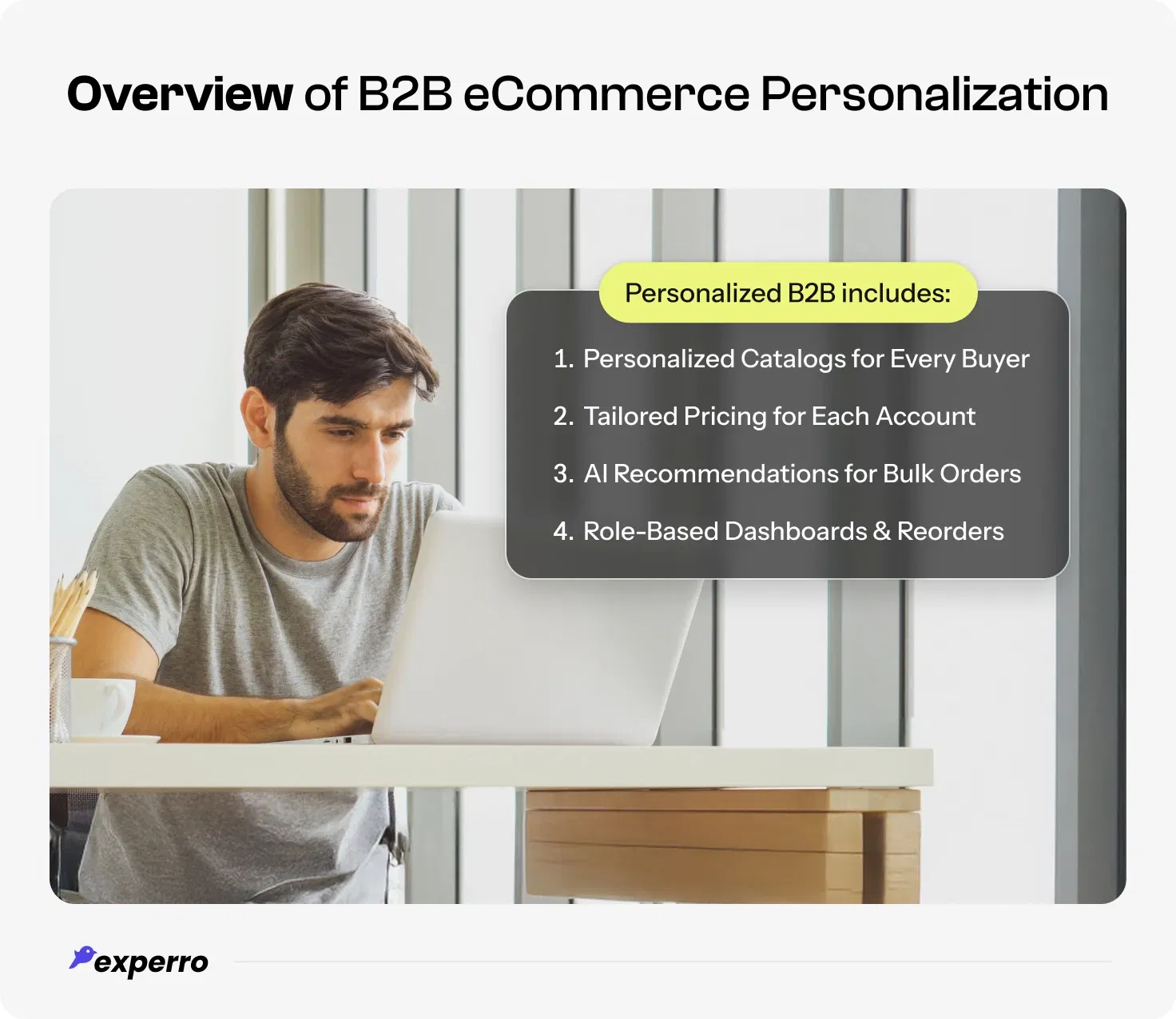
B2B eCommerce personalization is the process of delivering customized experiences to buyers based on their behavior, role, preferences, and purchase history.
Unlike B2C, personalization in B2B eCommerce requires understanding complex buying journeys and multiple decision-makers.
It involves creating personalized catalogs in B2B eCommerce, personalized search results, and tailored pricing models that align with different buyer segments.
Additionally, effective personalization for B2B eCommerce enhances engagement, shortens decision cycles, and drives customer loyalty.
Importance of ‘Personalization’ in B2B eCommerce
eCommerce personalization in B2B goes beyond recommending products. It’s about helping buyers find exactly what they need quickly and confidently.
As B2B transactions often involve bulk purchases or repeat orders, B2B website personalization ensures that every interaction, from browsing to checkout, reflects the buyer’s business context.
When done right, it leads to improved conversion rates, deeper relationships, and measurable ROI.
The expanding use cases of AI for B2B eCommerce add more intelligence to personalization, ensuring relevance at every touchpoint.
Having seen why personalization matters, let’s move ahead to uncover key strategies that make it truly effective for B2B businesses.
Key Personalization Strategies for B2B eCommerce
Personalizing the B2B eCommerce experience demands precision and understanding. Your business needs to implement B2B personalization strategies that align with buyer needs, behavior, and context across all channels.
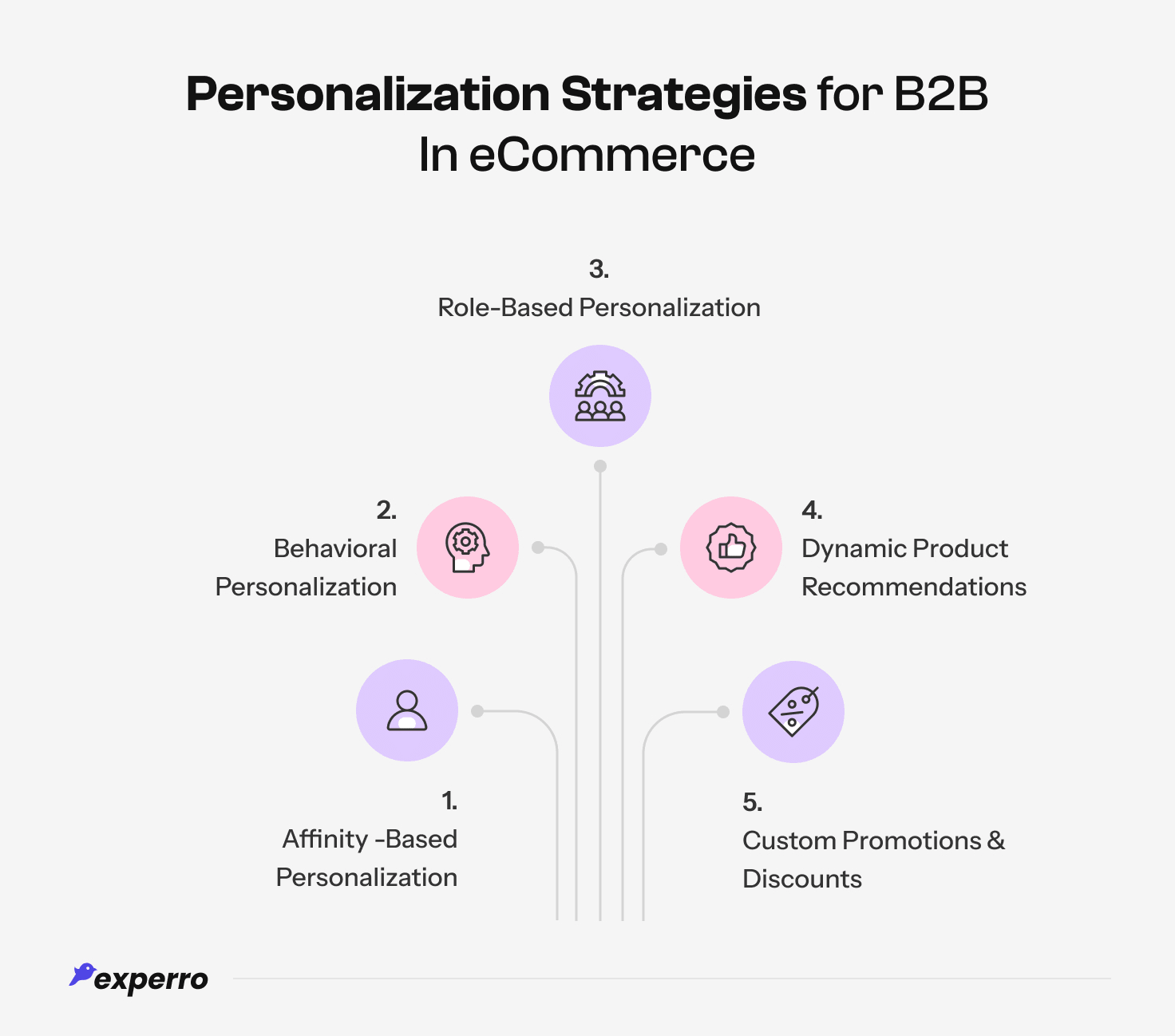
Here are some proven B2B personalization examples that can help you create seamless and intelligent buyer journeys.
1. Affinity-Based Personalization
Affinity-based personalization tailors experiences based on a buyer’s demonstrated interests and preferences. For example, a repeat buyer from the manufacturing sector might see relevant tools, components, or spare parts on the homepage.
This B2B product personalization helps shorten search times and boosts order frequency by anticipating what each buyer needs most.
2. Behavioral Personalization
Behavioral personalization tracks on-site and historical actions such as viewed categories, abandoned carts, and frequently reordered items to create context-aware recommendations.
This form of B2B customer personalization ensures that every digital touchpoint feels intelligent and timely, leading to higher engagement and reduced friction during purchase.
3. Role-Based Personalization
In B2B, multiple stakeholders are often involved in buying decisions. Role-based personalization helps create unique experiences for each role.
For instance, procurement officers might see volume discounts while engineers view product specifications. This level of website personalization ensures relevance and efficiency across the B2B buying process.
4. Dynamic Product Recommendations
Dynamic recommendations use real-time analytics to deliver personalized B2B shopping experiences. They can adjust based on stock levels, preferences, or seasonal demand.
With AI-powered B2B personalization, these recommendations evolve automatically, increasing product visibility and boosting conversion opportunities.
5. Custom Promotions and Discounts
B2B buyers appreciate price transparency and loyalty rewards. By using personalization for B2B websites, sellers can offer tailored promotions such as bulk order discounts or contract-specific pricing.
These B2B website personalization examples drive repeat purchases and strengthen buyer trust. Our B2B eCommerce statistics compilation talks more about it.
Now that you’ve seen the core strategies in action, it’s time to explore the real-world benefits that B2B brands can achieve with personalization.
What Are the Benefits of Personalization for B2B Seller Brands?
A well-executed personalized B2B eCommerce strategy delivers benefits that go far beyond conversions. It helps B2B sellers build long-term relationships and scale personalization efforts with precision.
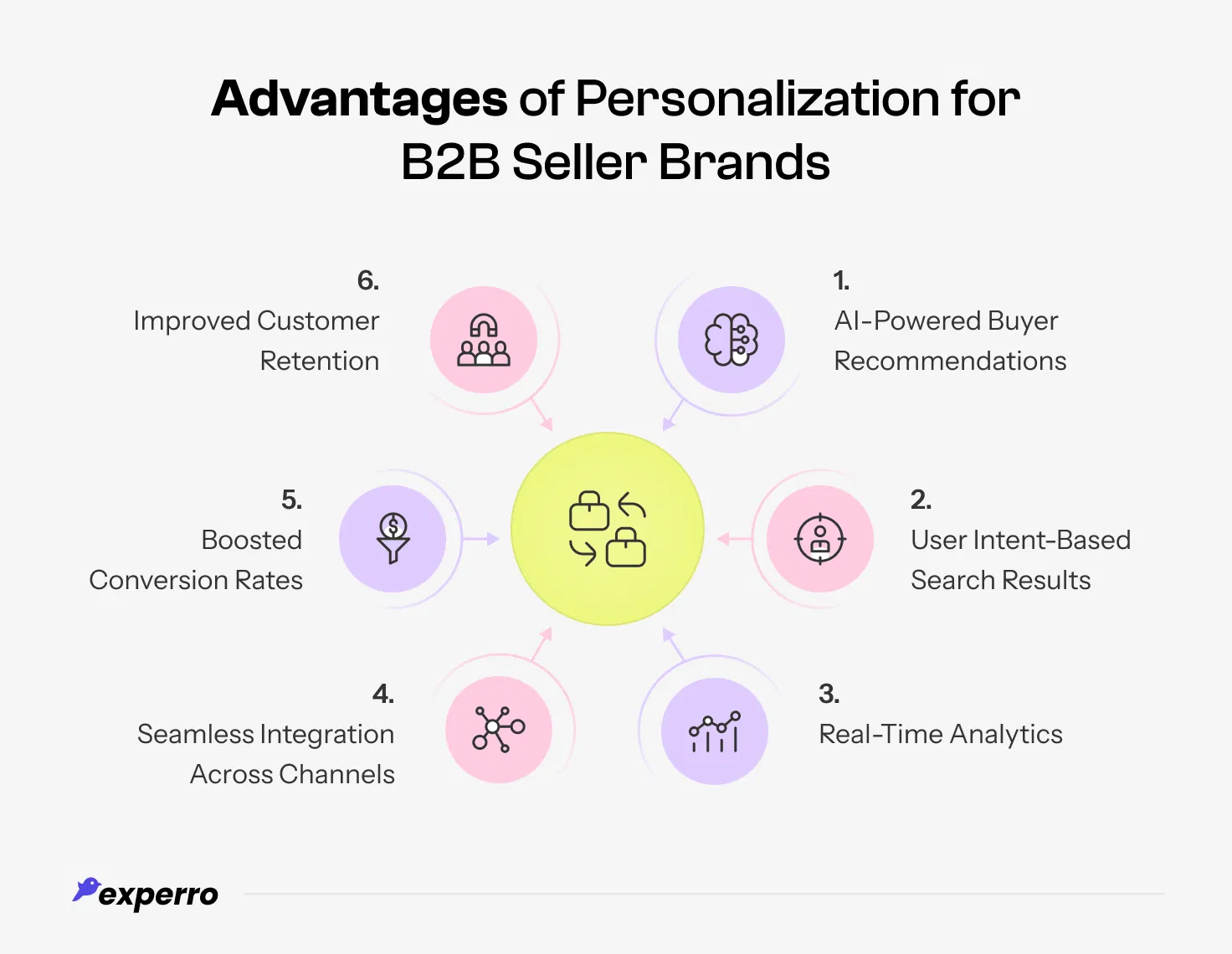
Here are some of the top benefits of personalization in B2B eCommerce.
1. Providing Recommendations that are Meant for Buyers
Through dynamic B2B personalization, sellers can deliver product suggestions that fit each buyer’s preferences, role, or industry.
These personalized experiences for B2B buyers improve discoverability and speed up decision-making, resulting in higher order values.
2. Search that Understands Buyer Intent
Personalized search in B2B eCommerce uses AI and data to interpret search intent rather than just keywords.
B2B eCommerce search results in faster and more accurate results that match buyer needs, forming the foundation of effective website personalization for B2B.
3. Real-Time Analytics for Smarter Decisions
Real-time personalization in B2B eCommerce enables sellers to monitor buyer behavior and adjust experiences dynamically.
This personalization engine helps decision-makers identify B2B eCommerce trends, predict buying patterns, and make data-driven business moves.
4. Seamless Integration Across Channels
B2B transactions often span multiple channels such as web, email, and CRM. B2B omnichannel personalization ensures that buyers experience consistent messaging and recommendations everywhere, maintaining continuity and brand trust.
This unified experience not only boosts engagement but also helps sales teams track buyer intent more effectively across every touchpoint.
5. Boosted Conversion Rates And Order Frequency
Personalization for B2B eCommerce positively influences buying behavior by reducing friction and improving relevance.
A tailored B2B customer journey leads to higher conversion rates, larger orders, and more frequent repeat purchases.
6. Improved Customer Retention
By anticipating buyer needs and personalizing every touchpoint, brands foster trust and loyalty.
B2B content personalization ensures buyers stay engaged long after the first purchase, creating long-term partnerships and improving overall customer satisfaction.
A study from Soocial.com reveals that companies that excel at B2B personalization report up to a 40% increase in revenue compared with those that do not.
While the advantages are clear, achieving them isn’t always easy. Let’s look at some common challenges businesses face when implementing B2B personalization.
What Are the Challenges in Implementing B2B Personalization?
While the benefits are clear, implementing B2B eCommerce personalization comes with challenges. Many sellers struggle to balance personalization depth with data management and system compatibility.

Here are some major obstacles B2B brands face today:
1. Adopting Personalization With Existing eCommerce Platform
Legacy systems often limit how deeply B2B personalization engines can integrate. Aligning new personalization tools with ERP or CRM data can be complex, delaying rollout and consistency across systems.
How does Experro help in adopting this functionality?
That’s where Experro helps as its headless architecture makes integration easy, ensuring consistent and fast personalization across platforms.
2. Data Privacy and Compliance Concerns
Personalization relies on collecting and analyzing customer data. Ensuring compliance with privacy regulations while maintaining personalization quality is a growing challenge for personalized B2B eCommerce.
How does Experro help overcome the data challenge?
To overcome this, Experro ensures secure and compliant data handling with built-in privacy controls that keep personalization at a scale both safe and effective.
3. Ensuring Consistent Experience Across Channels
Buyers expect unified experiences regardless of where they interact. Achieving B2B omnichannel personalization requires aligning messaging, pricing, and eCommerce recommendations across all touchpoints, which demands robust technology and planning.
How does Experro help in bringing consistency?
Here, Experro enables seamless omnichannel consistency by connecting all touchpoints including web, mobile, and CRM for a smooth and cohesive buyer journey.
Now that you’re aware of the challenges in B2B eCommerce, the next step is knowing the best practices that ensure success.
What Are the Best Practices for B2B Personalization?
To make the most of personalization in B2B, businesses should follow a structured approach. The right practices ensure consistency, accuracy, and measurable ROI across all personalization initiatives.
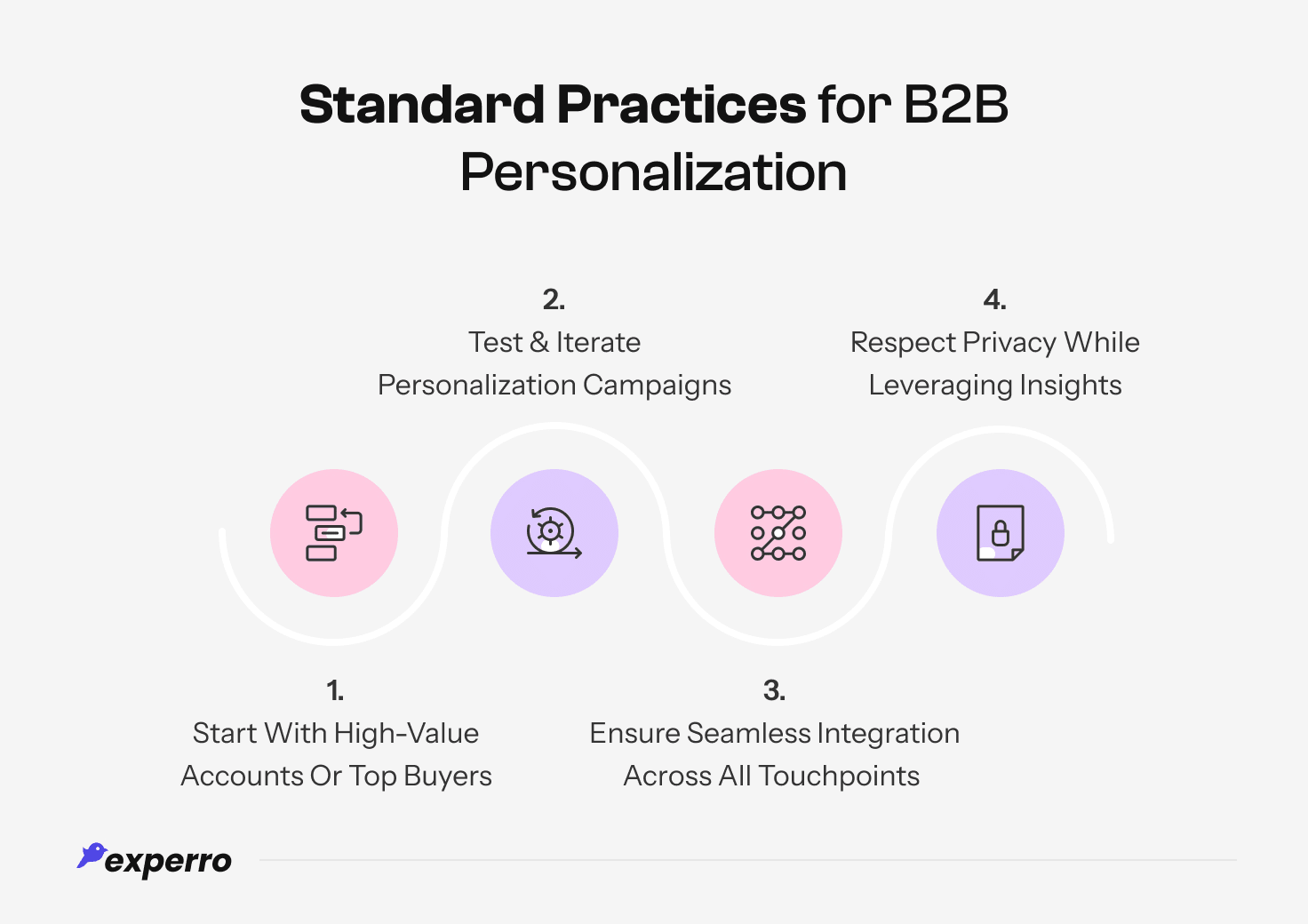
Here are a few proven methods for successful implementation.
1. Start With High-Value Accounts or Top Buyers
Prioritize your top-tier clients for hyper-personalization in B2B eCommerce. The accounts that often bring the highest ROI usually will have the best data for testing personalization models before scaling to broader audiences.
2. Test And Iterate Personalization Campaigns
Continuous testing helps refine dynamic B2B personalization. A/B testing different messaging, profile-based recommendations, or layouts ensures that strategies remain data-driven and buyer-focused.
3. Ensure Seamless Integration Across All Touchpoints (Web, Email, CRM)
Creating connected journeys across all platforms is key to personalization for B2B websites. Integrating your CRM, predictive customer analytics, and eCommerce tools ensures that every interaction feels consistent and relevant.
4. Respect Privacy While Leveraging Insights
Building trust through transparent data practices is essential. Ensure that B2B website personalization respects buyer consent and uses only necessary data for meaningful personalization.
Now that we’ve covered the best practices, let’s see how Experro makes the entire personalization process seamless and scalable for B2B brands.
How Experro Makes B2B Personalization Effortless?
Experro is an AI-powered B2B personalization platform that simplifies every aspect of creating personalized customer experiences.
With its intelligent B2B personalization engine, Experro analyzes behavior, role, and intent in real time to deliver personalized catalogs, search, and recommendations across digital channels.
Additionally, it supports B2B hyper-personalization with unified data integration, ensuring buyers enjoy relevant experiences every time they visit.
Whether it’s Gen AI B2B personalization or dynamic content personalization, Experro enables brands to scale personalization with precision and ease.
Conclusion
Personalization is the foundation of modern buyer engagement. Period.
From personalized search to recommendations, personalized B2B eCommerce transforms how businesses connect, convert, and retain target customers.
The future lies in AI-powered B2B personalization that adapts in real time and delivers value at every interaction.
Want to build an intelligent, conversion-driven experience for your buyers? Schedule a call for a quick walkthrough of how Experro can make it happen.
FAQs

Pallavi is an ambitious author recognized for her expertise in crafting compelling content across various domains. Beyond her professional pursuits, Pallavi is deeply passionate about continuous learning, often immersing herself in the latest industry trends. When not weaving words, she dedicates her time to mastering graphic design.
Subscribe to Our Newsletter!
Get the latest insights delivered straight to your inbox.