- eCommerce
- 11 min read
8 Best Algolia Alternatives That Are Way Better! (2026 Edition)
Published
21 March 2025Updated
26 December 2025

Disclaimer - The information in this article is based on publicly available sources, user reviews, and our own research at the time of writing. It is intended for educational and informational purposes only. We encourage businesses to independently evaluate solutions to determine the best fit for their needs.
core insights box
-
Algolia’s pricing and architecture limit scalability for Gen AI–driven product discovery.
-
Leading Algolia alternatives include Experro, Bloomreach, Coveo, Elasticsearch, Luigi’s Box, Attraqt, Doofinder, and Constructor.
- The right alternative for Algolia delivers business outcomes, not just search speed! (spoiler: it’s Experro)
- Experro is a one-of-its-kind Gen AI–native platform that’s redefining how brands deliver eCommerce search, product discovery, and content experiences.
Algolia is a widely adopted search platform, but it is not the only option available today. As eCommerce and digital experiences evolve, many businesses are actively evaluating alternatives that better align with their scale, data maturity, and growth goals.
Cost scalability, limited discovery depth, and rising expectations around Gen AI-driven experiences are pushing eCommerce teams to look for Algolia alternatives that go beyond keyword-based search.
Today’s brands need platforms that combine search with personalization, merchandising, and intent-aware discovery to influence conversions, engagement, and average order value.
In this guide, we break down eight leading Algolia alternatives, including Experro. The goal is not to declare a winner, but to help you identify which platform fits your business needs today and in the years ahead.
Which Is the Best Algolia Alternative? Comparing 8 Algolia Competitors
Choosing the right search solution can be overwhelming with so many options available.
If you're looking for a powerful Algolia alternative, this comparison will help you understand how leading platforms stack up, including Algolia’s competitors’ pricing and features.
| Feature | Experro (Best Choice🏆) | Bloomreach | Coveo | Elastic Enterprise Search | Luigi’s Box | Athos Commerce | Doofinder | Constructor |
|---|---|---|---|---|---|---|---|---|
| Gen AI-Powered Search | ✅ Advanced Gen AI-driven search with real-time learning | ✅ | ✅ | ❌ | ✅ | ✅ | ❌ | ❌ |
| Built-in Merchandising | ✅ Native merchandising tools | ✅ | ✅ | ❌ | ✅ | ✅ | ❌ | ✅ |
| Product Discovery Capabilities | ✅ Gen AI-driven product discovery with relevance and recommendations | ✅ | ✅ | ✅ | ❌ | ❌ | ❌ | ✅ |
| Hyper-Personalization | ✅ Gen AI-powered, behavior-based personalization | ✅ | ✅ | ❌ | ✅ | ✅ | ✅ | ❌ |
| Speed & Performance | ✅ Lightning-fast with optimized indexing | ✅ | ✅ | ✅ | ✅ | ✅ | ✅ | ✅ |
| Advanced Search Features | ✅ AI-driven ranking, typo tolerance, contextual relevance | ✅ | ✅ | ❌ | ✅ | ✅ | ❌ | ✅ |
| Analytics & Insights | ✅ In-depth analytics for search & merchandising | ✅ | ✅ | ✅ | ✅ | ✅ | ✅ | ✅ |
| Ease of Use | ✅ No-code & developer-friendly | ❌ | ❌ | ❌ | ✅ | ✅ | ❌ | ❌ |
| Pricing | ✅ Cost-effective with transparent pricing | ❌ High | ❌ High | ❌ Complex | ❌ Mid-tier | ❌ Mid-tier | ❌ Usage-based | ❌ Enterprise-focused |
If you’re struggling with Algolia limitations, switching to a better alternative is the next logical step.
Here’s a detailed comparison of the best alternatives to Algolia, with a focus on key features, pros, and cons.
1. Experro – #1 Agentic Experience Platform

Experro is an agentic experience platform that provides agentic experiences going far and beyond the customer expectations.
It is equipped with Gen AI-driven search functionalities, personalization, merchandising, AI product enrichment, real-time catalog updates, etc, thus eliminating the need for third-party tools.
Unlike top Algolia competitors, Experro enables no-code search customization and also offers advanced rule management, allowing businesses to fine-tune search results based on specific conditions. This allows business teams to manage instant search experiences without technical dependencies.
| Pros of Experro | Cons of Experro |
| ✅ AI-driven personalization and eCommerce merchandising for better customer experiences. | ❌ None found. |
| ✅ No-code customization for search relevance adjustments without developer help. | |
| ✅ Real-time catalog updates to ensure accurate product listings. | |
| ✅ Seamless integration with major eCommerce platforms for faster deployment. | |
| ✅ Built-in CMS to manage content and commerce in one platform. | |
| ✅ 24/7 dedicated customer support for quick issue resolution. |
2. Bloomreach

Bloomreach provides strong AI-driven valuable insights and good eCommerce integrations, making it a solid option for large enterprises.
But for many users, Bloomreach’s higher pricing and steep learning curve can make it challenging to adopt, especially for smaller businesses. The need for ongoing developer support also reduces day-to-day agility. 1
| Pros of Bloomreach | Cons of Bloomreach |
| ✅ Powerful AI-driven insights for better decision-making. | ❌ High pricing structure compared to competitors. |
| ✅ Good eCommerce platform integrations. | ❌ Steep learning curve. |
| ✅ Advanced search analytics for performance tracking. | ❌ Requires extensive developer support. |
| ❌ Limited merchandising control. | |
| ❌ No built-in CMS. |
3. Coveo

Coveo delivers AI-powered recommendations and enterprise-grade image search, making it ideal for large organizations.
However, some verified users highlight challenges with Coveo’s learning curve, developer dependency, and admin usability, along with concerns around documentation quality, indexing speed, and semantic search depth. 2
For this reason, businesses shift their attention to Coveo alternatives that promise faster onboarding and more user-friendly experiences.
| Pros of Coveo | Cons of Coveo |
| ✅ AI-driven search recommendations for personalized experiences. | ❌ Expensive for mid-sized businesses. |
| ✅ Enterprise-grade Algolia search alternative, designed for large-scale businesses. | ❌ Requires advanced technical expertise. |
| ✅ Robust analytics for data-driven insights. | ❌ Long implementation time. |
| ❌ Limited real-time catalog updates. | |
| ❌ Poor customer support. |
4. Elastic Enterprise Search

As an open-source alternative, Elastic Enterprise Search offers great flexibility and scalability.
However, some users have experienced incorrect search results in Swiftype, with mismatched or missing results that undermine search reliability. Even after engaging support, unresolved issues pushed them to move away from the product. 3
| Pros of Elasticsearch | Cons of Elasticsearch |
| ✅ Open-source flexibility for custom implementations. | ❌ Requires extensive setup. |
| ✅ Good scalability for growing businesses. | ❌ No built-in merchandising features. |
| ✅ Strong community support. | ❌ Not eCommerce-focused. |
| ❌ Poor documentation support. | |
| ❌ Higher maintenance costs. |
If you’re evaluating these platforms side by side, this detailed comparison of Algolia vs Elasticsearch vs Experro breaks down how they differ across search intelligence, personalization, and eCommerce readiness.
5. Luigi’s Box

Luigi’s Box is easy to set up and provides detailed search analytics.
But some users mention that setting up feeds and integrations in Luigi’s Box can be time-consuming and requires technical expertise. Smaller businesses also note that the pricing can feel high, especially when budgets are limited. 4
| Pros of Luigi's Box | Cons of Luigi's Box |
| ✅ Simple setup for quick deployment. | ❌ No built-in CMS or digital experience features. |
| ✅ Good search analytics for performance tracking. | ❌ High dependency on manual adjustments. |
| ✅ User-friendly interface. | ❌ Not ideal for large catalogs. |
| ❌ Poor customer support. |
6. Athos Commerce

Athos Commerce brings together the capabilities of Searchspring, Klevu, and Intelligent Reach into a single platform, but some users aren’t convinced of its advantages over other competitors.
They note that the dashboard feels basic, offers limited insights beyond popular search terms, and lacks advanced features like personalized search. 5
| Pros of Athos Commerce | Cons of Athos Commerce |
| ✅ Strong merchandising capabilities. | ❌ Lack of advanced AI-driven personalization. |
| ✅ User-friendly dashboard for ease of use. | ❌ Limited scalability. |
| ✅ Customizable search filtering options. | ❌ Poor integration options. |
| ❌ High dependency on third-party tools. | |
| ❌ Expensive for small businesses. |
7. Doofinder
Doofinder is a hosted site search solution positioned as an alternative to Algolia, known for its quick setup and ease of use.
It offers on-site search capabilities similar to Algolia, but users highlight scalability-related pricing concerns. As usage grows, costs can become restrictive for small and mid-sized businesses.
| Pros of Doofinder | Cons of Doofinder |
| ✅ Easy-to-integrate search solution. | ❌ Pricing is reasonably high. |
| ✅ Supports Multilingual stores. | ❌ Limited typo tolerance. |
| ❌ Support reliability concerns. | |
| ❌ Search functionality issues. |
8. Constructor
Constructor offers powerful frontend search as an Algolia alternative.
Although, some users note that dashboard search is limited to product names and doesn’t display variant products. 7
Also, it lacks clear documentation for understanding the analytics despite the dashboard looking strong.
| Pros of Constructor | Cons of Constructor |
| ✅Customer support is unmatched. | ❌ Weak analytics feature. |
| ✅Search is easy to integrate. | ❌ Unclear documentation. |
| ❌ No API call logging. |
Now that we’ve compared Algolia with its competitors, let’s explore where it falls short for modern eCommerce stores.
What Are the Key Algolia Limitations for Modern eCommerce Teams?
While Algolia offers the best search API for eCommerce sites, it falls short in several critical areas.
Let’s examine the key problems with Algolia search and why many existing Aloglia e-store owners are actively looking for Algolia alternatives.
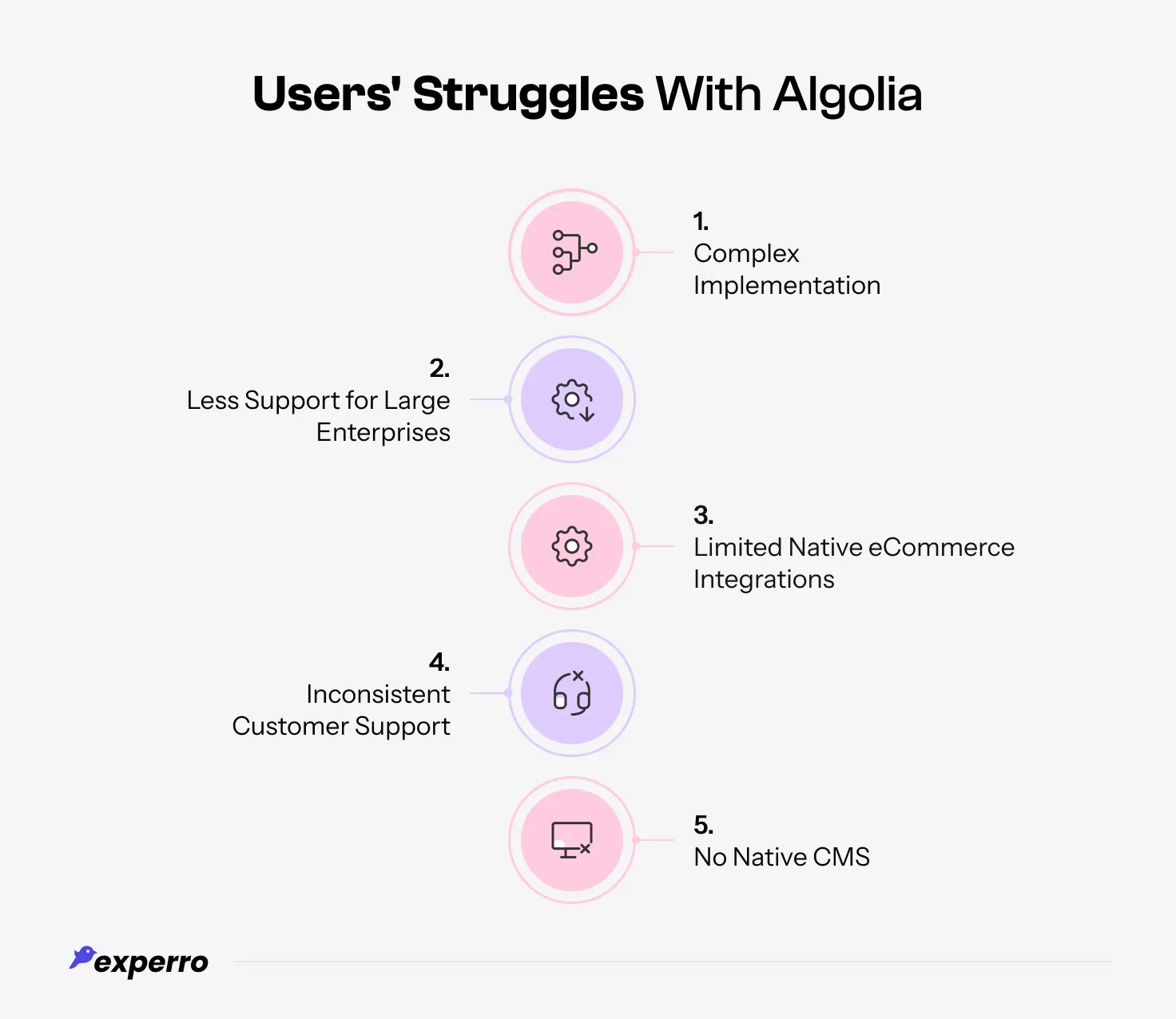
1. Complex Implementation & Developer Dependency
Setting up and customizing a store on Algolia requires deep technical expertise. Its configuration demands constant developer intervention, making it difficult for non-technical teams to manage search relevance and merchandising efficiently.
For companies seeking an Algolia replacement for eCommerce search, a seamless, low-code/no-code search solution is essential.
Many businesses struggle with custom indexing configurations, API dependencies, and scripting-heavy implementations that require ongoing maintenance.
Without a user-friendly interface for NLP search management, teams must rely on engineering resources for even minor updates. This leads to slower response times and higher operational costs.
2. Limited Support for Large & Frequently Updated Catalogs
Handling large and frequently changing product catalogs is another scalability issue with Algolia. Indexing large datasets can slow performance, leading to outdated search results and delayed product availability.
eCommerce catalog management helps businesses to handle large inventories efficiently, ensuring seamless scalability and real-time data updates.
However, Algolia’s indexing process can be both—resource-intensive and time-consuming. This causes delays in reflecting new arrivals, stock updates, or pricing changes.
Also, this leads to customer frustration when they see out-of-stock items in search results or miss out on newly launched products. Scalability concerns also arise as businesses grow, making fast and relevant search experiences harder.
3. Limited Native eCommerce Integrations
Algolia lacks deep, native integrations with major eCommerce platforms. Businesses often struggle to integrate it with platforms like Magento, Shopify or headless commerce solutions, requiring custom development efforts.
This lack of seamless connectivity can slow down implementation and increase overall costs.
Companies must invest in additional middleware, APIs, or third-party development without pre-built connectors or direct integrations to bridge the gap.
This creates potential compatibility issues, higher maintenance costs, and increased risk of data sync failures, leading to an inefficient user search and discovery experience.
In January 2023, security researchers identified that over 1,500 applications were leaking Algolia API keys and application IDs, with some exposing critical Admin API keys. This posed significant security risks, including unauthorized access to user data.
4. Inconsistent Customer Support & Documentation Challenges
Many users report problems with Algolia search due to poor support and confusing documentation. Getting timely assistance for critical scalability issues with Algolia can be frustrating, especially for businesses with mission-critical search functionality.
Without clear documentation and responsive support, troubleshooting becomes a major challenge.
Businesses often struggle with unresolved multi language support tickets, slow response times, and lack of hands-on guidance, especially when implementing complex customizations.
The documentation lacks clarity, making it difficult for teams to quickly find solutions. This leads to prolonged downtime and inefficiencies in managing search relevance and site performance.
5. No Native CMS or Digital Experience Capabilities
As one of the cons of Algolia, it doesn’t offer a built-in CMS or digital experience platform (DXP) capabilities.
Businesses must rely on multiple platforms for content management and search, increasing operational costs and complexity. This lack of a unified approach makes content-driven commerce harder to manage.
Without an integrated CMS, businesses must use separate platforms for content updates, product information, and on-site search, leading to inefficiencies in workflow and content personalization.
Managing content-driven experiences—such as landing pages, banners, and personalized content—becomes an additional burden when search is disconnected from the overall site experience.
What Are Customers Saying About Their Experience With Algolia?
The below image highlights key concerns users have with Algolia. While it offers a variety of features, the setup process is often seen as complex and time-consuming, requiring additional configuration.
Additionally, users have reported issues with customer support, including ongoing billing problems and unresponsiveness, leading to frustration and dissatisfaction.
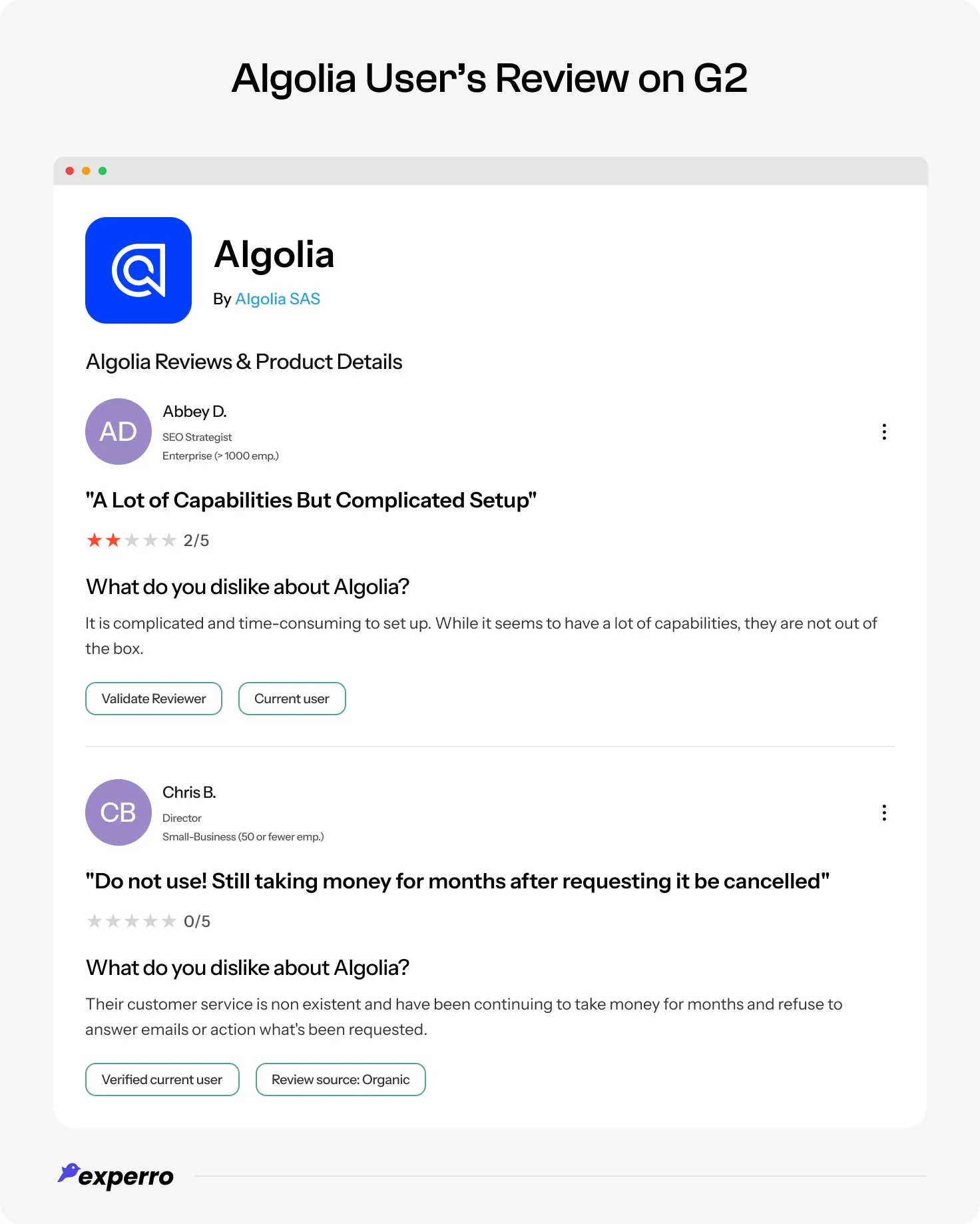
Source: G2 Review 1 | G2 Review 2
The below image showcases user concerns about Algolia's usability on Capterra. Reviewers mention confusion with the UI and terminology, misleading search results when information isn't precise, and internal error messages attributed to the platform.
Additionally, developers highlight documentation as a major pain point, impacting ease of use and troubleshooting.
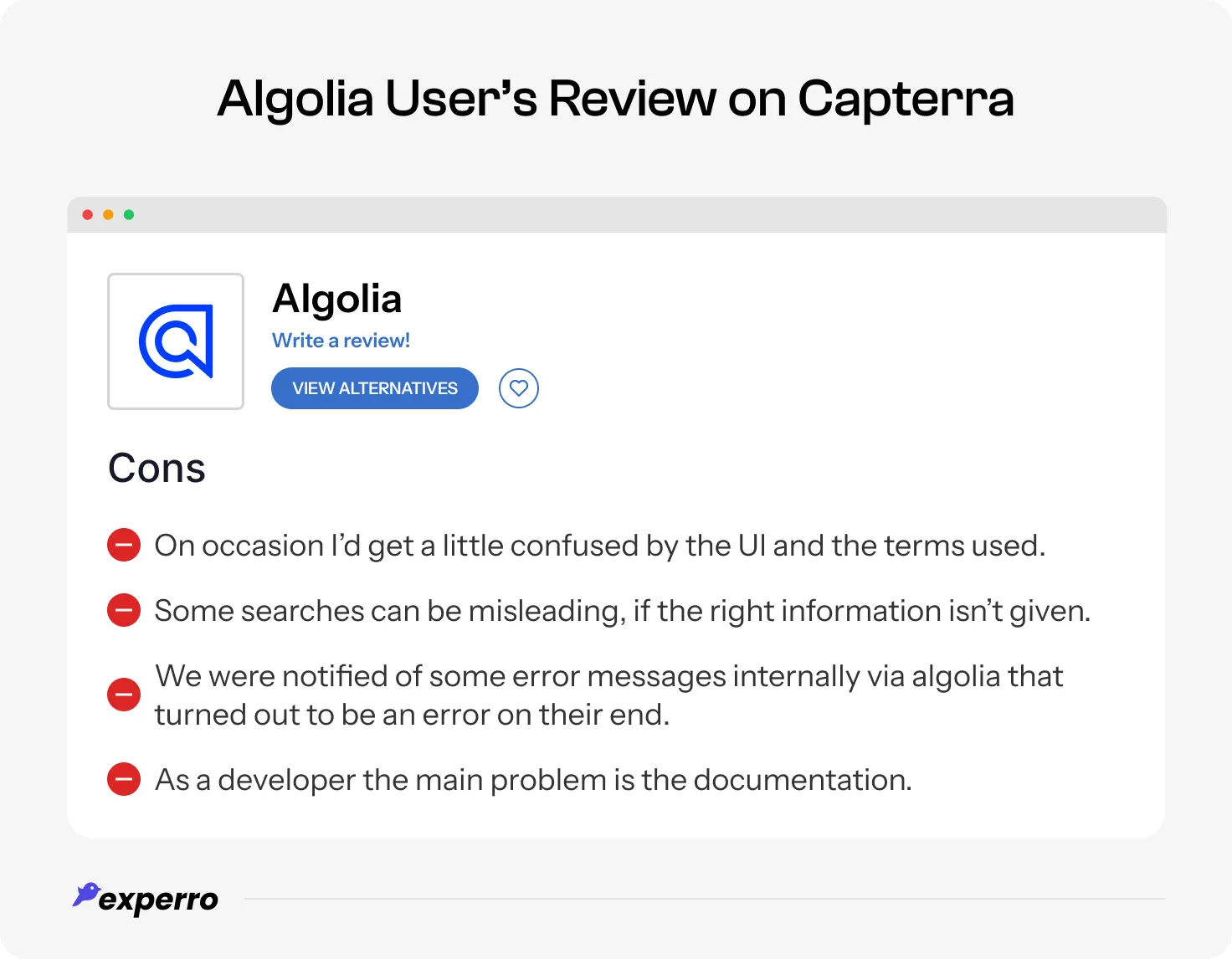
Source: Capterra
Is Algolia’s Pricing Justified for What It Delivers?
Let’s talk money!
Many businesses find pricing of Algolia to be excessive, considering its feature limitations.
Algolia's pricing is steep, making it costly for businesses to scale. Hidden costs, like overage fees and add-ons, can quickly drive up expenses.
The lack of built-in personalization, manual effort for merchandising, and poor scalability make it an overpriced solution.
On the other hand, Experro offers a transparent pricing model with no hidden fees. It’s efficient, cost-effective, and a powerful alternative worth considering.
Our platform provides an all-in-one digital experience platform, eliminating the need for multiple tools while ensuring cost-effectiveness and scalability.
To Conclude
Finding the right Algolia competitor is essential for businesses seeking better scalability, personalization, and affordability.
While several alternatives to Algolia exist, Experro stands out as the best Gen AI-powered Algolia alternative.
Algolia is a robust search solution, but Experro offers more with Gen AI-driven search, merchandising perosnalization, and a built-in headless CMS.
While Algolia focuses on search, Experro provides complete digital experience, ensuring better personalization, scalability, and efficiency for eCommerce businesses.
Connect with our experts on a call for a personalized demo.
Sources:
1 Bloomreach user review on G2
3 Elasticsearch user review on G2
4 Luigi's Box user review on G2
FAQs

Pallavi is an ambitious author recognized for her expertise in crafting compelling content across various domains. Beyond her professional pursuits, Pallavi is deeply passionate about continuous learning, often immersing herself in the latest industry trends. When not weaving words, she dedicates her time to mastering graphic design.
Subscribe to Our Newsletter!
Get the latest insights delivered straight to your inbox.