
Only 11 B2B eCommerce KPIs That Matter in 2026!
Published
2 December 2025Updated
4 December 2025

core insights box
- B2B eCommerce KPIs help in understanding how far the B2B business sales and CX have reached.
- B2B performance metrics aligned with decisions, approvals, negotiations, and repeat purchase cycles.
- Experro enhances every stage of the B2B journey with AI-driven discovery, personalization, and merchandising to boost buyer engagement and conversions.
How well do your current B2B eCommerce KPIs support better buyer journey decisions?
B2B buying has evolved, and many product KPIs that once defined success no longer capture how modern buyers evaluate, compare, and purchase products.
Today, understanding the right key performance indicators (KPIs) for B2B eCommerce is essential to measuring real performance across search, discovery, merchandising, and conversion.
With deeper B2B eCommerce analytics, you can move beyond surface-level numbers and uncover how efficiently buyers progress through each stage of the digital journey.
In this blog, we break down the 11 most essential B2B eCommerce metrics every enterprise should track to accelerate revenue, improve retention, and strengthen overall buying experiences.
Meet These 11 B2B eCommerce KPIs To Make Your Revenue Goals Feel Real!
Do you want to separate growth from guesswork?
How will you be sure whether your B2B sales are actually enough to reach the annual goal? Well, you can measure this by checking whether your business is meeting these 11 major KPIs of B2B eCommerce.
Tracking the right key performance indicators (KPIs) for B2B eCommerce helps you catch friction early and fix it fast.
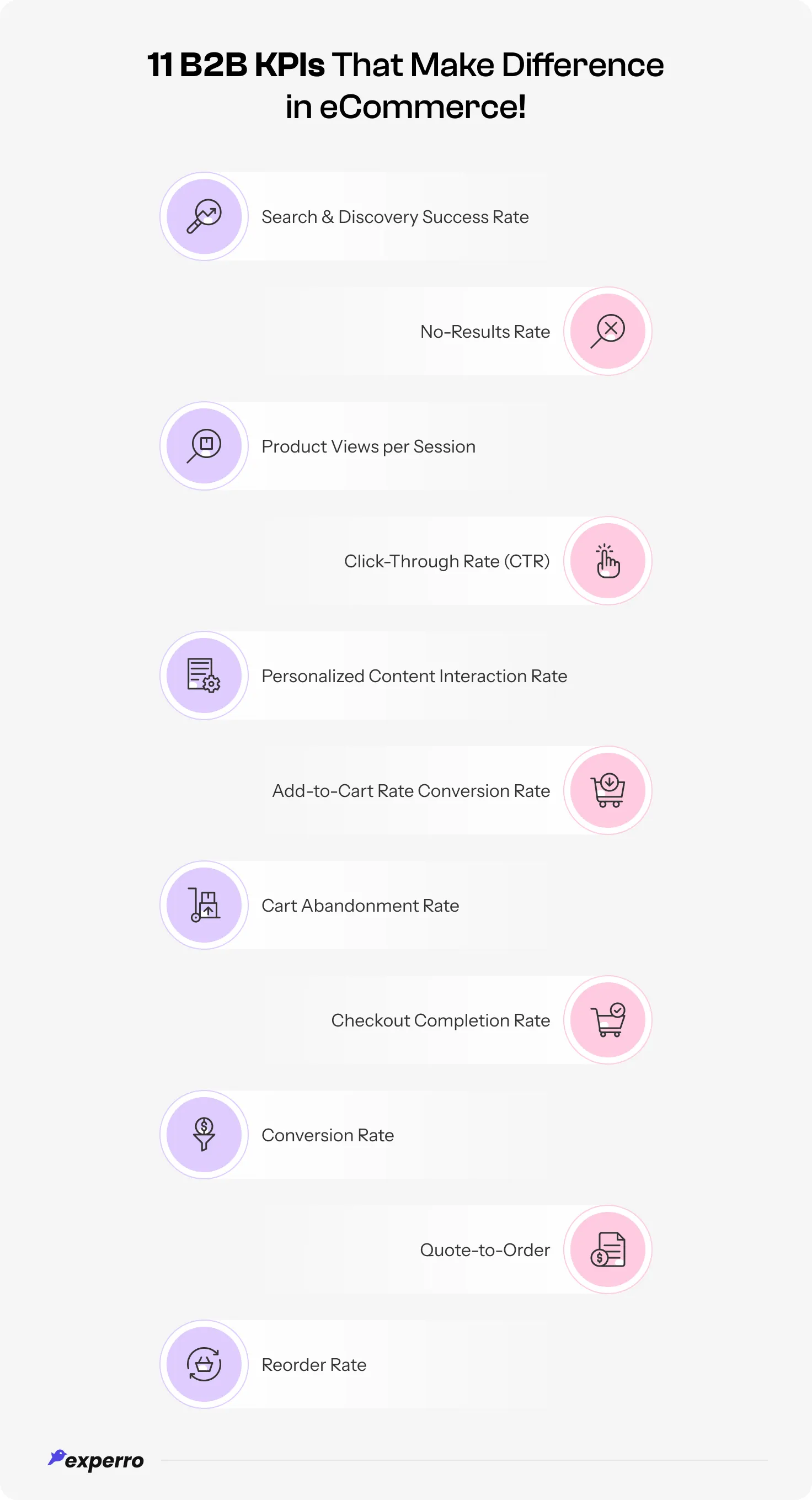
Each B2B eCommerce KPI example below ties directly to business objectives, efficiency, and better buyer experience.
1. Search & Discovery Success Rate
A high B2B eCommerce search & discovery success rate shows how effectively your platform helps buyers find the exact products they need without friction.
Because B2B catalogs often contain thousands of SKUs, variants, and technical specifications, this KPI reflects the strength of your inventory management, search logic, and relevance models.
When this metric is strong, website visitors can move from search to product pages faster, driving stronger engagement and order initiation. If the rate falls, it’s a clear sign that your search algorithm, synonyms, and category design need improvement.
Search & Discovery Success Rate = Successful Search Sessions Total Search Sessions × 100
2. No-Results Rate
No-results rate measures how often your search returns zero results and in B2B, this can be disastrous. Buyers use highly specific, technical, industry-oriented keywords, and if your system doesn’t recognize them, the buyer’s journey immediately breaks.
Missing product attributes prevent search engines from matching queries accurately, block effective filtering, and reduce discoverability, and this leads to higher no results rates.
Reducing this percentage ensures buyers aren’t forced to call sales reps or abandon your site entirely, which directly influences revenue and customer satisfaction.
No-Results Rate = No-Result Searches Total Searches × 100
3. Product Views per Session
Product Views per Session shows how many products a unique visitor opens and views during a visit, indicating how actively they’re checking specifications, details, or alternatives within your catalog. In B2B, deeper product exploration often means stronger purchase intent or a need to compare specifications, quantities, or alternatives.
High views per session indicate smooth navigation and strong product discoverability, while low views may signal friction in finding the right products.
If this KPI increases but conversions stay flat, your product detail pages may need better descriptions, technical data, or price transparency.
Product Views per Session = No-Result Searches Total Searches × 100
4. Click-Through Rate (CTR)
CTR measures the percentage of users who click on a product, banner, recommendation, or listing. It helps you evaluate the effectiveness of marketing strategies, marketing spend, and marketing qualified leads.
In B2B, where purchases are deliberate and often high-value, CTR helps you understand whether search results, merchandising placements, and recommendations resonate with buying roles.
A declining CTR can indicate mismatched relevance, unattractive product titles, or weak search ranking logic. When optimized well, CTR becomes a leading indicator of higher user engagement and stronger conversion rate optimization.
CTR % = Total Clicks Total Impressions × 100
5. Personalized Content Interaction Rate
This KPI shows how effectively personalized content engages buyers. Higher interaction demonstrates strong customer acquisition, customer value, and alignment with account-specific pricing or contract terms.
B2B personalization isn’t about generic recommendations. It is about helping buyers quickly find the most relevant products, content, and search results based on their role, needs, and buying context.
A higher interaction rate proves your personalization engine is delivering relevant content at the right time. A lower rate signals that your targeting logic or segmentation needs refinement, especially for multi-stakeholder buying groups.
Personalized Content Interaction Rate = Personalized Element Interactions Total Sessions × 100
6. Add-to-Cart Rate
Add-to-cart rate shows how many buyers move from browsing to initiating a purchase decision.
A low Add-to-cart rate often indicates practical barriers such as unclear product details, confusing variant or configuration options, unexpected costs, or insufficient information to validate the product’s suitability.
The Americas lead with an 8% add-to-cart rate, outperforming EMEA’s average of around 6%.
Thus, optimizing this stage strengthens the conversion pipeline and helps buyers progress through the purchasing journey with confidence.
Add-to-Cart Rate = Add-to-Cart Actions Total Sessions × 100
7. Cart Abandonment Rate
While the previous KPI showed how well buyers reach the cart, this one reveals what stops them from moving ahead to checkout.
Cart abandonment rate reveals how many buyers leave after initiating the purchase process. For B2B buyers, abandonment is often tied to lack of payment flexibility, unclear delivery timelines, or login restrictions.
High abandonment affects monthly recurring revenue (MRR) and total revenue generated.
Cart abandonment recovery has an immediate impact on revenue because B2B order sizes are typically large.
Cart Abandonment Rate = Carts Created − Completed Orders Carts Created × 100
8. Checkout Completion Rate
Checkout completion rate tracks how many buyers successfully complete the entire checkout process. B2B buyers expect features like auto-filling of saved addresses, PO-based checkout (Purchase Order Number), multi-address shipping, and negotiated pricing visibility.
If the rate drops, it usually indicates friction caused by too many steps, unclear instructions, or unsupported payment terms.
A smooth checkout experience significantly enhances loyalty and brings repeat business in B2B markets.
Checkout Completion Rate = Completed Orders Checkout Sessions × 100
9. Conversion Rate
Conversion rate is the ultimate measure of how well your entire digital funnel performs, right from discovery to final order placement.
In B2B, conversions represent deeper commitment, often tied to volume orders, negotiated pricing, or long-term contracts. A declining B2B conversion rate signals issues in relevance, content clarity, shipping terms, or overall user experience.
Even a 1% improvement in this KPI for marketplace eCommerce can result in significant revenue impact due to typically high B2B order values.
Conversion Rate = Total Orders Total Sessions × 100
10. Quote-to-Order Rate
Quote-to-Order Rate indicates how many quotes generated actually convert into orders. This KPI is especially important for industries with custom pricing, negotiated terms, and specialized SKUs.
A healthy rate means your quoting process is fast, accurate, and aligned with buyer expectations. A low rate suggests friction in pricing approval, negotiation cycles, or delays caused by manual processes.
This metric also provides insights into the alignment between your sales and digital teams.
Quote-to-Order Rate = Quotes Converted to Orders Total Quotes × 100
11. Reorder Rate
Reorder Rate measures how often existing customers return to place repeat orders, which is a critical indicator of loyalty, trust, and product fit.
Since B2B purchasing is cyclical, recurring, and often contract-based, this KPI reflects the stability of your revenue and long-term business health.
A declining reorder rate may signal product issues, supply chain inconsistencies, or increasing competition. Improving it directly strengthens your B2B customer retention metrics and lowers acquisition cost.
Reorder Rate = Repeat Orders Total Orders × 100
These 11 KPIs help B2B retailers understand how well their online store supports the buying process. Hitting these B2B website KPIs is important because they improve deal speed, order accuracy, repeat purchases, and overall revenue.
Now, let’s look at how basic KPIs differ from B2B-specific KPIs in the next section.
How Do Standard B2C KPIs Differ From B2B KPIs in eCommerce?
Standard B2C KPIs focus on fast decisions and simple funnels, where measurement models track actions like product views, add to carts, and quick conversions.
These metrics work well because B2C shoppers usually make individual, impulse-driven, or need-based purchases without much back-and-forth.
Whereas B2B KPIs track longer buying cycles involving multiple stakeholders, approvals, and repeat orders. Because of this complexity, measurement models emphasize quote activity, reorder patterns, negotiated value, and account performance.
These B2B eCommerce growth metrics help assess recurring demand and the strength of long-term customer relationships.
Both approaches are effective in their own contexts because each reflects how customers naturally buy in B2C and B2B environments. The goal isn’t to compare them, but to understand how each system helps businesses optimize the customer journey they serve.
How Experro Helps You Win Every B2B Buyer Moment?

Experro is the only agentic platform with AI-powered B2B product discovery engine that helps retailers optimize all KPIs for B2B eCommerce in one place.
It enhances product findability, personalizes content for different buying roles, helping teams navigate complex catalogs with greater clarity.
The platform's search, merchandising, and product discovery suite strengthens your B2B eCommerce metrics by removing friction from every touchpoint.
Additionally, it supports B2B marketplace metrics, multi-catalog setups, contract pricing, and role-based personalization. With Experro, your buyers find faster, decide quicker, and order more confidently, every single time.
Conclusion
Understanding the right B2B eCommerce business KPIs helps you optimize your entire buying journey. These KPIs reveal exactly where buyers struggle and where your growth opportunities lie.
By mastering your B2B eCommerce tracking KPIs, you set the foundation for scalable revenue and operational efficiency. Combined with actionable insights from B2B eCommerce benchmarks, you stay ahead of competitors.
To maximize your B2B sales, schedule a call with our experts for a complete walkthrough of how Experro can elevate your product discovery, conversion, and ROI.
FAQs
Subscribe to Our Newsletter!
Get the latest insights delivered straight to your inbox.