
- eCommerce
- 11 min read
Coveo Being Problematic? Compare 6 Coveo Alternatives Here!
Published
5 December 2025Updated
13 January 2026

Disclaimer: The information in this article is based on publicly available sources, user reviews, and our own research at the time of writing. It is intended for educational and informational purposes only. We encourage businesses to independently evaluate solutions to determine the best fit for their needs. This article was last updated on 8th December 2025 as part of our routine maintenance on the basis of newly available information.
core insights box
- Coveo’s growing complexity and rising costs are pushing brands to move away from it and explore more agile AI search alternatives.
- Modern search platforms now deliver stronger personalization, faster performance, and clearer pricing than Coveo.
- Top Coveo competitors in 2026 such as Experro, Luigi’s Box, Algolia, Glean, Bloomreach, and Athos Commerce close critical gaps in Coveo’s search quality, relevance, and usability.
- Experro stands out as the best Coveo alternative with unified AI search, deeper personalization, and complete merchandiser control.
Spending thousands on Coveo every month, yet key products don’t show up when customers search for them?
Well, multiple existing Coveo users today are questioning whether Coveo’s complex search solutions still justify the cost, especially when faster, simpler, and more scalable platforms have emerged.
With rising expectations around personalization, speed, and enterprise grade AI, businesses are exploring Coveo competitors for 2026 that meet modern experience standards.
If you’re evaluating Coveo alternatives, this guide will help you uncover stronger, more flexible, and more cost-effective options.
Comparing Coveo’s Alternatives In 2026!
Before you decide whether migrating from Coveo is the right move, it is important to understand what other platforms like Coveo offer, especially in pricing, ratings, and suitability for different use cases.
Below is a quick snapshot of the top Coveo alternatives for 2026 comparing the platforms across key decision criteria.
| Platform | Pricing | G2 Rating | Best For? |
|---|---|---|---|
| Experro 🏆 | Flexible, scalable plans with a free demo | 4.8/5 (20 badges in Summer 2025, 50 in Winter 2026) | Mid to enterprise brands needing a unified AI search and personalization engine |
| Luigi’s Box | Tiered pricing; cheaper than Coveo (but expensive for small businesses) | 4.7/5 | SMBs needing simple AI search with lightweight personalization |
| Algolia | Free: 10k searches; Grow plan ~ $51/month | 4.5/5 | Developers & merchandisers needing an API-first approach |
| Glean | Enterprise quotes only | 4.8/5 | Enterprise generative AI search for internal teams |
| Bloomreach | Enterprise-level, custom pricing | 4.3–4.8/5 | Large enterprises needing deep data and CDP-level personalization |
| Athos Commerce | Mid to high-tier pricing | 4.7/5 | Retailers wanting strong merchandising plus search |
Before choosing between Coveo competitors, it’s important to understand how each platform performs in real-world eCommerce and enterprise search scenarios.
This breakdown highlights where the best Coveo alternatives outshine Coveo’s complex search solutions, especially for teams wanting simplicity, speed, and stronger personalization.
Here’s how the top platforms compare when evaluating alternatives to Coveo for search & discovery:
1. Experro - The Best Alternative to Coveo 🏆

Experro stands out as the best eCommerce search platform and the strongest Coveo alternative for both eCommerce and enterprise search brands.
Unlike Coveo’s complex search solutions, Experro is designed for speed, agility, and merchandiser-friendliness without requiring heavy technical workflows.
Experro offers built-in machine learning and artificial intelligence models fine-tuned for commerce specific intent, ensuring shoppers see the right product faster and with higher precision.
Customers frequently note that its smart product browsing, and predictive discovery make it far easier for teams to launch changes instantly, something many Coveo customers struggle with.
Experro also provides transparent usage, predictable pricing, and native performance dashboards, so teams can optimize without hunting for data across multiple enterprise search tools.
With built-in product feed optimization and multilingual AI, Experro cuts manual work and gives you one powerful search platform to grow your store.
Experro is the best Coveo AI alternative in 2026 because it gives brands faster control, smarter search capabilities, and a far easier path to scale. In the Experro vs Coveo comparison, Experro clearly comes out ahead on speed, usability, and cost-efficiency.
| Pros of Experro | Cons of Experro |
| ✅Gen AI-powered search with high intent accuracy | ❌ None found |
| ✅No code controls for merchandisers and marketers | |
| ✅AI-driven personalization that adapts to every shopper in real time | |
| ✅Scalable and cost friendly compared to high Coveo pricing | |
| ✅Built specifically for eCommerce and enterprise grade experiences | |
| ✅Merchant intelligence for smarter retailer decisions | |
| ✅Real time analytics included for exceptional performance visibility |
2. Luigi’s Box

Luigi’s Box is a solid option for SMBs but is not ideal for scaling beyond mid-market. Customers repeatedly express that its AI capabilities are entry-level compared to enterprise platforms, limiting growth for brands needing deeper product discovery. 1
The platform’s existing user expressed concerns around advanced personalization, multilingual search depth, and hybrid AI relevancy are weaker than needed for enterprise grade use cases.
For these reasons, Luigi's Box does not qualify as a strong Coveo competitor when it comes to large-scale enterprises.
Overall, it is better suited for teams with minimal customization needs.
| Pros of Luigi's Box | Cons of Luigi's Box |
| ✅Easy setup and clean user experience | ❌ Limited scalability for enterprise level catalogs |
| ✅Affordable for small and mid-sized businesses | ❌ Personalization depth is weaker than other leading platforms |
| ✅Good for basic search and simple personalization | ❌ Fewer AI models and lighter relevancy tuning options |
| ❌ Not ideal for multi-language or global eCommerce brands | |
| ❌ Lacks unified merchandising and deep analytics |
4. Algolia

Algolia is popular among engineering centric teams but requires heavy developer involvement.
Reportedly, it has come to notice that brands switching from Coveo’s complex search solutions often face similar complexity with Algolia’s API-first model. Hence, neither Coveo nor Algolia is a good option to switch to. 2
Costs escalate quickly as traffic grows, and many users find the pricing over their budget. For teams already comparing Algolia and Coveo pricing models, this makes Algolia feel just as costly at scale. 3
Merchandising is not native, so eCommerce teams need additional tools. It is not the best fit if you want an all-in-one product discovery and site search solution without engineering overload.
| Pros of Algolia | Cons of Algolia |
| ✅Extremely fast API-based search | ❌ Requires significant developer involvement for setup and maintenance |
| ✅Highly customizable for engineering driven teams | ❌ No native merchandising suite |
| ✅Strong documentation and developer tooling | ❌ Personalization is not as robust as unified AI platforms |
| ❌ Not ideal for non-technical eCommerce teams |
5. Glean

Glean is a strong enterprise AI search alternative to Coveo, especially for internal knowledge search.
However, it is not built for eCommerce, product discovery, or customer facing search which is a major limitation for retail and D2C brands.
Merchandisers say the real complexity starts when data is incomplete or inconsistent. Missing attributes weaken filtering and make it harder for shoppers to find what they need. Integrating with identity systems, internal data sources and security layers adds more work, making the setup costly and IT-heavy for mid-sized teams. 4
It is powerful for internal enterprise intelligence and stands as a relevant Coveo alternative specifically for basic search use cases. However, it’s not suitable for eCommerce-focused search and discovery on web stores.
| Pros of Glean | Cons of Glean |
| ✅Excellent for enterprise knowledge search | ❌ Not built for eCommerce search or product discovery |
| ✅Strong generative AI capabilities for internal workflows | ❌ Expensive and often requires enterprise level IT support |
| ✅Seamless plug-and-play integrations with common productivity tools | ❌Long implementation cycles |
| ❌ Limited flexibility for retail or D2C brands | |
❌ Not suitable as a unified search platform for websites |
6. Bloomreach

Bloomreach offers deep personalization but comes with heavy implementation and high costs similar to Coveo pricing.
Its feature depth is strong, but the platform is often overpowered for brands not fully invested in CDP-level data maturity.
Merchandising tools and search tuning require significant onboarding time. Some users even draw parallels to common Coveo complaints, especially around platform rigidity and slow support response times. 5
It is best suited for large enterprises with complex ecosystems.
| Pros of Bloomreach | Cons of Bloomreach |
| ✅Deep personalization capabilities | ❌ Very expensive and not suited for mid-market |
| ✅Strong product recommendations and content integration | ❌ Requires long onboarding and technical support |
| ✅Good for data-rich enterprises | ❌ Search tuning is complex for non-technical teams |
| ❌ Heavy dependency on CDP level data maturity | |
❌Overpowered for brands that only need search and discovery |
7. Athos Commerce

Searchspring, Klevu, and Intelligent Reach have joined hands to form a new company under ‘Athos Commerce’.
Athos Commerce is great for small businesses but lacks the AI technology sophistication needed to replace enterprise search solutions like Coveo.
Its personalization capabilities are lighter, and search for relevancy tuning requires manual effort. Analytics and insights are limited compared to unified AI platforms.
Many users mention that Athos Commerce still does not deliver deep enterprise merchandising and recommendations functionality. It is better for straightforward catalog search rather than advanced AI driven discovery. 6
| Pros of Athos Commerce | Cons of Athos Commerce |
| ✅Easy for eCommerce teams to use | ❌ Limited AI depth compared to modern search platforms |
| ✅Good reporting for category level insights | ❌ Search relevancy requires manual tuning |
| ❌ Personalization features are basic | |
| ❌ Not suited for enterprise catalogs or complex product discovery | |
❌Lacks unified AI search and content search combination |
Now that we have come across all the Coveo alternatives, let's now check out which all areas does Coveo lack in.
Where Coveo Struggles to Support Merchandisers?
Many teams evaluating Coveo alternatives highlight recurring challenges that slow down search, relevance tuning, and merchandising adjustments.
These gaps often push businesses to consider switching to platforms that offer easier control and better visibility.
- Steep learning curve – Users report that it takes significant time and effort to understand and operate Coveo’s features. This slows down onboarding and makes teams dependent on external help for even routine tasks. 7
- Requires deep technical expertise – User reviews portray that even simple configurations often require advanced technical support, making it difficult for non-technical teams to operate independently. This creates workflow bottlenecks and prevents merchandisers from making quick changes. 8
- Complicated new features & updates – Users often say that teams struggle with both the complexity of existing features and missing features in Coveo platform, which makes managing daily operations and staying current with updates frustrating and time-consuming. 9
- Complex setup & high query consumption – Some users mention that setup is difficult, and query consumption can become expensive and restrictive. This often leads to unpredictable costs, especially for growing eCommerce businesses. 10
- Weak semantic search performance – Users report that semantic search does not always deliver the expected accuracy compared to modern AI-native platforms. This limits the quality of product discovery and frustrates teams aiming for higher search relevance. 11
These challenges slow down merchandisers and make it hard to run search and product discovery without constant technical help. As frustrations build, many teams start questioning if Coveo is still the right fit.
To make your decision easier, the next section breaks down what real users have experienced.
Is Coveo Worth It for Merchandisers? Here’s What Users Say
After facing multiple issues with Coveo, many users begin to wonder if the platform is still worth it for merchandisers.
This frustration is also why more teams are actively exploring Coveo search competitors and alternatives that offer easier controls and better eCommerce flexibility.
And honestly, that’s where the real question comes up in conversations: “Why switch from Coveo in the first place?”
Here’s why:
1. Coveo Users Raising Concerns About Relevance and Pricing
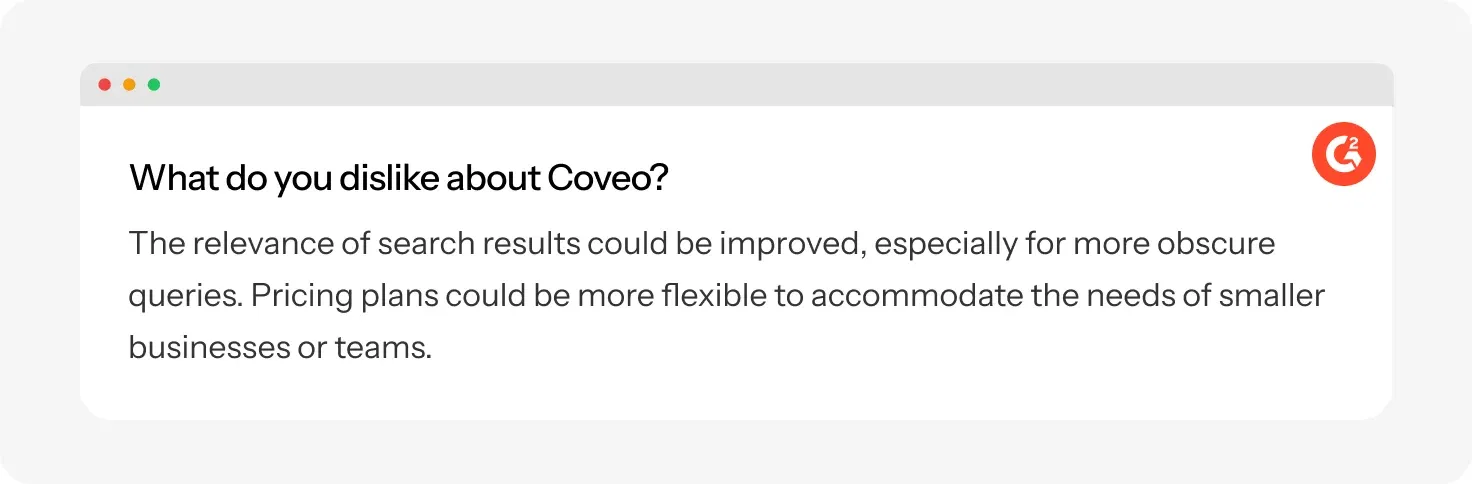
The user is pointing out that Coveo’s search relevance often misses the mark, especially for niche or obscure queries. They also feel pricing could be more flexible for smaller teams, raising early doubts about - “Is Coveo worth the price?”
Source: G2 Review
2. Buyers Highlighting Setup Complexity and Technical Load

This reviewer highlights that Coveo is difficult to set up and requires heavy developer involvement. They also mention outdated documentation, slow indexing, and search that does not feel modern, which are all frustrations that push users to explore alternatives.
Source: G2 Review
3. Clients Reporting Categorization and Scaling Issues
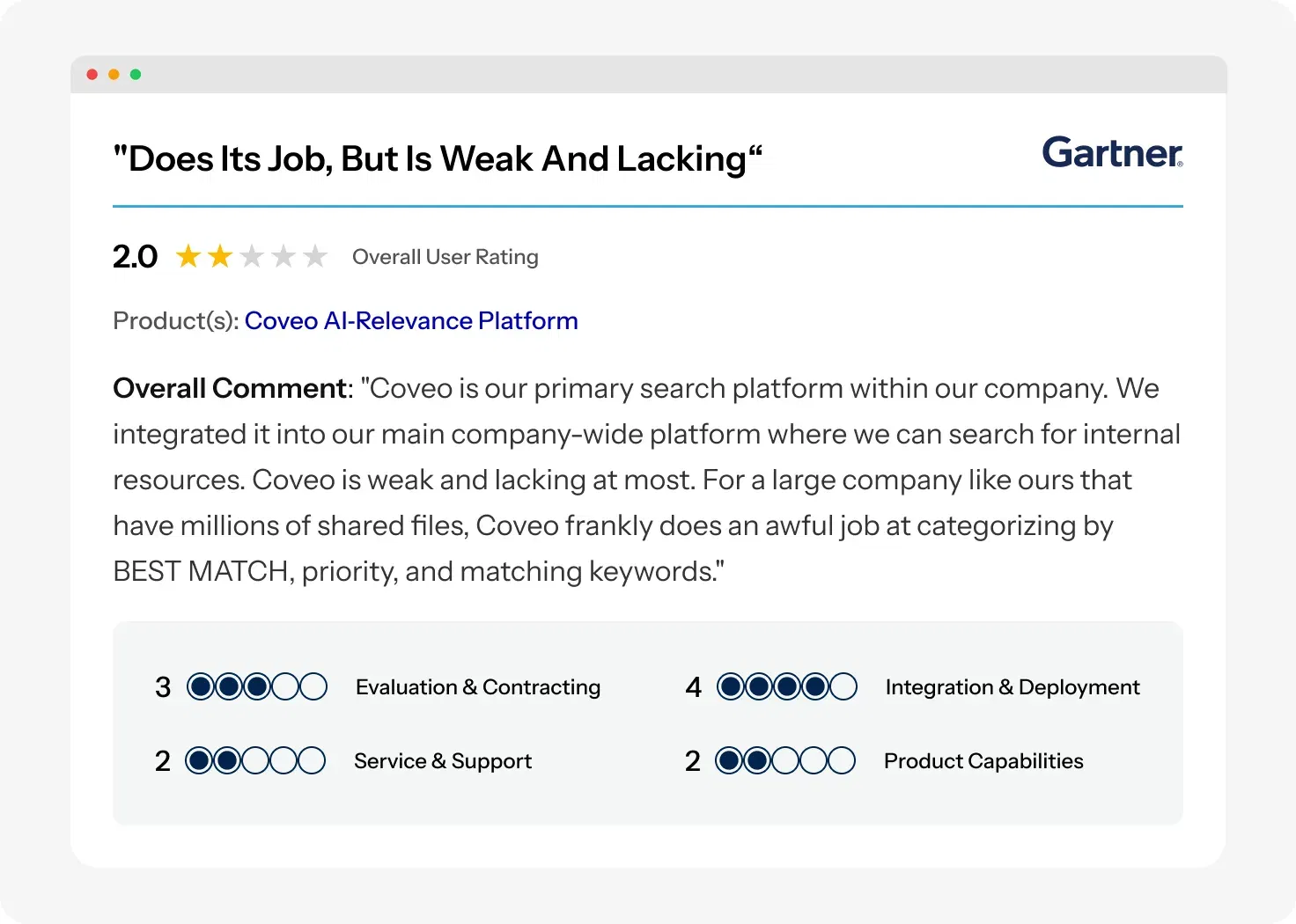
Here, the user explains that for large organizations with millions of files, Coveo struggles to categorize properly or match keywords accurately. They describe the platform as weak and unreliable for enterprise-level content discovery.
Source: Gartner
4. Users Frustrated With UI and Limited Reporting
Source: Gartner
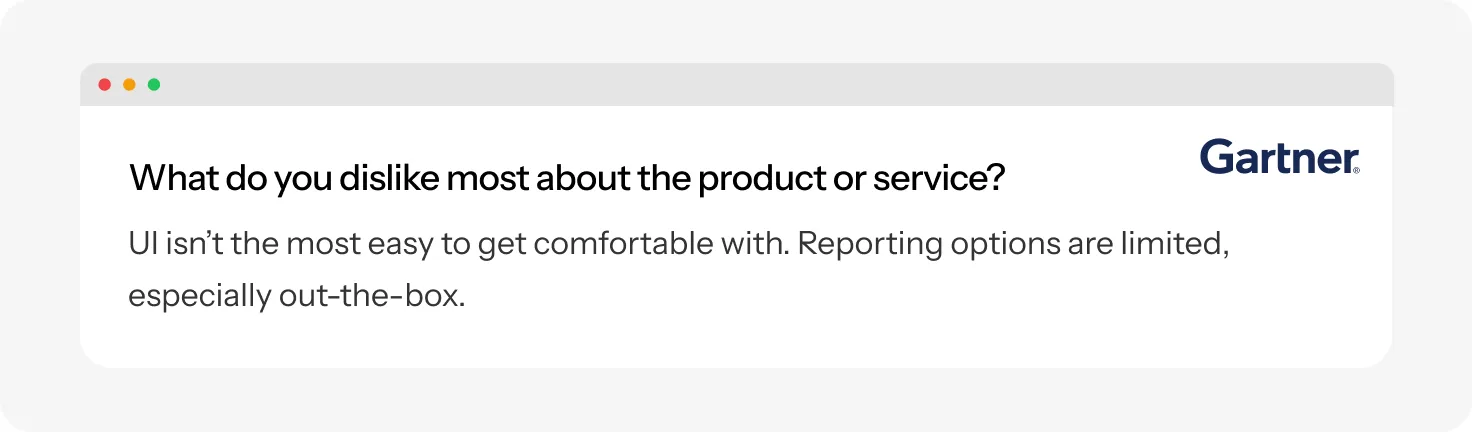
This review says that the UI is not easy to get comfortable with and the reporting capabilities are limited, making day-to-day operations slower for teams that rely on clear insights.
These recurring issues make it clear why many merchandisers are now reassessing Coveo and looking for the best Coveo replacements such as Experro that offer more control, accuracy, and ease.
Final Thoughts
Choosing between Coveo and the many search solutions like Coveo requires a clear evaluation of your business size, team structure, and growth goals.
If your merchandising team depends on agility, personalization, and fast experimentation, the limitations of Coveo AI search and customer satisfaction can become costly.
Popular platforms like Experro provide a unified search platform that simplifies workflows while delivering enterprise grade relevance and personalization. When exploring the best Coveo competitors, prioritize speed, flexibility, and transparent pricing plans.
To see how Experro compares and whether it is the best alternative to Coveo for your brand, schedule a call with our experts for a personalized walkthrough.
Sources:
FAQs

Pallavi is an ambitious author recognized for her expertise in crafting compelling content across various domains. Beyond her professional pursuits, Pallavi is deeply passionate about continuous learning, often immersing herself in the latest industry trends. When not weaving words, she dedicates her time to mastering graphic design.
Subscribe to Our Newsletter!
Get the latest insights delivered straight to your inbox.