
- Merchandising
- eCommerce
- 13 min read
How Product Clustering Directly Impacts eCommerce Sales
Published
13 September 2024Updated
13 January 2026

core insights box
- Advanced product clustering techniques move beyond basic categories to create high-conversion bundles that significantly boost the average order value.
- Using machine learning clustering techniques, retailers can automate product grouping to improve customer experience and drive sales.
- Clustering algorithms provide valuable insights for targeted promotions, dynamic pricing, and efficient supply chain management.
- Experro enables intelligent product clustering by unifying customer behavior, product data, and AI to deliver consistently relevant shopping experiences at scale.
In the vast landscape of modern eCommerce, the sheer volume of inventory can be both a retailer's greatest asset and their biggest organizational challenge.
Product segmentation and clustering, the process of grouping items based on shared characteristics, buyer behavior, or semantic similarities serves as the bridge between raw data and a seamless shopping experience.
When products are grouped intelligently, recommendation engines become significantly more accurate, leading to higher conversion rates and increased average order values.
Instead of generic "you might also like" suggestions, customers are presented with items that logically complement their current selection based on sophisticated data patterns.
This approach helps optimize product grouping, making it easier for customers to find what they need. By leveraging machine learning techniques, retailers can create product clusters that enhance customer experience.
An effective product clustering strategy turns a chaotic catalog into a personalized shopping experience. By grouping items based on how customers actually shop rather than just how they are labeled, you can boost discovery, increase sales, and ensure every product finds its perfect buyer.
What is Product Clustering in eCommerce?
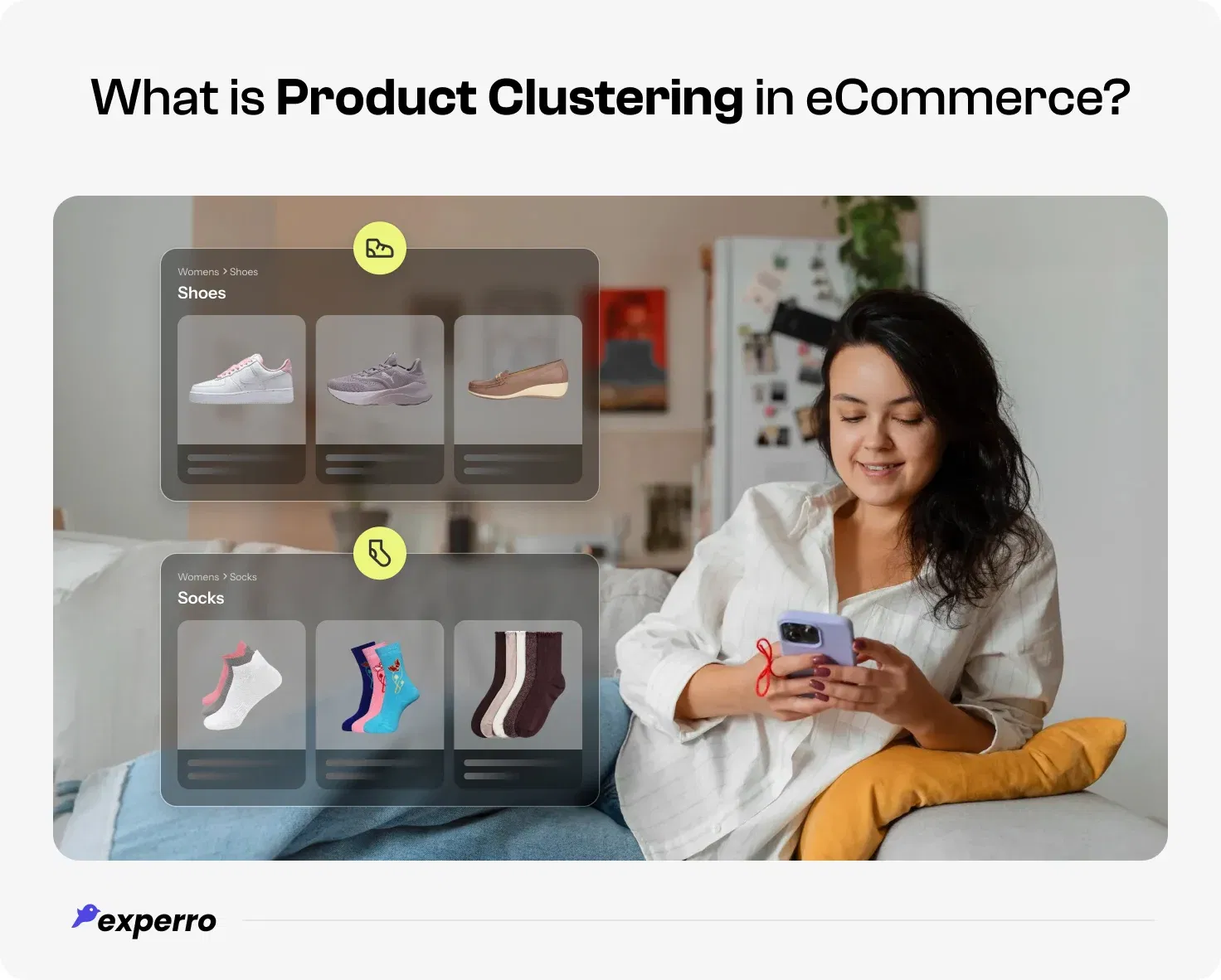
Product clustering in eCommerce is the process of grouping products based on shared physical attributes, customer behavioral patterns, and market performance metrics that help businesses enhance personalized recommendations.
This clustering strategy also helps retailers organize their inventory effectively. By clustering, products are grouped based on attributes like price, brand, or customer preferences.
Beyond simple categorization, clustering utilizes data-driven algorithms to uncover hidden relationships between items that might not share the same category but share the same buyer intent.
This allows businesses to predict demand more accurately and bridge the gap between product search vs discovery, ensuring the right products are always positioned in front of the right audience.
Now that you have a clear understanding of what are product clusters in eCommerce, let’s explore whether implementing them is truly beneficial for your business.
Are Product Clusters Worth Implementing?
Yes, absolutely! Transitioning from manual categorization to automated product cluster analysis is a high-impact move that turns stagnant inventory data into a dynamic engine for revenue growth.
By identifying how products actually move together, you stop guessing what customers want and start providing the precision-targeted product experiences they expect.
Product clustering helps businesses understand how products relate to one another, directly impacting inventory management, marketing, and sales strategies.
When you group products, providing personalized recommendations to customers becomes easier. This technique improves customer satisfaction and increases operational efficiency in retail clustering.
Examples of Retail Product Clustering
Below are the most effective real-world product clusters used by modern brands to strategically influence shopping behavior and maximize basket size.
- Traffic Magnets: High-visibility items priced aggressively to pull shoppers into the store or website.
- Convenience Complements: Small, essential add-ons placed near expensive items to solve an immediate frustration point.
- Lifestyle Habit-Builders: Products that require a recurring commitment and keep the customer returning to your brand.
- Efficiency Bundles: Products grouped together specifically to save the customer time by eliminating the need for research.
What Are the Types of Product Clustering?
Product clustering helps businesses group products based on various factors to optimize operations and customer experience.
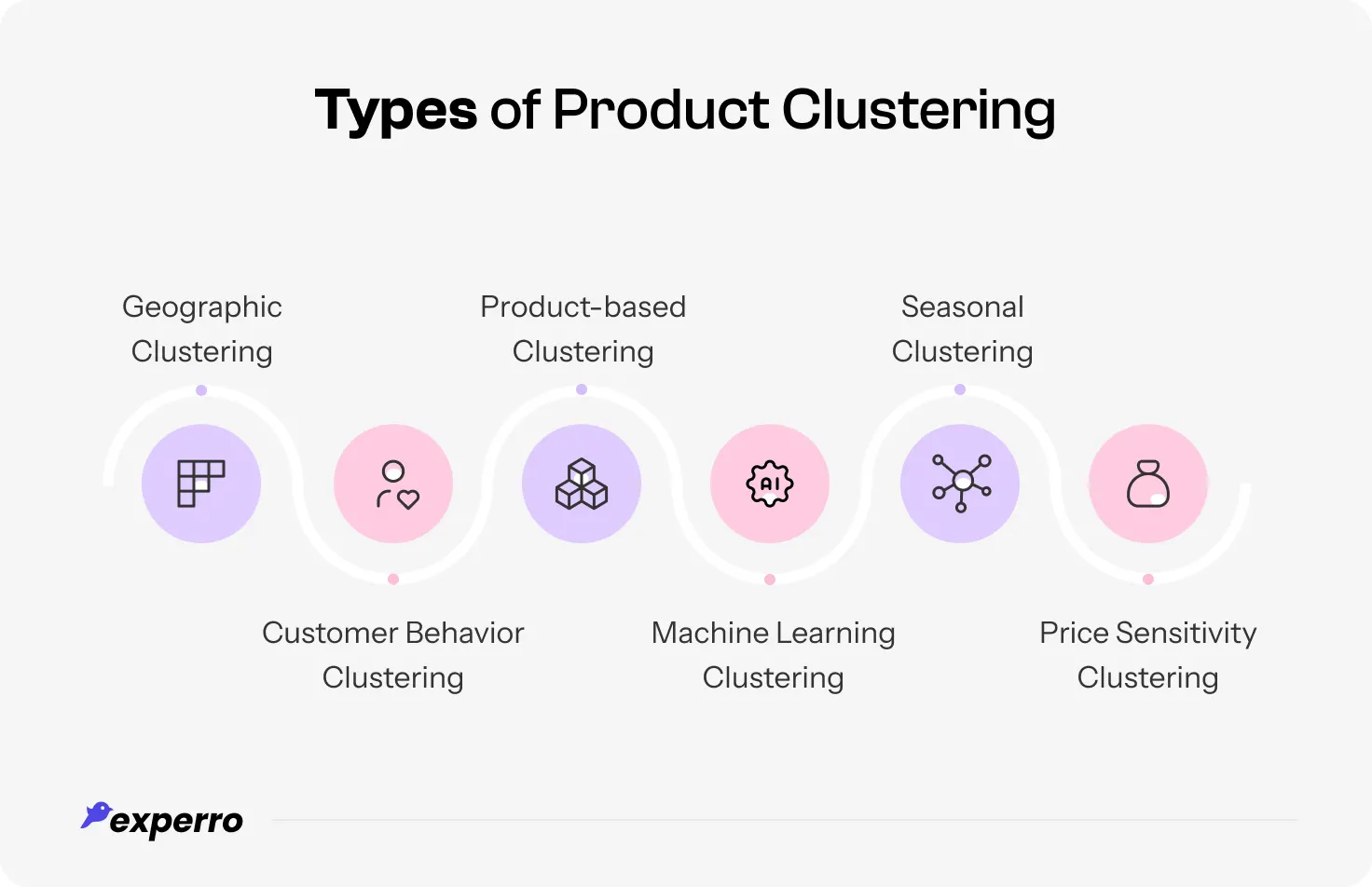
Here are some common types of product clustering in retail to drive better results.
1. Geographic Clustering
Geographic clustering involves grouping stores or products based on their location or proximity to one another.
For example:
A clothing retailer may group stores in coastal areas to prioritize beachwear, while stores in colder regions focus on winter apparel.
This method helps businesses optimize logistics, manage inventory more efficiently, and develop localized retail clustering strategies to meet regional demand.
2. Customer Behavior Clustering
Customer behavior clustering focuses on grouping products according to customer purchasing habits, preferences, and shopping behaviors.
For instance:
An online bookstore might cluster customers who frequently buy mystery novels, offering them personalized recommendations and promotions for similar genres.
This type of clustering in eCommerce enhances personalized merchandising, recommendations and marketing strategies, improving customer engagement and retention.
3. Product-based Clustering
Product-based clustering groups share similar characteristics such as category, price, or brand.
For example:
A beauty retailer could cluster skincare products from luxury brands together, optimizing product displays to encourage cross-selling between premium items.
Moreover, AI product enrichment improves product-based clustering by adding richer attributes like usage, benefits, and intent, making clusters more accurate and easier to personalize at scale.
4. Machine Learning Clustering
Machine learning clustering utilizes algorithms like K-means clustering algorithms to automatically group products based on data such as sales trends and customer behavior.
K-means clustering is a machine learning algorithm that groups similar data points into clusters, useful for tasks like customer segmentation and product recommendations in eCommerce.
For instance:
An eCommerce platform might use machine learning to group products frequently bought together, such as phone cases and screen protectors, to refine bundling strategies.
This approach helps businesses make data-driven decisions and refine their product clustering strategy.
5. Seasonal Clustering
Seasonal clustering groups are based on their performance during specific periods, such as holidays or peak seasons.
For Example:
A retailer could cluster holiday decorations that sell well during winter, ensuring these prominently featured items during the lead-up to the holiday season.
This clustering strategy allows retailers to align inventory and promotions with seasonal trends, ensuring products meet customer demand.
P.S. - With Experro, retailers can quickly curate high-performing AI-powered collection pages for every campaign and occasion launched in minutes with no developer effort.
6. Price Sensitivity Clustering
Price sensitivity clustering involves grouping products or stores based on how customers respond to different pricing levels.
For instance:
A grocery store may cluster budget-friendly products and create promotions aimed at price-conscious shoppers who respond positively to discounts and deals.
This clustering technique enables businesses to create targeted promotions and pricing strategies, improving the effectiveness of gen AI in retail clustering.
What Are the Benefits of Retail Product Clustering?
When businesses apply product clustering strategies, they unlock various benefits.
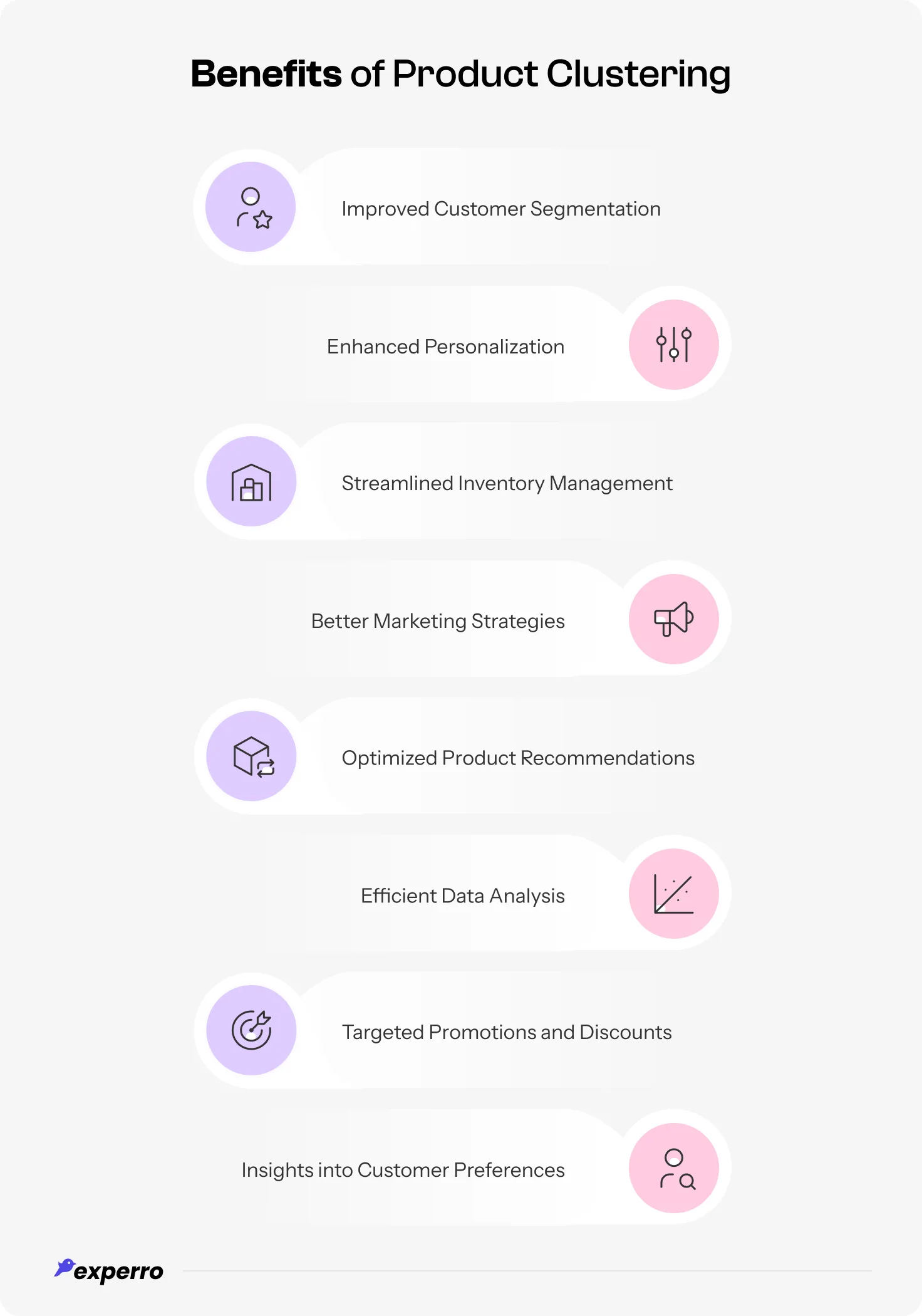
Here are a few key advantages explained in detail:
1. Improved Customer Segmentation
Effective product segmentation and clustering give businesses a deeper understanding of customer preferences and behaviors.
Companies can identify different consumer segments by grouping products according to customer actions. This allows businesses to create tailored marketing messages and offer products that meet specific needs.
Customers receive a more personalized shopping experience, leading to increased satisfaction. Over time, this approach fosters customer loyalty and encourages repeat purchases.
2. Enhanced Personalization
Product grouping plays an important role in delivering personalized shopping experiences.
With the help of machine learning clustering, businesses can identify the products that resonate most with individual customers based on their preferences and past purchases. This method ensures that product recommendations are not random but highly relevant.
It increases the chances of a sale as customers see items that are likely to match their tastes.
By applying advanced clustering techniques, companies can deliver hyper-personalization, making customers feel valued and understood. This enhances engagement, customer retention, and overall satisfaction.
3. Streamlined Inventory Management
Product clustering optimizes inventory management by grouping products based on sales trends and demand. Retailers can track inventory more effectively, ensuring the right products are available when and where customers need them.
Store clusters allow retailers to allocate stock strategically, based on geographic or demographic preferences.
This minimizes the risk of overstock or stock shortages. Retail store clustering further refines inventory management by aligning stock levels with localized customer demands.
Thus, businesses can avoid excess inventory costs and ensure their product offerings align with current market needs.
4. Better Marketing Strategies
Using product clustering, helps businesses refine their marketing strategies. By grouping products based on consumer behavior, businesses can craft campaigns that resonate with specific customer segments.
These tailored campaigns often result in higher engagement and conversions, as they address the needs and preferences of targeted customers.
Retail merchandising clusters enable businesses to position their products more effectively in both online and physical stores.
This helps companies market to the right audience at the right time, improving their overall marketing ROI and increasing the effectiveness of promotional efforts.
5. Optimized Product Recommendations
Accurate product recommendation in ecommerce drive sales. Product grouping ensures that customers receive recommendations that are closely aligned with their interests and preferences.
Businesses can analyze large datasets using K-means clustering algorithms and uncover hidden patterns in customer behavior. This allows them to recommend products that drives higher sales and conversions.
Thus, with clustering in eCommerce, businesses can provide an individualized shopping experience that encourages repeat visits.
6. Efficient Data Analysis
Cluster analysis allows businesses to handle large volumes of data with ease. By organizing products into specific groups, companies can quickly spot trends and shifts in customer preferences.
This enables faster, data-driven decision-making, reducing the time spent on manual product clustering analysis.
The advantages of clustering also include better eCommerce data analytics, as businesses can predict demand patterns more accurately.
With data grouped into relevant categories, companies can identify potential opportunities and challenges, adjusting their strategies accordingly. This leads to smarter, more informed decisions across all aspects of the business.
7. Targeted Promotions and Discounts
With clustering strategies, businesses can craft promotions that speak directly to specific customer segments.
By understanding what is the purpose of clustering, businesses can identify which products are most appealing to certain groups, allowing for highly relevant offers.
Promotions and discounts can be more effectively targeted, leading to higher customer engagement. This approach also helps avoid promotions that may not appeal to all customers, thus saving marketing resources.
The result is a better ROI on promotional efforts and improved customer satisfaction through personalized offers.
8. Insights into Customer Preferences
Store clustering in retail offers businesses valuable insights into customer preferences by grouping products based on consumer behavior.
These clusters reveal patterns such as popular product combinations, seasonal trends, and price sensitivity, allowing companies to refine their product selection and presentation.
By analyzing the characteristics of each cluster, businesses can adjust their product offerings to better meet customer expectations. This customer-centric approach leads to more satisfied shoppers and increased loyalty.
Over time, companies can use these insights to stay ahead of trends and continuously improve their product strategies, ensuring they meet evolving market demands.
To fully realize the benefits of product clustering, businesses must also be aware of the common pitfalls that can undermine results. Let's take a deepe look!
What are the Challenges in Product Clustering & How to Avoid Them?
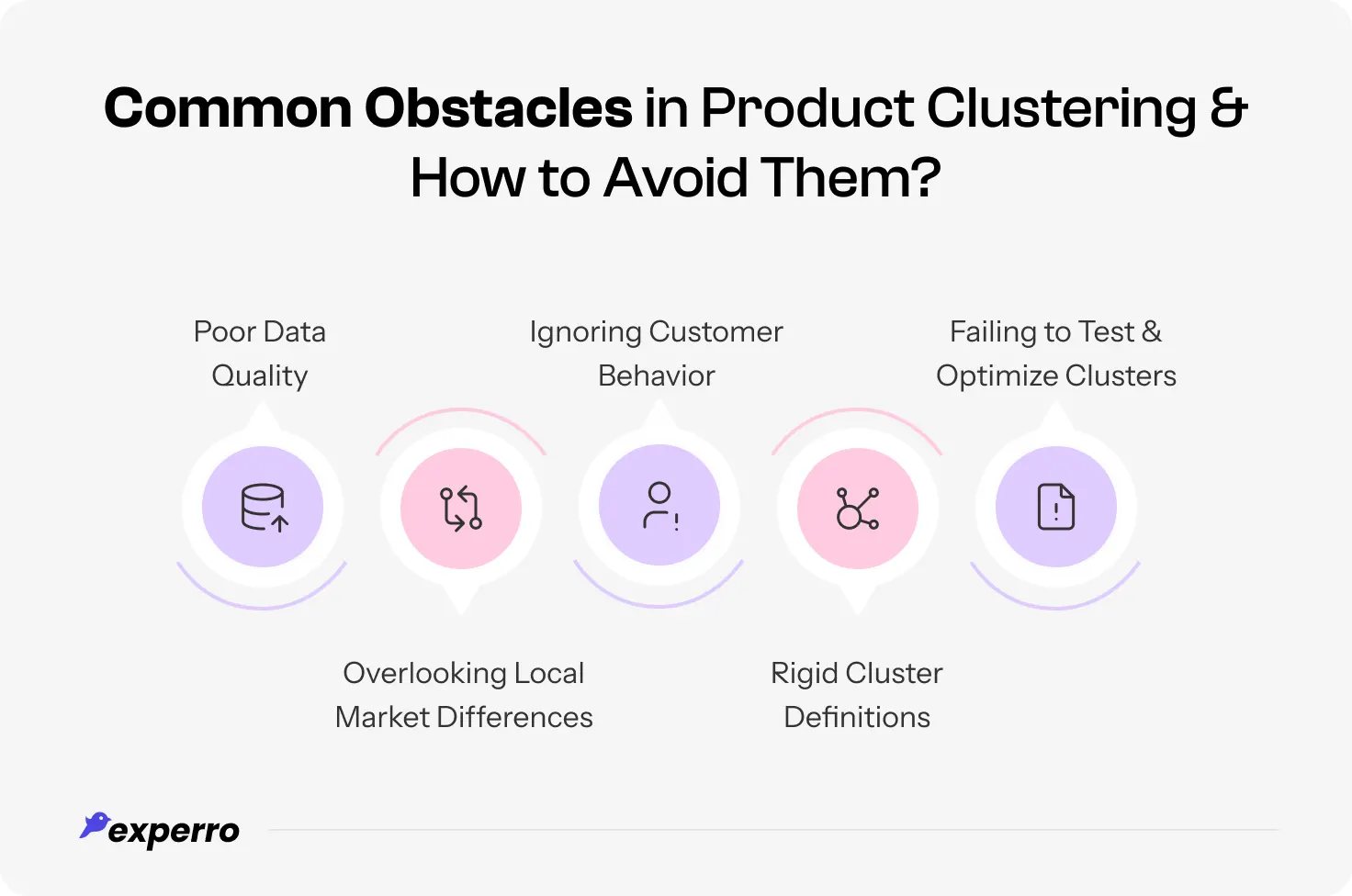
Below are the 5 common pitfalls of product grouping and the ways to avoid them:
1. Poor Data Quality
Product clustering relies on accurate data and using incomplete or outdated information can lead to ineffective clusters.
Avoid this by ensuring data is clean, regularly updated, and includes all relevant metrics like customer demographics, sales performance, and location-specific trends.
Product data enrichment helps fill data gaps by enhancing product and customer attributes, ensuring clusters stay accurate, relevant, and effective over time.
2. Overlooking Local Market Differences
Treating all stores the same without accounting for regional variations can result in mismatched product offerings and promotions.
For example, promoting winter coats in a region with a warm climate could lead to low sales.
Avoid this by analyzing local market conditions, preferences, and customer behaviors to create more relevant clusters. Leverage digital experience analytics to gain deeper insights into customer interactions and preferences.
3. Ignoring Customer Behavior
Focusing solely on geographic or sales data while neglecting customer preferences can create misaligned clusters. Geographic and sales data provide insights, but these can’t be the only bases.
They must be complemented by customer preferences, purchasing patterns, shopping frequency, and product taxonomy to ensure accurate clustering.
Avoid relying solely on clustering; complement them with customer preferences, purchasing patterns, shopping frequency, and product taxonomy to ensure more accurate and meaningful clustering results.
4. Rigid Cluster Definitions
Setting rigid parameters for clusters without a scope for flexibility can make it hard to adapt to changes in market dynamics.
Avoid this by using dynamic clustering strategies that allow for periodic adjustments based on evolving data.
5. Failing to Test and Optimize Clusters
Implementing store clusters without ongoing evaluation can result in missed opportunities for improvement.
Avoid this by regularly testing and optimizing clusters to ensure they continue to align with business goals and market changes.
What Are the Use Cases of Product Clustering?
Product grouping isn’t just beneficial; it has numerous practical applications across various business functions.
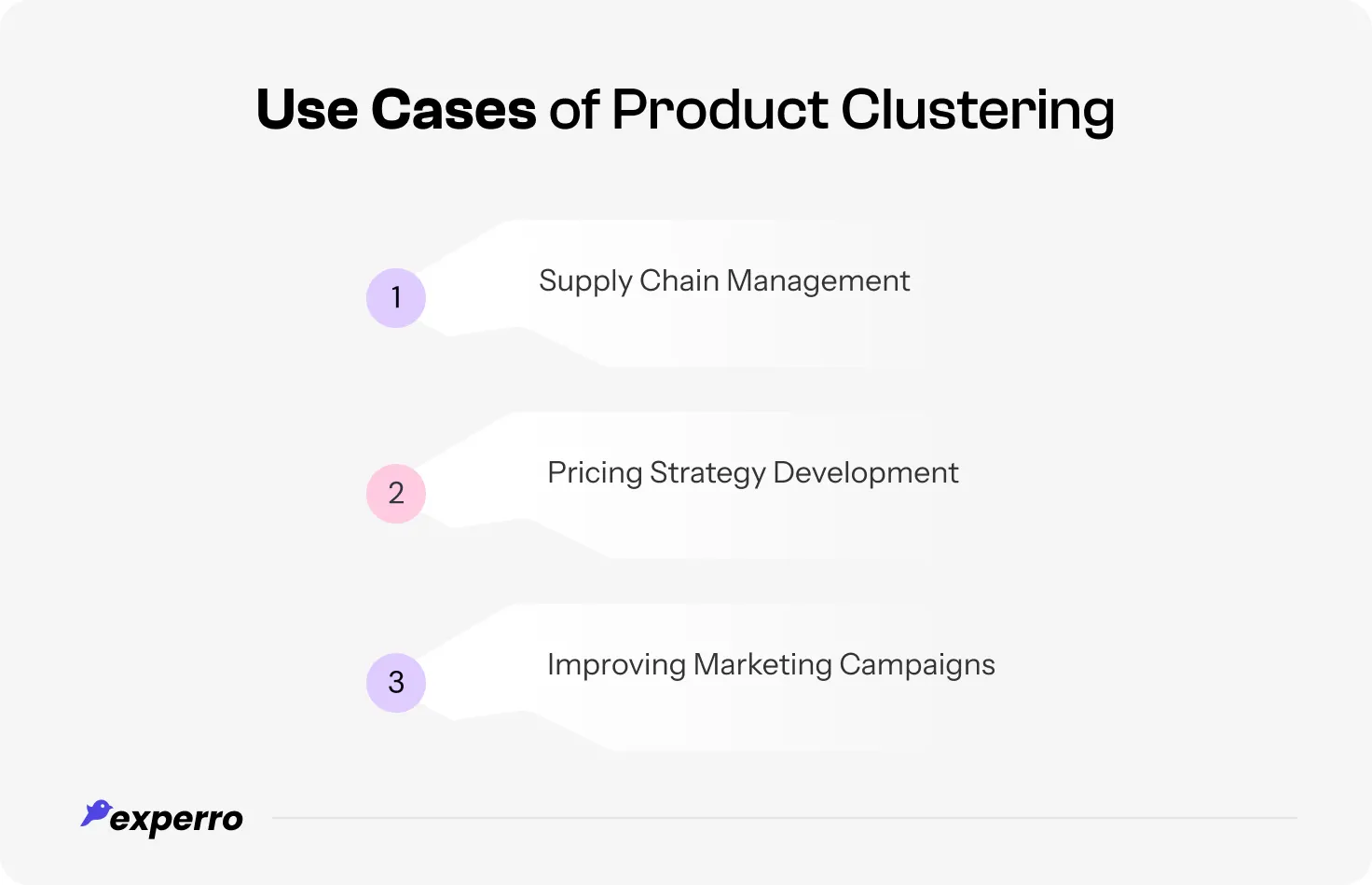
1. Supply Chain Management
One of the key use cases of product-based clusters is optimizing supply chain operations. By using smart/intelligent store clustering, businesses can group stores based on other relevant factors like location, demand trends, and customer preferences.
This ensures that inventory is distributed, reducing delivery times and minimizing logistical costs.
Additionally, clustering helps to forecast product demand more accurately, allowing for better allocation of resources. This leads to smoother operations, fewer stockouts, and improved customer satisfaction throughout the supply chain.
2. Pricing Strategy Development
Product clustering is effective for developing dynamic pricing strategies. By grouping products based on factors such as demand elasticity and market conditions, businesses can set prices that maximize profitability.
Product matching algorithms further enhance this by identifying which products are often purchased together, enabling effective bundling or discount strategies.
These techniques allow companies to stay competitive, offering tailored pricing that responds to market shifts. As a result, businesses can optimize their revenue and respond more flexibly to customer needs.
3. Improving Marketing Campaigns
Clustering in marketing is essential for creating more effective and targeted campaigns. By using clustering algorithms, businesses can segment their customer base more precisely, ensuring that marketing efforts resonate with each group’s specific preferences.
This data-driven approach allows for personalized promotions and content, improving campaign performance and engagement rates.
Retail clustering further refines strategies by accounting for geographic and demographic differences between store locations. With this insight, businesses can tailor campaigns to meet local needs, leading to higher conversion rates and stronger brand management.
How Does Experro Turn Product Clustering Into Measurable Results?
Experro automates product clustering using AI to group products based on real-time attributes, customer behavior, and performance signals without manual rules or complex setup.
With built-in AI product data enrichment and intelligent merchandising capabilities, Experro keeps clusters dynamic and accurate across search, category pages, and campaigns. This helps teams launch high-performing collection pages faster, improve product discovery, and scale personalization without ongoing development effort.
With automation built in from day one, teams can move faster, launch smarter campaigns, and rely on clusters that are designed to drive real commercial outcomes.
Conclusion
Product clustering is no longer just a luxury for retail giants; it is a fundamental necessity for any eCommerce business looking to stay competitive in a data-driven market.
By moving beyond static categories and embracing the hidden patterns within customer behavior and product performance, businesses can transform their storefront into a highly intuitive environment that anticipates needs before they are even voiced.
By integrating clustering algorithms into your strategy, you can ensure that your business remains competitive, adaptable, and customer-focused.
Product clustering is a solution worth implementing if you’re looking to enhance your product management and optimize your business operations.
FAQs

Pallavi is an ambitious author recognized for her expertise in crafting compelling content across various domains. Beyond her professional pursuits, Pallavi is deeply passionate about continuous learning, often immersing herself in the latest industry trends. When not weaving words, she dedicates her time to mastering graphic design.
Subscribe to Our Newsletter!
Get the latest insights delivered straight to your inbox.