
- Generative AI
- eCommerce
- Search
- 9 min read
Best Gen AI eCommerce Search Engines In 2026
Published
6 January 2026Updated
17 February 2026

core insights box
-
Advanced enterprise search platforms determine how quickly users find what they need and how much revenue brands gain or lose with every interaction.
-
This guide reviews the best ecommerce search engines for 2026, including Experro, Glean, Algolia, Lucidworks, Constructor, and Bloomreach, to highlight which solutions meet enterprise buyer expectations for future-ready AI-driven search capabilities.
-
Experro stands out with Gen AI-powered search among all the other eCommerce platforms in the market.
Choosing the best eCommerce search engines is a make-or-break decision in online shopping.
One great result can make a lifetime buyer. And one broken search result can cost you a customer.
More brands are realizing this as outdated systems often deliver irrelevant results and slow discovery.
Modern enterprise search engines and enterprise-grade search solutions now set a higher bar by understanding intent, personalizing results, and connecting every touchpoint.
This shift is often seen across global teams that want faster, smarter eCommerce search engines and stronger enterprise eCommerce search to support growth.
In this blog, we explore the best enterprise search engines, what defines a powerful search experience for 2026, and why choosing the right enterprise search tools can directly impact engagement, conversions, and customer loyalty.
What Are the Top Enterprise Search Software for 2026?
Choosing the right search platform is no longer about indexing pages. It is about intelligent experiences powered by AI, NLP, vector search, and hyper-relevance.
The enterprise search market is evolving fast with clear movement toward AI-driven enterprise search solution capabilities that support speed, personalization, multimodal inputs, and seamless scalability.
Below is an enterprise search software comparison of the top enterprise search engines to help you evaluate what works and what does not in 2026.
- Experro
- Glean
- Algolia
- Lucidworks
- Constructor
- Bloomreach
Let's go through all these in detail now.
1. Experro (Best Gen AI Search Platform)

Experro is often recognized among the best enterprise search engines because it delivers accurate, AI-driven results across websites, apps, and product catalogs.
Many teams also prefer it for enterprise eCommerce search, where autocomplete search aids fast discovery and high-intent relevance matter the most.
Experro brings together visual, vector, fuzzy, voice, and NLP search in one place, something that very few enterprise AI-powered search providers offer at this level of quality.
It gives business teams instant control over relevance without technical effort, and its performance scales smoothly for large catalogs and high-traffic environments.
Key Features of Experro:
AI-powered Recommendations for relevant search results
Real-time personalization using adaptive AI
Scales well for large data and heavy search loads
Merchant intelligence for marketers
Natural language search for faster, intuitive discovery
Smooth integrations with commerce and enterprise systems
Multimodal search for text and image inputs
Drawbacks of Experro
- None found yet
2. Glean

Glean helps teams search across tools, but real feedback shows several gaps that affect reliability and control.
Reportedly, users complain that basic search capabilities like sorting and filtering still feel limited or unclear in Glean. While it is popular among enterprise search vendors, clients say that identity management issues lead to mismatched results for offshore teams and contractors. 1
It is also often seen struggling to keep up with generative AI changes, which results in incomplete or inaccurate answers. Reviewers mention that analytics lacks flexibility and clearer indicators, even though CSV exports help with manual slicing. 2
Others added that results can become overwhelming and that deeper filtering or natural-language filtering is still missing. 3
Key Features of Glean
- Unified workplace search
- Integrations with productivity apps
- AI-driven knowledge assistant
Drawbacks of Glean
- No option to sort results by date
- Relevance logic is unclear and unpredictable
- Identity management leads to odd or missing results
- Can miss context due to LLM limitations
- Analytics dashboard is rigid and lacks insightful indicators
- Overwhelming results when looking for something specific
- Limited, non-natural-language filtering
- Needs more granular filters for deeper precision
- Lacks simple integrations like Google
- Works well only at a basic level
- Struggles with completeness vs accuracy
3. Algolia

Algolia is known in the eCommerce search software vendors space, but reportedly, clients say it requires more technical expertise than expected. 4
Users complain that the ranking logic feels too complex, especially when trying to balance multiple weighted factors. It is often seen as powerful in theory but difficult for non-technical teams to manage in practice. 5
Reviewers mention that while sorting rules can be changed, mixing priorities like title, proximity, and relevance becomes messy fast. NeuralSearch is admired but sits outside the pricing reach of many, and manual result tweaking requires custom development. 6
Key Features of Algolia
- API-first search infrastructure
- Fast indexing
- Scalable setup
Drawbacks of Algolia
- Search logic requires developer-level skill
- Hard to balance weighted priorities
- Sorting and subsorting feel restrictive
- NeuralSearch is too expensive for many
- Manual relevance boosts require custom building
- Non-technical teams struggle with usability
- Fine-tuning takes substantial time and learning
4. Lucidworks

Lucidworks delivers strong search infrastructure but reportedly, users complain that it behaves more like a legacy system that demands constant tuning.
Clients say achieving reliable accuracy requires recalibrating pipelines far more often than expected. It is often seen as highly capable but not friendly for teams without deep backend skills. 7
Reviewers mention that even basic adjustments require technical expertise, adding to ongoing effort and complexity. Because of this dependency on developers, many consider it time-consuming to manage when compared to modern AI-native platforms.
Key Features of Lucidworks
- Large connector ecosystem
- Customizable pipelines
Drawbacks of Lucidworks
- Requires backend development expertise
- Accuracy pipelines need frequent recalibration
- Even small updates require technical intervention
- Feels outdated versus modern AI-first platforms
- Time-consuming to configure and maintain
- Not ideal for plug-and-play accuracy
5. Constructor

Constructor is known for strong AI-driven search and personalization for commerce teams.
However, merchandisers often say it’s hard to reliably bury products at the bottom of search or category pages because AI and attractiveness scores override manual intent. 8
Users also mention that dashboard search works only by product name, and that variant-level products do not appear, making it difficult to review complete data. 9
Key Features of Constructor
- AI-powered product discovery
- Personalization for commerce
Drawbacks of Constructor
- Users often say burying products is inconsistent
- AI ranking overrides manual placement
- Dashboard search works only by product name
- Dashboard does not show product variants
- Hard to locate specific products for data review
6. Bloomreach

Bloomreach is used for enterprise commerce experiences and advanced personalization.
Users often say the product lacks basic functions like configurable hero HTML and that its architecture breaks when inputs are not perfectly set. 10
Others mention the platform is complicated, requires a lot of learning, and often needs coding knowledge for design tasks. Some reviewers also say that several actions take longer than expected, even for simple updates. 11
Key Features of Bloomreach
- AI-driven merchandising
- Personalization controls
Drawbacks of Bloomreach
- Users often say configurable hero HTML is missing
- Architecture breaks easily if inputs are not precise
- Platform feels complicated and requires heavy learning
- Design tasks often need coding knowledge
- Simple tasks can take longer than expected
Thus, these were the six enterprise search engines that we analyzed and compred for you. Next section explains all the necessary features that an enterprise level search engine should offer in eCommerce.
What Features Your Enterprise Search Tool Should Include?
Choosing the right platform becomes much easier when you know what truly drives accuracy, speed, and relevance.
Modern enterprise search engines now move far beyond simple keyword matching and support intent understanding, personalization, and multimodal discovery.
These are the core capabilities your team should consider before comparing enterprise search tools.
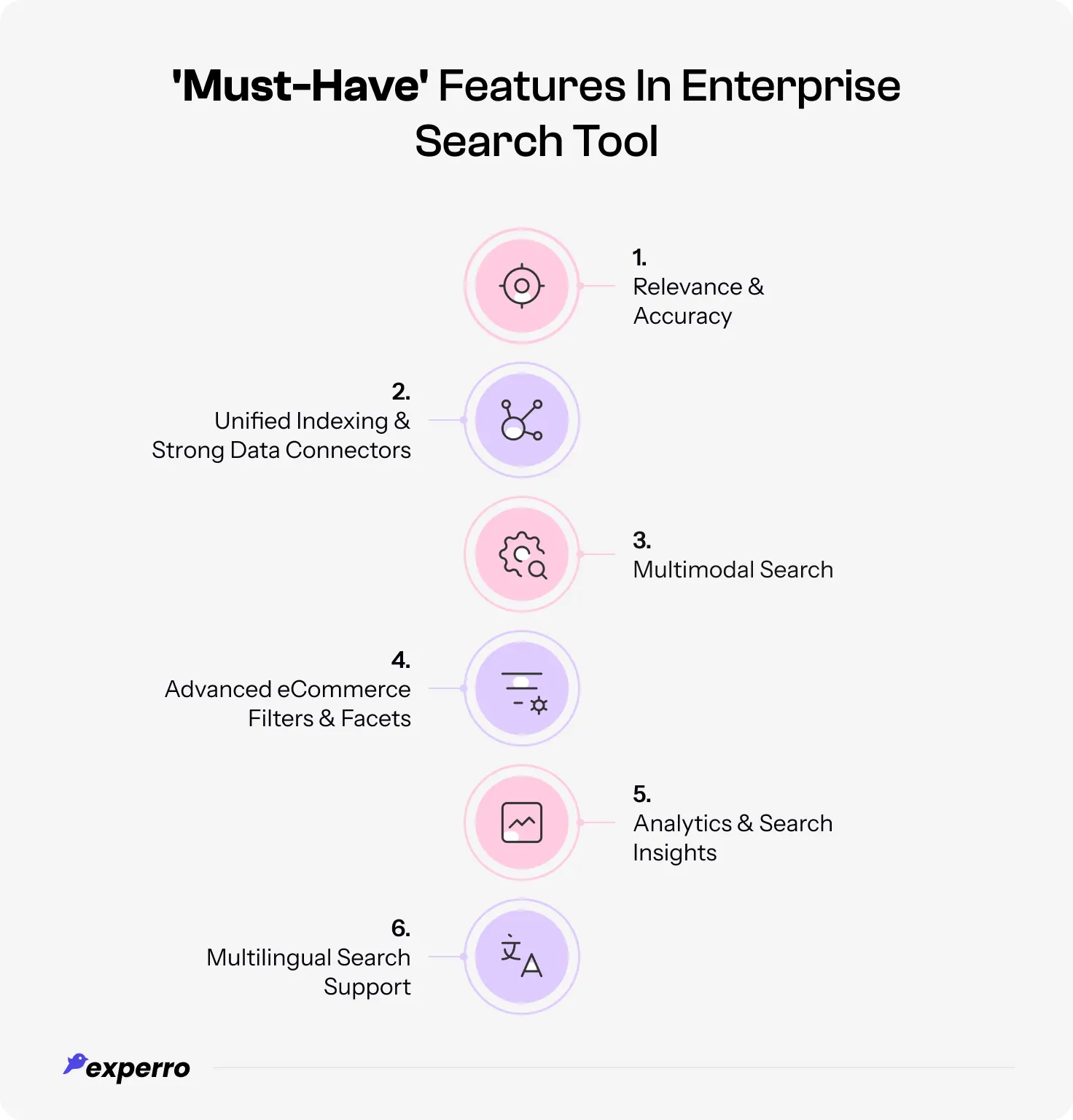
1. Relevance and Accuracy (AI/NLS)
The foundation of any strong search experience is how precisely results match user intent. AI models and natural language search help platforms understand context, synonyms, and meaning instead of relying only on keywords.
This reduces irrelevant results and improves discovery across content, products, and documents. Search Relevance continues to be one of the biggest deciding factors in many enterprise search engines comparison discussions.
And this is where Experro excels with high-intent AI relevance that adapts in real time, making it one of the best enterprise search AI options for digital commerce.
2. Unified Indexing and Strong Data Connectors
Enterprise teams handle data scattered across CMSs, commerce systems, DAMs, knowledge bases, and internal apps. A strong search platform should unify all of it into one searchable index with reliable connectors.
This helps users find information instantly without switching between systems. Reportedly, many enterprise search vendors struggle with complex integrations, which hurts both speed and stability.
To solve this, Experro offers powerful connectors and a unified index that simplifies enterprise-wide discovery.
3. Multimodal Search
Users now expect to search using images, text, voice, vectors, and natural language. A modern platform should support this multimodal behavior to make discovery feel effortless, regardless of format.
Multimodal search capability is especially critical for enterprise search engines for eCommerce, where visual and vector search dramatically improves product findability.
In response to this shift, Experro provides true multimodal search with visual, voice, vector, fuzzy, and NLP-driven user queries.
4. Advanced eCommerce Filters and Facets
Shoppers rely on fast refinement options, especially when browsing large catalogs. Any strong enterprise eCommerce search should include robust filters, dynamic facets, and personalized refinements.
Without this, users often feel overwhelmed or struggle to locate the right items. This limitation is often seen in legacy enterprise search platforms that lack commerce-specific depth.
To elevate this experience, Experro delivers advanced eCommerce filters and adaptive facets tailored for modern merchandising teams.
5. Analytics and Search Insights
Search analytics reveal what users want, where they struggle, and which queries need improvement. Strong insights help teams close content gaps, improve relevance, and monitor performance.
Many enterprise search software solutions include eCommerce analytics, but they are often rigid, confusing, or difficult to act on.
To make insights more accessible, Experro offers clear dashboards and actionable search analytics for continuous optimization.
6. Multilingual Search Support
Global brands need search that performs accurately across languages, dialects, and regions. Multilingual engines help teams reach wider audiences and avoid frustrating user experiences caused by poor translations or mismatched results.
This capability is becoming essential across top enterprise search engines used worldwide.
To support global growth, Experro includes multilingual semantic search built for international teams.
Conclusion
Search has evolved into a core business capability that directly shapes user experience, product discovery, and revenue outcomes.
Today’s leaders rely on advanced enterprise search solutions, Intelligent Site Search, and unified discovery to keep users engaged and reduce friction.
Whether your focus is accuracy, personalization, scalability, or stronger AI-driven results, choosing the right platform determines how well your digital ecosystem performs.
To explore how Experro can elevate your search experience, schedule a call with our experts for a personalized demo and strategy consultation.
Sources:
2 Glean Review Highlight on Capterra
3 Glean User Feedback on TrustRadius
5 Algolia Reviewer Insight on TrustRadius
6 Algolia User Review on TrustRadius
7 Lucidworks Review Highlight from Verified Users
8 Constructor Feedback Shared on G2
9 Customer Opinions on Constructor via G2
FAQs

Pallavi is an ambitious author recognized for her expertise in crafting compelling content across various domains. Beyond her professional pursuits, Pallavi is deeply passionate about continuous learning, often immersing herself in the latest industry trends. When not weaving words, she dedicates her time to mastering graphic design.
Subscribe to Our Newsletter!
Get the latest insights delivered straight to your inbox.