

core insights box
- Voice search in eCommerce is revolutionizing online shopping by offering hands-free, personalized, and faster AI-powered search experiences.
- Businesses adopting voice search gain a competitive edge with improved customer engagement, seamless accessibility for users, and higher conversion rates.
- To succeed with voice search activation, focus on natural language optimization, mobile compatibility, and personalized product discovery.
- Experro is coming up with advanced voice search capabilities to redefine your eCommerce platform and elevate the shopping experience.
Hey Siri, “show me waterproof hiking boots in size 10 that can be delivered by Friday.”
In the time it takes to unlock a phone, open a browser, and type a query, a voice-enabled shopper has already found their product, compared the price, and added it to their cart, all while making their morning coffee.
We have officially entered the era of "voice activated shopping".
For eCommerce brands, voice search isn't just a futuristic "nice-to-have" anymore; it’s the new standard for friction-free discovery.
But as the keyboard fades into the background, a new challenge emerges: Is your store smart enough to listen?
To stay ahead, you need to understand the 'how' and 'why' behind this conversational shift
But what exactly is voice search in eCommerce, and how to optimize your eCommerce site for voice search?
Let’s learn!
What Is Voice Search in eCommerce?
Voice search eCommerce means using voice commands to search for products, services, or information on online stores, allowing shoppers to find products, compare prices, and complete purchases simply by speaking to a digital device
Unlike traditional search, which requires users to manually type keywords into a bar, voice search uses Artificial Intelligence (AI) and Natural Language Processing (NLP) to understand full, conversational sentences.
By integrating voice recognition search directly into the shopping journey, brands can offer a truly voice-enabled shopping experience where a customer can manage their entire buyer journey - from discovery to purchase, using their voice.
The Statistics Around Voice Shopping for eCommerce
Voice search statistics reveal a clear trend: consumers are increasingly relying on voice-activated devices for their shopping needs.
Here are some key insights into the growing importance of voice search in eCommerce:
- 71% of consumers prefer voice enabled search over typing, highlighting it as a more convenient way to conduct queries.
- The global voice commerce market is projected to grow from $40.5 billion in 2023 to $147.9 billion by 2030.
- 49% of U.S. consumers use voice search for shopping.
- 27% of the global online population uses voice search on mobile devices, with the USA being a significant contributor.
How Does eCommerce Voice Search Works?

The mechanics of voice based ecommerce rely on a seamless, multi-step AI process that turns natural human speech into precise shopping actions through the following four stages:
- Speech-to-Text Conversion: The system captures your spoken words and uses high-speed AI to strip away background noise, instantly translating your voice into digital text that the store's database can read.
- Intent and Context Analysis: Unlike a typed search that looks for exact words, voice search analyzes the whole sentence to understand "intent" thus figuring out if you are just browsing for ideas or ready to buy a specific item right now.
- Semantic Product Matching: The search engine looks for the meaning of your request; for example, if you ask for "something for a rainy run," it will show you waterproof jackets even if that exact phrase isn't in the product title.
- Conversational Feedback: After finding the best match, the AI speaks back to the user to confirm details like size or color, creating a two-way dialogue that makes finishing a purchase as easy as having a conversation.
Thus, voice search for eCommerce businesses has transformed the way customers interact with online platforms.
With the power of AI voice recognition and voice-first design, shoppers can simply speak their queries to find products or navigate seamlessly.
This shift from traditional search underscores the rising dominance of voice search platforms as they offer page speed, accuracy, and hyper-personalization, reshaping the customer experience entirely.
What's the Difference Between Traditional Search & eCommerce Voice Search?

Voice search eCommerce, one of the inputs of multimodal search, is redefining the search experience by focusing on convenience and precision.
While traditional search relies on text-based inputs, search by voice enables users to simply speak their queries.
Below is a comparison to illustrate the key differences of voice search vs traditional search:
Aspect | Traditional Search | Voice Search |
|---|---|---|
| Input Method | Typing | Speaking |
| Search Speed | Slower | Faster |
| Query Style | Keywords | Natural Conversational Language |
| Device Dependence | Primarily desktops and mobiles | Includes voice assistants & smart devices |
| User Experience | Manual | Hands-free & seamless |
What Are the Benefits of Voice Search in eCommerce?
The adoption of eCommerce search by voice offers several advantages for businesses and customers alike.
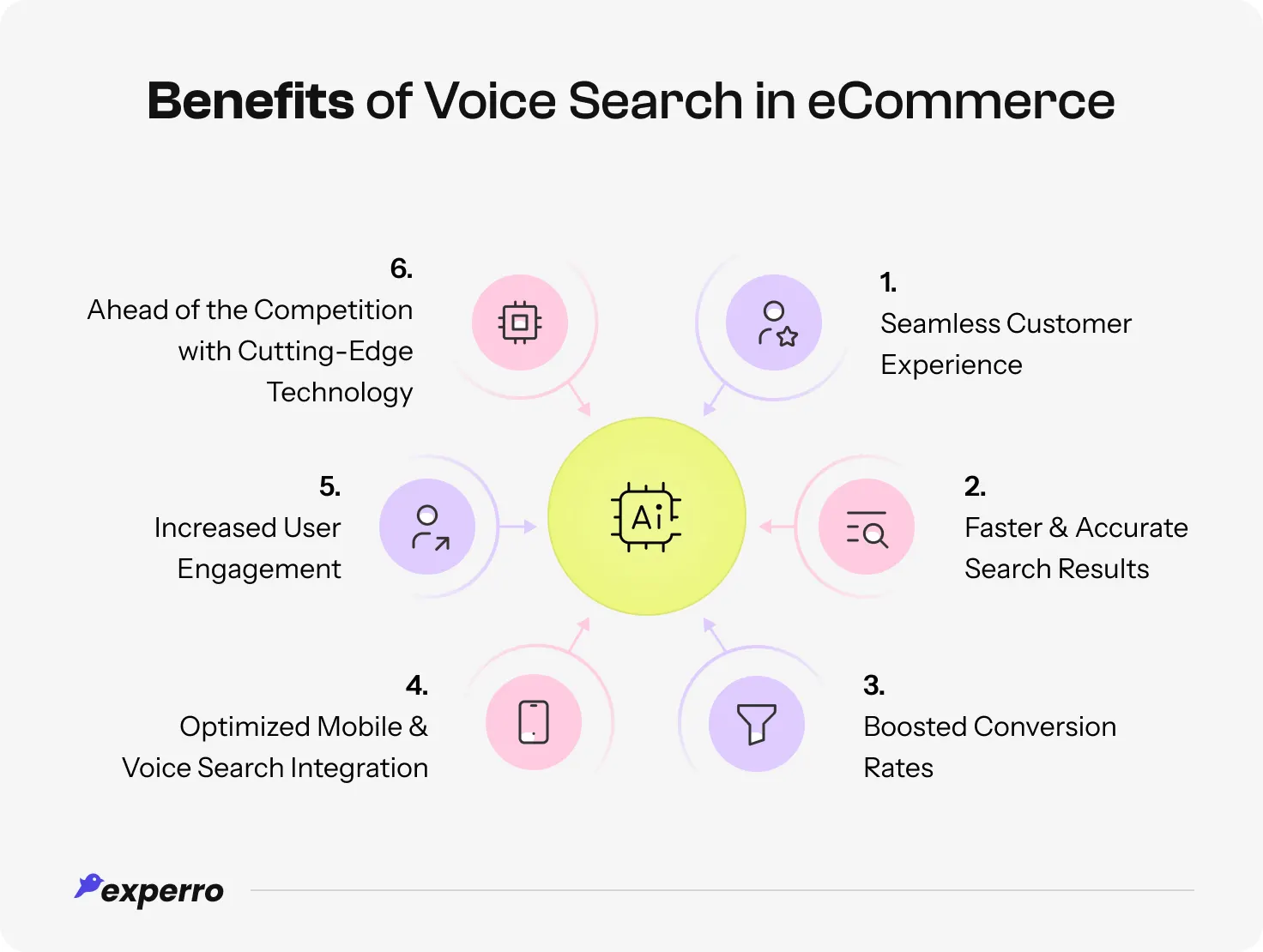
Adding voice search functionality to an eCommerce platform unlocks the following benefits:
1. Seamless Customer Experience Enhancement
By enabling voice-activated shopping, your businesses simplify the buying process for users.
Customers can browse, search, and purchase items effortlessly using voice recognition search, creating a personalized and intuitive shopping journey. This boosts convenience, especially for mobile shoppers.
2. Faster and More Accurate Search Results
AI search with voice commerce delivers quick, precise responses by interpreting natural language, enabling users to find what they need effortlessly.
With eCommerce voice search, users save time and enjoy a frustration-free shopping experience. The efficiency and search relevance translate to higher customer satisfaction and repeat usage.
3. Boosted Conversion Rates Through Personalized Interactions
Voice search leverages AI to provide tailored product recommendations based on a user’s unique shopping history and preferences.
By transforming the search process into a natural conversation, it removes the friction of manual navigation and builds immediate trust.
This seamless, personalized journey guides customers from discovery to checkout faster, significantly reducing cart abandonment and increasing overall sales.
4. Optimized Mobile and Voice Search Integration
Mobile-first eCommerce remains an essential part of online shopping, and voice search on website bridges the gap between convenience and efficiency.
Enhanced integration ensures a smooth, on-the-go experience, catering to the needs of today’s mobile-first voice searchers. It also provides a unified user experience across various devices and platforms.
5. Increased User Engagement and Retention
Interactive features like voice search keep customers engaged, reducing bounce rates and encouraging deeper platform exploration.
This engagement creates a more immersive shopping journey that strengthens customer relationships. Additionally, users are more likely to recommend platforms with innovative features to others.
6. Stay Ahead of the Competition with Cutting-Edge Technology
Incorporating voice search optimization in eCommerce ensures that businesses remain competitive by leveraging the latest innovations in voice search trends and technology.
Moving ahead with advanced features showcases a commitment to innovation that attracts tech-savvy gen z consumers. Moreover, it positions the business as a forward-thinking leader in the industry.
What Are the Challenges in Adopting Voice Search for eCommerce?
While voice search technology offers immense potential, businesses must overcome certain challenges.
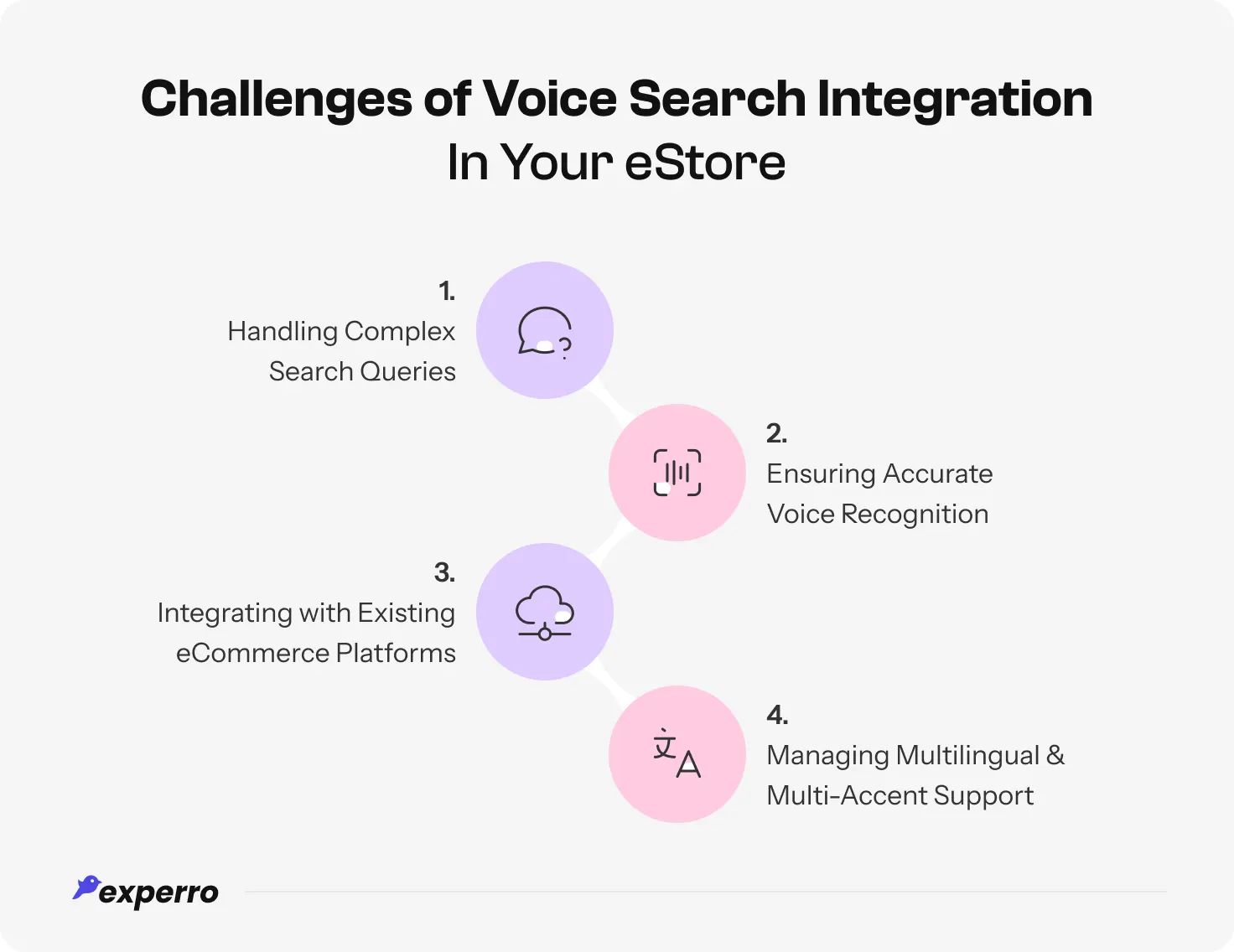
Let’s explore some of the limitations in implementing voice search for eCommerce:
1. Handling Complex Verbal Search Queries
Interpreting complicated or ambiguous queries requires advanced AI voice search capabilities to ensure accurate voice search results. Understanding user intent in fragmented or incomplete queries adds another layer of complexity.
Experro offers AI-driven NLP and vector search capabilities that better understand user intent and deliver more accurate query interpretation.
2. Ensuring Accurate Voice Recognition
Differences in accents, languages, and pronunciations can affect vocal search efficiency. Addressing these factors improves overall customer satisfaction.
Background noise or poor audio quality can further degrade recognition accuracy.
Implement advanced voice recognition algorithms and train them on diverse datasets to enhance semantic search accuracy across scenarios.
3. Integrating with Existing eCommerce Platforms
Adding voice search to website infrastructure can be challenging, especially for platforms with outdated systems. Ensuring compatibility with third-party systems and APIs adds to the complexity.
Partner with technology experts to design modular and scalable integrations that work seamlessly with existing platforms.
4. Managing Multilingual and Multi-Accent Support
Global audiences require multilingual support. Building systems to cater to diverse accents ensures better voice recognition search results. Addressing regional dialects further enhances user experience.
Leverage machine learning models trained on region-specific linguistic data to deliver accurate voice recognition globally.
What Are the Best Practices for Implementing Voice Search in eCommerce?
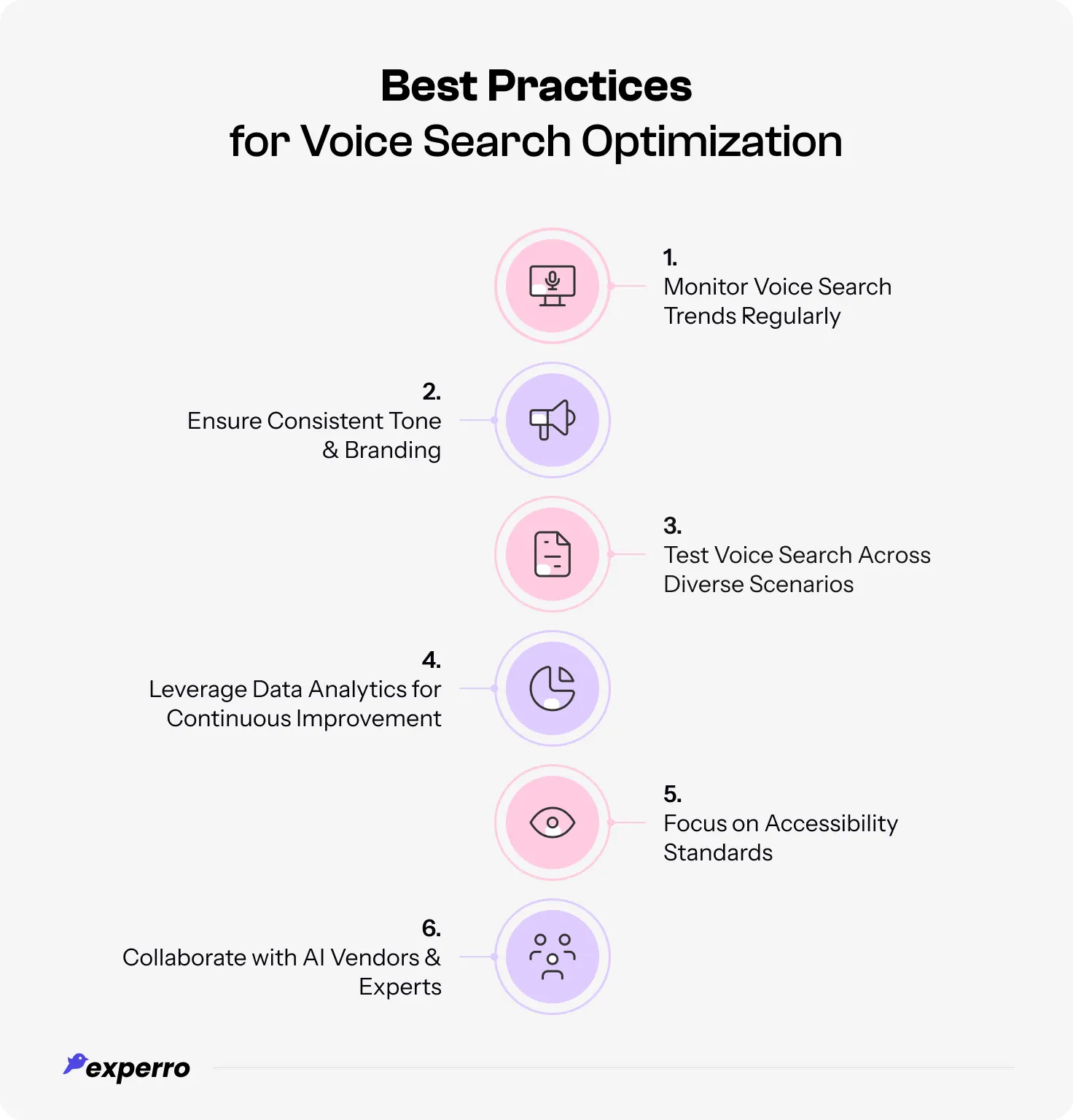
Below are the voice search best practices to optimize your eCommerce platform for voice-first interactions, ensuring seamless and intuitive shopping journeys.
1. Monitor Voice Search Trends Regularly
Stay updated on emerging trends and technologies in voice search to keep your store ahead of the curve. Voice search eCommerce is evolving rapidly with advancements in generative AI, NLP, and smart assistant technologies.
Regularly assessing futuristic eCommerce trends enables you to embrace innovations that boost system performance and enhance user satisfaction.
2. Ensure Consistent Tone and Branding
Align voice search responses with your brand's voice to provide a cohesive experience across all customer interactions. This includes creating a tone that reflects your brand values, whether formal, friendly, or playful.
Customers engaging via voice expect the same level of familiarity and trust they experience through other channels. Consistency helps reinforce brand identity and builds stronger connections with users.
3. Test Voice Search Across Diverse Scenarios
To ensure reliability, conduct thorough testing for various scenarios, including user personas, complex queries, and environments.
Simulating real-world conditions, such as background noise or interruptions, can also reveal critical insights for improving system performance. Frequent testing ensures your voice search eCommerce remains robust and user-friendly.
4. Leverage Data Analytics for Continuous Improvement
Analyze voice search engine performance metrics to identify areas for enhancement, such as misunderstood user queries or slow response times.
eCommerce analytics like user engagement, retention rates, and query success rates provide valuable insights into system performance. Use this data to fine-tune algorithms, adjust keyword mappings, and improve response accuracy.
5. Focus on Accessibility Standards
Make voice search inclusive by catering to users with limited tech proficiency, enhancing your platform's reach and usability.
Incorporate features like speech-to-text and text-to-speech options to accommodate various user needs. Ensure your voice search works seamlessly with assistive technologies like screen readers and voice-activated smart devices.
6. Collaborate with AI Vendors and Experts
Partner with specialists to stay on top of advanced AI models, ensuring your voice search eCommerce stays efficient and up to date.
Regular collaboration with AI vendors also ensures your system leverages the most advanced tools for natural language search understanding and voice recognition.
What Are the Key Strategies to Optimize Voice Search for Your eCommerce Website?
Businesses must adopt strategic approaches to succeed with voice search for eCommerce businesses.
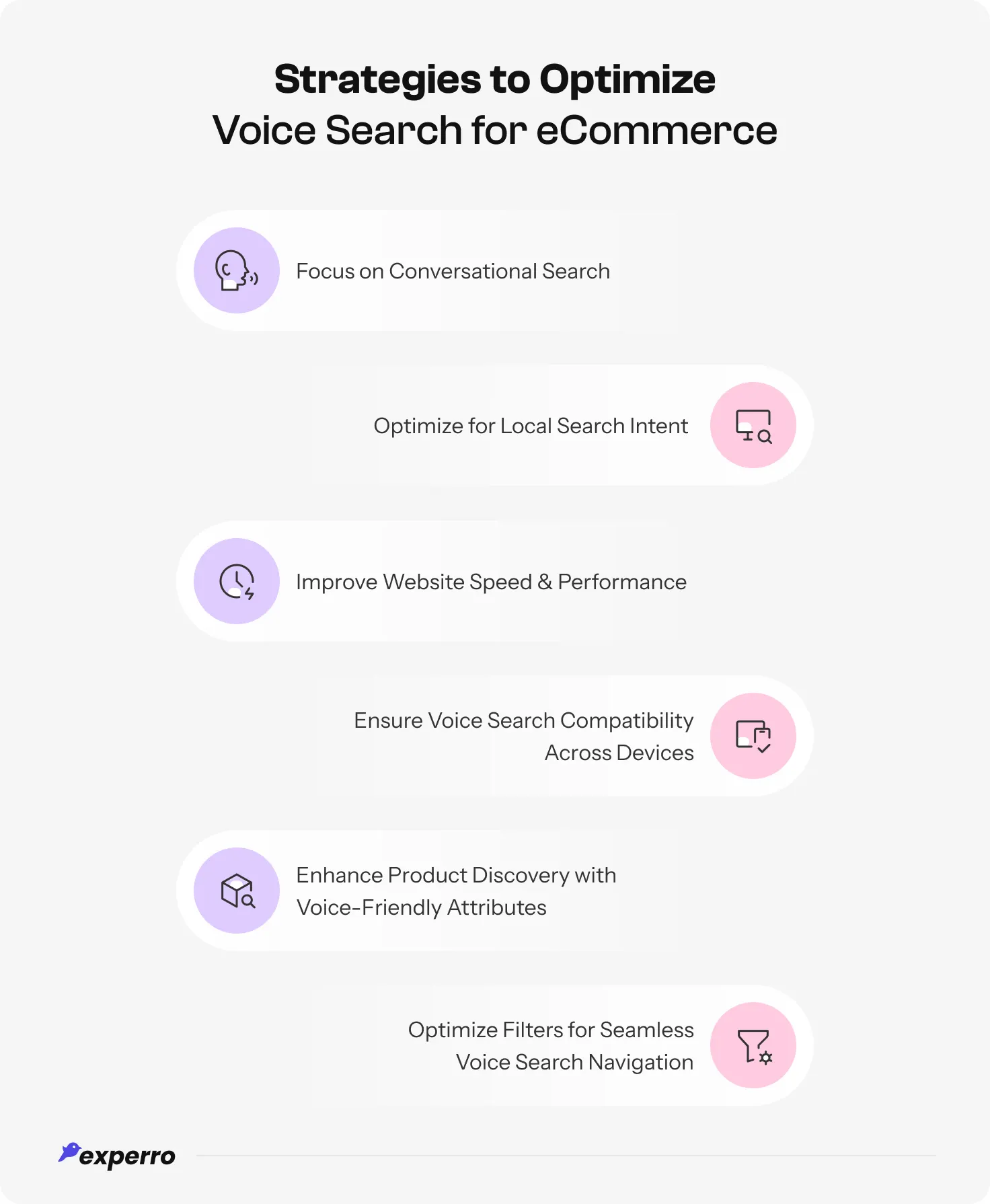
Let’s explore some voice search tips for your platform:
1. Focus on Conversational Language
Conversational search allows systems to understand and respond to natural, dialogue-like queries.
Optimizing for SEO with long-tail keywords and question-based phrases such as “how”, “what”, and “where” ensures your platform aligns with how users naturally speak.
Regularly updating keywords to reflect evolving language trends and customer preferences enhances relevance and boosts search performance.
2. Optimize for Local SEO Search Intent
Optimizing for local query intent based on eCommerce SEO ensures your business ranks higher in voice search traffic.
Add location-specific conversational keywords and integrate with platforms for better visibility.
3. Improve Website Speed and Performance
Slow websites hinder the efficiency of voice-enabled search. Enhancing speed boosts user experience, ensuring smooth audio search in eCommerce interactions.
Compress images, leverage caching, and optimize server response times to reduce load times. Ensure mobile-friendly designs to provide consistent performance across devices.
4. Ensure Voice Search Compatibility Across Devices
Seamless performance across smart devices and platforms is vital. Businesses must ensure to add advanced voice search system to website functionality for accessibility.
To identify gaps and test compatibility on smart assistants, mobile devices, and browsers. Regularly update systems to keep up with advancements in voice technology.
5. Enhance Product Discovery with Voice-Friendly Attributes
Categorizing voice search products with voice-friendly attributes helps customers find items more easily through voice command experience.
Use descriptive labels and meta tags that align with common voice queries. Integrate eCommerce filters to refine product search results for specific user needs.
6. Optimize Filters for Seamless Voice Search Navigation
To master voice search in ecommerce, your filters must be tagged with natural language synonyms that match how people actually speak.
Instead of just "Price: Low to High," ensure your backend recognizes "cheap," "budget-friendly," or "under $50" as the same filter trigger.
7. Use Schema Markup for Rich Product Data
Implementing Schema markup (Structured Data) helps search engines understand the specific details of your products, such as price, availability, and ratings which is critical for delivering accurate results in voice search in retail.
This technical clarity allows voice assistants to pull accurate, "read-aloud" answers directly from your site when users ask about specific items.
By providing this structured context, you increase the chances of your store appearing as the top-recommended result in voice-activated queries.
Conclusion
The era of voice-driven eCommerce is here, reshaping how customers connect with brands and make purchases.
Experro unveils advanced voice search capabilities, empowering businesses to deliver seamless, intuitive shopping experiences like never before.
With this transformative innovation approaching, now is the perfect time to embrace a voice-first future.
Schedule a call today to see how voice search eCommerce can redefine your business strategy and unlock growth opportunities!
FAQs

Pallavi is an ambitious author recognized for her expertise in crafting compelling content across various domains. Beyond her professional pursuits, Pallavi is deeply passionate about continuous learning, often immersing herself in the latest industry trends. When not weaving words, she dedicates her time to mastering graphic design.
Subscribe to Our Newsletter!
Get the latest insights delivered straight to your inbox.