
Why Shoppers Leave Your Category Pages (And How to Fix It)
Published
31 July 2026

valuable insights from blog:
- Poor navigation drives 37% of shoppers away silently, before they ever reach your products.
- Well-designed filters can lift conversions by 26%, a fix most teams overlook completely.
- Great category pages help shoppers find the right products faster, improving discoverability, SEO, and conversions.
- Experro's AI Browse keeps category pages accurate and current, no manual grind required, ever.
75% of online shoppers say filtering is essential to a good shopping experience. Now that is a number worth paying attention to. It's no longer just a helpful feature; it's something shoppers expect.
When filters are missing, inaccurate, or difficult to use, shoppers spend more time searching and less time finding the right products. That frustration often makes them leave without making a purchase. 🙄
As your catalog grows, so does the challenge. More products mean more choices, making it harder for shoppers to find what they need and easier to abandon their search. 😤
For growing eCommerce businesses, the impact quickly shows up in higher bounce rates, fewer add-to-cart actions, and missed sales opportunities.
That's where category page optimization makes the difference. This guide explores the eCommerce category page for best practices to improve product discovery, strengthen SEO, and turn more shoppers into customers.
But First, What Is a Category Page Actually For?
A product category page helps shoppers move from a general search to the products they actually want faster.
It brings your product catalog into clear categories with easy navigation, filters, sorting options, and a structured product grid. This helps shoppers browse smoothly, compare their options, and find the right products with confidence.
A well-designed category page makes shopping easier by helping shoppers discover relevant products quickly with less effort.
Why Should You Optimize Your eCommerce Category Pages?
our eCommerce category pages guide shoppers through every stage of the buying journey, from product discovery to purchase.
For store owners, entrepreneurs, and eCommerce teams managing online catalogs, following eCommerce category page best practices help create smoother browsing experiences, improve discoverability, and drive stronger conversions.
- Improve product discovery with intuitive navigation, relevant categories, and shopper-focused filters.
- Simplify browsing with clear product grids, category descriptions, and structured category pages.
- Build purchase confidence with product images, reviews, ratings, and key details.
- Increase conversions and AOV with relevant recommendations and smarter merchandising.
- Improve SEO visibility with optimized category pages, internal links, and clear taxonomy.
- Keep categories updated as products, inventory, and collections change.
Well-optimized category pages create better shopping experiences, improve engagement, and support long-term growth.
Optimizing category pages is an ongoing process, not a one-time task. The following eCommerce category page optimization tips will help you create a smoother shopping experience and better business results.
What Are the Best Practices for Category Page Optimization?
Your eCommerce category pages are more than product collections. They help shoppers discover products, compare options, and decide what to buy next. A well-optimized category page reduces friction and creates a smoother path from browsing to purchase.
The challenge is keeping every page useful as your product catalog grows. New products, changing inventory, and shifting shopper behavior can quickly make even strong category pages outdated.
The best eCommerce category page practices focus on creating category experiences that stay relevant, improve product discovery, and support long-term growth, and support long-term growth.
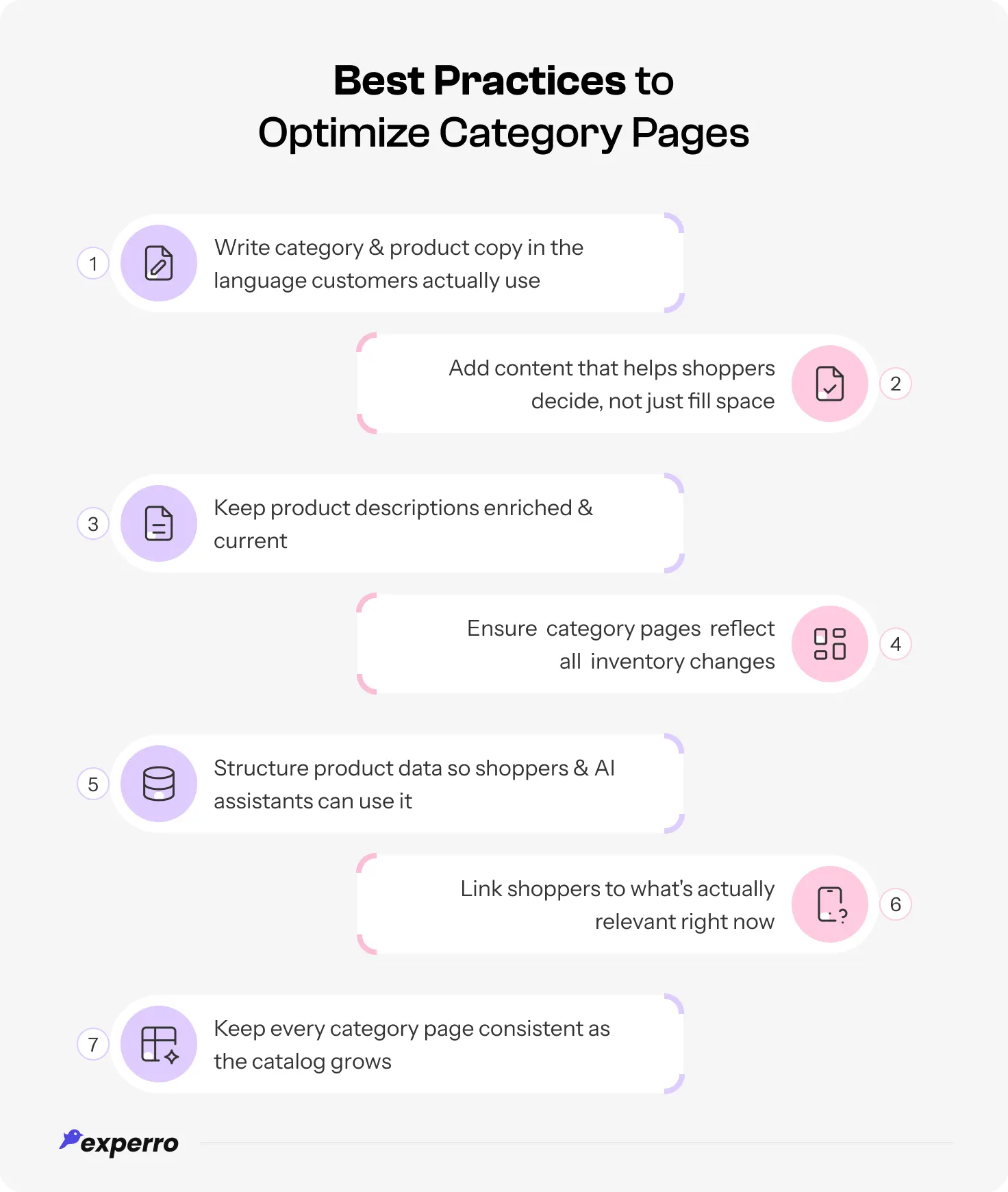
1. Write Category and Product Copy in the Language Customers Actually Use
Your shoppers don't use internal product terms when they search. They use familiar language that matches how they think and shop. Queries like "circular saws" will always be clearer than "rotary cutting tools".
Using customer-focused language across category pages, navigation labels, and category descriptions helps shoppers find products faster and helps search engines understand your product categories, as outlined in product content strategy.
As your catalog expands, keeping every category and subcategory page consistent becomes more challenging.
AI-powered content optimization helps maintain relevant, customer-friendly copy without manually updating every page, making it easier to scale content with the help of generative AI in eCommerce.
2. Add Content That Helps Shoppers Decide, Not Just Fill Space
Your product category page shouldn't leave shoppers searching for answers. Buying guides, comparisons, FAQs, and clear category descriptions help your customers compare options, understand what fits their needs, and move closer to a purchase.
This is one of the most effective eCommerce category page best practices because it improves product discovery and helps your eCommerce category pages rank for relevant long-tail searches. It also follows the principles of content discovery by making the right information easy to find at the right time.
Keeping every page useful takes ongoing effort. AI makes category page optimization easier by helping your team update and maintain consistent content across your catalog with less manual work.
3. Keep Product Descriptions Enriched and Current
Once shoppers find a product they're interested in, your product information should help them move forward, not slow them down. Incomplete descriptions, missing attributes, or outdated details make it harder to compare products and often lead to hesitation.
Clear descriptions, key features, specifications, reviews, ratings, and high-quality images give your shoppers the confidence to make faster decisions. In fact, 83% of online shoppers say product images influence what they buy.
Updating product information across a large catalog takes time. AI-powered product data enrichment helps your team keep product listing pages accurate, consistent, and up to date, making your catalog easier for shoppers and AI-powered search experiences to understand and discover.
4. Ensure Category Pages Reflect All Inventory Changes
There's nothing more frustrating than clicking on a product only to find it out of stock. If your eCommerce category pages show unavailable products or outdated promotions, shoppers can lose confidence and leave your store.
Your category pages should always reflect what is actually available. Showing the right products, seasonal collections, and updated product grids helps shoppers discover items they can buy instead of running into dead ends. That's a key part of effective category page optimization.
When your inventory changes every day, manual updates simply can't be kept up. AI-powered digital merchandising automatically keeps your category pages aligned with real-time inventory, so your shoppers always see the most relevant products.
5. Structure Product Data So Shoppers and AI Assistants Can Use It
Shoppers need clear product information to compare options quickly. Consistent details like pricing, availability, ratings, sizes, colors, and variants create a better browsing experience.
Structured product data also helps search engines understand your catalog and improves visibility across search results. It is becoming increasingly important as AI shopping assistants rely on accurate product information to recommend relevant items.
Managing this information across thousands of SKUs is difficult without automation. A structured approach keeps every product category page accurate, searchable, and ready for AI-powered product discovery.
When customers can't find the details they need, they often leave without buying. Clear pricing, availability, sizes, colors, ratings, and variants make it easier to compare products, reduce uncertainty, and create a smoother experience across your product category pages.
How you organize that information matters just as much. A well-structured product taxonomy keeps your catalog logical and consistent, helping search engines and AI shopping assistants understand your products and improve product discovery.
Managing product data at scale isn't easy. AI supports category page optimization by keeping your eCommerce category pages accurate, searchable, and consistently updated, so customers can quickly find the products they're looking for.
6. Link Shoppers to What's Actually Relevant Right Now
Your shoppers shouldn't have to search from scratch every time they want to explore more. When someone views a product or category, the next recommendation should feel like a natural step, not a random suggestion. That's how effective eCommerce category page best practices keep customers engaged for longer.
Connecting related product category pages, collections, and best sellers based on customer interests improves product discovery and creates a smoother browsing experience.
This becomes even more effective when you use profile-based recommendations to tailor what each shopper sees based on their behavior and preferences.
Instead of constantly updating these experiences manually, AI keeps every category relevant, personalized, and aligned with changing shopper's intent.
7. Keep Every Category Page Consistent as the Catalog Grows
Managing a few category pages is simple. Maintaining hundreds of optimized category pages with consistent content, navigation, and merchandising is where many eCommerce teams struggle.
As your catalog expands, some pages naturally receive more attention than others. Over time, inconsistent descriptions, outdated products, and uneven experiences can impact SEO performance, usability, and customer satisfaction.
The strongest category page optimization strategies focus on scalable processes. Consistency across every category, subcategory, and optimized product detail page helps brands deliver a reliable shopping journey from product discovery to purchase.
These optimizations help transform category pages into smarter shopping experiences where products stay relevant; navigation feels effortless, and shoppers find what they need with confidence. Next, see how Experro enables this at scale.
How Experro Keeps Every Category Page Optimized
Every category page influences how easily shoppers discover products and how confidently they continue browsing.
Experro's AI Browse brings together AI-powered browsing, merchandising, and product discovery to keep eCommerce category pages relevant, organized, and aligned with changing inventory and shopper behavior, all from a single platform.
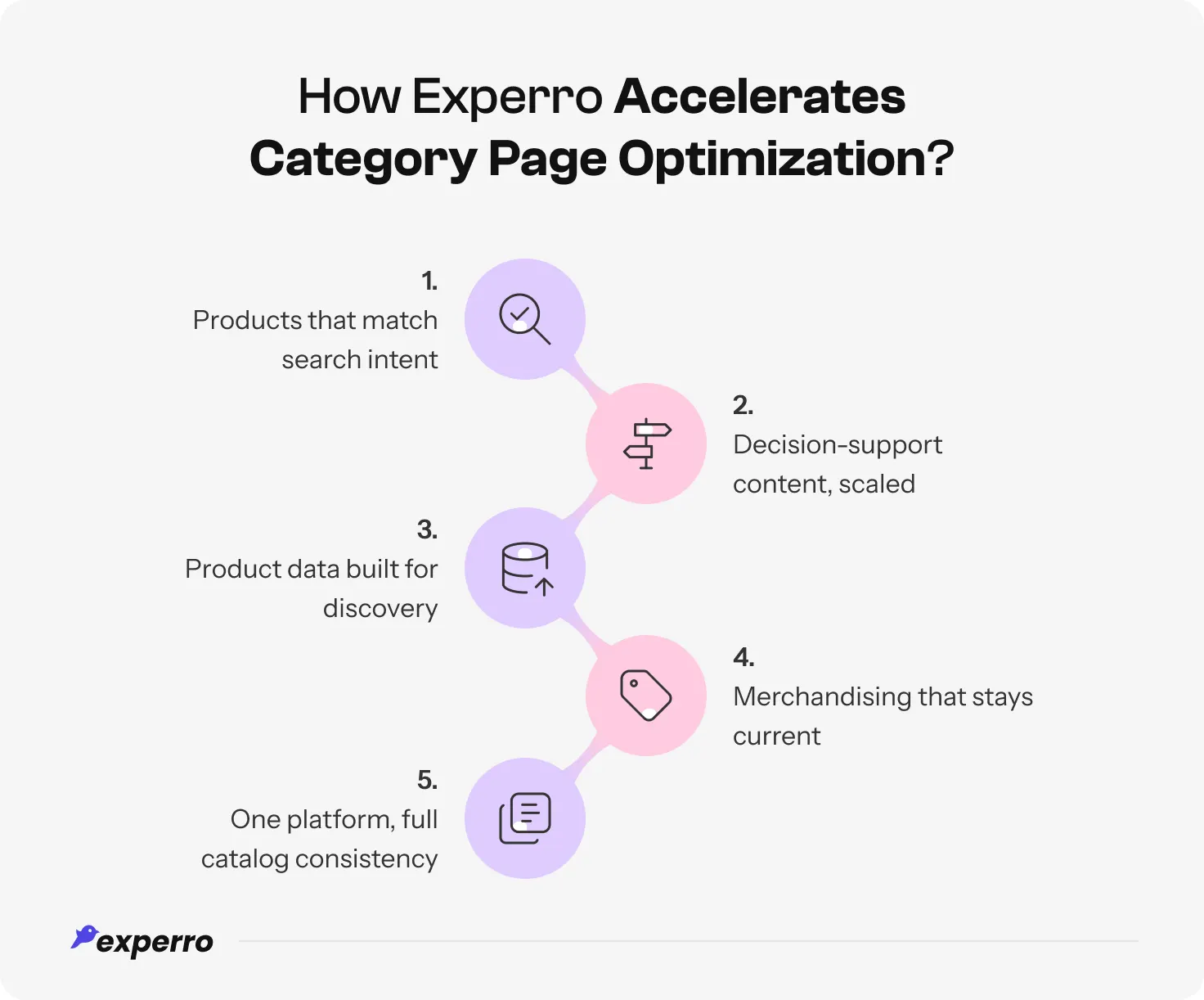
1. Products That Match Search Intent
Experro's AI Browse continuously adapts category pages to reflect changing shopper behavior, product availability, and merchandising priorities.
Instead of relying on static category structures, it helps deliver more relevant browsing experiences that connect shoppers with the products they're most likely to explore and buy.
2. Decision-support Content, Scaled
Experro scales FAQs, guides, and comparisons across hundreds of pages with no manual updates needed. This builds shopper confidence while keeping every collection page consistent and user-friendly.
Notably, adding FAQs alone can lift conversions by 157.1%; a small addition with an outsized impact.
3. Product Data Built for Discovery
Experro keeps product attributes, variants, and details clean and structured. This strengthens product discovery across search engines and AI shopping assistants that depend on accurate data to recommend the right products.
High-quality visuals alone drive a 94% higher conversion rate — proof that structured, complete product data is a real conversion rate lever, not just an SEO checkbox.
4. Merchandising That Stays Current
Experro connects merchandising decisions to real-time inventory and shopper behavior. Instead of static main category pages, brands surface what customers need today, backed by breadcrumbs and consistent layouts that reduce bounce.
5. One Platform, Full Catalog Consistency
As catalogs scale, quality often slips. Experro keeps content, merchandising, and product data unified, so every page stays optimized for shoppers and AI-driven discovery alike.
Since strong UX can boost conversions by 400%, category page quality isn't optional; it is core to eCommerce success.
A category page should not become harder to manage as your catalog grows. Experro helps brands keep every discovery experience relevant by continuously aligning content, product data, and merchandising, so shoppers find the right products faster, and teams can scale with confidence.
Building Category Experiences That Scale With Your eCommerce Growth
Category pages play a critical role in helping shoppers discover and evaluate products. But as eCommerce catalogs expand, maintaining accurate content, relevant products, and consistent merchandising across every category becomes increasingly difficult.
The focus should not be on optimizing individual pages, but on creating a scalable system that keeps every category experience useful as products, inventory, and customer expectations change.
Experro helps eCommerce teams manage category optimization at scale by connecting product data, content, and merchandising, so shoppers can find the right products faster while teams maintain control over growing catalogs.
Ready to improve product discovery across your eCommerce store? Get in touch with experts at Experro and see how you can create more effective category experiences.
FAQs
Subscribe to Our Newsletter!
Get the latest insights delivered straight to your inbox.