

core insights box
- Conversational search helps shoppers find the right products using natural questions, reducing search friction and shortening the path to purchase.
- It utilizes artificial intelligence and NLP to understand context and deliver more relevant, personalized results.
- Conversational search adapts results based on shopper intent, behavior, and business goals in the same interaction.
- Experro's conversational search guide shoppers from vague questions to relevant products, reducing search exits and increasing conversion opportunities.
Ever asked your search engine, "Where can I find the best beige formal pants?" and it replies, "Here are four beige pants I found for your office wear:"
That's conversational search — AI that gets you!
Unlike traditional search engines that rely on specific keywords, conversational search uses natural language to provide a more interactive and human-like search experience.
With chat-based commerce, users can ask follow-up questions in a conversational tone, like how they would speak to another person.
As the demand for more personalized and accurate search results increases, conversational search platforms are essential for enhancing user experience.
What Is Conversational Search?

Definition - A conversational search engine is an AI-powered search system that understands natural language queries, interprets user intent and context, and delivers relevant, real-time results through interactive, multi-turn conversations.
These engines analyze the context of a question, providing more personalized conversational search results.
With advancements in conversational search software, these engines continue to improve customer experience by offering real-time, accurate responses.
Global conversational AI market is expected to reach USD 86.42 billion by 2032, growing at a CAGR of 23.97% from 2024 to 2032.
Unlike traditional keyword search systems, conversational search framework doesn't just match keywords. The conversational search uses an eCommerce search algorithm that understands the user's intent.
The next section explains how the conversational AI search works exactly.
How Does Conversational Search Work?
Conversational search works by combining large language models (LLMs), natural language processing (NLP), and conversational AI search techniques to understand how users naturally ask questions and what they actually mean. Instead of relying on exact matches, it focuses on intent-based understanding.
Unlike traditional keyword-driven systems, this conversational search framework enables real-time, interactive discovery. The engine interprets conversational keywords, evaluates intent, and delivers relevant results that adapt as the interaction continues.
This approach closely aligns with how modern answer engines operate today, where user intent is prioritised over exact keyword matching, especially in conversational search ecommerce experiences.
At a high level, conversational search works through three core components:
1. Understanding the Query (Natural Language Understanding)
The system processes user input using NLP to interpret natural language queries. It identifies intent, context, and conversational signals rather than treating the input as isolated keywords.
2. Retrieving Relevant Information (Semantic Search and Ranking)
Using semantic retrieval and ranking, the engine surfaces results based on meaning and relevance. This is a core part of AI-powered conversational search optimization, ensuring accurate results even for vague or descriptive queries.
3. Generating the Response (Context-Aware Output)
The engine generates context-aware responses that evolve with the conversation. By learning from previous interactions, it continuously improves relevance and supports better user journeys, directly addressing how conversational search improves user experience.
Conversational search functionality is now embedded across eCommerce platforms, conversational commerce search tools, voice interfaces, and applications, enabling consistent discovery across devices and touchpoints.
Let us walk you through the benefits of adopting conversational search in your eCommerce platform.
What Are the Advantages of Conversational Search For 'Retailers'?
The benefits of conversational search go beyond interactions. It reshapes how users interact with multimodal search engine and digital platforms, creating more meaningful, personalized experiences.
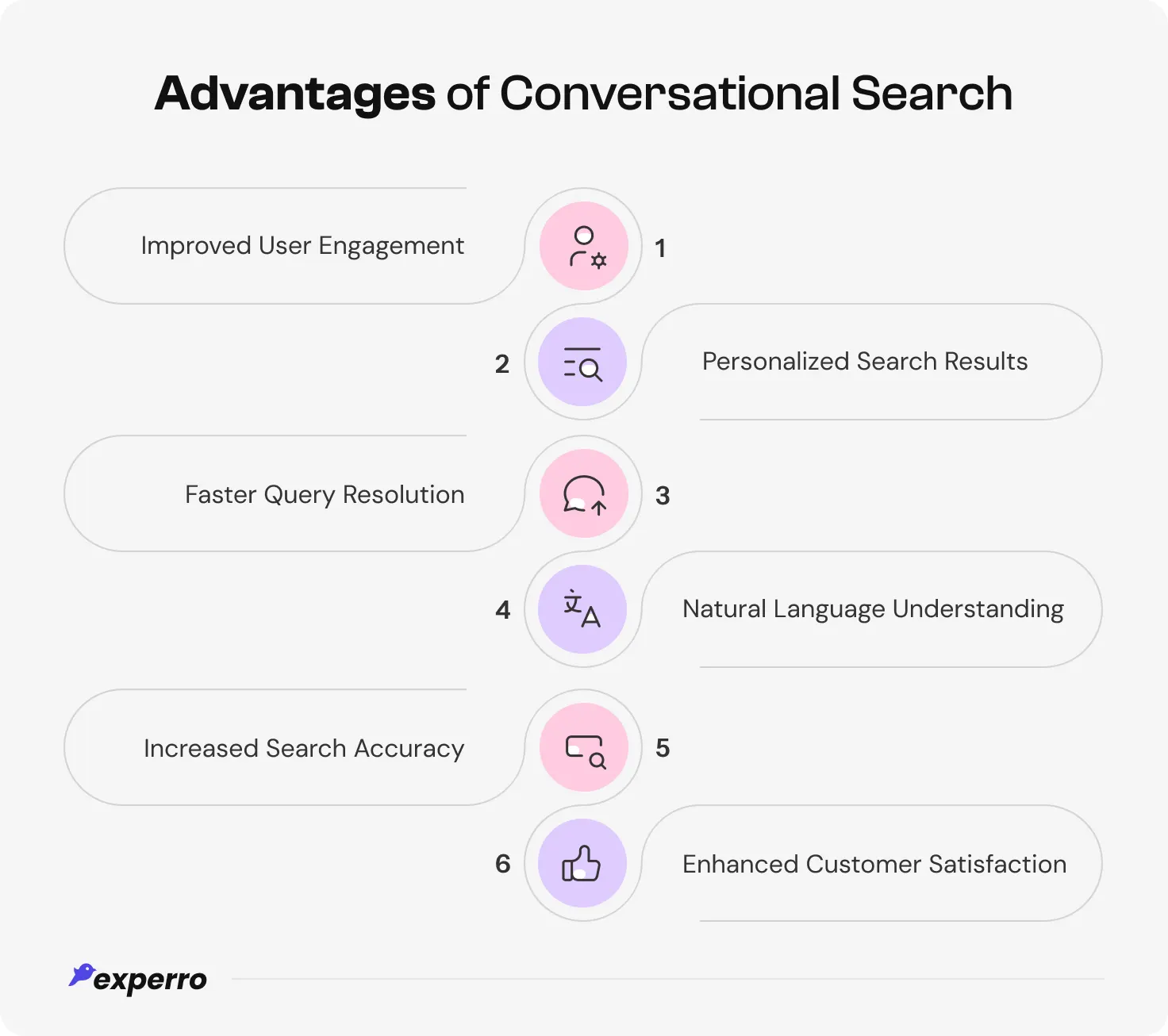
Below are some of the key advantages that conversational search systems provide.
1. Improved User Engagement
Dialogue-driven commerce enhances user engagement by offering a more interactive and dynamic search experience. Users no longer must input rigid keywords to find what they need.
Instead, conversational search UI enables users to ask questions naturally. The system can lead the conversation by suggesting useful questions.
As a result, an online business using conversational search software can retain users for extended periods, improving overall human interaction on their platforms.
2. Personalized Search Results
AI-powered chat-based commerce delivers personalized search results tailored to individual preferences. By understanding the context and search history of a user’s conversational queries, these systems provide more relevant and customized answers.
This is especially useful in eCommerce conversational search, where customers can receive product suggestions based on previous interactions.
With eCommerce search optimization, platforms can ensure users receive results that align closely with their needs, improving satisfaction.
3. Faster Query Resolution
One of the best benefits of conversational search technology is its ability to resolve queries faster. Instead of navigating through multiple result pages, users receive direct answers to their questions.
This makes the search process more efficient, reducing the time spent searching. The conversational search experience is particularly beneficial for online businesses, as it leads to quicker customer support and query resolution.
Conversational search tools make it easier to find information or products with minimal effort, speeding up decision-making.
4. Natural Language Understanding
Conversational algorithms excel in understanding natural language search queries, which allows users to communicate more freely. The system not only grasps the short and long-tail keywords but also the context and intent behind the question.
For example, Google conversational search is built to understand casual speech and slang, making it easier for more people to use. This natural language understanding enhances the user experience by eliminating the need for precise phrasing.
This shift makes voice search feel more accessible, especially for users who prefer speaking over typing.
5. Increased Search Accuracy
With AI conversational search, the accuracy of search results improves drastically. The system uses AI to learn from previous queries and adapt to user behavior, which helps to deliver more precise results.
Search intelligence on eCommerce platforms continuously refine their algorithms to provide the most relevant answers.
This level of accuracy is especially valuable for complex queries where users may not know the exact terms to search. Conversational keyword research ensures the engine delivers results matching the user’s true intent.
6. Enhanced Customer Satisfaction
Conversational search engines help improve customer satisfaction by offering quick, relevant, and personalized results.
In sectors like eCommerce, conversational search shopping allows customers to find what they’re looking for without hassle, leading to higher conversion rates.
As businesses integrate conversational API and dashboards, they can track user satisfaction in real-time, making necessary adjustments to optimize the user experience.
By offering faster query resolution and more accurate responses, businesses can improve customer loyalty and overall satisfaction.
Are Any Trending Retail Brands Using Conversational Search?
Yes! all big-name enterprise brands make use of conversational search brings it bridges the gap between what user wants and what they provide.
Here's the list:
1. Amazon
Amazon uses conversational and intent-based search to support complex product discovery and comparison journeys.
Example query: “Best noise-canceling headphones for frequent travel under $300”
2. IKEA
IKEA uses conversational search to help customers navigate high-consideration furniture purchases.
Example query: “Sofa that fits a small living room and is easy to clean”
3. Wayfair
Wayfair applies conversational search to simplify discovery across large home and furniture catalogs.
Example query: “Queen-size bed with storage for a compact bedroom”
4. Decathlon
Decathlon uses conversational search to support activity-based and skill-level product discovery.
Example query: “Beginner-friendly trekking shoes for uneven terrain”
What Are the Use Cases of AI-Powered Conversational Search in 2026?
Conversational search technology has a wide range of gen AI use cases across different industries.
From retail to complex customer support systems, this AI-driven approach reshapes how businesses interact with customers.
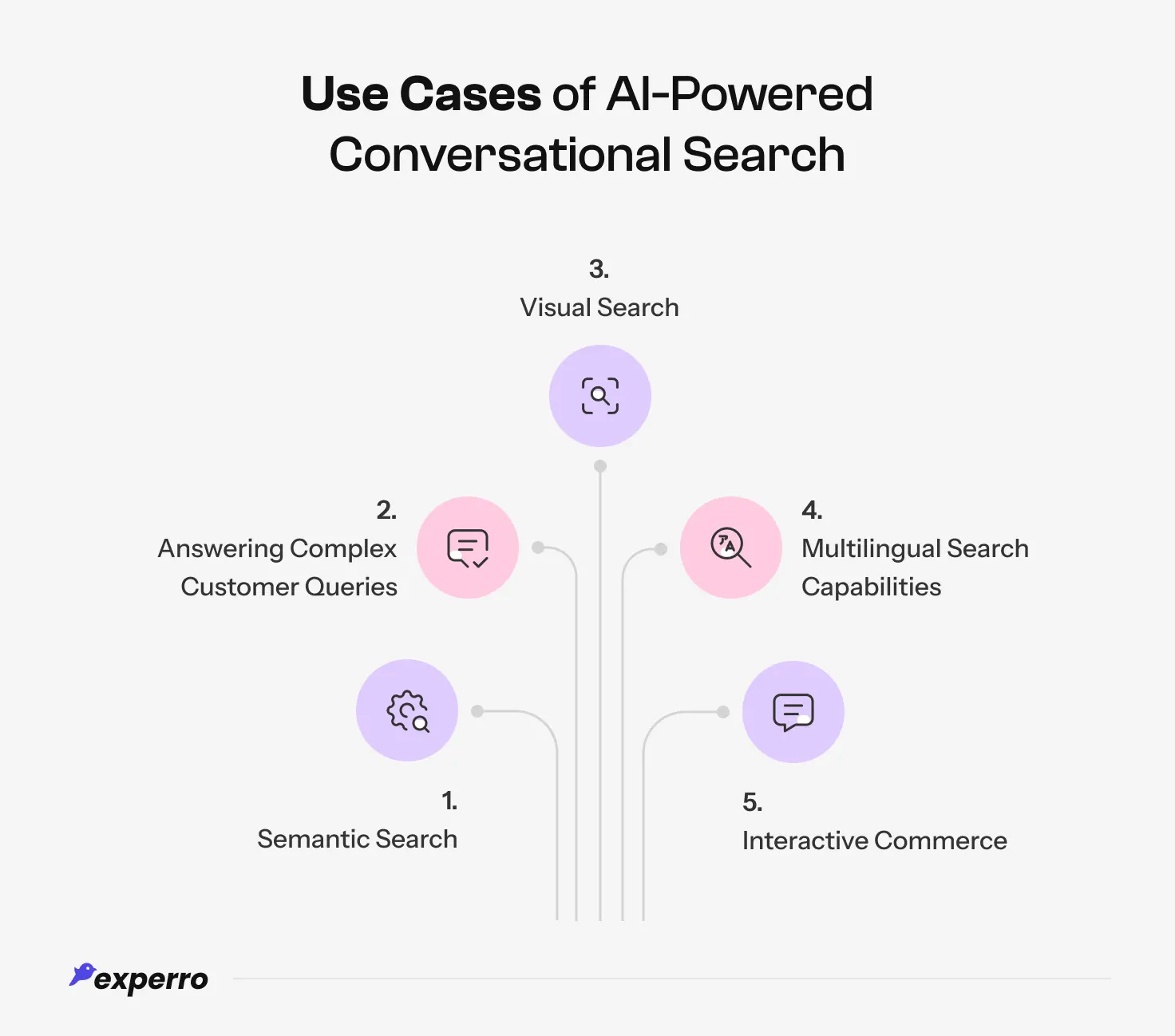
Let’s look at some innovative applications of conversational search:
1. Visual Search
Visual search integrates conversational search capabilities with image recognition, allowing users to search using pictures instead of text.
This feature is particularly valuable in eCommerce, where customers can search for products by uploading images. Conversational AI search platforms then engage users in a dialogue to refine the results further.
It helps customers find exactly what they’re looking for, improving the overall shopping experience.
2. Semantic Search
Semantic search uses dialogue-driven commerce to understand the meaning behind a query rather than just matching keywords.
This leads to more relevant search results. Conversational search systems using semantic understanding provide more contextually appropriate answers.
Semantic search plays a crucial role especially in industries like healthcare or legal services, where accuracy is critical. Conversational search functionality improves the depth of the search results, ensuring a richer, more insightful user experience.
3. Interactive Commerce
Conversational commerce is reshaping the way people shop online. With chat-based commerce in eCommerce, customers can ask detailed questions about products, receive personalized recommendations, and even complete transactions via chat.
Businesses using conversational search optimization in their platforms can improve their sales funnel by delivering a seamless, interactive shopping experience.
This conversational approach to shopping enables faster decision-making and a smoother customer journey.
4. Multilingual Search Capabilities
Advanced AI-powered dialogue-driven commerce supports multilingual capabilities, enabling users to search in their native languages. This feature is especially useful for global companies that serve diverse markets.
For example, conversational search on Bing is built to understand casual speech and slang, making it easier for more people to use.
This multilingual conversational search capability enhances the search experience for non-English speaking users, making it more inclusive and efficient.
5. Answering Complex Customer Queries
Chat-based commerce is ideal for handling complex customer queries that require detailed responses. Conversational AI systems are equipped to dive deeper into customer problems, offering step-by-step solutions in real-time.
Whether it’s troubleshooting a technical issue or answering specific product questions, these systems provide quick and precise answers.
With conversational dashboards, businesses can monitor these interactions and continuously improve customer support.

What Is the Future of Conversational Search?
The future of conversational search is moving beyond keywords toward intent-based search. You can expect advancements in generative AI for eCommerce, including NLP and ML driving its evolution.
With advances in generative AI, conversational search is evolving into an LLM-powered conversational search assistant that understands context, adapts in real time, and guides users toward the right outcome, not just the right result.
For businesses, this shift unlocks measurable conversational search ROI, from higher conversion rates and engagement to fewer zero-result searches and faster purchase decisions.
In the future, conversational search will not be a feature. It will be the primary interface between customer intent and digital experiences.
Why Adopting Conversational Search Capabilities in Experro Is Your Best Bet?
Conversational search only delivers value when it is deeply connected to your product data, customer behavior, and commerce workflows. That is where Experro stands apart.
Experro’s conversational AI agent is built specifically for eCommerce, not retrofitted from generic chat or keyword-based systems. It combines LLM-powered intent understanding, semantic search, and real-time personalization to help shoppers discover the right products faster, even when queries are vague, complex, or exploratory.
Unlike standalone search tools, Experro connects conversational search directly with merchandising, recommendations, content, and analytics. This ensures every interaction is optimized not just for relevance, but for measurable outcomes like higher conversion rates, improved engagement, and reduced zero-result searches.
In short, Experro turns conversational search into a revenue-driving experience, not just a feature. It helps brands move from answering questions to guiding decisions, at scale.
Conclusion
Conversational search is not just a trend but a fundamental shift in how we interact with search engines and digital platforms.
As AI-powered systems continue to evolve, dialogue-driven commerce will become essential for businesses and users alike.
The ability to understand natural language, provide personalized results, and resolve queries quickly makes real-time commerce interaction a powerful feature for enhancing user satisfaction.
Whether it’s improving eCommerce platforms or handling complex queries in customer service, the benefits of conversational search are undeniable.
As technology advances, the future holds even more potential for creating a more engaging, accurate, and human-like search experience.
FAQs

Pallavi is an ambitious author recognized for her expertise in crafting compelling content across various domains. Beyond her professional pursuits, Pallavi is deeply passionate about continuous learning, often immersing herself in the latest industry trends. When not weaving words, she dedicates her time to mastering graphic design.
Subscribe to Our Newsletter!
Get the latest insights delivered straight to your inbox.