
- eCommerce
- Search
- Product Discovery
- 13 min read
How Does an eCommerce Search Algorithm Work? Full Guide
Published
13 March 2025Updated
15 June 2026

core insights box:
- An eCommerce product search algorithm processes shopper queries, retrieves matching products, and ranks them in the order most likely to convert.
- Modern algorithms run a five-stage pipeline: query understanding, retrieval, filtering, ranking, and a feedback loop that learns from every shopper interaction.
- Experro's Gen AI search algorithm handles every query type, from exact SKUs to natural language, while continuously learning to surface the products most likely to drive a sale.
Looking ahead, U.S. eCommerce is expected to grow at an average annual rate of 7.8% from 2023 to 2027. As the market expands, the stores winning the most share aren't the ones with the flashiest design or the loudest ads, they're the ones whose search bar actually helps shoppers find what they want.
A shopper types "warm jacket for skiing". A legacy algorithm reads three tokens, pulls 800 matches, and sorts by something close to alphabetical or upload date. The shopper scrolls a row, bounces, and the session ends without a cart. The merchant logs it as low conversion. The real issue sits one layer deeper, in how the algorithm scored and ranked what it actually found.
Most eCommerce search algorithms retrieve well and rank poorly. That gap is where revenue disappears.
The rest of this piece breaks down how eCommerce search algorithms work in 2026, the layers behind a modern stack, how AI reshapes ranking and personalization. Read along...
What Exactly is eCommerce Search Algorithm?
Definition - eCommerce product search algorithm is the ranking system that decides which products show up, and in what order, when a shopper types a query into your store's search bar.
Unlike general web search, it's built to drive conversions, by balancing inventory level with merchandising goals and profit margins.
If the algorithm is the brain; the product search engine is the full system it lives inside.
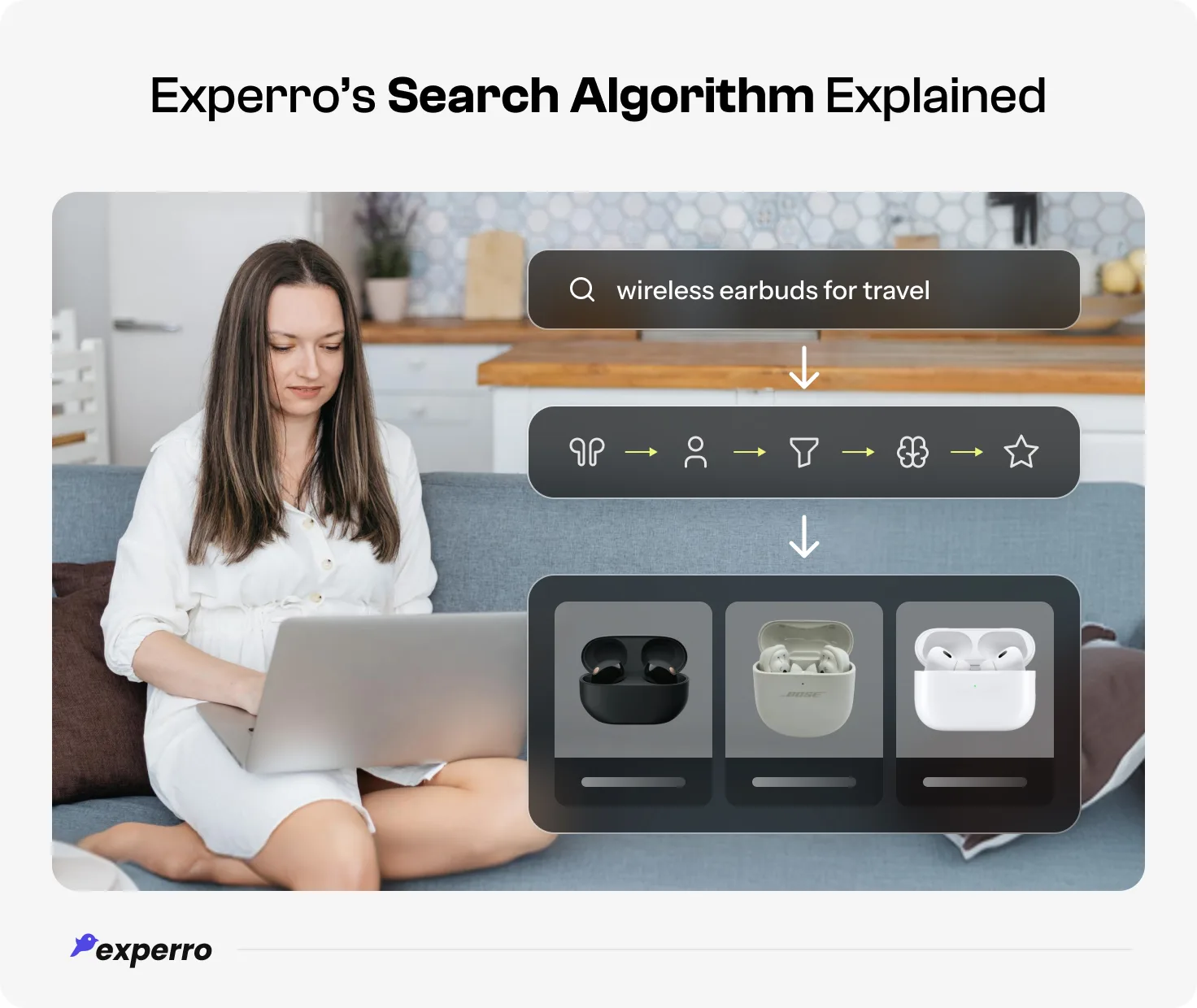
A well-optimized eCommerce search algorithm ensures that customers find what they’re looking for, quickly and effortlessly.
How Do eCommerce Search Algorithms Work? (And it's Core Components)
Every search on your store runs through the same pipeline, whether the shopper types two words or twenty.
The algorithm moves through five stages end to end, usually in under 300 milliseconds, and each stage handles one job before passing the result to the next.
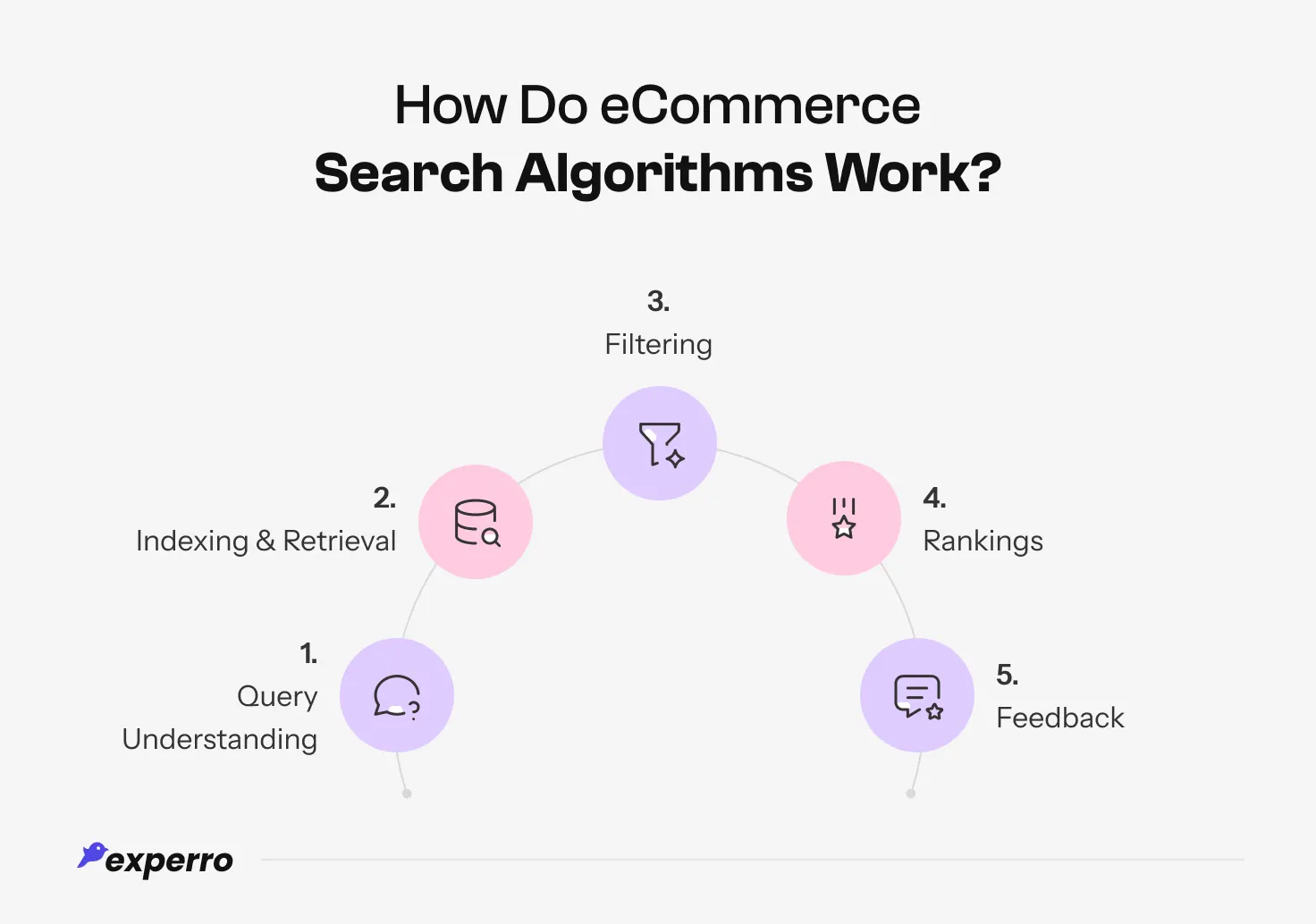
1. Query Understanding
The eCommerce search algorithm reads the raw search string, cleans it up, fixes typos, and figures out what the shopper actually wants. The newest evolution of this layer is conversational search, where the algorithm reads full sentences and follow-up questions the way a salesperson would.
For example: A makeup shopper typing "red lipstic matte" gets the spelling corrected to "lipstick" and the word "matte" tagged as a finish attribute, not just another keyword.
2. Indexing & Retrieval
The algorithm pulls candidate products from the index using two methods running in parallel. Lexical search handles exact wording, while vector search reads the meaning behind the query so results aren't limited to literal keyword matches.
For example: A jewelry shopper searching "14k gold hoop earrings" gets exact matches through lexical search. A fashion shopper typing "something to wear to a beach wedding" gets linen dresses and resort sets through vector search, even when the product titles don't use those words.
3. Filtering
The results are filtered based on various factors like relevance, popularity, personalization and behavioral insights. Anything that shouldn't appear in the result set gets trimmed before ranking begins. This includes out-of-stock items, region or currency mismatches, and any active facet selections the shopper has applied.
For example: A B2B buyer searching for industrial fasteners only sees SKUs available in their pricing tier and shipping region, so irrelevant items never reach the ranking stage.
4. Rankings
A scoring model orders every surviving product based on how likely it is to lead to a sale. It weighs relevance, click-through rate, conversion history, price, stock, personalization, and merchandising rules together to produce the final order.
For example: For a skincare query like "vitamin C serum", the bestselling serum lands above a niche one even when both match the query equally, because conversion history and review scores tip the ranking in its favor.
5. Feedback
Every click, add-to-cart, and purchase gets logged against the query that produced it. Over time, the ranking model learns which products convert for which queries and adjusts the order on its own.
For example: If footwear shoppers searching "running shoes" keep skipping casual sneakers and buying cushioned trainers, the model picks up the pattern and reorders results the next time the same query comes in.
Thus, a powerful product engine algorithm does more than just return results; it helps customers discover products they didn’t even know they needed.
What Are the 6 Types of Queries That Algorithm Understands?
Customers search in different ways, and your eCommerce platform’s search algorithm should be able to handle them all.
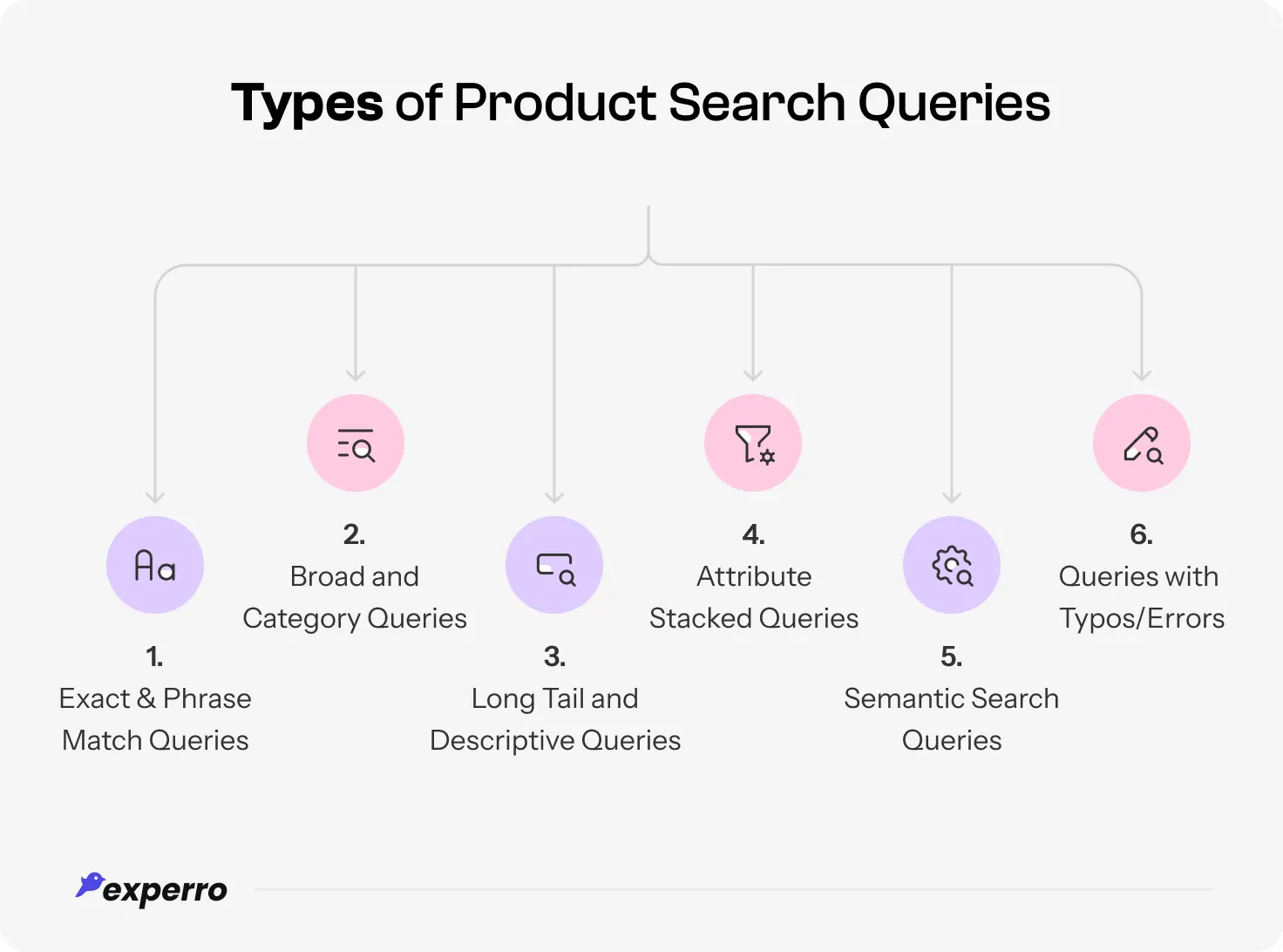
The six query types below cover what shows up in real search logs. If your algorithm can't handle any one of them cleanly, that's where revenue starts leaking.
1. Exact and SKU-based Queries
These are the searches where the shopper already knows exactly what they want and types it in directly - often a SKU search, a model number, or an exact product name. They've done their research somewhere else and they're on your store to buy, not to browse.
Thus, the shopper expects the exact product to land at the top, not a list of close alternatives around it. Get this wrong and you lose your highest-intent traffic in seconds, because these shoppers don't scroll, they leave.
2. Broad and Category Queries
These are one or two-word searches like "dresses," "laptops," or "sneakers" where the shopper is browsing, not hunting. They're at the top of the funnel and open to suggestions, which means the algorithm's job is to guide them, not just list what matches.
The whole experience depends on what shows up in the first few rows. A smart algorithm reads who the shopper is, what's trending, and what the merchandising team is pushing this week, then builds a first page that feels curated instead of random. Get this right and a browse turns into a click, get it wrong and the shopper hits the back button.
P.S. - Getting the first category page right is what turns a browse into a sale. Experro's AI Browse does this automatically, lifting revenue per visitor and conversions without manual setup.
3. Long Tail and Descriptive Queries
These are the longer, more specific searches where the shopper spells out exactly what they want, often with a budget, a use case, or a personal preference baked in. By the time someone types this much into a search bar, they're not browsing anymore. They're close to buying and they're testing whether your store actually has what they described.
Long-tail searches are the easiest to convert because the shopper already told you what they need. They're also easy to lose, since there's no room for "close enough." The algorithm is then all about search relevance, how well the results line up with what the shopper actually asked for.
4. Attribute Stacked Queries
These searches happen when a shopper combines several requirements into one line, like a material with a style with a price cap. They're listing the exact specs the product has to match, not describing how they want to feel or what the product is for.
Product search algorithm has to treat every word as a hard requirement and apply the filters the shopper would otherwise click through manually.
That only works if your catalog has clean, well-structured product attributes behind the scenes.
A jewelry shopper typing "14k gold hoop earrings under $200" is naming material, type, and price in one shot, and if the search only catches "earrings," the shopper feels ignored and moves on.
5. Semantic and Natural Language Queries
These are searches where the shopper talks to your search bar in a natural language like the way they'd talk to a salesperson. They describe the situation, the vibe, or the problem they're trying to solve, and they expect the search to figure out which products fit.
The catch is that the words they use almost never appear in your product titles. A shopper typing "gift for a friend who just moved into her first apartment" isn't searching for any specific category, and no algorithm built on keyword matching is going to handle that cleanly. The search has to understand what the shopper means, not just what they typed, and pull products that actually fit the moment.
6. Fuzzy and Misspelled Queries
Typos show up in every search log, no matter how clean the catalog is. Shoppers type fast, often on mobile, and they don't slow down to double-check spellings, especially for brand names they've only heard out loud or seen in an ad.
The shopper doesn't think they made a mistake, they think your store doesn't carry the product. A search for "Charlot Tilberry" that returns zero results sends the shopper straight to Google, and Google sends them to a competitor who handled the typo gracefully.
To avoid zero search results, the algorithm has to catch the intent behind the misspelling and serve the right results anyway, without making the shopper retype anything.
Thus, these were the various types of queries that are often observed by eCommerce store owners.
So, What a eCommerce Product Search Algorithm Needs to Succeed?
Good eCommerce search doesn't come down to one clever algorithm. It comes down to whether the pieces feeding that algorithm are actually in place. When any one of them is missing, the whole experience suffers, no matter how advanced the technology is.
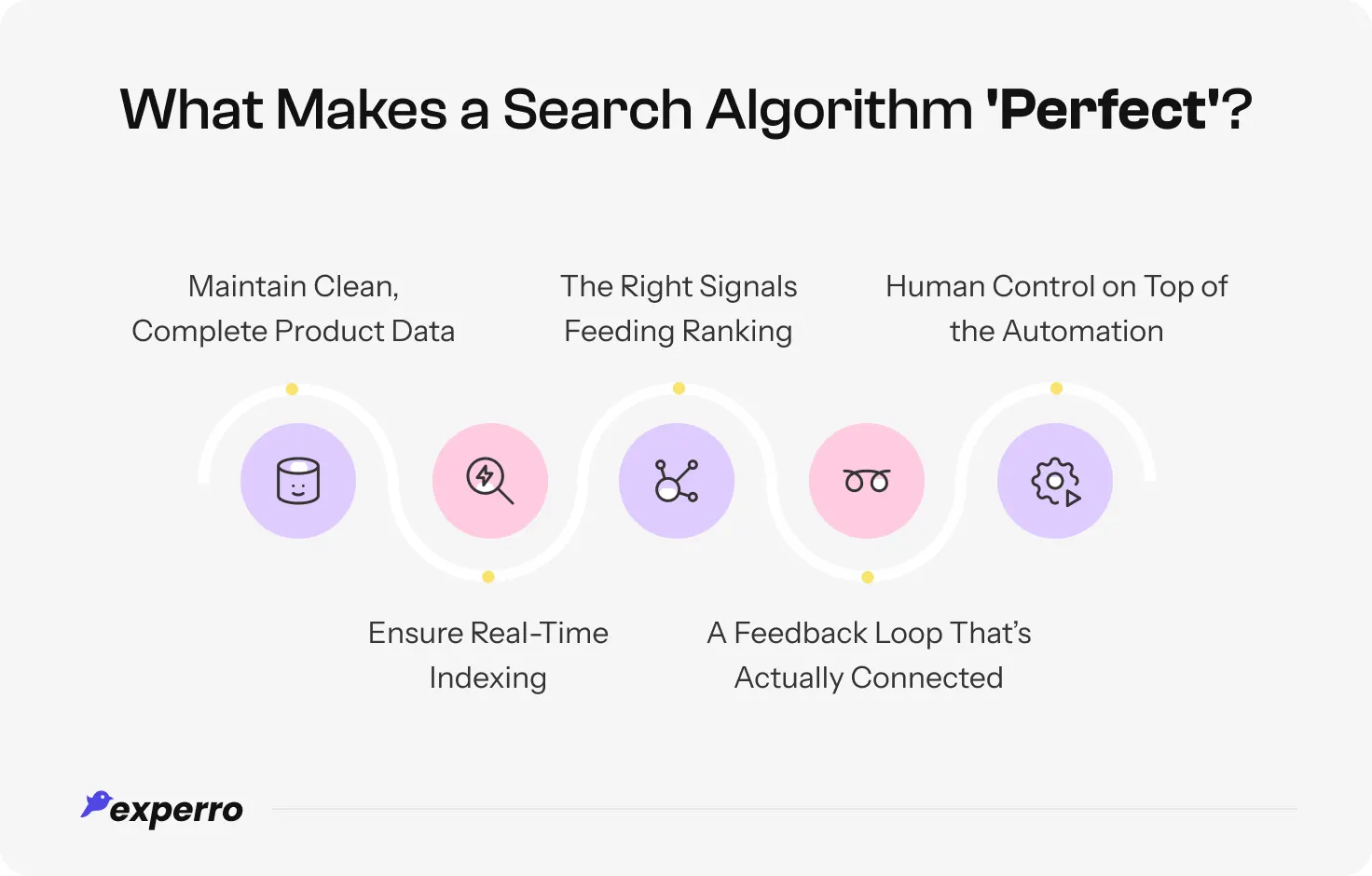
These five factors decide whether your search works for shoppers or quietly works against you.
1. Maintain Clean, Complete Product Data
The algorithm can only search what's in your catalog data, and it can only match on attributes that are actually filled in. If half your products are missing material, color, or use-case tags, those products quietly vanish from the searches that should surface them.
Most "the algorithm is broken" complaints trace back to thin product data, not the algorithm. Before tuning anything, the catalog has to be tagged properly and consistently.
This is exactly the gap Experro's AI product data enrichment closes, using Gen AI and computer vision to auto-generate complete, consistent attributes across every SKU.
2. Ensure Real-Time Indexing
A search algorithm is only as current as its index. If a product sells out, gets repriced, or launches, the algorithm needs to know within seconds, not on tonight's batch update.
Stores running stale indexes end up showing out-of-stock items at the top and hiding new arrivals shoppers are actively searching for. Real-time sync between your catalog and your search index is non-negotiable for a store that changes daily.
3. The Right Signals Feeding Ranking
Ranking is only as smart as the signals it's allowed to see. An algorithm that ranks on keyword match alone will always lose to one that also reads conversion history, stock levels, margin, and shopper behavior.
Success here means wiring the algorithm into the data that actually predicts a sale, not just the data that confirms a keyword appears in the title.
Wiring personalization at scale into the ranking layer is what separates an algorithm that ranks for the average shopper from one that ranks for the individual.
4. A Feedback Loop That’s Actually Connected
A product search algorithm should get smarter every week on its own, but only if shopper behavior flows back into it. Plenty of stores have the capability switched off or never wired up, so the algorithm repeats the same weak results month after month.
Success means the loop is live: clicks, carts, and purchases continuously teaching the algorithm what works for each query.
5. Human Control on Top of the Automation
Even the best algorithm needs an override. Merchandisers have to be able to boost a new collection, pin a promoted product, or bury clearance items without filing an engineering ticket.
A search algorithm that can't be steered by the people who own the business goals isn't a success, it's a black box. The strongest setups pair automated ranking with no-code merchandising control.
But, How to Measure If Your Search Algorithm Is Working Accurately?
You can't fix what you don't measure, and search is one of the most under-measured parts of most eCommerce stores.
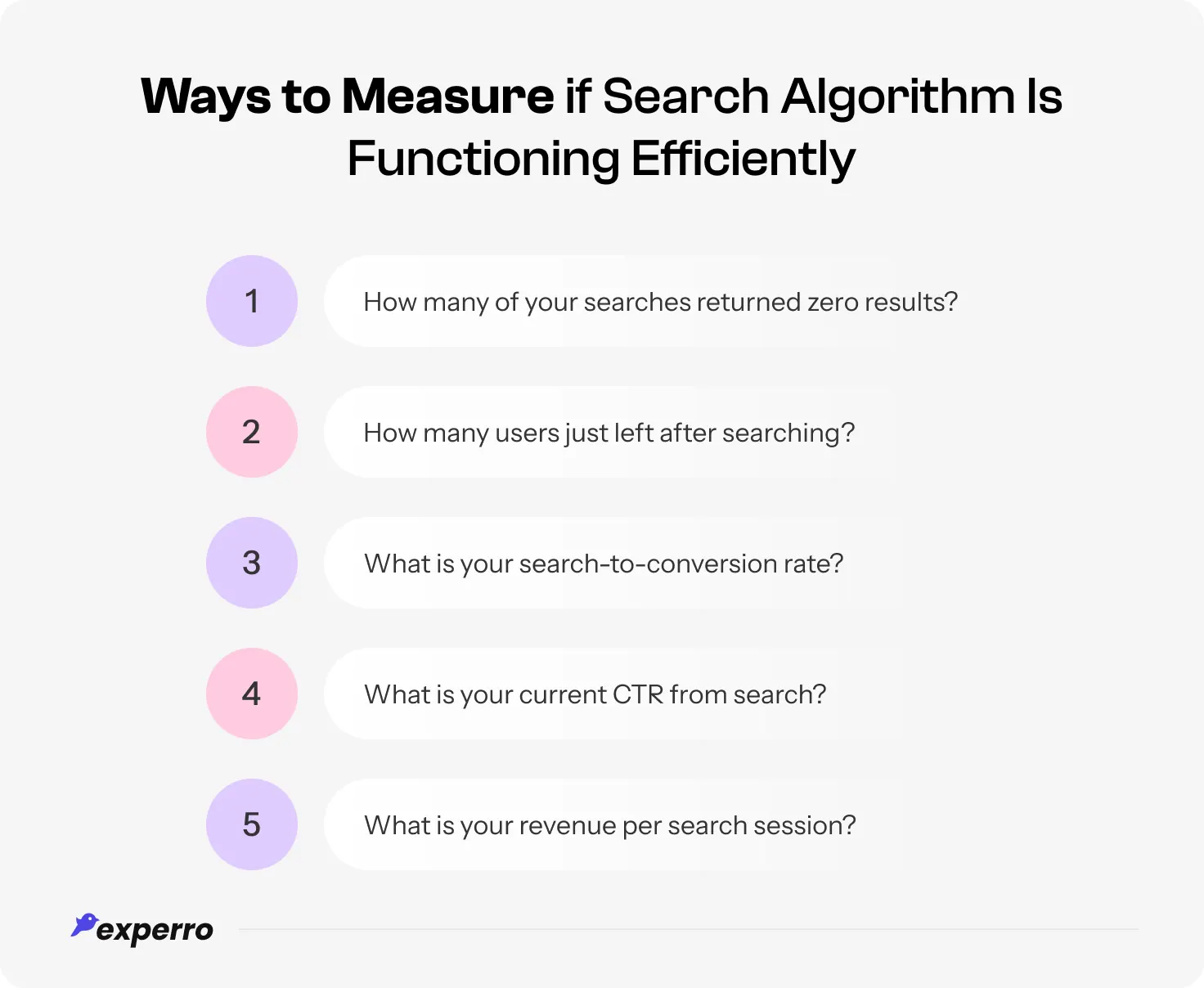
The numbers below tell you, honestly, whether your algorithm is earning its place or quietly leaking revenue. Track them on a steady cadence and the weak spots show up long before they hit your bottom line.
- How many of your searches returned zero results?
This is the percentage of searches that return nothing at all, and it's the first number to check. Every one of those is a shopper who told you exactly what they wanted and got a dead end. Anything above 10% means the algorithm's query understanding needs work.
- How many users just left after searching?
This tracks how often shoppers search, look at the results, and leave without clicking anything. The search algorithm found products and the shopper rejected all of them, which points squarely at a ranking problem, not a retrieval one.
- What is your search-to-conversion rate?
This is the metric that matters most, because it ties search directly to revenue. If your searchers aren't converting noticeably better than your browsers, your algorithm is wasting your highest-intent traffic.
- What is your current CTR from search?
This measures whether the top results are good enough to earn a click. Low click-through with high search volume means the right products exist but the ranking is burying them. It's an early warning that tends to move before conversion does, which makes it useful to watch weekly.
- What is your revenue per search session?
This rolls everything up into one number, how much money each search is actually worth. It's the cleanest metric for proving search ROI internally and the best one to put in front of leadership, because it converts "our search is better" into a figure a CFO understands.
Get these five right and the algorithm takes care of itself. And honestly, that's the whole goal, search that runs in the background without anyone babysitting it.
Optimize Your eCommerce Product Search Algorithm with Experro!

Experro's Generative AI-driven product search algorithm helps your customers find what they need fast, then nudges them toward what they're most likely to buy. Here's what you get:
✅ Exceptional Search – Gen AI-powered search understands queries in real time and returns precise, intent-matched results.
✅ Personalized Results – Product suggestions adapt to each shopper's browsing and purchase history, so no two people see the same generic list.
✅ Voice & Visual Search – Multimodal search lets shoppers search by image or voice, not just text.
✅ Smart Merchandising – eCommerce merchandising gives your team no-code control to boost, pin, and prioritize products without engineering.
✅Real-Time Indexing - New products, price changes, and stock updates reflect in search instantly.
Upgrade your search experience with AI-driven precision and speed. With Experro, every search leads to better engagement and higher conversions.
Conclusion
A well-optimized eCommerce search algorithm is a game-changer for online stores.
By leveraging AI, ML, and smart personalization, you can drive more conversions and keep customers engaged.
Investing in a powerful search experience ensures visitors turn into loyal buyers. Is your platform falling short of a few or all functionalities? Want to improve your ROI? Let’s discuss on a call!
FAQs

Pallavi is an ambitious author recognized for her expertise in crafting compelling content across various domains. Beyond her professional pursuits, Pallavi is deeply passionate about continuous learning, often immersing herself in the latest industry trends. When not weaving words, she dedicates her time to mastering graphic design.
Subscribe to Our Newsletter!
Get the latest insights delivered straight to your inbox.