
- Generative AI
- Recommendations
- BigCommerce
- 11 min read
Why BigCommerce Recommendations Fail (And How to Fix Them)
Published
20 May 2026Updated
1 June 2026

core insights box
- Most BigCommerce product recommendations fail because they rely on static rules instead of interpreting real-time shopper intent.
- When recommendation engines ignore live product-page behavior, they lose the ability to guide decisions, resulting in lower conversion potential.
- Experro solves the core problem of static, rule-based BigCommerce recommendations by introducing a Gen AI-powered engine that understands real-time shopper intent, which improves discovery, cross-sell, and AOV.
A shopper adds a product to cart, but your BigCommerce recommendation engine suggests something irrelevant. That’s not an error. It’s an intent mismatch. That is BigCommerce recommendations feature malfunctioning. And that’s the problem.
Most stores run blind to it because the widgets load, the products appear, and everything looks like it’s performing. But there’s a difference between a recommendation that renders and one that actually converts.
Wrong products at the wrong moment don’t just fail to convert. They silently tell your shopper that your store doesn’t know them, doesn’t see them, and doesn’t deserve the next click.
91% of consumers are more likely to shop with brands that recognize, remember, and provide relevant recommendations, yet most BigCommerce stores push popularity over intent and call it personalization.
That gap is exactly where conversions die, and where smarter, intent-driven recommendation layers make all the difference. This post breaks down every reason your BigCommerce recommendations are failing and what actually fixes them.
Why BigCommerce Recommendations Fail (Core Product and Intelligence Limitations)
Modern eCommerce has changed. Shoppers no longer follow linear journeys.
They explore, compare, hesitate, and return across multiple touchpoints — behaviors that demand real-time intelligence.
But most BigCommerce recommendations still rely on static logic built for a simpler era. That gap is precisely what the BigCommerce Experro integration layer was designed to solve.
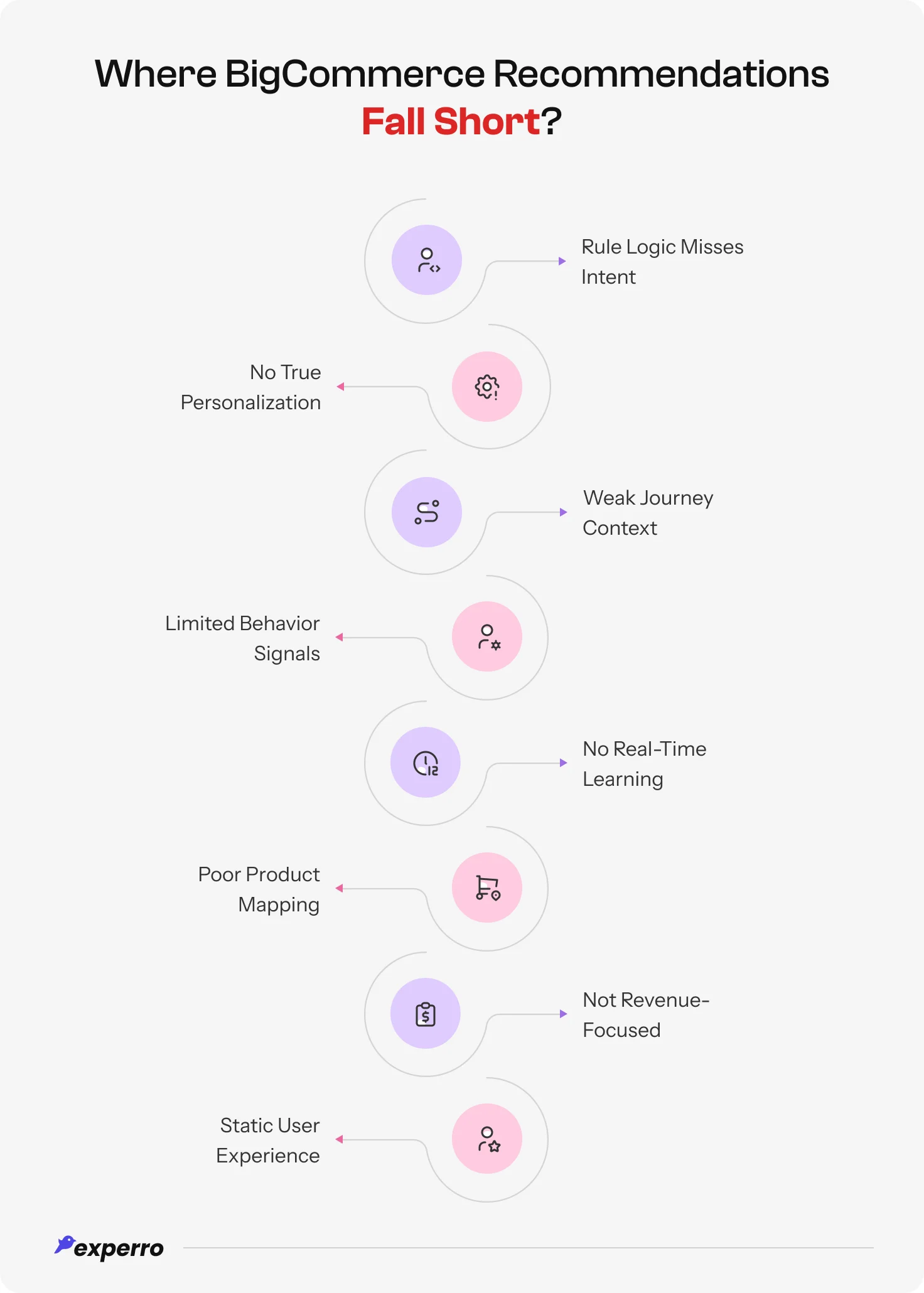
Let’s break down the real reasons these systems fail and what that means for experience, engagement, and revenue.
1. Rule-Based Systems Cannot Understand Real Shopper Intent
Most BigCommerce product recommendations are still driven by rule-based setups like basic BigCommerce related products logic.
These systems depend only on historical purchase patterns instead of real-time intent. So, they can show related items, but they cannot understand why a shopper is on a product page.
For example, a user comparing two premium headphones may receive irrelevant accessories instead of better alternatives or comparisons. The system cannot identify whether the user is:
- exploring options,
- comparing features,
- or ready to purchase
This is where BigCommerce recommendations become too generic, and the experience starts to feel disconnected from how shoppers make decisions.
2. Weak Personalization Across Customer Journeys
Modern shoppers expect recognition, not repetition. But many BigCommerce personalized recommendations still fail to treat users as individuals.
Even when systems collect purchase history, browsing signals, and recently viewed products, this data is often not deeply applied inside the recommendation engine.
As a result:
- loyal customers see the same suggestions as new visitors
- customer groups are not meaningfully differentiated
- recommendations feel repetitive instead of adaptive
Without strong use of first-party data, shopper profile, and user behavior, personalization remains surface-level instead of meaningful. It is a must to improve BigCommerce personalization for the recommendations to flow better.
3. Lack of Context Across Funnel Stages
Shoppers behave differently at each stage of the journey, yet many BigCommerce recommendation systems remain static throughout the experience:
- product pages require comparison-driven suggestions to help users evaluate options
- cart pages respond better to cross-selling and complementary product recommendations
- checkout demands precise, high-intent recommendations instead of exploratory suggestions
However, many native BigCommerce recommendation widgets still show generic modules like “You may also like” across every stage of the funnel.
This lack of context means the system fails to adapt to real-time product recommendations in BigCommerce, even when shopper intent clearly changes within the same session.
4. Behavioral Signals Are Not Fully Utilized
Shoppers constantly leave behind behavioral signals, but most systems only capture surface-level actions like clicks or purchases.
They often ignore:
- scroll depth on product detail pages
- repeated product visits
- comparison behavior across categories
- hesitation before adding to cart
- time spent evaluating product types
These signals are critical for understanding shopping behavior, but they are rarely used to power AI-powered product suggestions effectively.
Without them, recommendations become reactive instead of predictive, missing the real intent behind the session.
Handpicked Read!
A compiled list of industry-favorite 8 product recommendation engines for you.
5. No Continuous Learning or Feedback Loop
A strong recommender system should improve with every interaction. But many BigCommerce product recommendations do not learn effectively from user behavior.
Signals such as:
- clicks
- skips
- add-to-cart actions
- conversions
are often underutilized, leading to static recommendation patterns.
Over time, this results in:
- repetitive suggestions
- declining relevance
- inaccurate recommendation outcomes
- reduced personalization quality
Even when machine learning algorithms exist, they are not always optimized for continuous adaptation.
6. Weak Product Relationship Intelligence
Most BigCommerce recommendation engines rely on basic co-purchase patterns instead of deeper product understanding and intent-based relationships.
But real shopping behavior is far more complex. Customers expect:
- complementary products that complete full use cases
- higher-value alternatives that better match intent and budget
- bundles across categories that solve end-to-end needs
- smarter cross-sell opportunities driven by context
For example, a camera purchase is not just about accessories. It often requires lighting equipment, editing tools, and storage solutions to support the full workflow.
These limitations create clear BigCommerce recommendation gaps, reducing discovery depth, limiting basket expansion, and ultimately weakening revenue potential.
7. Recommendations Are Not Aligned with Revenue Outcomes
Many BigCommerce product recommendations prioritize product visibility over measurable business outcomes.
Even when recommendations appear relevant, they are not optimized for:
- sales growth
- average order value
- repeat purchases
- customer lifetime value
This is why BigCommerce product recommendations often fail — not because of technical issues, but because of strategy.
Without revenue-aware logic, recommendation systems fail to contribute meaningfully to business performance across the BigCommerce store.
8. Static Experiences in an AI-Driven Commerce World
Today’s shoppers expect adaptive systems like Amazon and Netflix, where recommendations update instantly based on behavior.
However, many BigCommerce recommendation systems still rely on static modules such as:
- Recommended for you
- Customers also bought
- Recently viewed products
These modules often fail to adapt during active sessions, even when shopper intent changes in real time.
For example, if a user shifts from browsing budget products to premium options, recommendations often remain unchanged and irrelevant.
This creates a gap where BigCommerce recommendations feel static, generic, and disconnected from modern real-time personalization expectations.
In the end, BigCommerce recommendations fall short due to gaps in intent, behavior tracking, personalization, context, and continuous learning. Together, these issues make them feel static instead of smart. The shift is toward adaptive BigCommerce product recommendations that respond in real time and align with how shoppers think and buy.
How Experro Fixes BigCommerce Recommendation Limitations?
BigCommerce recommendation systems were built for a predictable shopping flow, but shoppers no longer behave in predictable ways.
They shift intent mid-session, compare across tabs, and make decisions in seconds, while most stores still rely on static suggestions that miss the moment that actually drives conversion.
That small delay in relevance is often where attention breaks, and revenue quietly slips away.
This is exactly where Experro’s AI-powered recommendation engine changes the experience. Instead of reacting late or depending on rigid rules, it understands behavior in real time, adapts as intent evolves, and keeps every product recommendation aligned with what the shopper is trying to decide at that moment.
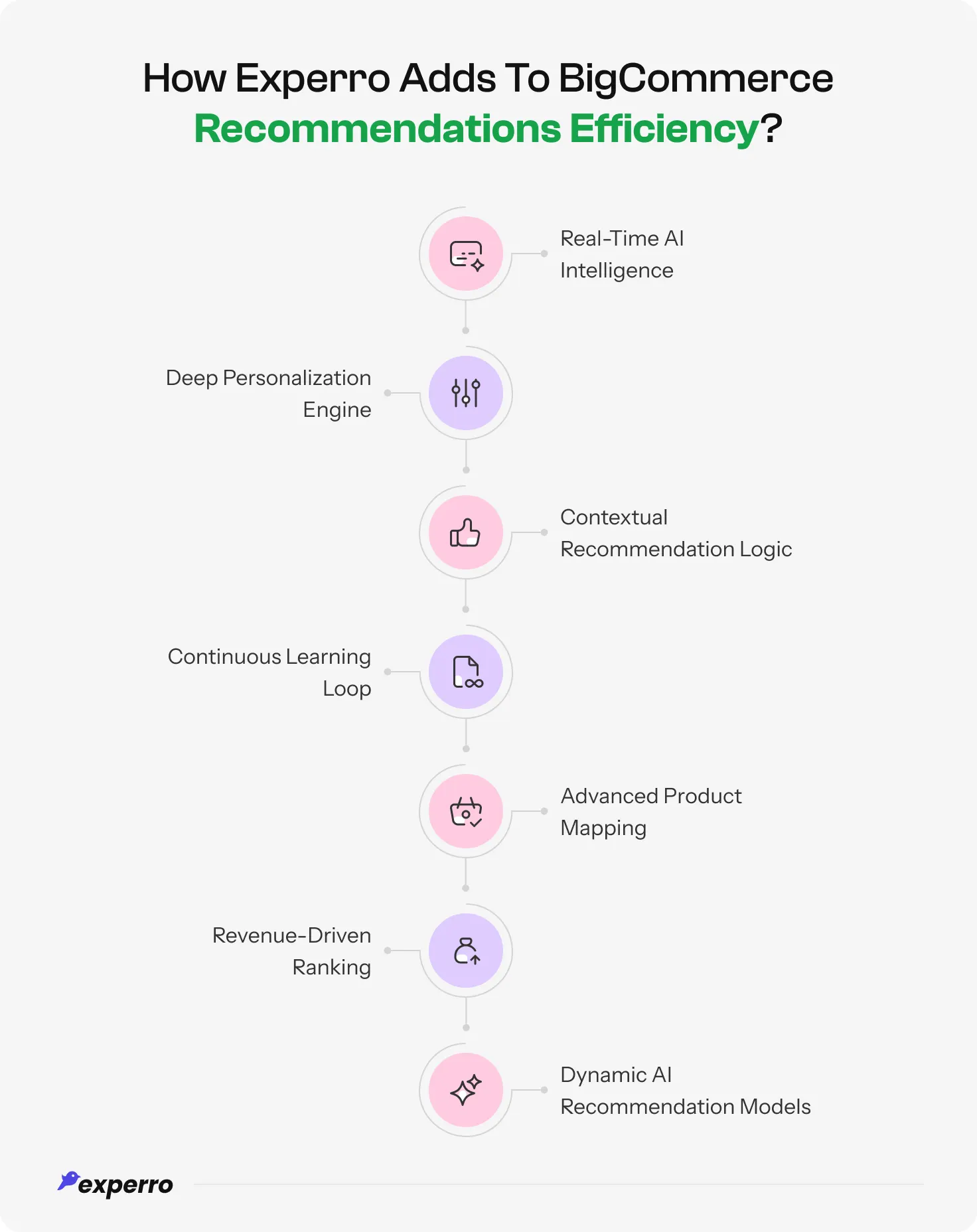
Now, let’s break down how each limitation is solved in a practical, system-level way.
1. Replacing Static Rule Logic with Real-time AI Intelligence
Traditional BigCommerce native recommendations rely on rigid rule-based logic such as “related products” or “frequently bought together”.
This often results in irrelevant BigCommerce recommendations because static rules cannot understand why a user is browsing a product page or what decision they are trying to make.
Experro eliminates this limitation by introducing a Gen AI-driven recommendation engine that interprets real-time context, including:
- Real-time user behavior
- Session-level intent signals
- Catalog relationships across product categories
- Engagement depth across the store
Instead of pre-defined rules, recommendations are generated dynamically based on live intent interpretation.
Result: Every product recommendation in BigCommerce stores becomes context-aware and behavior-driven.
2. Fixing Irrelevant and Generic Recommendation Outputs
A key limitation of BigCommerce recommendation systems is that they often treat all users the same, regardless of intent, behavior, or stage in the buying journey.
This makes many traditional product recommendation setups in BigCommerce overly generic, reducing relevance and weakening overall shopping experiences. As a result, efforts to improve BigCommerce recommendations often fail to deliver meaningful revenue impacts.
Experro addresses this by applying real-time contextual filtering within its recommendation engine, ensuring every suggestion is shaped by live user signals such as:
- browsing and purchase history
- cross-category exploration behavior
- engagement signals like scroll depth and dwell time
- interaction with recently viewed products
- affinity between complementary products
This ensures every recommendation is generated per session and adapted to individual intent, rather than reused across users.
Result: The integration of Experro in the BigCommerce store helps remove irrelevant suggestions and delivers highly contextual, behavior-driven BigCommerce personalized recommendations only.
3. Eliminating Static Experience with Real-Time Learning
Traditional BigCommerce recommendation systems often fail to keep up with real-time shopper behavior, causing product recommendations to lose relevance due to static logic that cannot adapt, learn, or respond to evolving customer intent.
Experro eliminates this limitation by introducing a continuous learning loop powered by AI-powered product suggestions that adapt in real time instead of relying on fixed rules.
Its BigCommerce recommendation engine reacts instantly to live shopper behavior and continuously improves relevance across the storefront.
The system learns from:
- clicks on product suggestions and recommendation widgets
- ignored or skipped recommendations
- purchases (both first-time and repeat behavior)
- engagement across pages and categories
- interaction patterns across sessions
Even when businesses face challenges with existing setups or issues in related product logic, Experro stabilizes performance through a plug-and-play recommendation layer and seamless integration flexibility.
The system continuously refines ranking models and updates recommendation logic in real time, ensuring product relevance improves with every interaction.
Result: Recommendations evolve dynamically instead of remaining static or outdated.
4. Fixing Weak Product Relationship Understanding
Most systems rely on basic pairing logic, which leads to shallow BigCommerce “frequently bought together” and related products experiences — one of the main reasons BigCommerce product recommendations often fail to meet merchant expectations.
Instead of truly understanding intent, they surface generic or loosely related items that fail to influence purchase decisions.
Experro addresses this gap with affinity-based intelligence that powers more advanced BigCommerce AI product recommendations. It identifies deeper, behavior-driven relationships across users and products by analyzing:
- users with similar shopping behavior
- products co-selected across comparable journeys
- hidden relationships between complementary products
- browsing history and past purchase patterns
This enables more meaningful cross-sell opportunities and stronger profile-based recommendation accuracy.
Result: Fixes inaccurate BigCommerce product recommendations using deeper AI-driven product and behavioral relationships.
5. Turning Recommendations into Revenue Optimization
Traditional systems treat recommendations as display components, not performance drivers. This leads to a weak impact on conversion rates and average order value (AOV).
Experro solves this by aligning every recommendation with business KPIs:
- conversion rates
- average order value (AOV)
- customer lifetime value (CLV)
- cross-sell and upsell performance
- overall increase sales outcomes
Every recommendation is ranked not just by relevance, but by revenue impact potential.
Result: Recommendations become a measurable revenue engine, positioning Experro as a leading product recommendations app for BigCommerce built for performance-driven commerce.
6. Creating a Unified Discovery System (Search + Recommendations + Merchandising)
One hidden issue in BigCommerce setups is fragmentation between search, merchandising, and recommendations.
Experro solves this by merging them into a unified AI discovery layer:
- studies user behavior and improves search results
- browsing activity refines the 'recommended for you' outputs
- merchandising rules are optimized using AI signals
This ensures consistency across search results, product pages, and discovery flows inside the online store.
Result: Eliminates disconnected experiences across the customer journey.
7. Expanding Beyond Static Widgets with Full AI Recommendation Coverage
The gap between browsing and buying is not intent; it is misaligned recommendations.
Most BigCommerce setups only cover a few fixed placements:
- frequently bought together
- you may also like
- recently viewed products
But shoppers make decisions across many more touchpoints.
Experro extends recommendation intelligence across the entire journey:
- product pages
- category pages
- cart pages
- search results
- returning visits
Result: Every touchpoint is powered by the same behavioral intelligence layer.
So, no matter where the shopper is, the experience feels consistent, relevant, and connected. That consistency is what turns scattered suggestions into guided discovery.
When recommendations align with real behavior, the entire shopping experience becomes more natural, more relevant, and more effective without forcing anything. Hence, overcoming the BigCommerce issues will help with a better functioning store.
Conclusion: Modern eCommerce Needs Smarter Recommendations
Shoppers no longer follow predictable buying journeys. Their intent changes continuously as they browse products, compare options, refine preferences, and revisit categories across sessions.
When recommendation systems fail to adapt in real time, product discovery quickly becomes repetitive, disconnected, and less effective at influencing purchase decisions.
That is where many traditional BigCommerce recommendations fall short. They surface products but often lack the behavioral intelligence needed to deliver truly relevant recommendations at the right moment.
Experro helps BigCommerce stores move beyond static recommendation logic with adaptive, real-time product discovery that continuously responds to shopper behavior and buying intent.
Contact us to see how smarter recommendation experiences can improve product relevance, increase engagement, and drive stronger conversion outcomes across your storefront.
FAQs

With 6+ years of experience in AI, software, and digital transformation across tech, healthcare, and fashion, Rahul focuses on making complex ideas simple, clear, and actually useful. He has learned how often great ideas get lost in complexity, which is why he centers his writing on clarity, helping entrepreneurs and leaders cut through noise and make decisions with confidence.
Subscribe to Our Newsletter!
Get the latest insights delivered straight to your inbox.