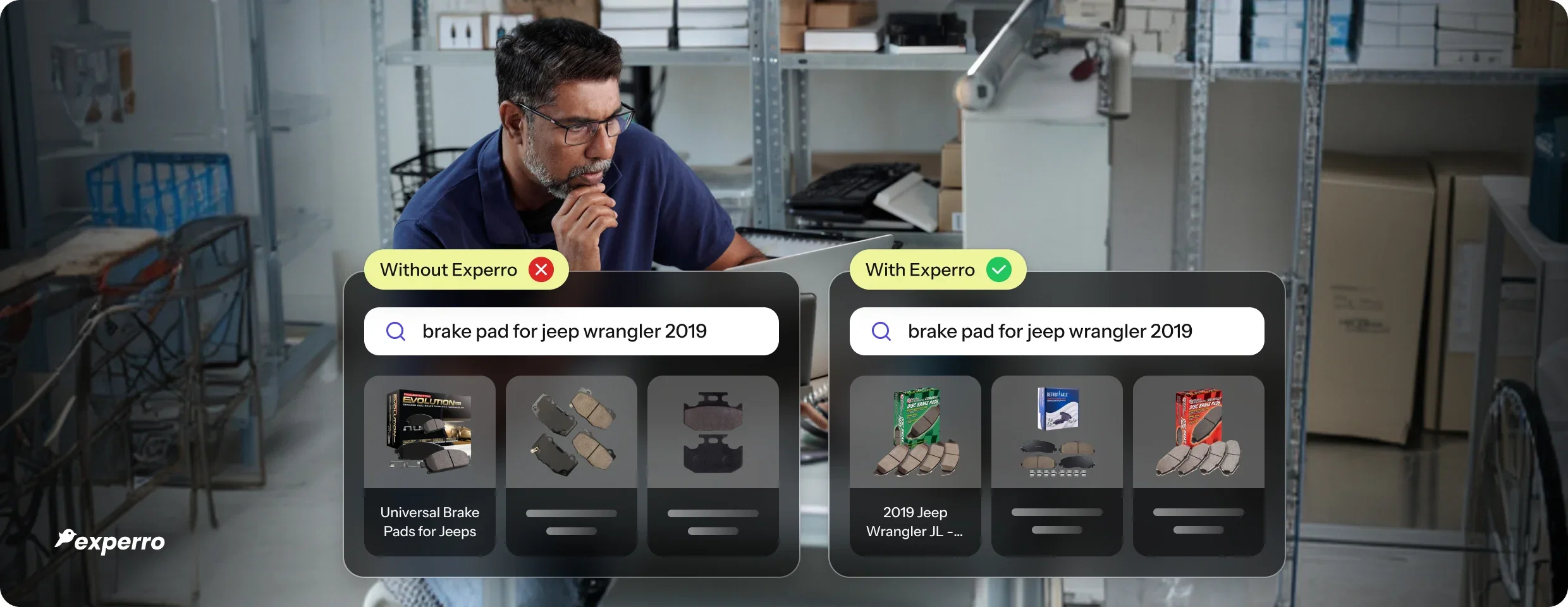
Turn BigCommerce Search into a Revenue Driver with Experro
Published
30 April 2026Updated
1 June 2026

core insights box
- Most BigCommerce search failures don’t appear as errors, they appear as silent exits. Behind every exit is a high-intent shopper who couldn’t find what they truly meant.
- BigCommerce search relies on keyword matching instead of interpreting shopper intent and context, causing irrelevant results that miss actual user needs and purchase intent.
- Every BigCommerce search fails at the exact moment, intent is highest. One irrelevant result is enough to break trust and end the buying journey instantly.
- In the AI era, BigCommerce search failure is no longer a UX issue — it’s a direct revenue leak. AI-powered search like Experro Gen AI Search fixes this by decoding intent in real time and improving conversions.
Disclaimer: This blog discusses Expero’s integration based on publicly available user reviews, forum discussions, customer feedback, and online opinions. While we believe Expero’s integration can be a strong fit for many users, the information shared here is intended for awareness. Readers are encouraged to conduct their own due diligence and evaluate whether the solution aligns with their specific needs, use case, and business goals.
Your most decisive buyers don’t browse. They land on your store, go straight to BigCommerce search, and expect the right product within seconds.
They may type something like “comfortable office chair for back pain”. But if the search only returns the closest keyword match, not the right answer; that intent is lost fast.
That is where BigCommerce search fails for high-intent shoppers. The issue is not always traffic. It is the gap between what shoppers mean and what search understands.
And the cost is real. 81% of those shoppers leave after a poor search experience and are more likely to buy elsewhere.
This blog breaks down where BigCommerce search falls short, why it impacts conversions, and what it takes to close that gap.
Why Native BigCommerce Search ‘Fails’ in the AI Search Era?
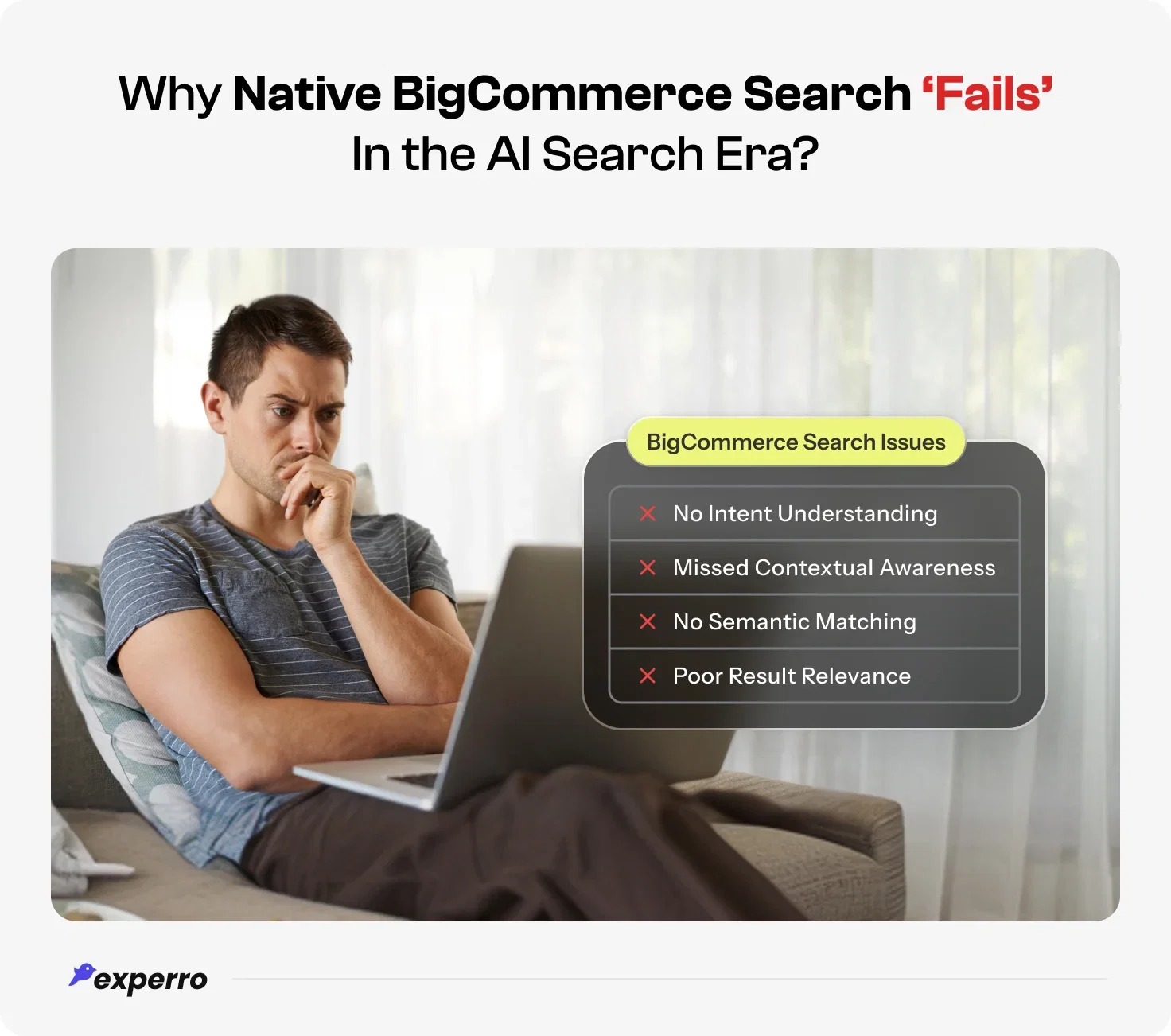
Every eCommerce journey today starts with intent, and the search bar is often where that intent becomes clear. Shoppers type what they need in their own words, expecting fast, accurate, and relevant results.
But many BigCommerce stores still rely on native search systems built for keyword matching, not how people search today. These systems often miss meaning, context, and natural language queries, creating a gap between what shoppers want and what results they see.
In the AI search era, this gap explains why native BigCommerce search starts to fail. Not because it stops working, but because it no longer matches how shoppers search, compare, and buy online.
Key Limitations of BigCommerce Search
| Search Limitation | What Goes Wrong? | Impact on Search Experience |
| Keyword Matching | Matches exact words instead of meaning | Misses relevant products even when they exist |
| Intent Understanding | Cannot interpret why the customer is searching | Shows irrelevant or loosely related results |
| Intent Understanding | Struggles with multi-condition searches | Returns incomplete or broad search results |
| Product Relationships | Treats each product as isolated | No substitutes, alternatives, or recommendations |
| Behavioral Learning | Does not learn from clicks or purchases | Search results stay static over time |
| Personalization | Same results for all users | No tailored experience based on user intent |
| Manual Merchandising | Depends on manual ranking rules | Hard to scale and maintain search quality |
| No-result Handling | No smart fallback or suggestions | Users hit dead ends and exit the site |
| Product Data Usage | Underuses attributes and metadata | Weak relevance and missed matches |
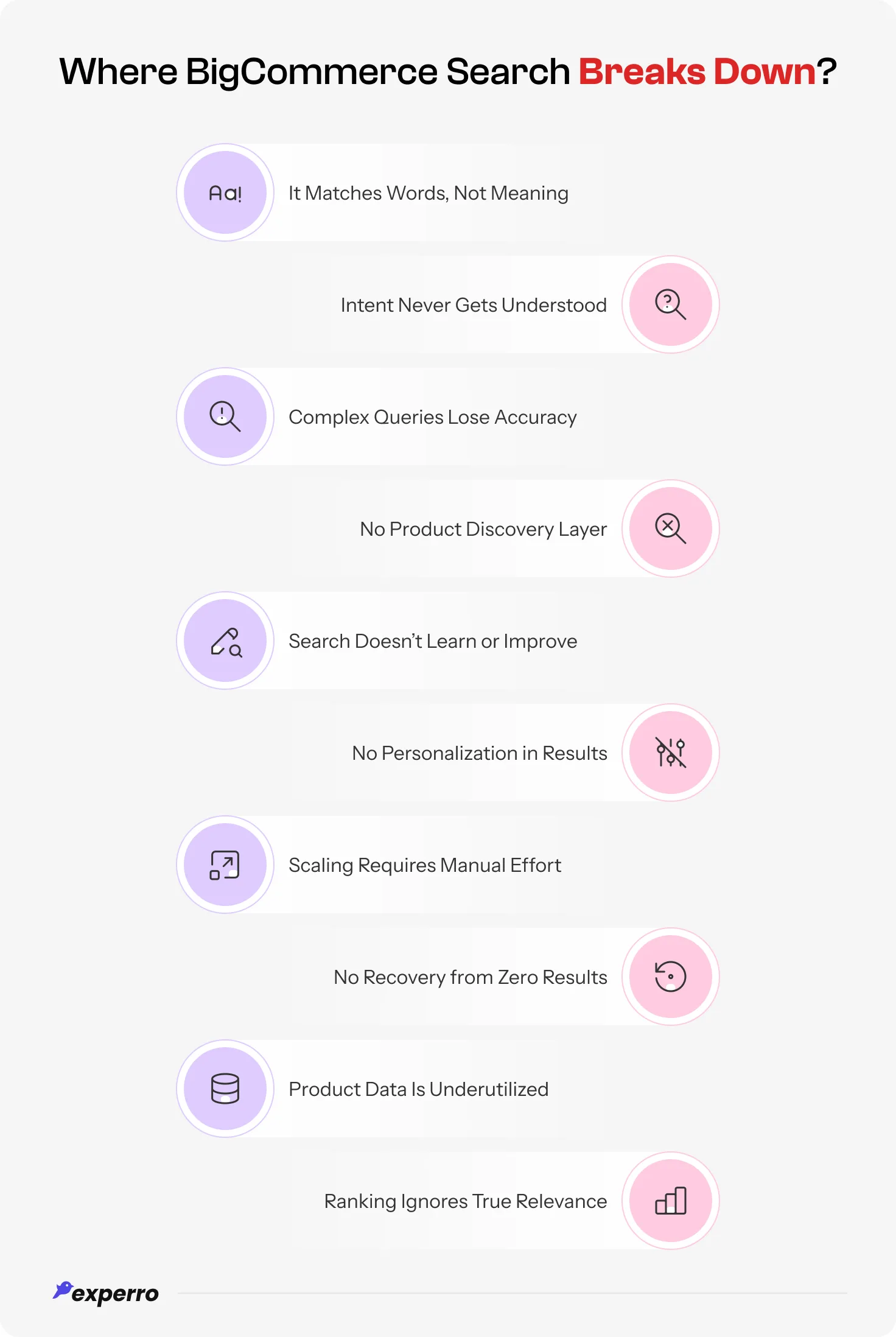
1. Only Understands Words, Not Meaning
BigCommerce search doesn’t “understand” shoppers; it only reacts to the words they type.
A shopper might search “comfortable shoes for long walks”, expecting support and cushioning options. But instead of reading intent, the system just breaks the query into keywords and matches them with product titles and descriptions.
And that’s where the frustration starts. The need is clear in the shopper’s mind, but the results don’t reflect it. Relevant products often stay hidden in BigCommerce site search, not because they don’t exist, but because the system never understood the meaning behind the search. Search relevance is a big factor and not every solution nails it like Experro does.
2. Shopper Intent Gets Lost in the Search Function
Every search a shopper types carries intent — whether it’s budget, durability, urgency, or a specific use case. But the problem with BigCommerce site search issues is that this intent often gets lost in translation.
Instead of understanding what the shopper actually wants, the system focuses on keyword matching. It doesn’t prioritize meaning, context, or underlying need, which means the real decision behind the query is ignored. Only a search platform equipped with search intelligence can actually deliver good results.
This creates a gap between expectation and outcome. Shoppers looking for something affordable, long-lasting, or purpose-specific are often shown results that don’t align with their intent.
As a result, discovery slows down, relevance drops, and customers struggle to quickly find products that truly match what they are trying to achieve.
3. Complex Search Queries Fail to Deliver Accuracy
Modern shoppers use detailed, intent-rich queries like “smart LED TV with 4K resolution and built-in streaming apps under $500”, reflecting clear expectations around price, features, and functionality.
However, this is where BigCommerce search problems begin to surface. The system struggles to process multiple conditions together within a single query, making it difficult to deliver precise results.
These BigCommerce search issues arise because the system breaks complex queries into parts instead of understanding the full intent. As a result, it often produces wrong results or incomplete matches.
This highlights the limitations of built-in BigCommerce search, where BigCommerce search is not enough to handle layered intent, often leading to BigCommerce search showing irrelevant products and a weaker product discovery experience.
4. BigCommerce Search Fails to Recommend Related Products
Shopping is rarely linear. A shopper exploring one product is often open to better alternatives, upgrades, or complementary items, but BigCommerce site search does not adapt to this natural behavior.
Instead of understanding these product relationships, it treats each item in isolation. As a result, BigCommerce faceted search struggles to guide discovery or surface options that genuinely align with what the shopper may need next.
This highlights BigCommerce built-in search limitations. BigCommerce search is not personalized and hence it reduces contextual understanding. Store owners often complain about the need to improve the algorithm of recommendations.
As a result, it becomes harder to improve BigCommerce product search through meaningful cross-sell and upsell recommendations.
5. BigCommerce Native Search Does Not Learn from Customer Behavior
Every interaction in a store tells a story about what shoppers click, view, and buy clearly what they prefer. But BigCommerce search does not evolve with these signals.
Even when users consistently interact with certain products, the system fails to learn from that behavior or adjust rankings accordingly. Instead of getting smarter over time, BigCommerce search performance remains static and disconnected from real usage patterns.
As a result, search does not improve with experience. This creates ongoing BigCommerce search issues where relevance does not evolve, making it harder for stores to deliver a truly adaptive and improving product discovery experience.
6. When Search Results Are Not Personalized
Two shoppers can type the same query, but their intent is rarely identical. One is focused on price and comparison, while the other is looking for quality, features, or long-term value. Yet BigCommerce search treats both the same.
It does not respond to behavior signals like clicks, browsing patterns, or purchase history. There is no learning or adjustment over time.
Instead, it continues to display static results, creating an impersonal BigCommerce search experience that feels disconnected from real intent. Try improving the BigCommerce personalization quality in order to provide your shoppers with a top-notch shopping experience.
As this pattern continues, it leads to recurring BigCommerce search issues and overcoming the BigCommerce performance issues is inevitable.
It reflects BigCommerce built-in search limitations, where results do not evolve with user behavior, making it harder to improve the personalized product search and deliver truly relevant discovery.
7. When No-Result Searches Create Dead Ends
A shopper arrives with clear intent, types a specific query, and expects immediate relevance, but the search returns nothing, breaking that expectation in an instant.
What should feel like a guided discovery moment instead becomes a stop with no direction.
There are no suggestions, no nearby matches, and no smart refinement options to keep the journey moving forward. Only one way to avoid zero search results is by utilizing Experro's opportunities feature and make the most out of it.
This exposes deeper BigCommerce search issues and limitations in BigCommerce site search behavior, where failed queries are not intelligently recovered, disrupting BigCommerce product search continuity and weakening the overall discovery experience.
8. Product Data Is Not Fully Utilized
Most eCommerce stores already maintain rich, structured product data, but BigCommerce site search does not fully leverage this information during discovery.
Even when attributes, specifications, and detailed descriptions are available, they are often only partially considered in ranking logic.
This creates a gap where available product context is not effectively translated into relevance, exposing core BigCommerce search limitations in how data is interpreted.
This weakens accuracy in BigCommerce product search, where valuable product information fails to meaningfully guide shopper intent or improve discovery outcomes.
9. Ranking Does Not Reflect True Relevance
A shopper types a query with a clear goal in mind, but the order of results doesn’t always reflect that intent. In BigCommerce search, ranking is still heavily shaped by keyword alignment rather than behavioral or conversion signals.
This leads to situations where products with stronger relevance or higher likelihood of purchase appear lower, while loosely matched items gain top placement simply due to textual overlap.
The result is a disconnect between shopper expectation and what BigCommerce site search prioritizes.
These BigCommerce search limitations expose a structural gap in BigCommerce product search, where ranking logic doesn’t consistently mirror real-world buying intent or product value within the discovery flow.
Why Do The BigCommerce Limitations Matter?
The core BigCommerce search limitation is not just technical. It is an intent of mismatch that breaks how modern shoppers decide what to buy. Today’s users expect Google-like searches. It should understand meaning, context, and intent instantly. Not rigid keyword matching.
When BigCommerce search fails, it hurts product discovery. It reduces SEO performance. It lowers conversion rates. It also weakens overall store revenue. This is why businesses are moving to AI-powered and generative search. It understands intent in real time and delivers relevant results.
Business Consequences of BigCommerce Search Failure
Search is the moment where shopper intent is at its peak, and also the moment where it is most fragile.
When this experience fails, the impact is not isolated; it immediately affects discovery, conversions, and overall store performance.
If BigCommerce search fails to deliver relevant results, it doesn’t just break a feature, it disrupts the entire buying journey, quietly reducing revenue potential across the store.
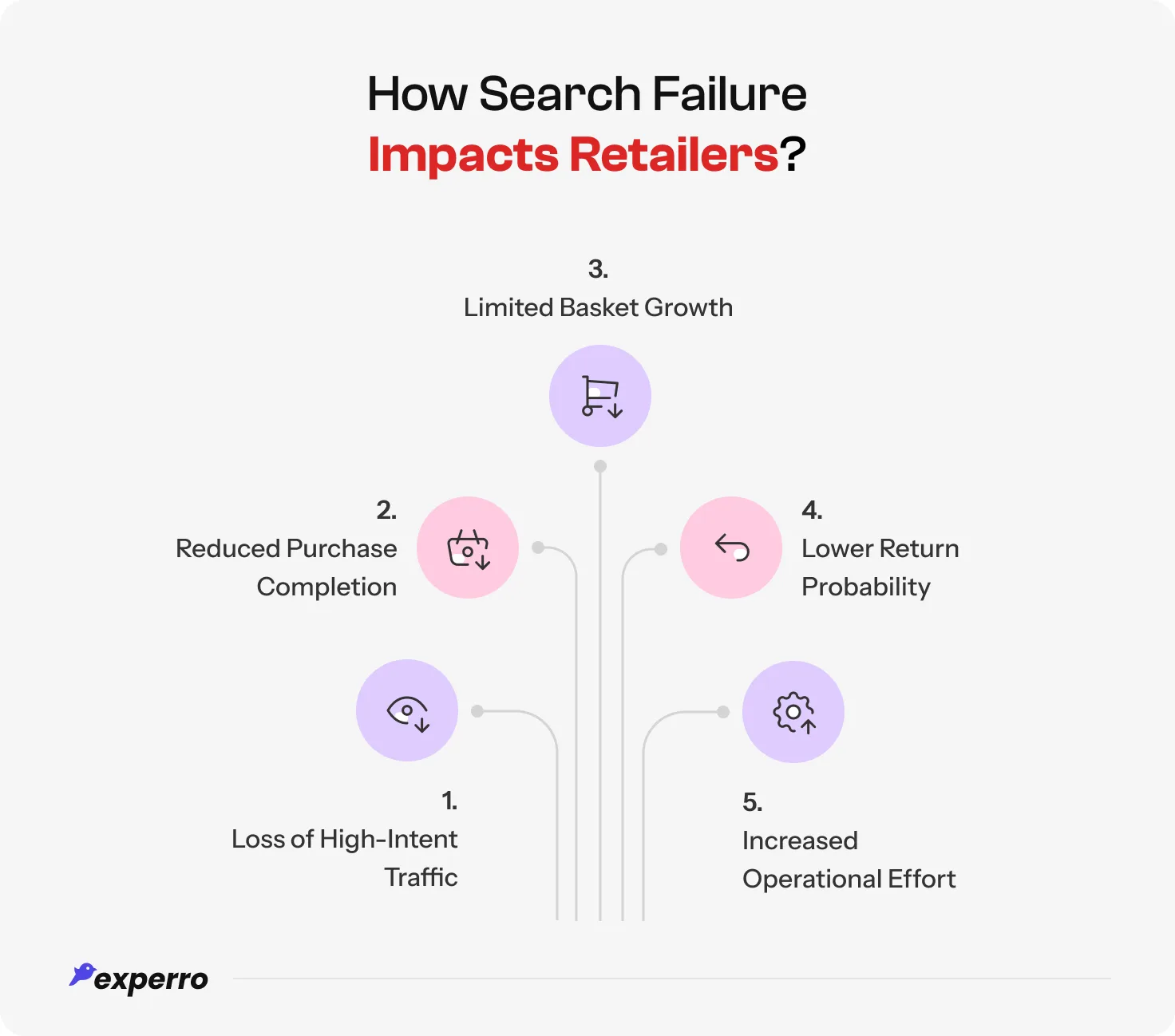
Let’s break down what this really means for your online store.
1. Loss of High-Intent Entry Traffic
A large share of your most valuable users are search users, the ones who already know what they want. These customers search directly through the search bar instead of browsing, expecting fast and relevant results.
When BigCommerce search fails at this stage, those users don’t explore further — they leave. This means your highest-converting traffic never reaches product pages, directly impacting traffic quality, conversion potential, and revenue from search-driven sessions.
2. Reduced Purchase Completion
Even when users stay, BigCommerce search is inaccurate, which creates unnecessary friction in the buying journey. Instead of delivering precise results, it often surfaces irrelevant or inconsistent products that don’t match shopper intent.
This forces customers to repeatedly refine queries, adjust filters, or browse multiple pages just to get closer to what they need. Every extra step increases effort and reduces clarity in the decision-making process.
As this friction builds, the shopping momentum breaks. Instead of moving smoothly from search to checkout, users hesitate, get distracted, or abandon the journey midway.
Over time, this directly reduces conversion rates and weakens the overall effectiveness of the eCommerce funnel.
3. Limited Basket Expansion
Strong product discovery doesn’t stop at helping users find a single item, it helps them discover what else fits their needs.
But BigCommerce search fails to surface related, complementary, or alternative products during the journey. As a result, shoppers are not guided toward better-fit or add-on items, which limits basket expansion opportunities.
Even when a purchase is completed, the absence of intelligent product suggestions reduces average order value and weakens overall revenue potential.
4. Lower Customer Return Rate
The first BigCommerce site search experience often defines whether a customer comes back. When users struggle to find relevant results, it quickly creates the perception that the store is difficult to navigate.
A poor search experience doesn’t remain limited to a single session; it directly influences whether a customer chooses to return at all.
When shoppers repeatedly face difficulty with BigCommerce product search, friction builds and confidence in the store’s ability to deliver the right products begins to drop.
Over time, this disconnect between search intent and results leads to fewer return visits. Customers are less likely to revisit a store where discovery feels effort-heavy, directly impacting retention, repeat purchases, and long-term customer value—making it a clear business consequence of search failure.
5. Increased Operational Overhead
When search systems fail to deliver relevant results, the responsibility shifts from automation to internal teams, often exposing complications in BigCommerce search that merchants must constantly manage.
Instead of acting as a self-optimizing discovery layer, the system becomes a manual process. Merchants are forced to adjust keywords, boost products, refine rules, and continuously manage visibility just to keep search usable.
In many cases, this leads to a problematic BigCommerce search experience where optimization never truly stabilizes. As catalogs expand, this workload scales into a persistent operational burden.
Over time, what should be an intelligent system turns into a maintenance-heavy workflow, increasing inefficiency and pulling focus away from core growth activities like merchandising strategy and customer experience improvement.
How Experro Fixes the Core Limitations of BigCommerce Search
You can clearly see where BigCommerce site search starts to break down — shoppers arrive with intent, but leave without finding what they need. Missed intent, irrelevant results, and weak discovery quickly interrupt the buying journey.
Even when businesses try a BigCommerce search app or shift toward BigCommerce advanced search, the core gaps in understanding and relevance often remain. When BigCommerce search doesn't understand intent or leads to BigCommerce search showing irrelevant products, the experience loses momentum and directly impacts engagement, conversions, and revenue at scale.
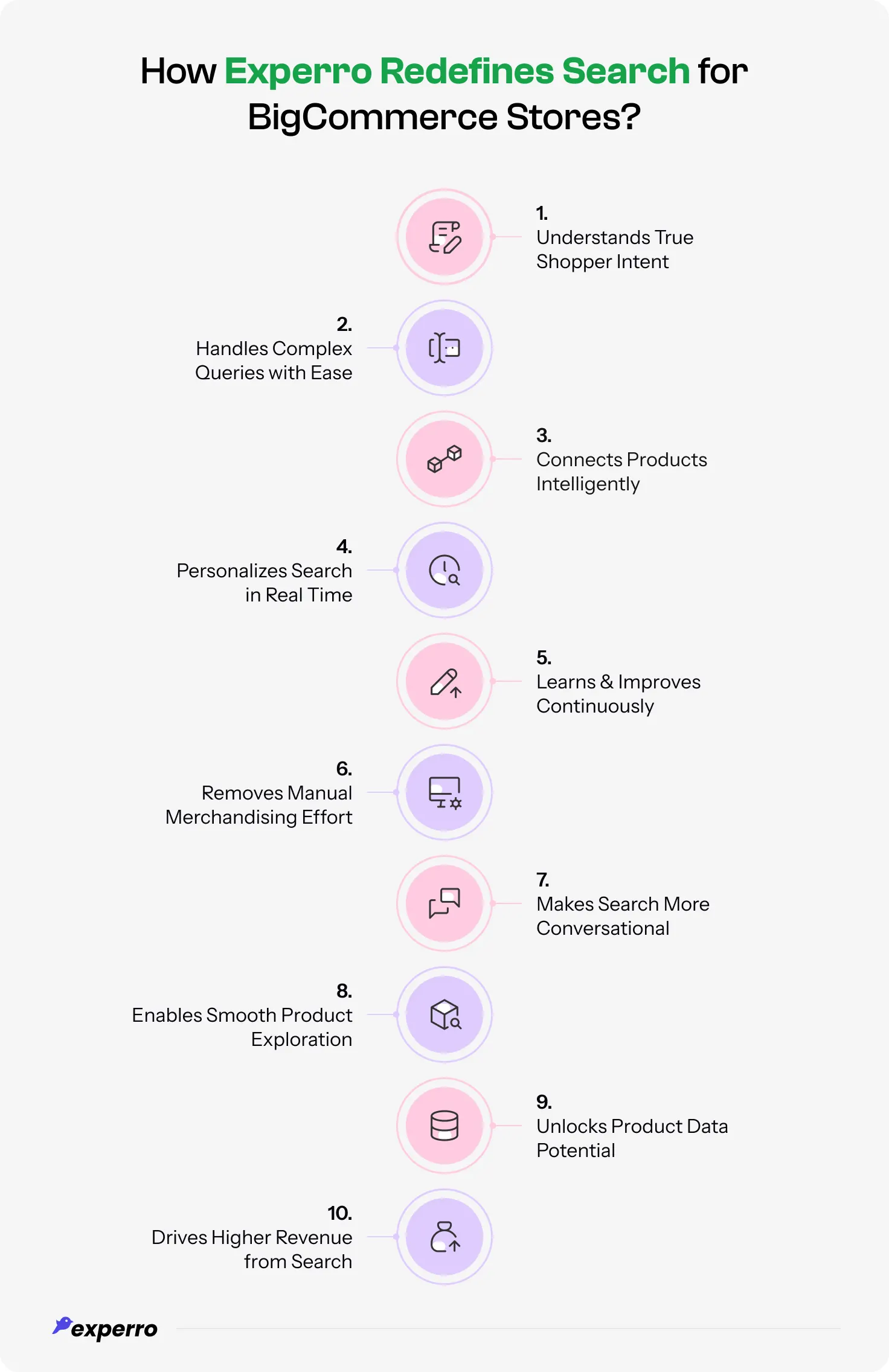
This is where the real shift begins — from exposing limitations to rethinking how search should actually understand and guide every shopper.
1. Understanding True Shopper Intent (Beyond Keywords and Queries)
Most BigCommerce search systems still rely heavily on keyword matching, which is why they often return irrelevant or incomplete results. Experro goes beyond this by understanding the intent behind a shopper’s query, not just the words they enter.
For example, when a user searches “portable laptop stands for working long hours with adjustable height”, Experro interprets the underlying intent of ergonomics, comfort, and extended usage as a single, connected need.
This leads to more relevant results and significantly improves product discovery. Instead of forcing shoppers to refine or rephrase their search, the system adapts to their intent, creating a smoother and more intuitive shopping experience.
2. Reading Natural, Complex Queries Without Losing Context
Modern shoppers don’t think in keywords — they express full intent in a single query, combining price, use case, and product type. Traditional systems often break these into isolated terms, which leads to lost meaning and irrelevant results, making it harder to improve BigCommerce search in real scenarios.
Experro solves this with AI-powered intent layering that preserves full context and understands how each element of a query connects to real shopper intent. This ensures search results stay accurate, structured, and relevant, even when queries are complex or conversational.
It is especially effective in voice search in eCommerce, where users naturally speak in long, detailed sentences that require true contextual understanding rather than simple keyword matching.
3. Connecting Products for Smarter Product Discovery
One major limitation of native systems is that they treat every item in isolation. As an AI search app for BigCommerce, Experro changes this by building intelligent, context-aware connections across the catalog.
It links:
- substitutes
- complementary products
- related categories
behavior-driven associations
This means a shopper doesn’t just see a single result — they are guided toward better alternatives, relevant add-ons, and logical next steps within the same journey. Instead of restarting their search, the experience naturally expands around their intent.
The result is stronger product discovery, deeper exploration, and higher engagement driving increased basket size without additional effort from merchants.
4. Personalizing Every Search in Real Time
Generic results are one of the biggest reasons BigCommerce search fails in modern eCommerce environments. Experro solves this by making every customer search dynamic.
- It adapts based on:
- browsing behavior
- session activity
- real-time interaction signals
- intent shifts during navigation
This ensures that every user sees different, relevant search results, improving the probability of conversion. Instead of static ranking, the system behaves like a living search engine's intelligence layer that evolves with each interaction.
Experro actually understands every shopper’s affinities and gives profile-based recommendations.
5. Continuously Improving Search Through Learning
Traditional systems remain static even as shopper behavior evolves. This often leads to missed opportunities where search results don’t reflect real-time demand or changing preferences.
It also creates performance challenges around increasing BigCommerce search speed, where systems focus on response time but not intelligent refinement of results.
Experro addresses this through continuous learning loops, aligning with BigCommerce search enhancement needs by making search adaptive rather than fixed. Every click, purchase, and interaction becomes a signal that refines future results.
This ensures that high-performing products consistently surface at the top, while low-performing or irrelevant items gradually lose visibility. Over time, this creates a self-improving system that reduces manual optimization efforts.
The result is a faster, smarter, and continuously evolving search experience that improves both discovery efficiency and long-term store performance.
6. Making Search Input Smarter and More Conversational
A weak search bar experience often leads to abandoned sessions. Experro improves this with predictive suggestions, typo tolerance, and intelligent query completion to guide users from the very first interaction.
Even when users don’t enter perfect or structured queries, Experro understands intent and delivers relevant results by interpreting meaning rather than just matching keywords, reducing failed searches and improving conversion flow.
This turns search into a guided, intent-aware experience instead of a rigid input box. It aligns with conversational search in eCommerce, where systems understand natural language and context the way users actually think and communicate for more accurate product discovery.
7. Enabling Effortless Product Exploration
Instead of forcing users to repeatedly refine searches, Experro makes product exploration feel natural and fluid through smart filtering, dynamic faceted search, and contextual suggestions that adapt to user intent in real time.
This helps customers move through large catalogs more intuitively, avoiding irrelevant loops and making it easier to narrow down the right products without friction. Navigation across pages, categories, and listings becomes more structured and goal-driven rather than trial-and-error based.
It naturally aligns with autocomplete search in eCommerce, where guided inputs and real-time suggestions help users transition smoothly from search to discovery with minimal effort.
8. Turning Product Data into Search Intelligence
Most eCommerce platforms already have rich product data, but it often remains underutilized. With improve BigCommerce product discovery challenges, valuable catalog depth fails to translate into meaningful search outcomes, leaving shoppers unable to find the most relevant products.
Experro changes this by activating product data through behavioral signals and structured catalog intelligence. Instead of treating data as static fields, it transforms them into dynamic inputs for smarter search experiences.
It fully leverages:
- product attributes
- detailed product descriptions
- category mapping
- structured metadata
At the same time, it also addresses performance inefficiencies tied to improve BigCommerce search speed, ensuring that search is not only intelligent but also fast and responsive even at scale.
This combination reduces SEO limitations, improves relevance, and prevents valuable products from being hidden due to weak indexing or duplicate content issues.
The result is a cleaner, faster, and more intelligent discovery system that enhances visibility and product findability across the entire store.
9. Driving Revenue Through Search Intelligence
Search-driven shoppers often contribute up to 60% of eCommerce revenue, making search a critical growth lever. Yet, keyword-based traditional BigCommerce search and the fact that BigCommerce search can't handle synonyms limit its ability to capture real intent—leading to missed conversions. Even faster BigCommerce search fails to help if results lack relevance.
This is where Experro shifts the equation — from limitation to revenue opportunity. By moving beyond keyword dependency, it understands shopper intent in real time and delivers results that actually guide decisions.
Instead of just returning products, Experro actively drives revenue by improving:
- relevance with context-aware results
- intent matching beyond exact keywords
- conversion flow by reducing friction
- engagement depth through personalized discovery
This makes search a strategic growth lever rather than just a functional tool.
Experro brings together everything modern eCommerce search needs, intent understanding, contextual relevance, personalization, predictive guidance, and continuous learning, to remove the friction users feel inside BigCommerce search.
Instead of forcing customers to refine queries or work around limitations, it responds the way real shoppers think: dynamically, contextually, and in real time.
Every interaction becomes part of a smarter system that keeps improving with use, making search not just a way to find products, but a reliable path to conversion and growth.
Conclusion
Search is often the first real conversation between your customer and your store. They arrive with intent, type what they need, and expect the right answer immediately. But when that moment doesn’t deliver clarity, BigCommerce search fails to keep that conversation going.
What happens next is subtle but costly. Users scan irrelevant search results, try once or twice more, and then leave without saying a word. Even highly motivated search users don’t wait around — they move on. And just like that, opportunity is lost inside your online store.
Today’s customers expect search to feel effortless, like intelligent search engines that understand meaning, not just keywords. When your search doesn’t meet that expectation, every query becomes a missed chance to convert intent into action.
If you’ve seen this happening, your search is already holding back growth.
See how Experro’s AI-powered search changes this by understanding intent and improving every customer search in real time.
Book a demo with us to explore how it improves search relevance, enhances product discovery, and drives higher conversions.
FAQs

With 6+ years of experience in AI, software, and digital transformation across tech, healthcare, and fashion, Rahul focuses on making complex ideas simple, clear, and actually useful. He has learned how often great ideas get lost in complexity, which is why he centers his writing on clarity, helping entrepreneurs and leaders cut through noise and make decisions with confidence.
Subscribe to Our Newsletter!
Get the latest insights delivered straight to your inbox.
Recommended Reads