

core insights box
- Search relevance boosts user satisfaction because, despite search queries being imperfect, users get perfect results.
- Key factors that influence the accuracy of search outcomes include keyword synonym matching and understanding user intent together.
- AI is transforming the future of search relevance with advancements in semantic search, voice search, and real-time personalization.
- Experro enhances search relevance by leveraging AI and ML to deliver personalized and accurate search results.
Ever typed a search query and instantly found exactly what you were looking for, even when you didn’t use the “right” words?
That seamless experience is driven by search engine relevance. It determines how accurately an eCommerce search engine understands shopper intent and delivers results that feel intuitive, timely, and useful.
This matters more than most brands realise. Research shows that over 40 percent of shoppers abandon an eCommerce site after encountering irrelevant search results, making relevant search in eCommerce a direct driver of revenue, not just user experience.
Whether customers are searching for a specific product or exploring options, search relevance shapes how quickly they find what they need and how confident they feel in their purchase decisions.
For businesses, search relevance improvement is not a UX enhancement alone. It directly impacts engagement, trust, and conversion rates. So what makes search results truly relevant, and how can brands measure and improve them at scale?
What Is Search Relevance?
Search relevance refers to how accurately search results match a user’s query and intent, ensuring they find the most useful information or products quickly and efficiently.
Rather than relying only on keyword matching, modern search relevance evaluates multiple signals, including content quality, contextual factors such as location or browsing history, and user engagement signals like clicks and time spent on results.
In advanced search systems like Experro, machine learning and AI continuously analyse these signals to understand meaning and context, rank results more effectively, and deliver highly relevant outcomes that improve user satisfaction and business performance.
What Is the Importance of Search Relevance?
Throwing some light on the importance of search relevance:
Delivers accurate and useful results instantly - eCommerce search relevance ensures users find what they are looking for the moment they enter a query.
Directly impacts customer satisfaction and trust - Relevant search results reduce frustration and create confidence in the shopping experience.
Prevents missed sales opportunities - In eCommerce, irrelevant results often cause users to abandon searches, leading to lost revenue. In eCommerce, where product search bar UI relevance is crucial, irrelevant results can lead to missed sales opportunities.
Improves engagement across the search journey - Strong search relevance increases click-through rates, time on site, and product discovery.
Supports higher conversion rates - When results align with user intent, shoppers are more likely to complete purchases.
Enables scalable optimisation through AI - Modern search relevance algorithms combine keyword matching and user intent to continuously improve result quality.
The next section will talk about the factors that affect search relevance and its effectiveness.
Which 'Factors' Influence Search Relevance in Modern eCommerce?
The accuracy of search result relevance depends on several factors.
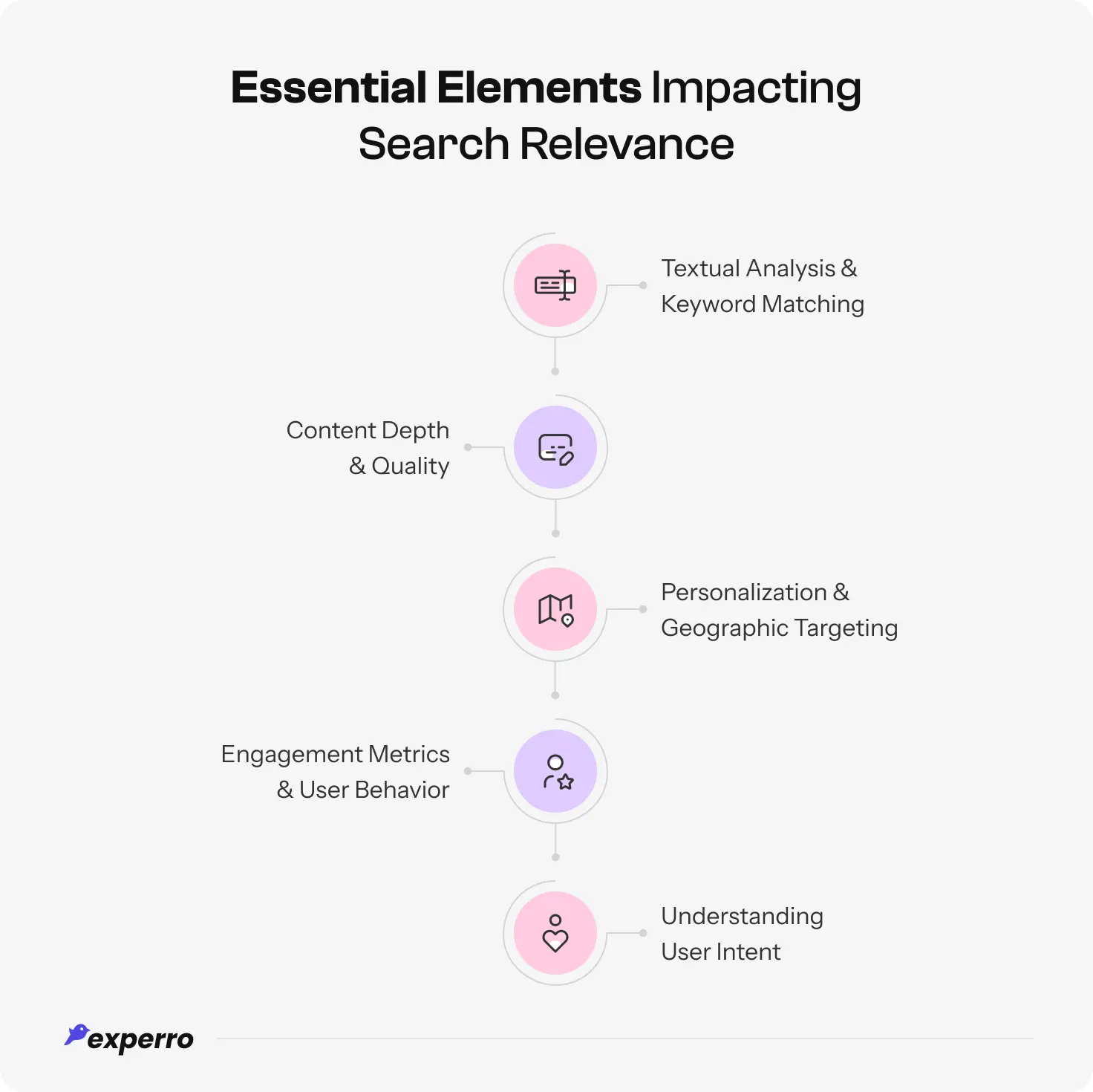
Here are some of the key elements that contribute to a more relevant search experience:
1. Textual Analysis and Keyword Matching
This is the foundation of search relevance. Searchandising algorithms rely heavily on analyzing the text in both the user’s query and the content to find keyword matches.
Accurate textual relevance ensures users get the most relevant results based on their search terms. Fine-tuning the search relevance score through keyword matching improves search accuracy.
2. Content Depth and Quality
The value of content also affects the relevance of search results. High-quality content that covers a topic in detail is more likely to rank higher in relevance search.
3. Personalization and Geographic Targeting
Personalization at scale is essential for improving search relevance. AI search relevance technologies consider factors like location, preferences, and browsing history.
For instance, eCommerce product search relevance evaluation can vary by region, offering tailored results based on geographic data.
4. Engagement Metrics and User Behavior
Measuring search relevance often involves analyzing engagement metrics. Click-through rates, bounce rates, and time spent on a page are important indicators that impact the search relevance evaluation process.
Algorithms adjust the search term relevance based on how users interact with the search results and their shopping behaviors tracked through eCommerce analytics.
5. Understanding User Intent
Web search engines now focus on a user's search intent to deliver results. By analyzing patterns, search relevance machine learning can predict what the user truly wants.
The algorithm adjusts to deliver relevant results based on past behavior, making the search bar experience more accurate and personalized.
How to Measure the Search Relevancy?
The true value of search relevancy shows up in how quickly users find what they want and how often that discovery turns into a purchase.
Search Relevance + Personalization = Revenue $
Search relevance is measured by how effectively results align with user intent, not by a single universal score. Instead, relevance is assessed through user behaviour and engagement patterns.
Some teams use industry benchmarks such as BEIR or MS-MARCO to test ranking performance, but these provide directional insight rather than an absolute relevance measure.
Modern search relevance algorithms improve continuously by learning from user interactions, engagement data, and feedback, helping search results stay aligned with evolving intent.
Additionally, search relevance algorithms can be refined based on user feedback, engagement metrics, and data from eCommerce analytics tools, leading to more relevant search results.
What Strategies Can Help You Drive More Relevant Searches?
Optimizing search result relevance requires specific strategies.
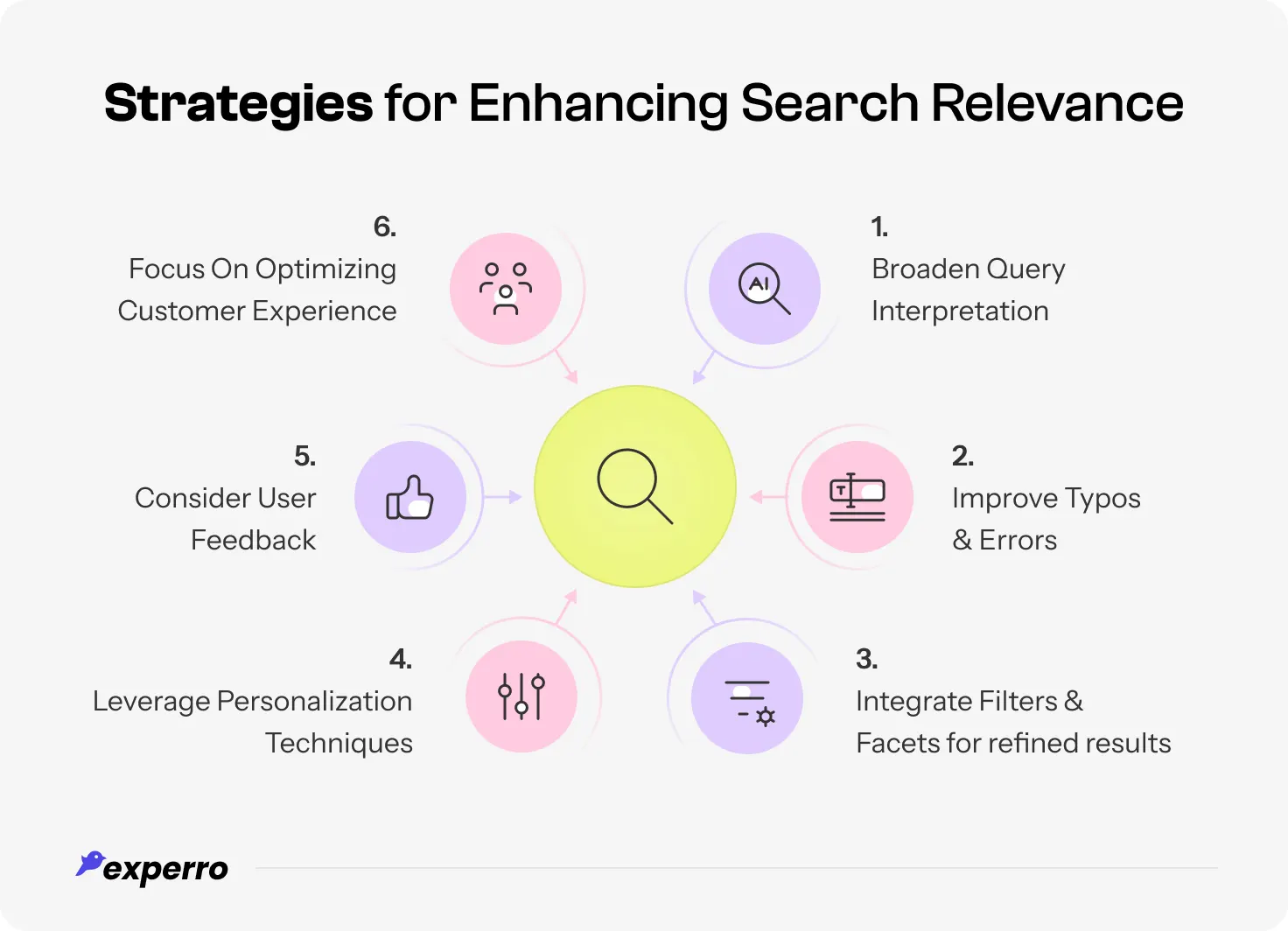
Let’s explore some of the best approaches:
1. Broaden Query Interpretation
Users often use different phrases for the same concept. Understanding search queries at a deeper level ensures relevant results are shown, even when users phrase things differently. This helps avoid zero-result pages.
Algorithms can analyze synonyms and variations, offering a more expansive and inclusive search result relevance.
2. Improve Typos and Errors
Correcting user errors like typos is essential for search result accuracy. Returning relevant search results (even if the query contains errors) ensures the search system provides the most relevant search experience.
The fuzzy search understanding helps retain users who might otherwise get frustrated by missed searches.
3. Implement Filters and Facets for Refined Results
eCommerce Filters allow users narrow down their search, increasing search result relevance. By integrating facets like price, category, or brand, eCommerce search relevance can be optimized.
It helps users fine-tune their queries, ensuring more relevant searches and reducing irrelevant results.
4. Leverage Personalization Techniques
Using AI to personalize search results based on past behavior, preferences, and geography increases the relevance of search results.
Hyper-personalization techniques enhance user satisfaction and improve search relevance rankings.
5. Consider User Feedback to Improve Results
Gathering feedback through user interactions helps to refine search systems. Measuring search relevance metrics like satisfaction scores and incorporating this data into the algorithm boosts accuracy.
This feedback loop can optimize search relevance continuously.
6. Focus On Optimizing Customer Experience
The overall improvement of customer experience directly impacts search relevancy. A search system designed with the user in mind, from speed to ease of navigation, will deliver more relevant information.
This improves search relevance optimization, leading to increased conversions and customer loyalty.
Why settle for basic AI search? Experro combines intelligent, real-time personalization with strong search relevance, making it a powerful alternative to legacy search platforms like Klevu.
What Are the Key Challenges in Achieving AI Search Relevance?
As with any technology, there are challenges in maintaining optimal search result relevance:
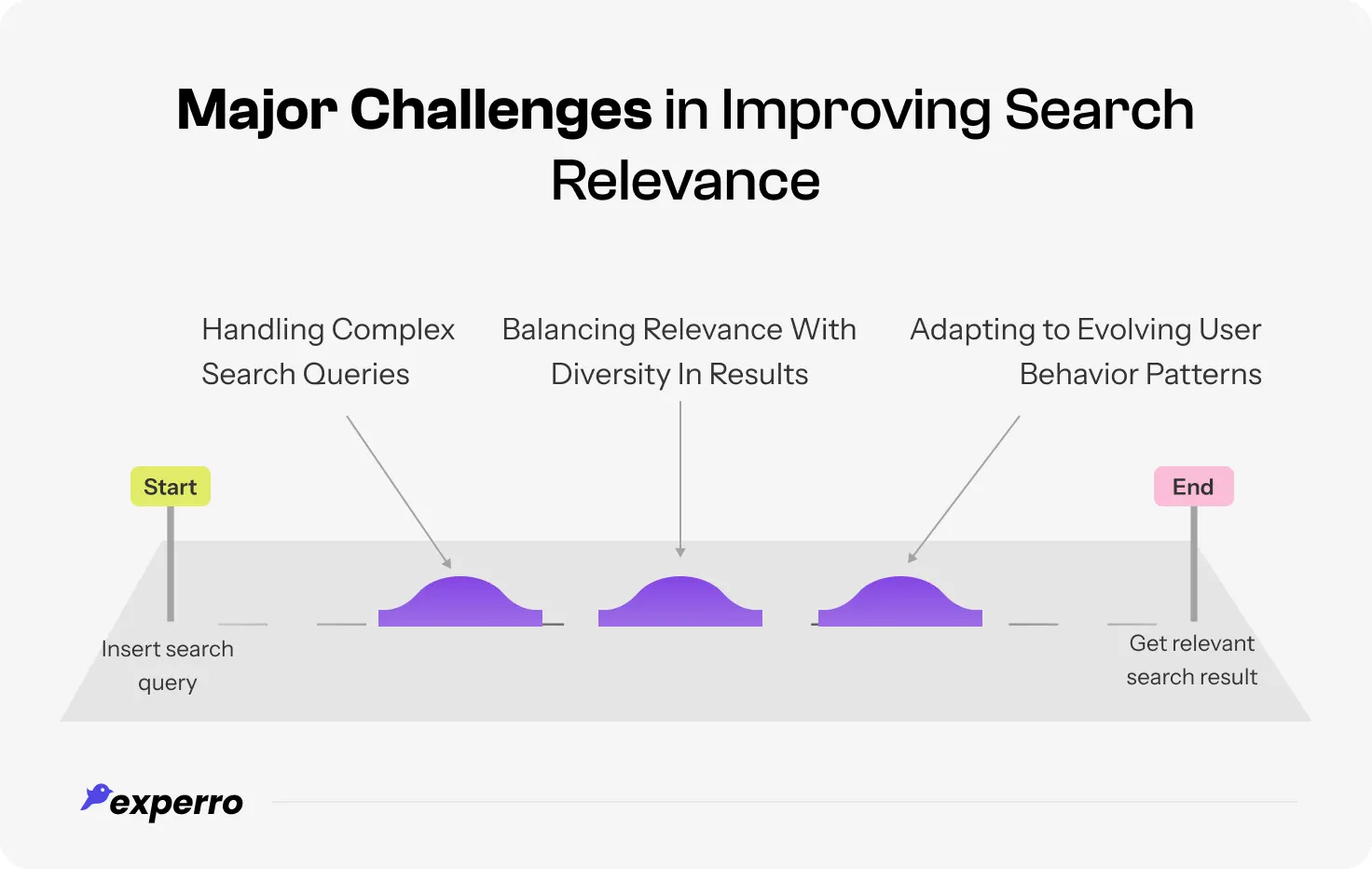
1. Handling Complex Search Queries
Complex or multi-part queries can be difficult to interpret. An effective search relevance algorithm must dissect such queries and deliver accurate results.
AI-driven search intelligence is improving, but handling complex searches remains a key challenge.
2. Balancing Relevance With Diversity in Results
Offering diverse but relevant search results can be tricky. While delivering relevant searches is important, too much relevance might limit users' options.
Achieving the right balance between relevance and diversity in a product search engine helps ensure a satisfying search experience.
3. Adapting to Evolving User Behavior Patterns
User behavior changes over time, requiring search relevance optimization to evolve. Search engines must adapt by continuously learning from engagement metrics and feedback.
Keeping up with these changes ensures the search system stays relevant to the user's needs.
Solution - To sum it all up, Experro can handle complex or lengthy queries, can still give relevant results, and also understand the intent behind user queries deeply.
What Are the Future Trends in Search Relevance?
Relevant search results are evolving rapidly.
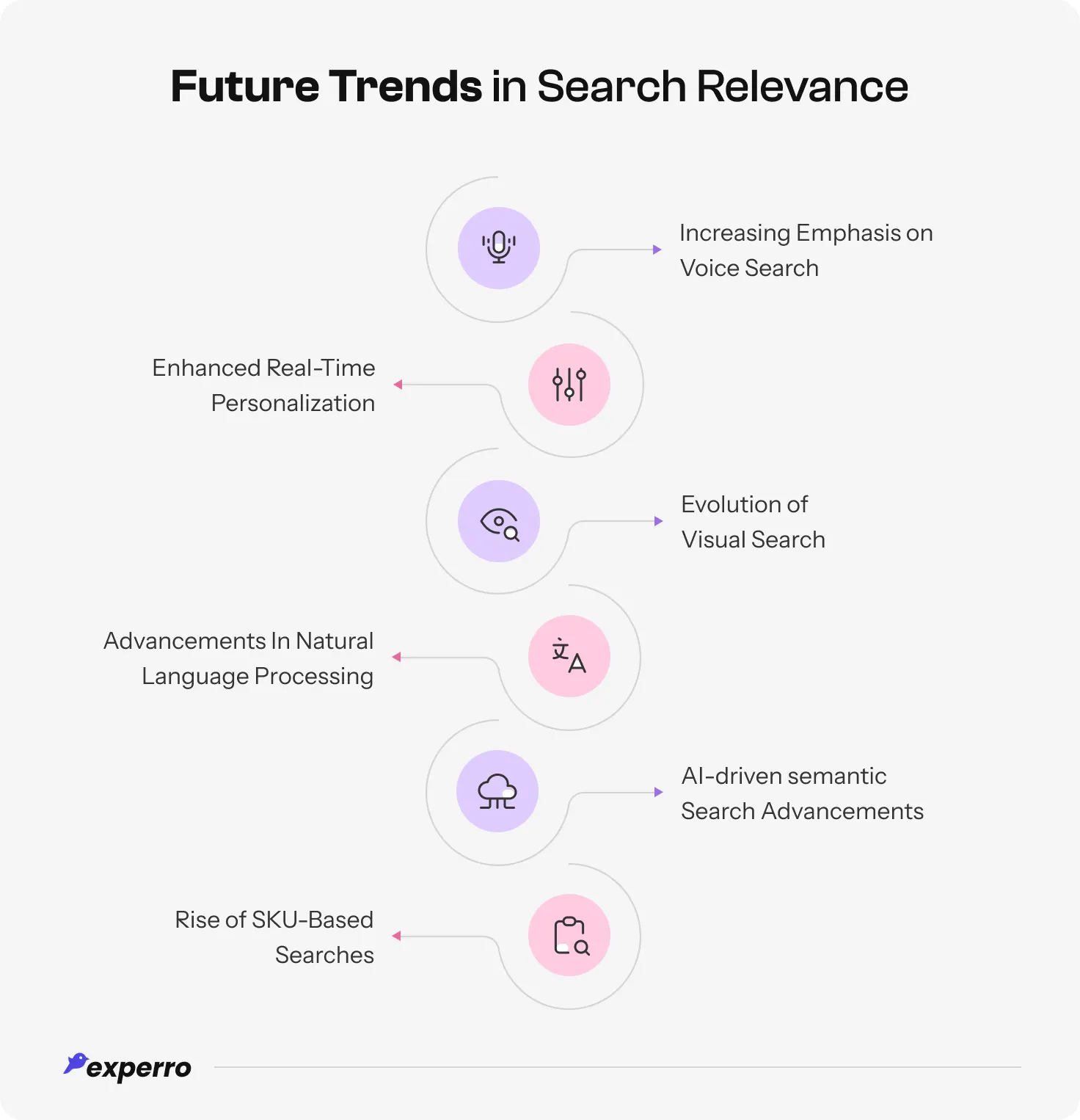
Here are the key trends shaping the future:
1. AI-driven Semantic Search Advancements
Semantic search powered by AI is transforming how search engines understand user queries. This allows search relevance systems to better interpret the meaning behind words, delivering more accurate and relevant search results pages.
2. Increasing Emphasis on Voice Search
Voice search is becoming more common, and search relevance algorithms need to adjust. Voice queries tend to be longer and more conversational, requiring search systems to interpret them accurately for relevant search experiences.
3. Advancements in Natural Language Processing
Natural language search technologies are improving result relevance by better understanding the nuances of language. These advancements help search relevance systems deliver more context-aware results.
4. Enhanced Real-Time Personalization
As search personalization advances, its impact is becoming measurable. Users coming from AI-powered search experiences spend 8 percent longer on sites than those arriving through traditional search.
AI-driven systems can provide real-time adjustments to search results based on user actions, leading to more relevant searches and better customer experiences.
5. Evolution of Visual Search
Visual search is gaining traction, especially in eCommerce. Future search relevance systems will need to integrate visual recognition technology to provide relevant search experiences based on images rather than text alone.
6. Rise of SKU-Based Searches
Experienced shoppers and B2B buyers increasingly rely on SKU-based searches to find specific products quickly. Search relevance systems must support exact-match capabilities and recognize SKU patterns to ensure fast and precise results.
Monetize Search Relevance to Drive Conversions
Learn how your brand can achieve results, similar to our client JustRae, with Experro’s AI-powered search relevance tools.

How Does Experro Strengthen eCommerce Search Relevance for Your Retail Brand?
For relevant search in eCommerce, Experro continuously learns from real shopper interactions, including clicks, conversions, and engagement signals. As a result, relevance improves automatically over time rather than requiring constant manual optimisation.
With Gen AI-powered search, Experro ensures to understand the intent behind a user's search query and then display the search results.
Experro also functions as a complete search relevance tool, combining intelligent ranking, behavioural learning, and built-in analytics. This gives teams clear visibility into relevance performance, zero-result queries, and optimisation opportunities, without the complexity or fragility seen in many competing solutions.
The outcome is a search experience that is stable, adaptive, and aligned with real customer intent, helping retailers achieve sustained search relevance improvement, higher engagement, and stronger conversion performance.
Conclusion
Contextual relevance in search is critical for delivering accurate, useful results. Optimizing accuracy not only enhances user satisfaction but also increases business growth.
As AI and ML technologies evolve, relevant search results will become more dynamic and personalized.
Businesses must invest in improving search relevance algorithms, measuring search relevance, and leveraging personalization techniques to stay competitive in the digital market.
To learn more about delivering more precise search results to your customers, get on a call with our team.
FAQs

Pallavi is an ambitious author recognized for her expertise in crafting compelling content across various domains. Beyond her professional pursuits, Pallavi is deeply passionate about continuous learning, often immersing herself in the latest industry trends. When not weaving words, she dedicates her time to mastering graphic design.
Subscribe to Our Newsletter!
Get the latest insights delivered straight to your inbox.