- Agentic Experience
- Personalization
- Generative AI
- 10 min read
What Is Agentic Personalization in eCommerce?
Published
16 May 2025Updated
20 April 2026

core insights box
- Agentic personalization goes beyond recommendations; AI agents autonomously reshape search, content, and product discovery based on how each shopper behaves in real time.
- The moment a shopper lands, AI agents are already reading signals most teams don't even know to track.
- Agentic personalization doesn't just improve the shopping experience; it quietly removes every friction point before the customer notices it.
- Experro's agentic personalization brings all of this to your store: real-time AI, adaptive merchandising, and intelligent search, built to convert.
No two shoppers are alike. But your store doesn't know that yet. That's the problem!
The first-time visitor browsing sneakers and the loyal customer coming back for the third time this week, both of them see the same layout, same banners, same recommendations. And most brands still think that's fine.
Trust us when we say it, IT'S NOT!!!
Shoppers have been conditioned by Netflix, Spotify, and Amazon to expect experiences that feel built for them. When your storefront doesn't deliver that, they don't tell you. They just bounce.
Rule-based personalization tried to bridge this gap and it helped, for a while! But manually managed segments and static conditions can't keep up with how fast real shopper intent moves.
What rule-based traditional personalization can't, agentic personalization can! It doesn't wait for you to update a rule or rebuild a segment. It observes, decides, and adapts in real time, for every single visitor.
In this guide, we break down what agentic AI personalization actually is, how it works under the hood, real-world examples, and how forward-thinking eCommerce brands are using it to build experiences that convert.
What Is Agentic Personalization?
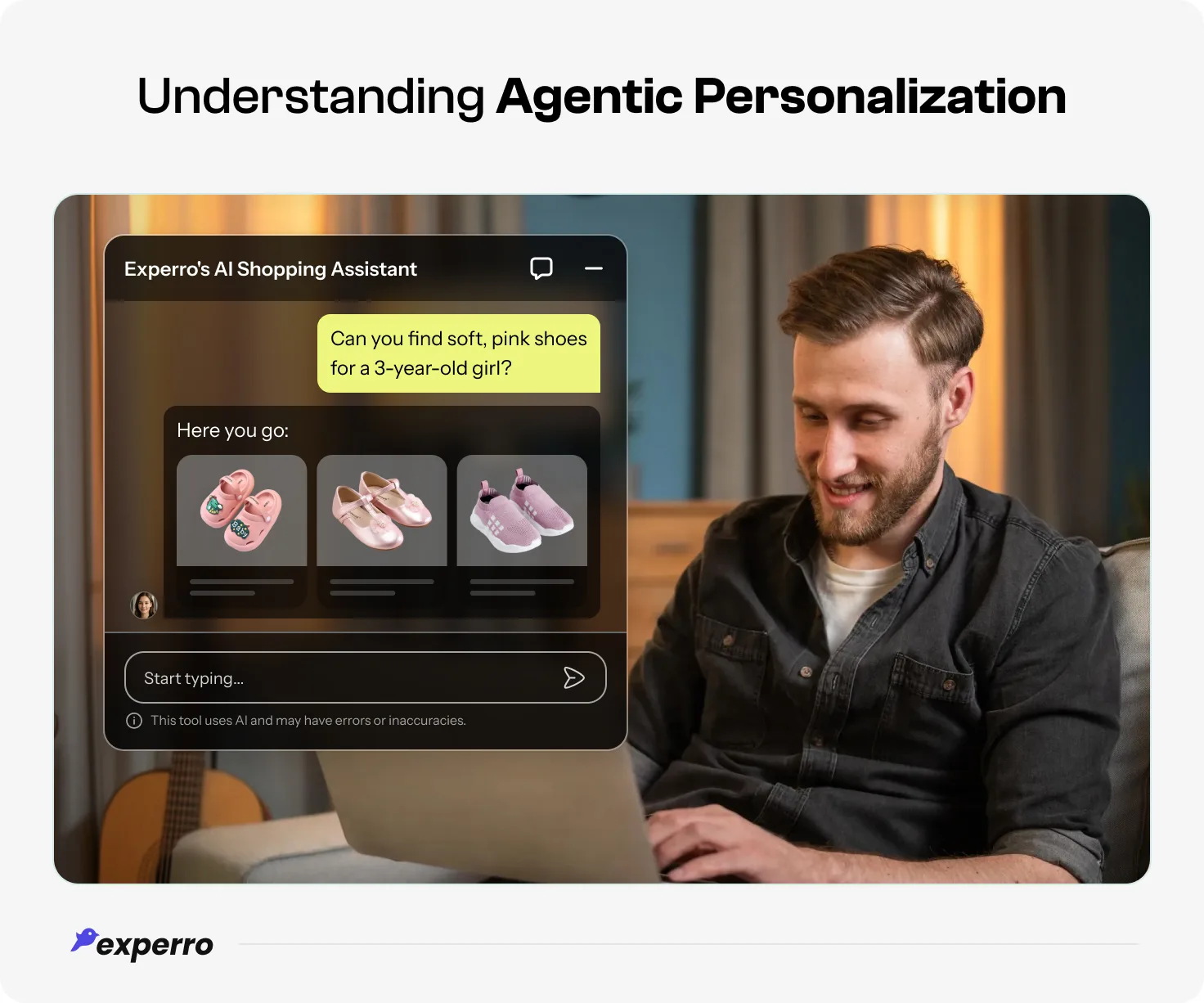
Agentic Personalization is powered by autonomous AI agents that learn from each shopper's behavior in real time and act independently to shape their experience — no manual rules, preset segments, or human intervention required.
Unlike static rules or behavioral tags, this model uses large language models (LLMs) to continuously read user signals and make decisions: reshuffling product listings, swapping content blocks, and recommending new categories.
The agents operate on goals like improving conversions or increasing engagement, not on instructions.
That's what makes agentic AI in CX fundamentally different — it doesn't wait for input. It proactively guides each journey based on intent, behavior, and context as it happens.
But how exactly does this differ from the traditional personalization most eCommerce stores are already doing?
Comparing Agentic Personalization vs Traditional Personalization
While traditional personalization focuses on pre-set rules and reactive experiences, agentic personalization for online retailers uses AI-driven logic to create proactive, adaptive engagements.
Here's a clear comparison:
| Point of Difference | Traditional Personalization | Agentic Personalization |
|---|---|---|
| Approach | Rule-based, reactive | AI-driven, proactive |
| Adaptability | Static experiences | Learns & adapts in real-time |
| User Input | Waits for behavior and prompts | Predicts behavior and performs action |
| Scalability | Manual configurations | Scales automatically through autonomous decisions |
| Channel Coverage | Fragmented | Unified omnichannel delivery |
How Does Agentic Personalization Work?
The agentic personalization begins with intelligent agents embedded within your digital e-store. These intelligent agents observe user behavior, extract patterns, and take actions autonomously to optimize the journey in real time.
AI-orchestrated personalization relies on an intelligent stack of technologies that combine to personalize every customer interaction. These systems aren’t just reactive, they’re proactive, predictive, and self-improving — exactly how Experro’s Gen AI-powered personalization engine is redefining modern commerce.
From real-time behavior capture to adaptive learning loops, here’s a simple breakdown behind the working model of agent-based personalization:
| Phases | What's happening behind the scenes? |
| Watching | The moment a shopper lands, AI starts observing every click, scroll, pause, and skip to understand what they're looking for right now, not six months ago. |
| Building a Live Profile | Based on those signals, it builds a real-time picture of who this shopper is and what they want today. |
| Making a Decision | Without waiting for any rule or human input, the AI decides what this shopper should see next - which products, which content, which layout. |
| Reshaping the Experience | The store adapts — product order changes, recommendations update, content shifts, all within milliseconds, without the shopper noticing a thing. |
| Learning From the Outcome | Whether the shopper clicked, ignored, or bounced, that reaction feeds back into the system, making the next decision sharper. |
Now that you know how agentic personalization works, here's what it actually looks like in action.
What Are the Examples of Agentic AI Personalization?
Agentic personalization isn't a concept on a roadmap anymore. Retailers are running it in production today and the gap between those who are and those who aren't is already showing up in conversion numbers.
Here are some of the real-world examples of agentic AI personalization:
1. Amazon Rufus: From Recommendation to Action
Rufus reads your order history, tracks live browsing behavior, and can autonomously execute a purchase when a product hits your set target price. It doesn't suggest, it acts!
2. Sephora × ChatGPT: Personalization Outside the Storefront
According to a recent news from Sephora, it has launched an app inside ChatGPT that lets shoppers ask beauty questions conversationally and receive curated recommendations based on the full product catalog. The agent lives where the customer already is — not waiting for them to visit the site.
3. Nike: NikeAI That Knows You
Nike's AI agent pulls from your purchase history, loyalty profile, and real-time intent simultaneously. Ask it "trail shoes for wet weather under $150" and it filters across 170M+ member profiles worth of behavioral data to surface what's actually right for you, not just what matches the keywords. It learns with every interaction, getting sharper the more you use it.
How Agentic Personalization Will Look on Your Store: Key Use Cases
The following are some of the use cases of personalization done by AI agents:
1. Search That Gets Smarter With Every Query
Agentic search reads what a shopper has browsed, bought, and is doing right now and uses all of it to decide what surfaces first. Agentic personalization makes sure that a budget-conscious shopper and a premium buyer typing the same word should never see the same results.
2. A Homepage That's Different for Every Visitor
A first-time visitor sees bestsellers. A returning shopper sees what they left behind. A loyal customer sees new arrivals in categories they actually buy from. No manual rules, the agent decides the layout based on who just landed.
3. Recommendations Built on What People Skip, Not Just What They Click
Agentic AI personalization tracks the full picture: what was clicked, scrolled past, added then removed, compared but not bought. The recommendations that come out of that are genuinely different from "customers also bought."
4. Proactive Nudges at the Exact Moment a Shopper Is About to Leave
A shopper lingers on a product page, scrolls back up, hovers toward the back button. Through omnichannel personalization, the agent catches that signal and responds: a stock alert, a relevant bundle, a personalized offer before the moment passes.
What Are the Benefits of Agent-Based Personalization In Commerce?
Agentic AI hyper personalization does more than improve recommendations — it changes the commercial outcomes of your store in ways traditional personalization simply can't match. Read on to know the real benefits it brings to your eCommerce business.
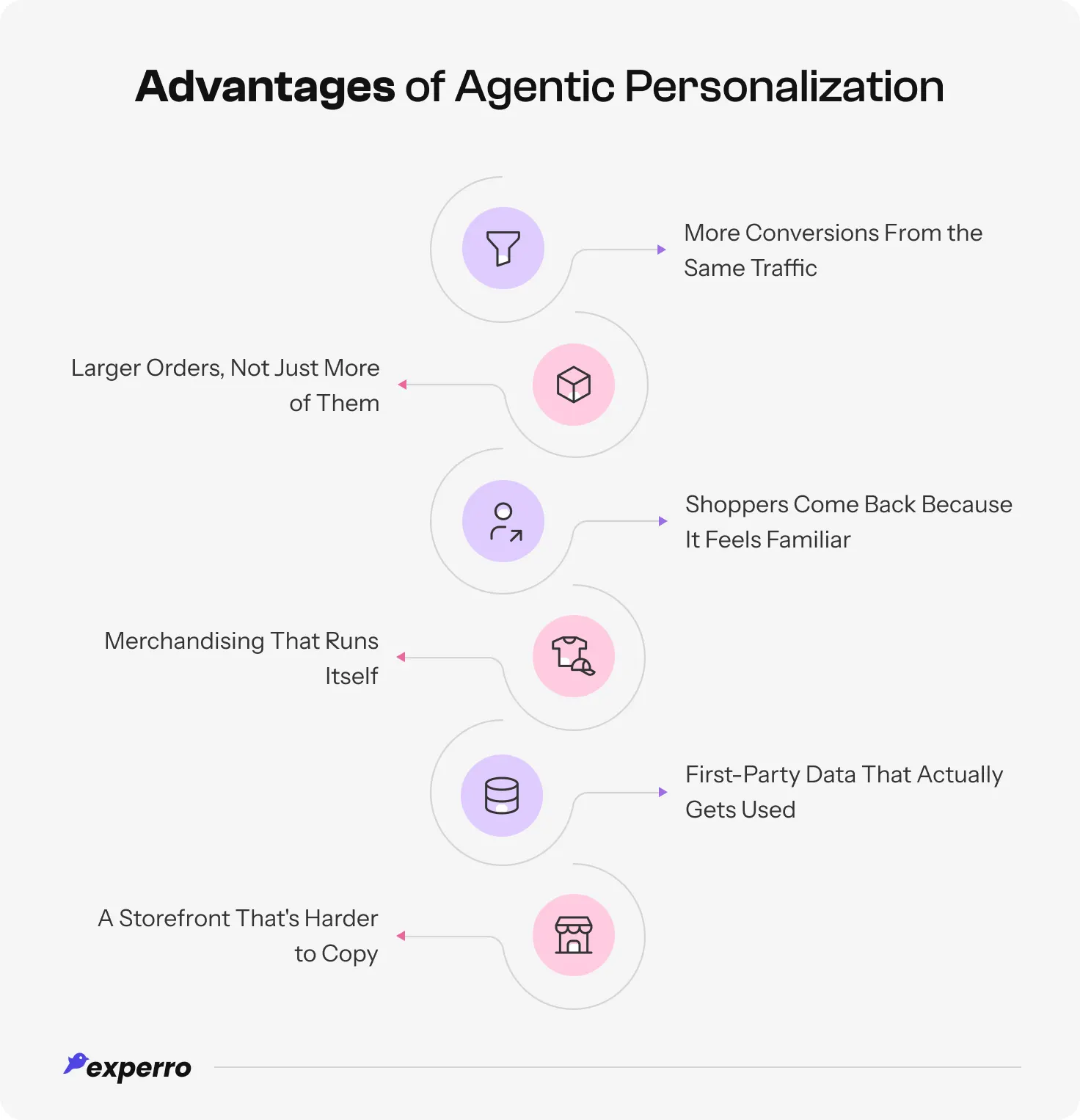
1. More Conversions From the Same Traffic
Agentic personalization works on visitors already on your site. When every shopper sees search results and recommendations built around their actual intent, more visits end in a purchase, without spending more on ads.
2. Larger Orders, Not Just More of Them
The agent knows what a shopper hesitated on, compared, and skipped. Experro's AI recommendation engine uses that contextproduces recommendations that genuinely complement what's in the cart, not generic upsells that get ignored.
3. Shoppers Come Back Because It Feels Familiar
Every return visit builds on the last one. The store remembers preferences, past behavior, and browsing patterns, making each session feel more intuitive than the one before. That feeling drives repeat purchases.
4. Merchandising That Runs Itself
No rules to configure, no segments to manually update. With Experro's ecommerce merchandising software at the core, the agent handles thousands of shopper profiles simultaneously and adapts in real time. Your team focuses on strategy, not maintenance.
5. First-Party Data That Actually Gets Used
Most brands collect behavioral data and barely touch it. Agentic personalization puts every signal to work- clicks, skips, dwell time, comparisons and gets sharper with every session.
6. A Storefront That's Harder to Copy
Competitor brands can replicate your products and pricing. They can't replicate months of accumulated shopper intelligence built into your personalization layer. That's a compounding advantage.
After learning all the benefits, let’s dive deeper into the hurdles of implementing adaptive experience personalization in eCommerce in the next section.
Challenges of Implementing Agentic Personalization in eCommerce
Despite the benefits, challenges of agentic personalization in eCommerce can’t be ignored:
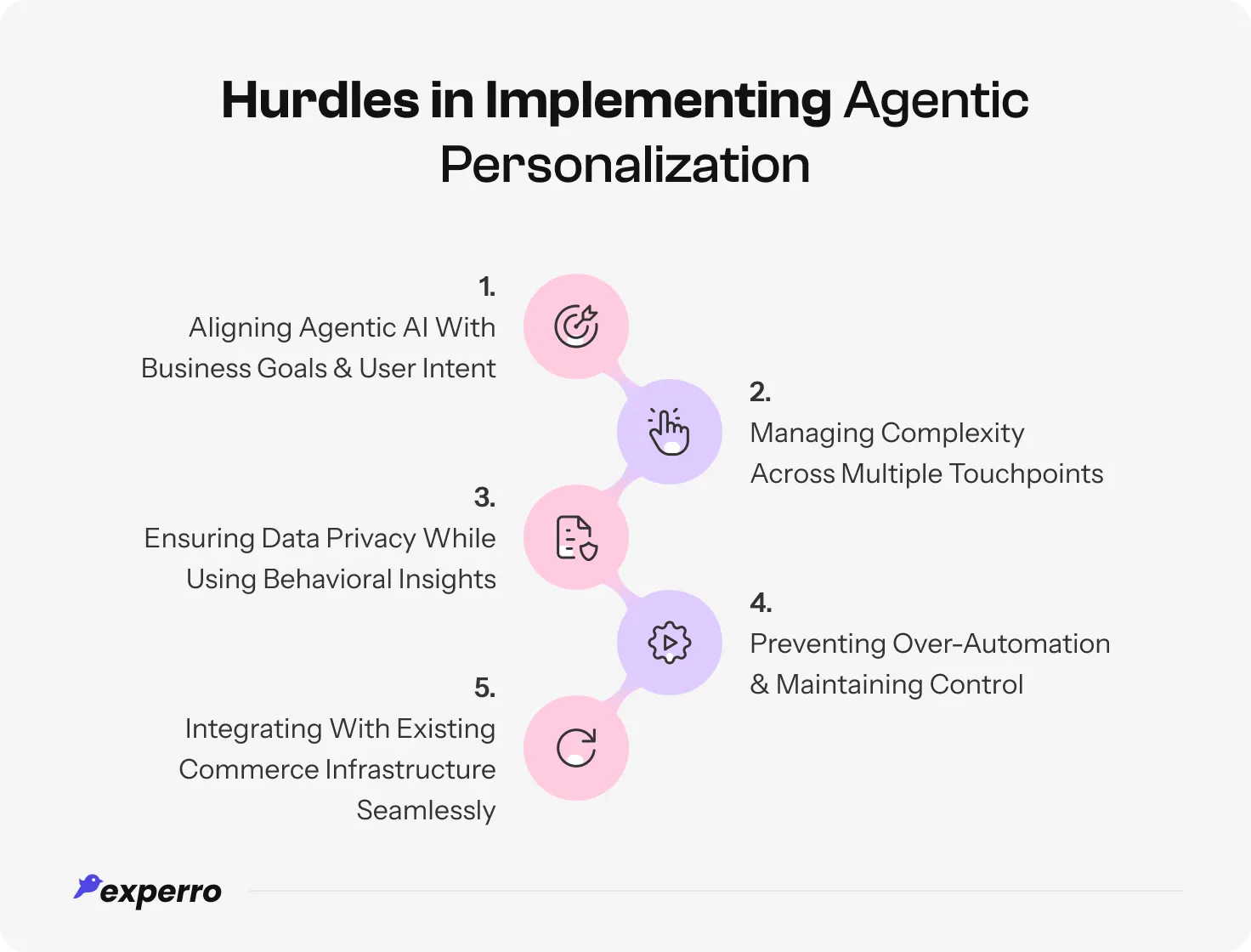
1. Aligning Agentic AI With Business Goals and User Intent
Agents may act independently, but without aligned goals, they risk pursuing metrics over meaning. It's critical to frame AI objectives around both customer loyalty and business ROI.
Even the smartest agent is ineffective if it lacks a clear, business-aligned purpose.
Unlike other agentic experience platforms, Experro's agentic personalization engine is built to balance real-time shopper behavior with your specific business rules, so the agent never chases metrics at the cost of your actual goals.
2. Managing Complexity Across Multiple Touchpoints
As personalization spreads across devices, ensuring consistent behavior becomes complex. AI agents must understand the user’s context across sessions and channels.
Gaps in synchronization can create jarring experiences that frustrate users and reduce trust. Seamless orchestration is no longer optional, but it's expected.
Experro handles cross-channel complexity through a centralized data layer that keeps every touchpoint - web and mobile in sync.
3. Ensuring Data Privacy While Using Behavioral Insights
Customers expect a journey of personalization, but also demand privacy. Striking this balance is tough when collecting and using behavioral data. Missteps in data handling can damage brand reputation and violate regulations. Agentic AI must be privacy-conscious by design.
That’s why Experro offers built-in consent management and anonymization tools to balance personalization with compliance.
4. Preventing Over-Automation and Maintaining Control
Agents may deliver shopping experiences that feel impersonal or unpredictable. Guardrails, testing, and human overrides must be built-in. Blind automation without oversight risks alienating customers. Brands must always remain in the driver’s seat.
Experro handles the balance between agent autonomy and human oversight through customizable workflows and manual override controls.
5. Integrating With Existing Commerce Infrastructure Seamlessly
Legacy systems often resist change. Integrating agentic personalization tools and technologies with older platforms can be resource intensive. Inflexible architecture can stall implementation and limit AI capabilities. Compatibility must be prioritized from the start.
To ease this, Experro’s API-first, headless architecture makes integration with legacy systems and modern stacks frictionless.
How Experro Delivers Agentic Personalization Across Your Entire E-store
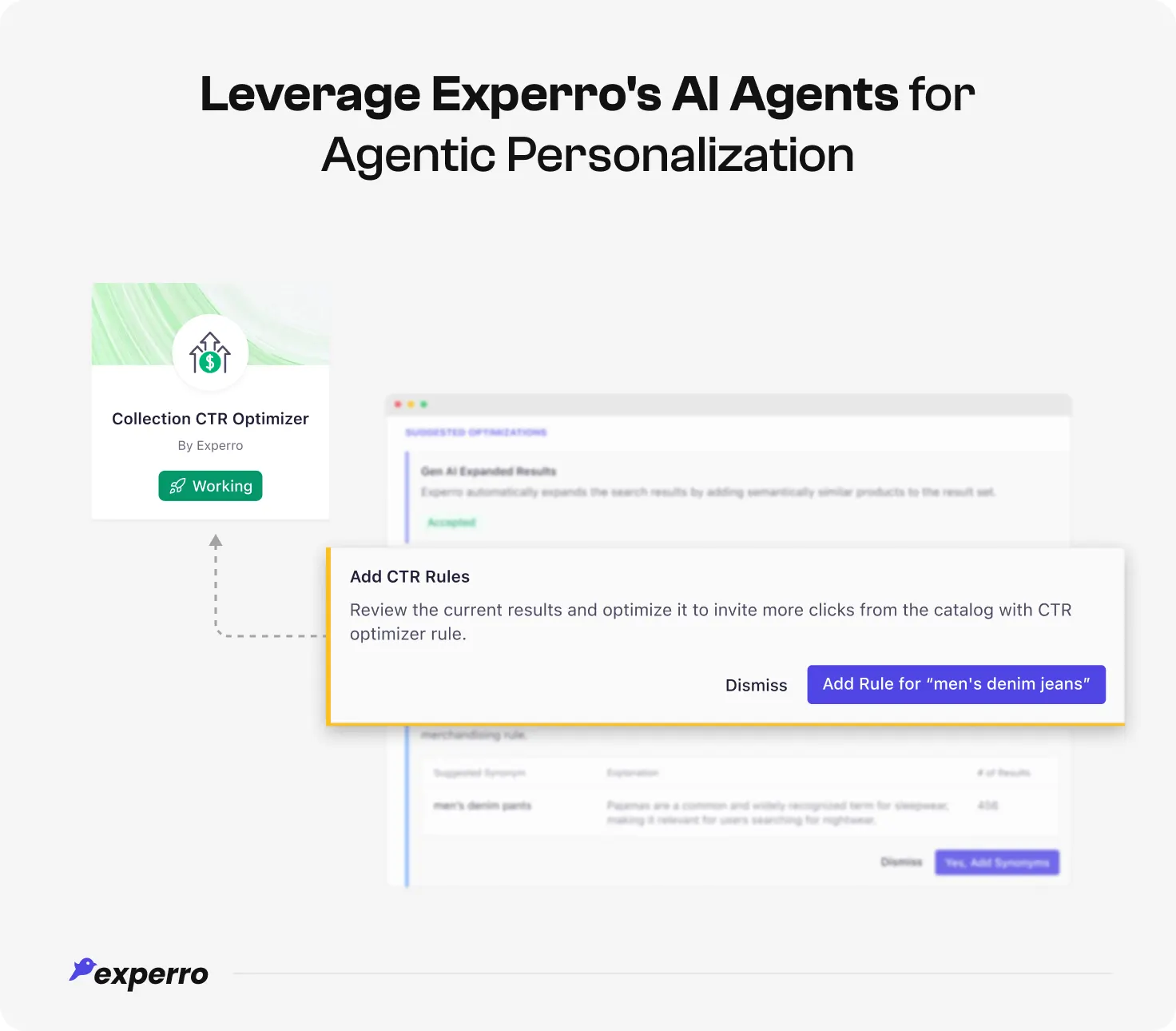
Agentic personalization sounds complex. Getting it live on your store shouldn't be.
Experro, agentic platform for personalization, brings every part of your storefront: be it search, recommendations, content, or category pages on the same agentic layer. One shopper profile. One intelligence engine. Every touchpoint adapting from it.
Most brands implementing personalization end up with disconnected tools: one for search, one for recommendations, one for content. The shopper experiences the gaps. With Experro, there are no gaps. The agent works across the full journey, not just isolated moments of it.
Your merchandising team doesn't need to become AI experts either. Experro's no-code controls mean the people who know your business best are the ones steering it with the agent doing the heavy lifting underneath.
The result is a store that gets measurably better at converting, retaining, and growing, every single day it runs!
Conclusion
Agentic personalization isn’t just another digital marketing trend but it’s the agentic future for personalization.
By enabling Agents to drive context-aware decisions, brands can offer seamless, intelligent, and relevant experiences at scale. For retailers, it means better ROI. For users, it means a better customer journey.
To stay competitive, eCommerce agentic personalization must be part of your roadmap. Connect with our experts on a call for a demo on how Experro makes this future possible today.
FAQs

Pallavi is an ambitious author recognized for her expertise in crafting compelling content across various domains. Beyond her professional pursuits, Pallavi is deeply passionate about continuous learning, often immersing herself in the latest industry trends. When not weaving words, she dedicates her time to mastering graphic design.
Subscribe to Our Newsletter!
Get the latest insights delivered straight to your inbox.