
- eCommerce
- Generative AI
- Merchandising
- 14 min read
Adopt eCommerce Merchandising Strategies for Unstoppable Sales
Published
25 August 2026Updated
26 August 2026

core insights box
- Your product listings perform better when shoppers see the most relevant products in the right order.
- Every placement matters; better merchandising can reduce friction and help more shoppers move from browsing to buying.
- As your catalog grows, AI can handle repetitive merchandising work while your team stays focused on strategy and growth.
- Experro connects shopper intent, product data, search, browse, and merchandising to create shopping experiences that feel more relevant and easier to navigate.
Your shoppers do not experience your product catalog the way your merchandising team does. 👀👀👀
For a shopper, it comes down to three questions: What should I look at? Is it right for me? What should I buy?
Every product placement, search result, recommendation, and offer shapes that decision. Get it right, and the journey feels effortless. Get it wrong, and even your best products can be missed. That is where eCommerce merchandising strategies make a difference.
The goal is not to show more products. It is to help shoppers find the right product at the right moment.
In this guide, you’ll discover practical strategies to improve product discovery, make smarter merchandising decisions, increase conversions, and turn more browsing into revenue.
Why Modern eCommerce Merchandising Requires a Strategy
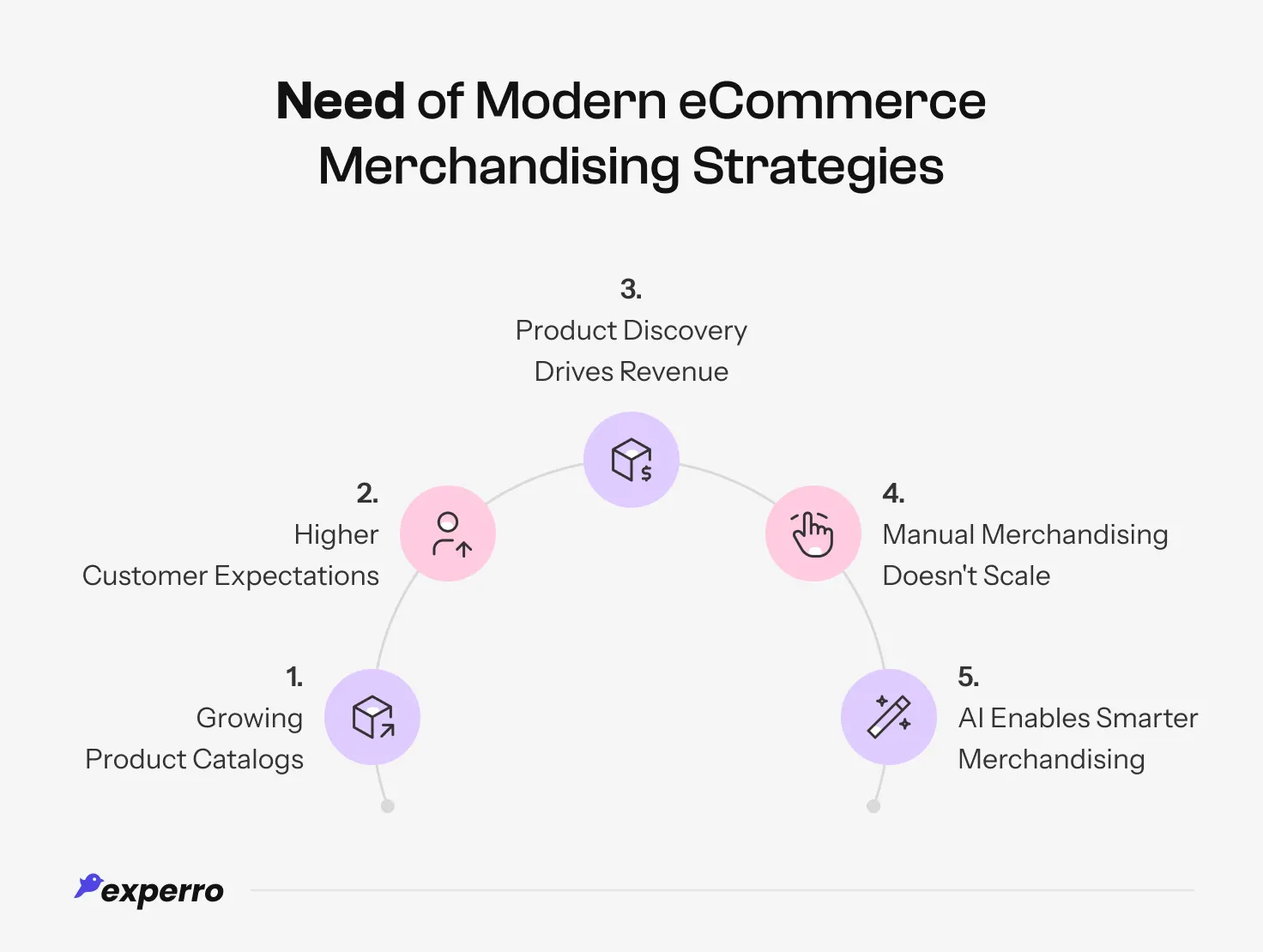
Your shopper has more choices than ever. A large product catalog can create discovery problems when relevant products are difficult to find.
That makes eCommerce merchandising strategies more IMPORTANT than product placement. They shape how your shopper moves from discovery to consideration and purchase.
Manual merchandising can work when your catalog is small. But as product categories, online shoppers, traffic, and business priorities grow, managing product placement manually becomes harder to scale.
That is where digital merchandising becomes more valuable. It helps teams balance customer behavior with commercial priorities. You may want to promote a new product while your shopper needs the most relevant product first.
You also need to consider inventory management, customer data, product performance, seasonal demand, and customer segmentation.
AI-powered merchandising helps you respond to these changes faster. It can analyze customer data and commerce signals in real time, helping you make more relevant product-ranking and personalization decisions.
The goal is not to automate every decision. It is to combine merchant control with intelligent automation, so your shopper sees relevant products at the right moment.
12 eCommerce Merchandising Strategies for Better Conversions
Great merchandising isn’t about showing your shoppers more products. It’s about helping them find the right products at the right time. These eCommerce merchandising strategies can make your shoppers’ journey more relevant and easier to navigate.
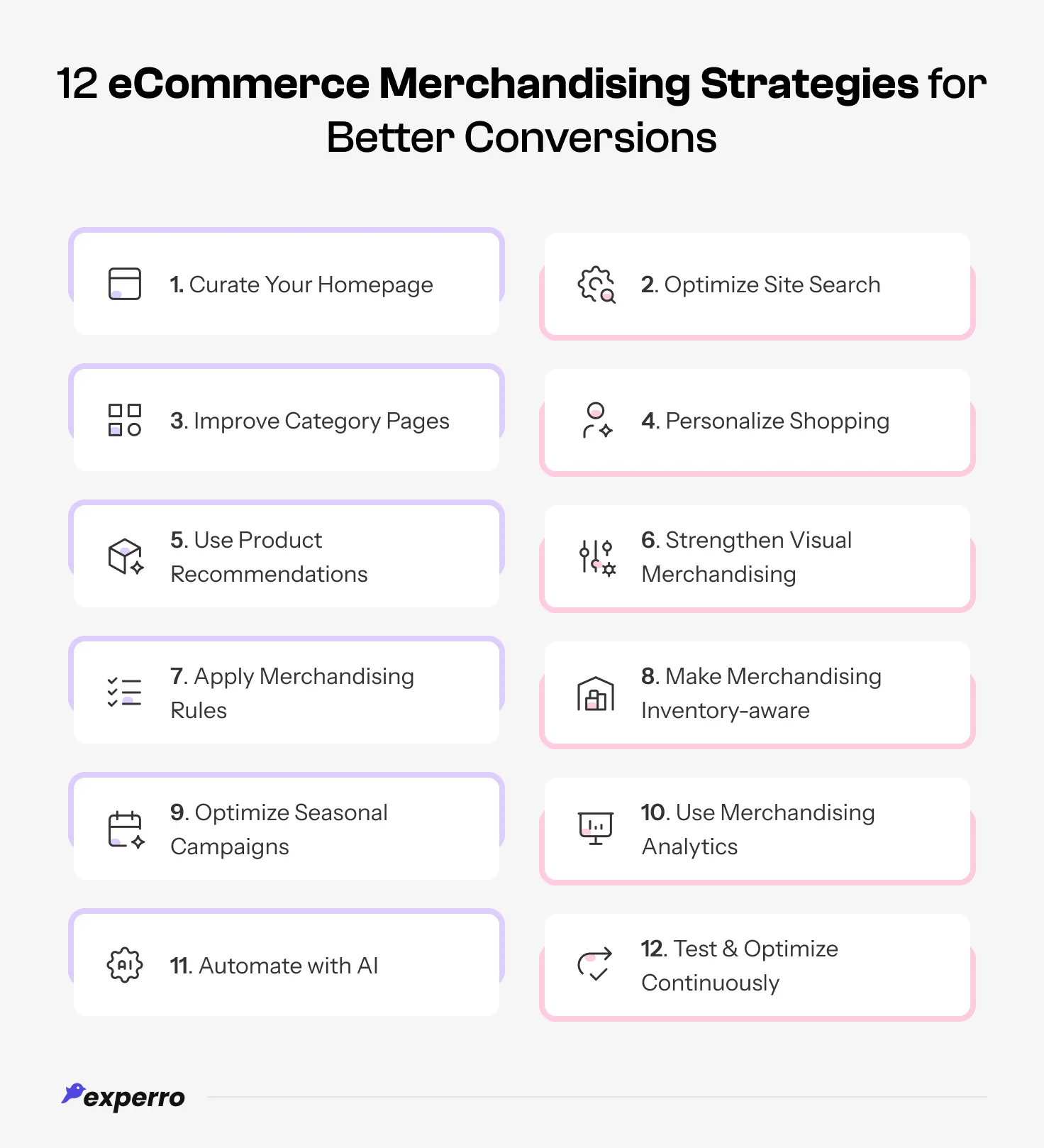
1. Curate Your Homepage Like a Storefront
Your homepage is your online store's first merchandising opportunity.
Think of it like a digital shelf. Your shopper should immediately understand what you sell, what matters now, and where to explore next.
Use product presentation, promotional banners, seasonal collections, high-quality images, and featured products in eCommerce to create a clear path to your product catalog.
Prioritize products based on business goals, customer behavior, inventory, campaigns, and product performance.
Do not overload the homepage with every product category. Give your shopper a focused starting point that makes product discovery easier.
A well-merchandised homepage can reinforce your brand identity while guiding shoppers toward relevant products and high-value categories.
2. Optimize Site Search with Searchandising
Your shopper who uses site search has already expressed intent.
That makes the site search one of the most valuable areas for eCommerce merchandising. If search results are irrelevant, your shopper may leave before reaching a product page.
Searchandising in eCommerce combines search relevance with merchandising controls. It allows you to influence product ranking while maintaining useful search results.
Use autocomplete search in eCommerce, filters, fuzzy search, synonyms, and search ranking rules to help shoppers find products faster.
You can also use searchandising rules to promote seasonal products, prioritize strategic products, or reduce visibility for products that are unavailable or less relevant.
The best search experience balances relevance with commercial control. Your shopper should find what they searched for while your team can respond to business priorities.
3. Treat Category Pages as Revenue Drivers
A category page should not simply list products.
It should help your shopper narrow choices, understand differences, discover relevant products, and move toward a purchase decision.
Use eCommerce catalog management to organize products around shopper intent and business priorities.
You can prioritize best sellers, new products, high-margin items, seasonal products, or products with healthy inventory when the context supports it.
Product listings should also provide strong visual merchandising. Use high-quality images, clear product information, useful filters, and logical product placement.
Your category page should reduce decision friction, not add another layer of choice. When product presentation and product ranking work together, your category pages become active revenue drivers rather than passive product catalogs.
4. Personalize the Shopping Experience
Your shoppers do not have identical needs.
Data-driven personalization uses customer data, customer behavior, purchase history, browsing signals, and customer segmentation to make the shopping experience more relevant.
A returning shopper may see products related to previous purchases. A new shopper may receive recommendations based on current browsing behavior.
This creates a personalized shopping experience without requiring your shopper to search through an entire catalog.
Research consistently shows that shoppers value personalization. One commonly cited finding is that 77% of consumers expect personalized shopping experiences.
But personalization should have a clear purpose. Relying on rigid rules can make personalization difficult to scale and maintain as shopper behavior changes.
Rule-based personalization can fall short when teams manage increasingly complex customer journeys. Use personalization to improve product discovery, reduce choice overload, and help your shopper reach relevant products faster.
5. Use Intelligent Product Recommendations
Product recommendation strategies help your shopper discover relevant products they may not have actively searched for.
Place product recommendations across product pages, category pages, cart experiences, and other high-intent touchpoints.
Use complementary products for cross-selling. Use relevant higher-value alternatives for upselling. A generative AI recommendation system can dynamically adjust recommendations based on shopper behavior, product relationships, and real-time signals.
For example, a shopper viewing a camera may see compatible lenses, memory cards, or cases. A shopper viewing a premium product may see relevant alternatives within the same category.
The objective is not to show more products. It is to show more relevant products.
Relevant recommendations can improve product discovery while creating opportunities to lift conversion rate and increase average order value.
6. Strengthen Visual Merchandising
Online shoppers cannot physically interact with your products. Your website's merchandising therefore needs to communicate product value through visuals, information, and presentation.
Work to optimize product detail pages with high-resolution images, product videos, detailed product descriptions, reviews, ratings, and user-generated content that reduce uncertainty.
Product videos can be particularly valuable because they demonstrate products in use. According to Wyzowl, 89% of consumers say video quality impacts their trust in a brand.
Your visual identity also matters. Consistent colors, typography, imagery, and messaging strengthen brand recognition through disciplined brand management and create a cohesive shopping experience.
Strong visual merchandising helps your shopper understand the product before they reach the checkout.
7. Use Merchandising Rules Strategically
Merchandising rules give your team direct control over product visibility and product ranking.
Instead of manually changing individual product positions, you can create repeatable controls based on business conditions.
For example, a pin rule can guarantee visibility for a strategic product. A boost rule can increase its ranking without forcing a fixed position, while an eCommerce product search algorithm helps determine which products are most relevant to shoppers.
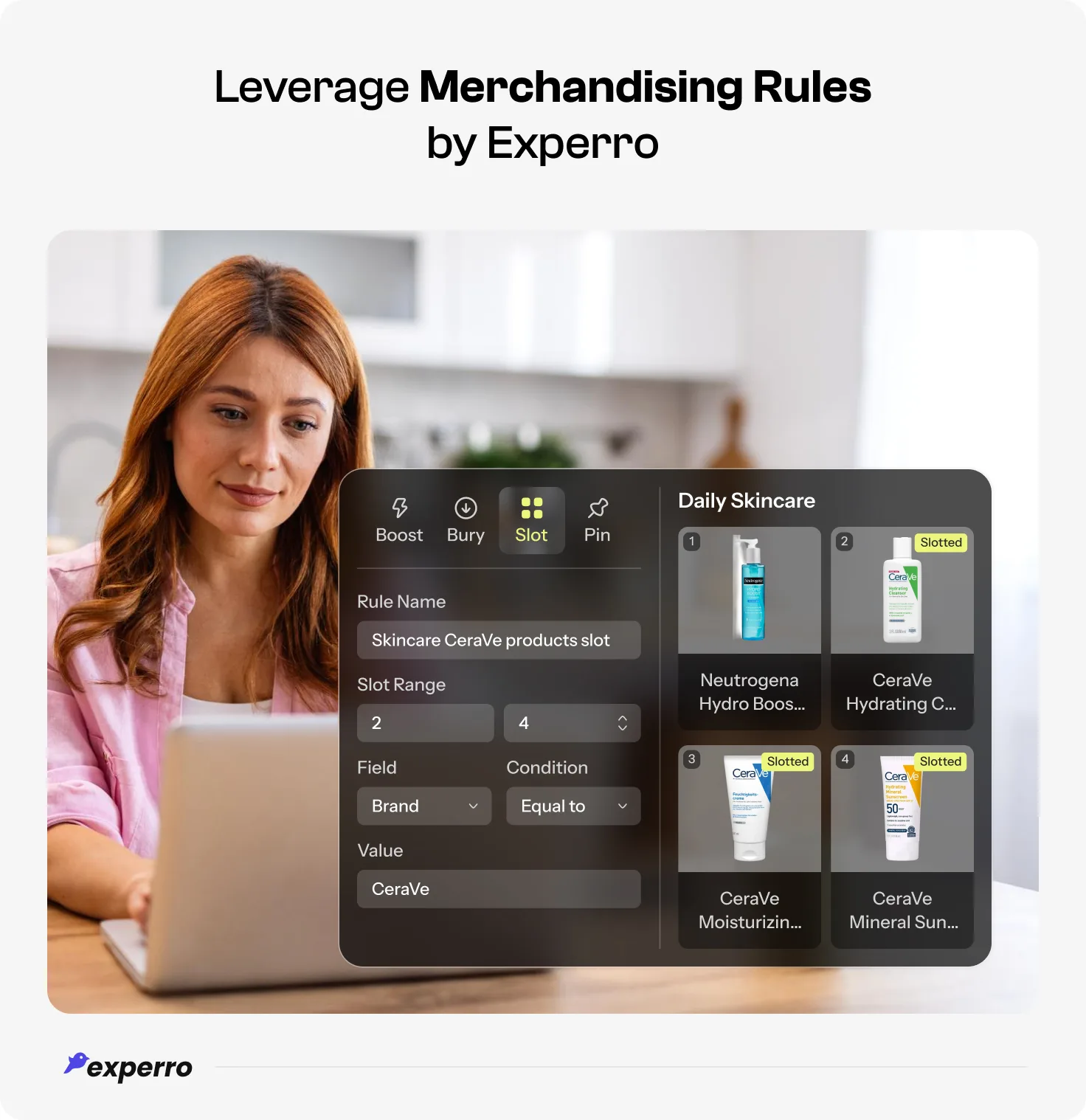
A bury rule can reduce the visibility of products that are outdated or less relevant. A slot rule can place a product in a defined position.
These eCommerce merchandising rules are useful for launches, promotions, seasonal campaigns, inventory priorities, and strategic product placement.
However, rules need governance. Conflicting rules can create unpredictable product rankings, making it harder for merchandisers to maintain consistent and relevant product experiences as the number of rules grows.
Your team should define rule priority, ownership, purpose, start date, end date, and conflict resolution before scaling rule-based merchandising.
8. Make Merchandising Inventory-aware
Product relevance means little when your shopper cannot purchase the product.
Inventory-aware merchandising connects product visibility with inventory management. It helps you avoid aggressively promoting products that are unavailable or difficult to fulfill.
You can also use inventory signals to support commercial priorities. Products with healthy inventory can receive stronger visibility during campaigns. Products approaching stockout can be treated differently depending on your business objectives.
Real-time inventory management can also reduce customer purchase friction caused by out-of-stock products.
This creates a stronger connection between your product catalog, merchandising efforts, and operational reality. Your shopper gets a more reliable experience because the products you promote are more likely to be available.
9. Merchandise Around Seasonal Campaigns
Customer demand changes with seasons, events, holidays, launches, and promotions.
Your merchandising strategies should change with it. Create seasonal collections, promotional banners, campaign-specific product placement, and temporary merchandising rules around relevant demand periods.
Use inventory, customer behavior, product performance, and campaign goals to determine what deserves greater product visibility.
Most importantly, define an end date for temporary rules. A seasonal rule that remains active after the campaign can create outdated product rankings and weaken your shopping experience.
10. Use Merchandising Analytics to Make Better Decisions
Strong merchandising decisions require evidence.
Track metrics such as conversion rate, average order value, search conversion, product visibility, click-through rate, revenue per visitor, and recommendation performance.
Use eCommerce analytics to understand what happens after your shopper sees a product.
High visibility with low engagement may indicate poor relevance or weak product presentation. High clicks with low purchases may point to problems with pricing, product information, trust signals, or availability.
Google Analytics and other commerce analytics tools can help you identify these patterns.
A/B testing, a core part of eCommerce conversion rate optimization, can then help you compare merchandising decisions before rolling them out more broadly. Analytics turns merchandising from guesswork into a measurable optimization process.
11. Leverage AI Automation to Scale Merchandising
Manual merchandising becomes difficult when you have thousands of products, multiple categories, and large volumes of shopper behavior.
AI-powered merchandising helps your team process these signals at scale. AI can analyze customer data, product performance, search behavior, inventory signals, and shopping patterns in real time.
It can support product ranking control, personalized recommendations, product discovery, and merchandising automation.
Broader automation in eCommerce and retail can support product ranking, personalized recommendations, product discovery, and merchandising automation.
AI can also help identify which products are becoming more relevant as shopper behavior changes.
However, automation should not remove merchant control. Your team should define business objectives, constraints, priorities, and rules. AI can then handle more repetitive and data-intensive decisions within those boundaries.
This creates a scalable model for modern AI-powered merchandising.
12. Continuously Test and Optimize Merchandising Decisions
Customer behavior changes. Product performance changes. Inventory changes. Campaigns change.
That is why continuous optimization should be part of your merchandising strategy. Test category layouts, product ranking, recommendations, promotional banners, product placement, and search experiences.
Measure the effect on conversion rate, average order value, product engagement, and revenue. eCommerce search metrics can help you evaluate how shoppers interact with search and whether your search experience is performing as expected.
You should also review your merchandising rules regularly.
A rule that performed well during a campaign may become irrelevant later. Removing outdated rules prevents rule debt from accumulating across your digital storefront.
The best merchandising teams treat every decision as something that can be measured, tested, and improved.
5 Core Merchandising Rules Every eCommerce Store Should Know
Why does one product sit at the top of your category page while another disappears three rows down? It's not luck. It's a merchandising rule working behind the scenes.
These five controls are what let eCommerce teams manage product visibility and product ranking across category pages and search results, instead of leaving everything to a default algorithm.
Rule | Mechanism | Effect on Position | Best Use Case |
Pin | Fixed coordinates | Exact, unmovable | Launches, flagship campaign |
Boost | Adds ranking weight | Rises, algorithm-driven | High-margin, seasonal SKUs |
Bury | Subtracts ranking weight | Falls, stays searchable | Clearance, discontinued lines |
Slot | Fixed coordinates, group | Exact, sequenced | Curated, themed collections |
Deprioritize | Trims weight slightly | Falls modestly, visible | Thin-stock, lower-focus items |
1. Pin Rule: Lock a Product into Position
Need your shopper to see a specific product first? Pinning keeps it in a fixed position, so your launches, promotions, and campaigns deliver the experience you planned.
Example: Launching a new sneaker collection? Pin the hero SKU to the top of the category page so shoppers see it first.
2. Boost Rule: Raise Visibility Without Losing Relevance
Have a product you want more shoppers to discover? Boosting gives it extra ranking influence while your algorithm still considers shopper behavior and search relevance.
Example: Want to increase visibility for a high-margin winter jacket? Boost it so it ranks higher for relevant searches without forcing it into every shopper’s view.
3. Bury Rule: Lower Weak Performers Without Removing Them
What if a product no longer deserves prime visibility, but your shopper may still want it? Burying moves it lower while keeping it searchable and available.
Example: A summer sandal is nearing the end of its season. Bury it lower in the category while keeping it available for shoppers who still search for it.
4. Slot Rule: Curate the Whole Shelf, Not Just One Product
Want to guide your shopper through a collection in a specific order? Product slotting lets you arrange multiple products intentionally across campaigns, collections, and curated shopping experiences based on relevant product attributes.
Example: For a “Back-to-School Essentials” collection, slot backpacks first, followed by lunch bags, stationery, and accessories to create a natural shopping flow.
5. Deprioritize Rule: Ease Off the Spotlight Without Disappearing
Not every product needs your shopper’s attention right now. Deprioritization reduces its prominence while keeping it visible for shoppers who still want to find it.
Example: If a product has limited inventory, deprioritize it so higher-stock alternatives appear first while the product remains searchable.
Together, these eCommerce merchandising rules help you decide what deserves attention, what needs less exposure, and how your shopper moves through your product selection.
How Experro Automates Modern eCommerce Merchandising
Your team already has dashboards, search data, merchandising rules, and shopper signals. The challenge is knowing what needs attention, why it is happening, and what to do next.
When your catalog and shopper behavior change every day, valuable opportunities can be missed while your team is still digging for answers.
Experro Merchant Assistant (EMA) closes that gap. This AI merchandising assistant for eCommerce analyzes your storefront performance, explains what is changing, uncovers missed opportunities, recommends the next best move, and helps your team put approved changes into action.
Your questions will be answered here:
- “What’s hurting performance right now?” EMA spots issues across search, products, categories, clicks, and conversions, helping your team catch problems before they turn into bigger revenue losses.
- “Why is this happening?” EMA connects product performance, rankings, search behavior, and merchandising rules to explain what is driving a change, so your team gets the context behind the numbers.
- “What should we fix first?” EMA turns merchandising analytics into prioritized recommendations, helping your team focus on the opportunities with the greatest potential to improve product discovery, relevance, and conversion.
- “Can we fix it without spending hours on execution?” EMA helps draft merchandising rules, ranking adjustments, synonyms, and collection promotions, reducing the manual work between identifying an opportunity and making the change.
- “Can AI move faster without taking control away from us?” EMA works as an AI merchandising agent that prepares and explains each action, while your merchandisers decide what gets approved and launched.
With Experro Merchant Assistant, your team can move from spotting problems to confidently acting on opportunities without adding more dashboards or manual work.
EMA handles the analysis and repetitive execution, while your merchandisers stay focused on the strategy that drives better product discovery, relevance, conversion, and revenue.
Bringing eCommerce Merchandising Strategies Together
Your product catalog does not sell by itself. Strong eCommerce merchandising strategies help shoppers find relevant products, compare options, and move closer to purchase.
The best approach combines site search, category management, personalization, recommendations, visual merchandising, inventory signals, analytics, AI automation, and testing. Together, they make product discovery faster and more relevant.
The goal is not to automate everything. Give your team control where it matters, use shopper data to improve relevance, and let AI handle repetitive merchandising tasks at scale.
Ready to make merchandising smarter? Contact us to learn how Experro helps automate eCommerce merchandising, improve product discovery, and personalize shopping experiences. Turn shopper intent into measurable revenue.
FAQs

With 6+ years of experience in AI, software, and digital transformation across tech, healthcare, and fashion, Rahul focuses on making complex ideas simple, clear, and actually useful. He has learned how often great ideas get lost in complexity, which is why he centers his writing on clarity, helping entrepreneurs and leaders cut through noise and make decisions with confidence.
Subscribe to Our Newsletter!
Get the latest insights delivered straight to your inbox.