
- Generative AI
- eCommerce
- 11 min read
8 Best AI Shopping Assistants for eCommerce in 2026
Published
21 August 2026Updated
24 August 2026

core insights box:
- Think beyond “chat”. Great assistants understand what shoppers mean, remember context, and guide them toward better choices.
- Want discovery that feels effortless? Experro combines AI search, conversational discovery, personalization, and recommendations to help shoppers find their fit.
- This blog enlists the top-performing the conversational AI shopping assistants viz. Experro, Bloomreach, Constructor, Algolia, Netcore Unbxd, and Athos Commerce.
An AI shopping assistant reads what a shopper wants, in plain language, and guides them to the right product in the hcat itself. No filters, no guesswork, just a real answer.
You've likely felt this shift already. Typing a keyword and scrolling through pages of results feels slower every year, and shoppers are quick to notice which stores still make them do all the work.
The numbers prove it. 72% of shoppers now expect AI to improve their shopping experience, and a good assistant can lift average order value by 30% while cutting how long it takes to find the right product.
So which platform actually delivers on that promise? We scored eight of them against the same criteria, so you can find the best AI shopping assistant for your store without guessing which vendor to trust.
How We Evaluated the Best AI Shopping Assistants
Choosing a top AI shopping assistant isn’t about who has the flashiest demo. We focused on what actually makes a difference when real shoppers start using it.
We evaluated each platform across the areas that shape the shopping experience and business impact:
- AI shopping capabilities: Can it understand real shopper questions and intent?
- Product discovery: Does it help shoppers find relevant products quickly?
- Personalization: Can it tailor recommendations to individual shoppers?
- Commerce readiness: Does it integrate smoothly and scale with your store?
- Implementation: How quickly can teams get it running?
- Customer experience: Does it make shopping easier and more engaging?
- Value: Do pricing and capabilities make sense for the business?
The goal was simple: identify AI shopping assistant software that genuinely improves product discovery and helps shoppers find the right products faster. Below, we compare the leading options to help you see how they differ at a glance.
Best AI Shopping Assistants At a Glance
| AI Shopping Assistant | Best For | Commerce Integrations | Pricing | G2 Ratings |
| Experro🏆 | Brands that want search, discovery, merchandising, and a conversational agent on one platform | Shopify, Adobe Commerce/Magento, BigCommerce, headless/custom | Custom, test-before-you-buy trial available | G2 Fall 2025 Leader (eCommerce) |
| Large enterprise retailers running search, content, and email from one suite | Native connectors, Snowflake, Omniconnect middleware | Module plus usage-based, roughly $50K to $430K/year | 4.6/5 (716 reviews) |
| Enterprise catalogs that need strong search without platform lock-in | Shopify Plus, BigCommerce, Adobe Commerce, Salesforce Commerce Cloud, commercetools | Free 4-week assessment, then custom quote | 4.8/5 (58+ reviews) |
| Developer teams building a custom, agentic experience | Broad API and SDK ecosystem, 50+ integration templates | Free plan, usage-based Grow/Grow Plus, custom Elevate | 4.5/5 (450+ reviews) |
| Netcore Unbxd | Mid-market to enterprise catalogs wanting a conversational layer without a full suite | Shopify, Magento, BigCommerce, custom | Custom, roughly 2-month implementation | 4.4/5 (68+ reviews) |
| Athos Commerce | Mid-market Shopify/BigCommerce stores consolidating search vendors | Shopify, BigCommerce, Magento | From $699/month | 4.5/5 (219 reviews) |
The 8 Best AI Shopping Assistants Worth Considering
Shoppers on your store have a need, a budget, and a few preferences, but no idea what product to go with. Is your store capable enough to help them figure it out, or does it leave them scrolling through hundreds of results? If latter is your scenario, THIS IS YOUR LOSS! 😰
And you must do something about it...
The eight AI shopping assistants below aim to make that decision easier, each with a different approach to discovery and guidance.
1. Experro

Experro brings AI shopping assistance, search, personalization, and merchandising together in one platform, so brands don't have to piece together separate tools to improve product discovery.
Its conversational AI agent, Skara, lets shoppers describe what they're looking for naturally, then uses search and personalization to surface relevant products faster.
Why Experro Stands Out
- One platform for discovery: Combines conversational AI, search, personalization, and merchandising instead of relying on separate tools. 1
- Understands shopper intent: Handles natural, detailed shopping requests and uses context to surface relevant products.
- Personalized discovery: Uses shopper behavior and preferences to deliver more relevant products and recommendations. 2
- No-code control: Gives marketers greater control over search, merchandising, and customer experiences without heavy developer involvement. 3
- Strong search performance: G2 reviewers consistently praise Experro for its fast and accurate product search.4
Key AI Shopping Assistant Capabilities:
- Skara: Conversational shopping assistant for natural-language requests and relevant product discovery.
- Gen AI Search: Supports text, image, and natural-language product discovery.
- Personalization: Tailors product recommendations and experiences to individual shoppers.
- Merchant Intelligence: Turns search and shopper interaction data into merchandising insights.
Considerations:
- It works best with well-enriched product data, although Experro’s AI product enrichment tool can help fill gaps in your catalog.
2. Bloomreach

Bloomreach's Loomi shopping agent is pitched as a personal assistant that never forgets a shopper. It remembers past preferences and picks up right where a customer left off, and it's part of a much bigger commerce cloud that also covers content management and email marketing.
If you're comparing conversational AI options broadly, this look at generative AI and customer experience is worth reading before you commit to a multi-module suite like Bloomreach's.
Pros of Bloomreach:
- AI personalization delivers relevant experiences with minimal manual effort.5
- Unifies customer data, AI insights, and omnichannel campaigns.6
Cons of Bloomreach:
- G2 feedback suggests Loomi can feel confusing when users need a specific report or clear next step.7
- Some users find reporting takes time to learn, especially when getting started.8
- Complex setups may need extra support for integrations and reporting.9
- Connecting multiple data sources can require additional effort, particularly for more complex setups.10
3. Constructor

Constructor built its name as an API-first search and product discovery platform before adding an AI Shopping Assistant on top, and you can still feel that developer-first thinking in how the product works.
Its style of AI assisted shopping reads customer intent well and plugs cleanly into existing systems. If it's on your shortlist, our Experro vs Constructor comparison breaks down exactly where the two platforms differ on conversational commerce.
Pros of Constructor:
- Easy to use for technical and non-technical teams.11
- AI continuously improves product rankings using real user behavior.12
Cons of Constructor:
- Some users say there’s a learning curve when getting into Constructor’s deeper features.13
- Some integrations can be tricky depending on your existing eCommerce setup.14
- Timely support can be challenging for performance issues.15
- A/B testing is limited for some advanced use cases.16
4. Algolia

Algolia is best known as a developer favorite for search infrastructure, and its Agent Studio product extends that same API-first approach into conversational, agentic commerce.
That's a big part of enabling customers to get an answer without leaving the search bar. Algolia's pricing free plan option makes it easy to test before you scale into paid tiers. For a side-by-side look at merchandising controls, see the Experro vs Algolia comparison.
Pros of Algolia:
- Fast, accurate search makes finding products quick and easy.17
- Easy-to-tweak ranking and filtering for different requirements.18
Cons of Algolia:
- G2 reviewers note that pricing can climb as search volume and data grow.19
- Some teams find search relevance needs more fine-tuning for complex queries.20
- Advanced weighted ranking may require more effort.21
- Query suggestions can feel too basic as they mainly reflect popular terms rather than changing search intent.22
5. Netcore UNBXD

Netcore Unbxd built its Shopping Agent directly on top of its existing product discovery platform, so the conversational layer inherits the same search, ranking, and personalization models the platform already uses for regular site search.
It's a genuine way to enhance customer experiences by reading shopper behavior and customer behavior as it happens rather than after the fact. Compare it to Experro's approach here.
Pros of Netcore UNBXD:
- AI-powered search handles typos and vague keywords well.23
- Easy catalog management and experience customization.24
Cons of Netcore UNBXD:
- G2 feedback highlights a confusing dashboard when setting up rules and campaigns.25
- Some teams find ongoing maintenance too technical for smaller in-house teams.26
- Integration with other tools has a learning curve.27
- Customization can take considerable time, particularly for product feeds and recommendations.28
6. Athos Commerce

Athos Commerce came out of the 2025 merger of Searchspring, Klevu, and Intelligent Reach, bundling search, merchandising, and a conversational AI tool called Asklo under one parent brand.
That's a real upgrade from either product running on its own. If Klevu is part of your evaluation, Experro's comparison against Klevu is a useful reference point.
Pros of Athos Commerce:
- Robust search with strong personalization and merchandising capabilities.29
- Gives merchants strong control over product search and merchandising.30
Cons of Athos Commerce:
- G2 feedback suggests product recommendation controls can feel limited for advanced personalization needs.31
- Some users find merchandising rules harder to manage across large catalogs.32
- G2 feedback points to a less intuitive dashboard when working with analytics and rules.33
- Customers note that pricing can be relatively high for smaller businesses. 34
How to Choose the Right AI Shopping Assistant
Picking an best AI shopping assistant isn’t just about comparing features.
Start with the problem you want to solve, then look at how well each platform fits your shoppers, your tech stack, and your business goals.
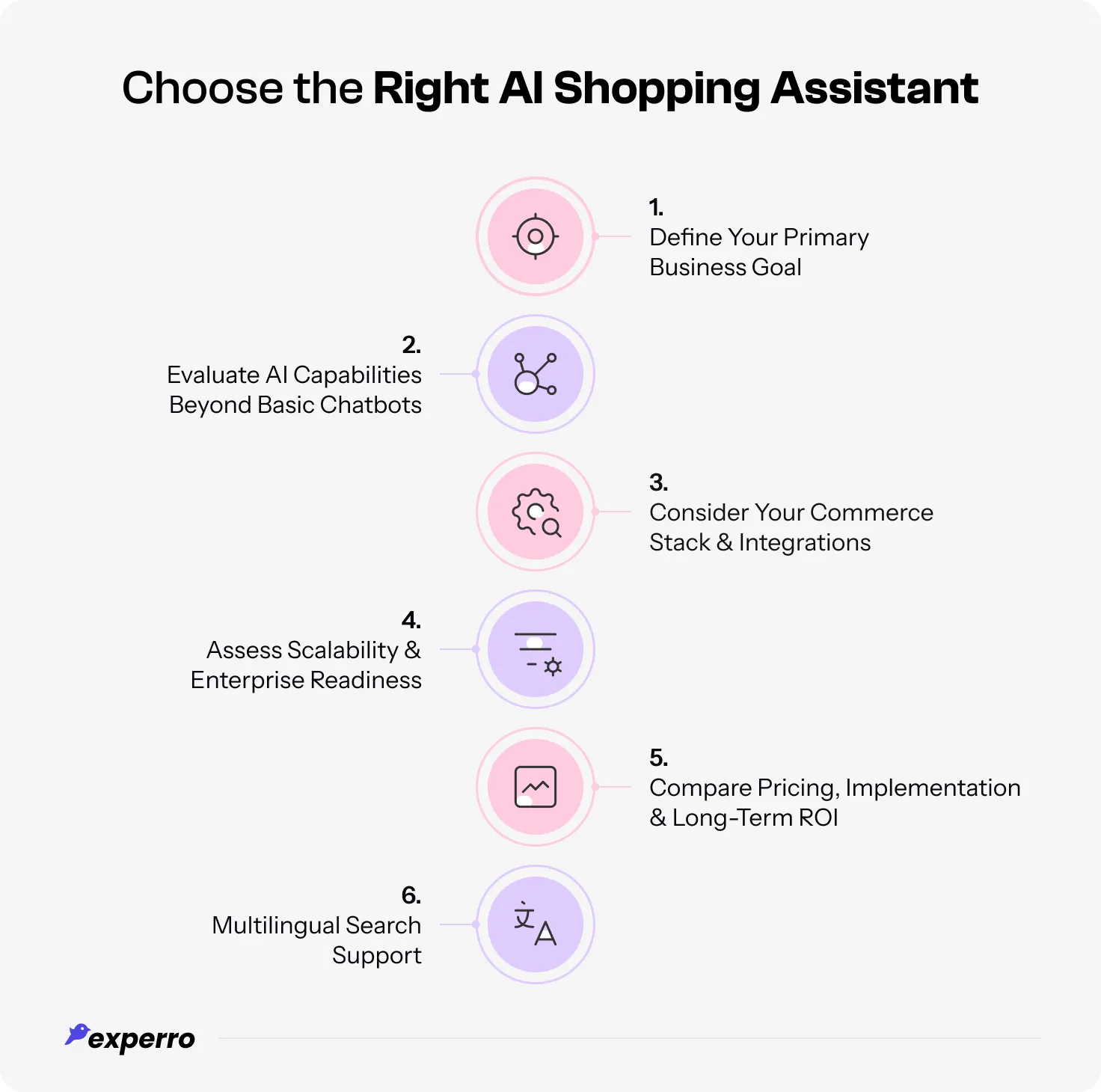
1. Define Your Primary Business Goal
First, get clear on what you actually want the assistant to improve. Are shoppers struggling to find products, leaving without buying, or asking too many questions? Understanding the role of an AI shopping assistant in addressing these challenges will make it much easier to choose the right solution.
2. Evaluate AI Capabilities Beyond Basic Chatbots
Not every “AI assistant” can handle a real shopping conversation. Look at AI shopping assistant examples like Sandy AI by Experro to see how naturally it can handle detailed questions, understand context, and help shoppers discover relevant products instead of relying only on keyword matching or scripted replies.
3. Consider Your Commerce Stack and Integrations
Your assistant needs reliable access to your product catalog, pricing, inventory, and customer data. Check how easily it connects with your existing commerce platform and, just as importantly, how quickly that information stays up to date.
4. Assess Scalability and Enterprise Readiness
Enterprise readiness goes beyond a smooth demo. When evaluating the most popular AI shopping assistant, consider how well it can handle traffic spikes, protect customer data, and maintain reliable performance at scale.
5. Compare Pricing, Implementation, and Long-Term ROI
Don’t judge the cost by the monthly price alone. Factor in implementation time, integrations, ongoing management, and how quickly you can expect results. Experro’s AI agent ROI calculator can help you estimate the potential business impact before making the call.
6. Multilingual Search Support
Check whether the assistant genuinely understands different languages or just translates the interface around it. Real multilingual search interprets intent, product terms, and slang in the shopper's own language, not a literal word swap. This distinction matters most in markets where sizing, currency, or seasonal terms differ from your home market.
Choosing the best AI shopping assistant for eCommerce is ultimately about finding a platform that fits your shoppers, product catalog, and business goals. Look beyond features to assess how well it improves discovery, guides decisions, and delivers measurable value.
Make Every Product Search Feel More Personal
The best AI shopping assistant isn’t the one with the most features. It’s the one that helps shoppers find the right products with less searching, fewer dead ends, and more confidence.
When conversational discovery, intelligent search, personalization, and recommendations understand shopper intent, the journey feels more natural and brands have a better opportunity to turn product discovery into purchases.
Ready to make product discovery easier?
Experro helps eCommerce brands create more relevant shopping experiences with AI-powered search, conversational discovery, personalization, and recommendations.
Contact us to see what Experro can do for your store.
Citations:
5. Bloomreach Pros & Cons on G2
6. Bloomreach Pros & Cons on G2
7. Bloomreach Pros & Cons on G2
8. Bloomreach Pros & Cons on G2
9. Bloomreach Pros & Cons on G2
10. Bloomreach Pros & Cons on G2
11. Constructor Pros & Cons on G2
12. Constructor Pros & Cons on G2
13. Constructor Pros & Cons on G2
14. Constructor Pros & Cons on G2
15. Constructor Pros & Cons on G2
FAQs

With 6+ years of experience in AI, software, and digital transformation across tech, healthcare, and fashion, Rahul focuses on making complex ideas simple, clear, and actually useful. He has learned how often great ideas get lost in complexity, which is why he centers his writing on clarity, helping entrepreneurs and leaders cut through noise and make decisions with confidence.
Subscribe to Our Newsletter!
Get the latest insights delivered straight to your inbox.