- Digital Experience
- eCommerce
- Generative AI
- 11 min read
eCommerce Competition Is Rising. What’s Your USP?
Published
1 September 2026

key takeaway pointers:
- Your shopper has plenty of options, make choosing your store feel easier than opening another tab.
- Don’t make shoppers hunt, help them find the right product quickly and turn “just browsing” into buying.
- Let AI do more than search, use real shopper intent to make recommendations and discover discovery feel timely and genuinely helpful.
- With Experro, bring AI-powered discovery and merchandising together so shoppers have reasons to choose you.
eCommerce competition is intensifying because shoppers have more choices. They can compare products, prices, reviews, and delivery times across stores in seconds.
That makes every online interaction a competitive moment. In fact, 81% of shoppers research online before making a purchase. So, when your product appears alongside a competitor’s, what gives shoppers a reason to choose you?
Price alone no longer wins. Product range alone doesn’t either. When shoppers can compare almost everything, the real advantage lies in how quickly and confidently they can find what they need.
That’s where eCommerce competitive advantage is changing in 2026. The brands that stand out make discovery easier, recommendations more relevant, and every interaction feels more useful.
So, how do you create an experience competitors can’t easily copy? 🤔🤔🤔
This guide explores what drives eCommerce competition, how leading brands differentiate, and how AI-powered product discovery can turn choice overload into a competitive advantage.
Why is eCommerce Competition Getting Harder in 2026?
Here's the uncomfortable truth: eCommerce competition isn't getting harder because shoppers got pickier. It's getting harder because everyone else got better.
Barriers to entry are lower than ever. Customer expectations are higher than ever. And the gap between the two is where brands either win or quietly lose relevance.
So, why is eCommerce so competitive? What’s driving these eCommerce competitive pressures?
Here are five changes reshaping the eCommerce competitive landscape in 2026:
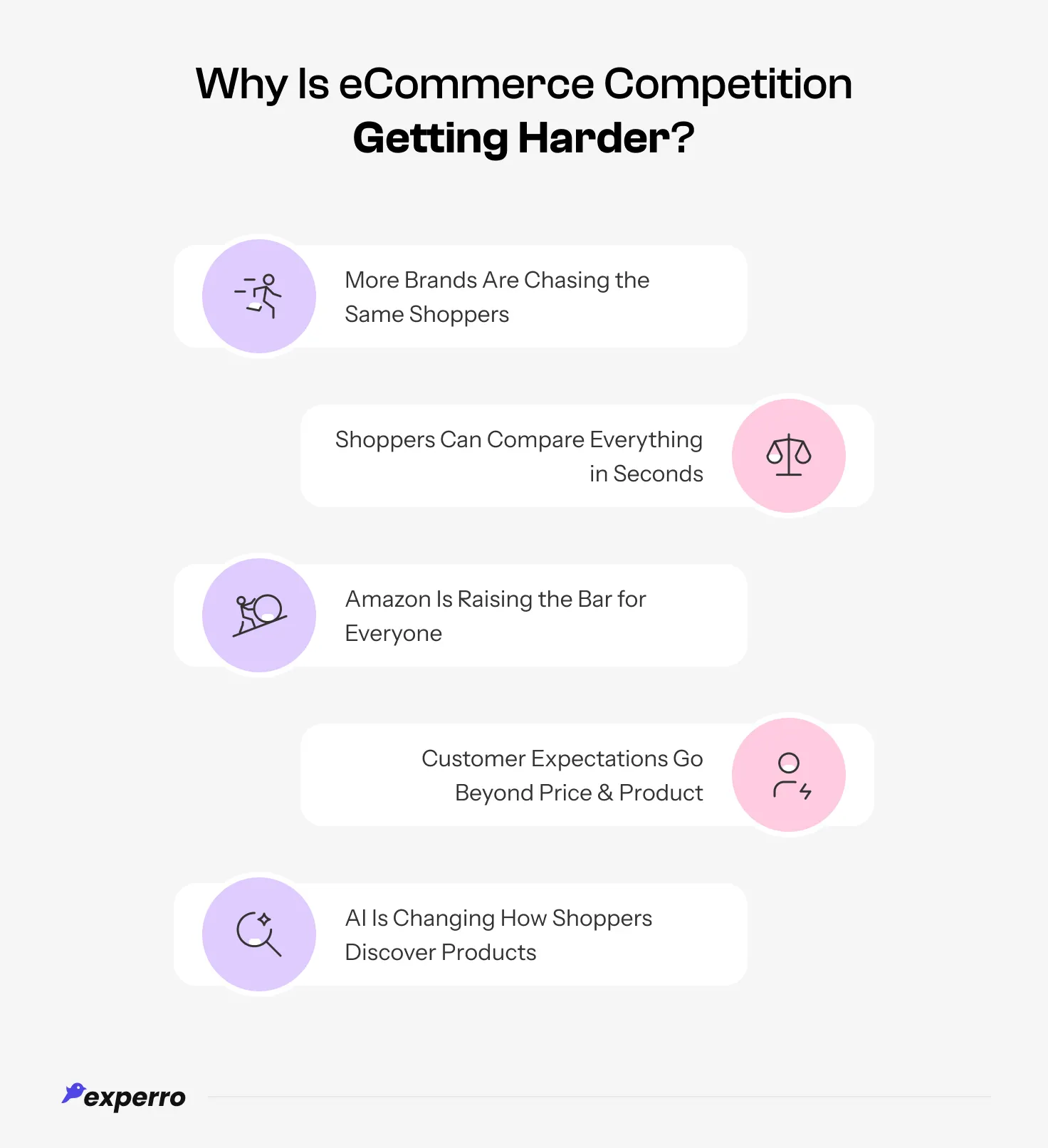
1. More Brands Are Chasing the Same Shoppers
Every week, new sellers enter your category. As more sellers enter established categories, protecting eCommerce market share becomes harder when shoppers have dozens of comparable options just a click away.
Your potential customers now see more ads, more lookalike online stores, and more nearly identical product offerings than ever, which means attracting customers has stopped being something you can do on autopilot.
We've broken down exactly how brands are responding to this saturation in our blog on eCommerce growth strategies.
2. Shoppers Can Compare Everything in Seconds
Modern online shoppers jump between eCommerce platforms, read customer feedback, and compare prices across multiple tabs before deciding.
This constant back-and-forth means your competitive positioning gets tested in real time, on every single visit whether you're ready for it or not. If your own search experience is part of the problem, our guide on auditing your site search is a good place to start.
3. Amazon is Raising the Bar for Everyone
Amazon didn't just build a store; it trained an entire generation of online shoppers to expect instant search, sharp recommendations, and effortless checkout. That expectation doesn't stay inside.
Amazon has set a standard that every eCommerce business gets compared against, including yours. (It is still possible to compete with the giant marketplace such as Amazon.)
The data backs this up: Amazon’s recommendation engine reportedly drives 35% of its sales, showing the revenue impact personalization can create when product discovery adapts to shopper behavior.
4. Customer Expectations Go Beyond Price and Product
Fast delivery, personalization, and effortless navigation aren't bonus features anymore, they're the baseline. Payment friction alone can cost you the sale: roughly 10% of shoppers abandon their cart simply because their preferred payment option isn't available.
That's website traffic you paid for, walking away over something entirely fixable, the same friction points we unpack in reducing customer purchase friction and abandoned cart recovery strategies.
Retailers who make shopping easier can often charge more and retain customers longer, using the experience itself as an eCommerce differentiation strategy rather than competing on price alone.
5. AI is Changing How Shoppers Discover Products
AI-powered search has moved product discovery from simple keyword matching to genuine intent understanding. Shoppers increasingly expect AI to assist with research and comparison, and eCommerce businesses slow to adopt this shift risk losing ground on relevance, speed, and ultimately conversion.
Our breakdown of generative AI in eCommerce covers exactly how this transition is playing out across categories.
The digital transformation reshaping retail is changing how eCommerce businesses compete, making innovation and experience just as important as price and product.
Livestreaming eCommerce sales in the US reportedly reached $50 billion in 2023, while the global AR-in-eCommerce market is projected to reach $38.5 billion by 2030.
Shoppers are also getting comfortable with new interfaces entirely: an estimated 35% of the US population owned a smart speaker by 2025, which changes what "search" even means for your target audience, a shift we cover in voice search in eCommerce.
When More Sellers Sell Similar Products, What Makes Your Store Worth Choosing?
When shoppers can find similar products from several brands, having a good product is no longer enough. Your eCommerce differentiation strategy has to give them a reason to choose you.
That is where eCommerce competitive advantage comes into play. But what actually makes a store worth choosing? Here are five parts of the shopping experience that can make the difference.
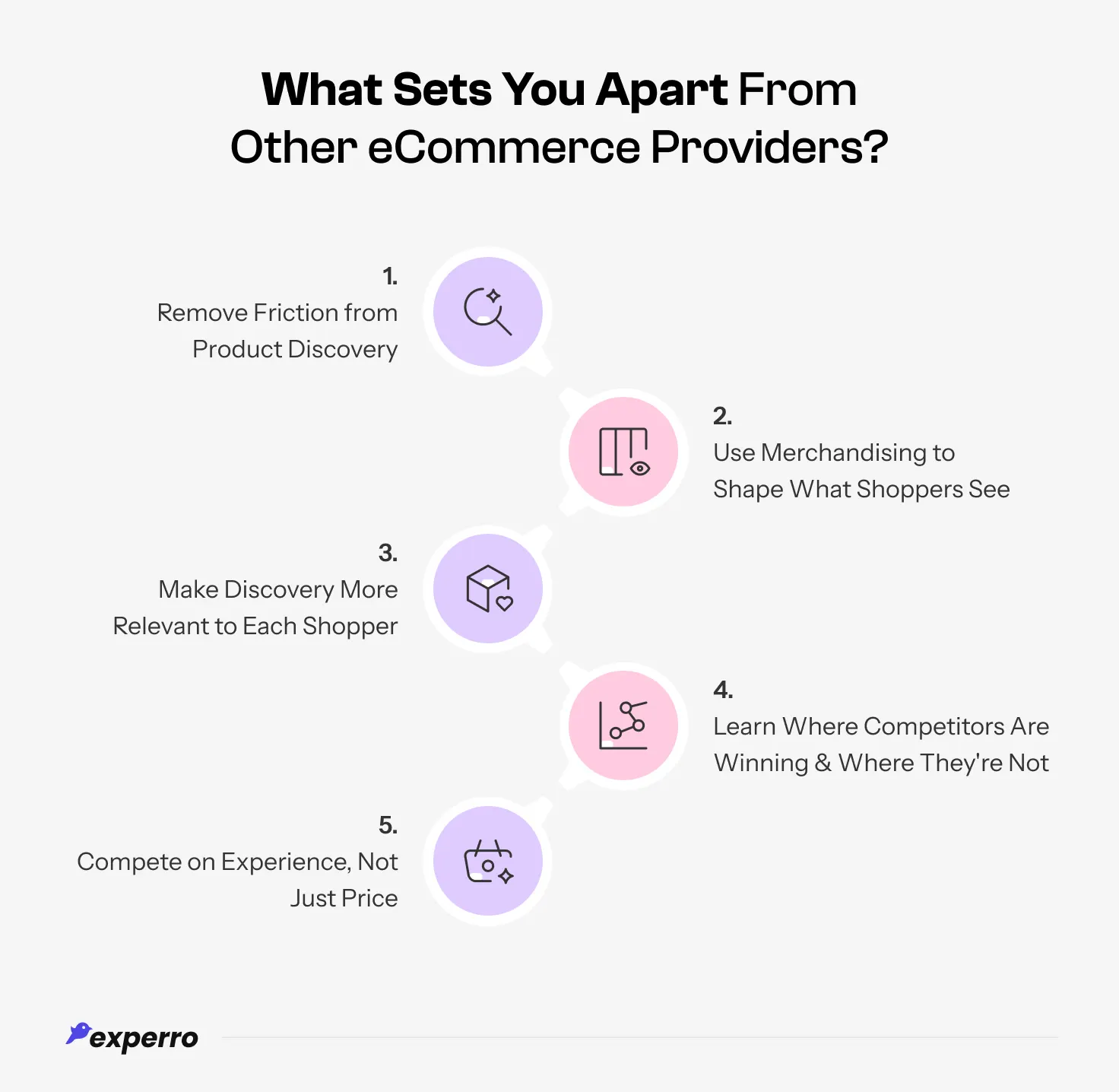
1. Remove Friction from Product Discovery
Every extra click, irrelevant search result, or confusing filter pushes a shopper one step closer to a competitor's checkout instead of yours.
Fast, accurate product discovery isn't a nice-to-have, it's what keeps online shoppers moving forward instead of abandoning the journey with minimal effort spent looking elsewhere.
The distinction actually matters more than most teams realize, which is why we wrote a dedicated piece on product search vs product discovery.
2. Use Merchandising to Shape What Shoppers See
Smart merchandising puts the right product offerings in front of the right shopper at the right moment, instead of showing every visitor an identical generic grid.
This directly lifts average order value and helps you win on relevance rather than who can drop their price first a discipline we call searchandising when search and merchandising work together.
Even something as simple as 3D visualization has been shown to reduce product return rates, a small marketing technique with a measurable bottom-line effect.
3. Make Discovery More Relevant to Each Shopper
Generic storefronts feel interchangeable no matter whose eCommerce site you're on. Personalization built on real customer data and consumer preferences makes your eCommerce platform feel like it was built specifically for the person browsing it, something we walk through in data-driven personalization.
This doesn't just feel nice; it measurably increases customer engagement and customer loyalty, both of which compound over time into real lifetime value.
As eCommerce competition trends continue to shift toward more personalized experiences, making the journey feel uniquely relevant gives retailers a stronger way to stand apart, as detailed in the benefits of personalization in eCommerce.
4. Learn Where Competitors Are Winning, and Where They're Not
Ongoing competitor analysis and competitive benchmarking against both direct competitors and indirect competitors reveal exactly where the gaps are.
Identifying market gaps is often the fastest, cheapest path to a real, defensible competitive advantage. What competitors miss can become the opportunity your eCommerce differentiation strategy is built around. It's also how you find your unique value proposition instead of guessing at one.
For a closer look at how fast-moving brands turn this into a habit rather than a quarterly chore, see why moving fast is the real eCommerce advantage.
5. Compete on Experience, Not Just Price
Price wars are a race to the bottom. They compress margins for every competitor involved and rarely build lasting customer loyalty.
A better shopping experience protects your margins while still winning the sale and unlike a price cut, it's genuinely hard for competitors to copy overnight.
If you want a structured way to find out where your own experience is falling short, our customer experience audit guide walks through the process step by step, and how to improve eCommerce customer experience covers what to fix first.
Experience is clearly the new battleground. But what's actually powering the strongest experiences right now? Increasingly, the answer is AI.
What Happens When AI Becomes Part of Your Competitive Advantage?
AI is changing eCommerce competition, from how shoppers discover products to how brands respond to what they need.
For businesses learning how to stay competitive in eCommerce, the real question is where AI can create an advantage shoppers can actually feel.
The answer becomes clearer when you see AI at work across the moments that shape a shopper’s journey. Let’s look at five of them.
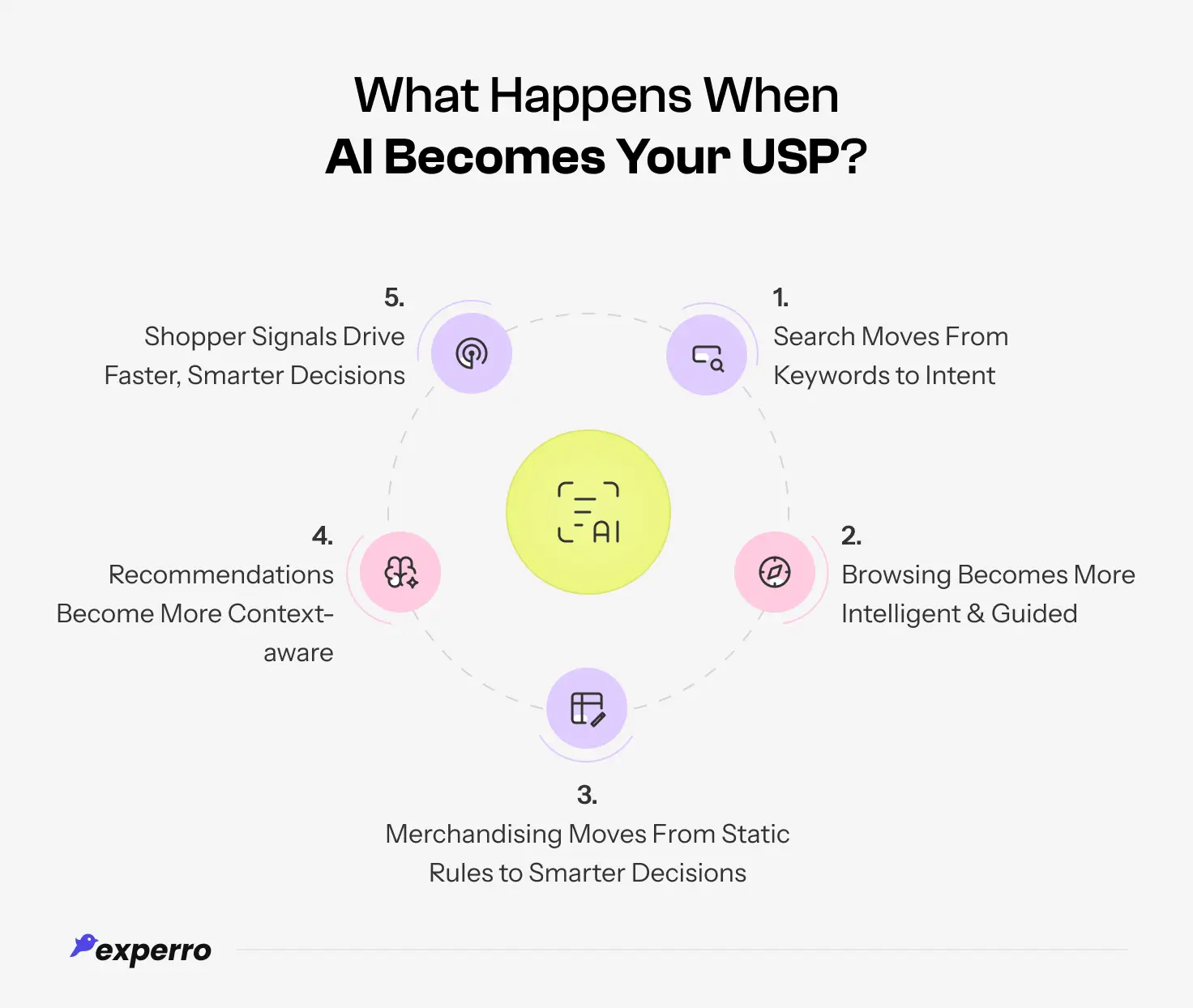
1. Search Moves From Keywords to Intent
AI-powered search understands what shoppers mean, not just the words they type.
It connects long-tail queries, synonyms, and product attributes to relevant results through semantic search.
It can also handle typos and spelling variations with fuzzy search, reducing zero-result searches and dead ends.
The result? Shoppers find relevant products faster instead of leaving for a competitor, one of the most practical ways to stay competitive in eCommerce.
2. Browsing Becomes Intelligent and Guided
AI can walk online shoppers through your catalog the way a great in-store associate would narrowing thousands of SKUs down to the handful that actually matter to that individual shopper, based on consumer habits and customer data rather than generic category rules.
As the eCommerce competitive landscape gets more crowded, guided discovery helps shoppers find relevant products faster. See our guide to advanced eCommerce filters for practical examples.
3. Merchandising Moves From Static Rules to Real-time Decisions
Fixed rules can't keep pace with actual shopper behavior.
AI adjusts merchandising continuously, based on what's happening on your eCommerce platform right now, not what happened last quarter, and not a sales team's best guess.
We've seen this failure mode often enough to write about it directly in why rule-based personalization fails.
4. Recommendations Become Genuinely Context-aware
Recommendations built on real behavioral signals feel relevant instead of random, which is exactly why Amazon's AI-driven personalization has reportedly lifted product sales by around 11%.
Our product recommendation strategies guide covers how to build this without the guesswork.
5. Shopper Signals Drive Faster Decisions
AI turns browsing behavior, search queries, and click patterns into valuable insights instantly, instead of leaving that customer data sitting unused in a dashboard nobody opens, the exact use case behind predictive customer analytics.
Shoppers are also increasingly comfortable using new interfaces to shop, with roughly 35% of the US population owning a smart speaker.
The direction is unmistakable. Discovery is becoming more conversational, more predictive, and less dependent on shoppers doing the work themselves.
For retailers, turning these signals into better experiences is becoming a smart eCommerce differentiation strategy, especially when shoppers have more ways to compare and switch. So what does putting all of this into practice actually look like? This is exactly where Experro comes in.
How Experro Helps You Win Shoppers With Smarter Product Finding
When your shopper can compare you with competitors in seconds, discovery becomes a real eCommerce competitive advantage.
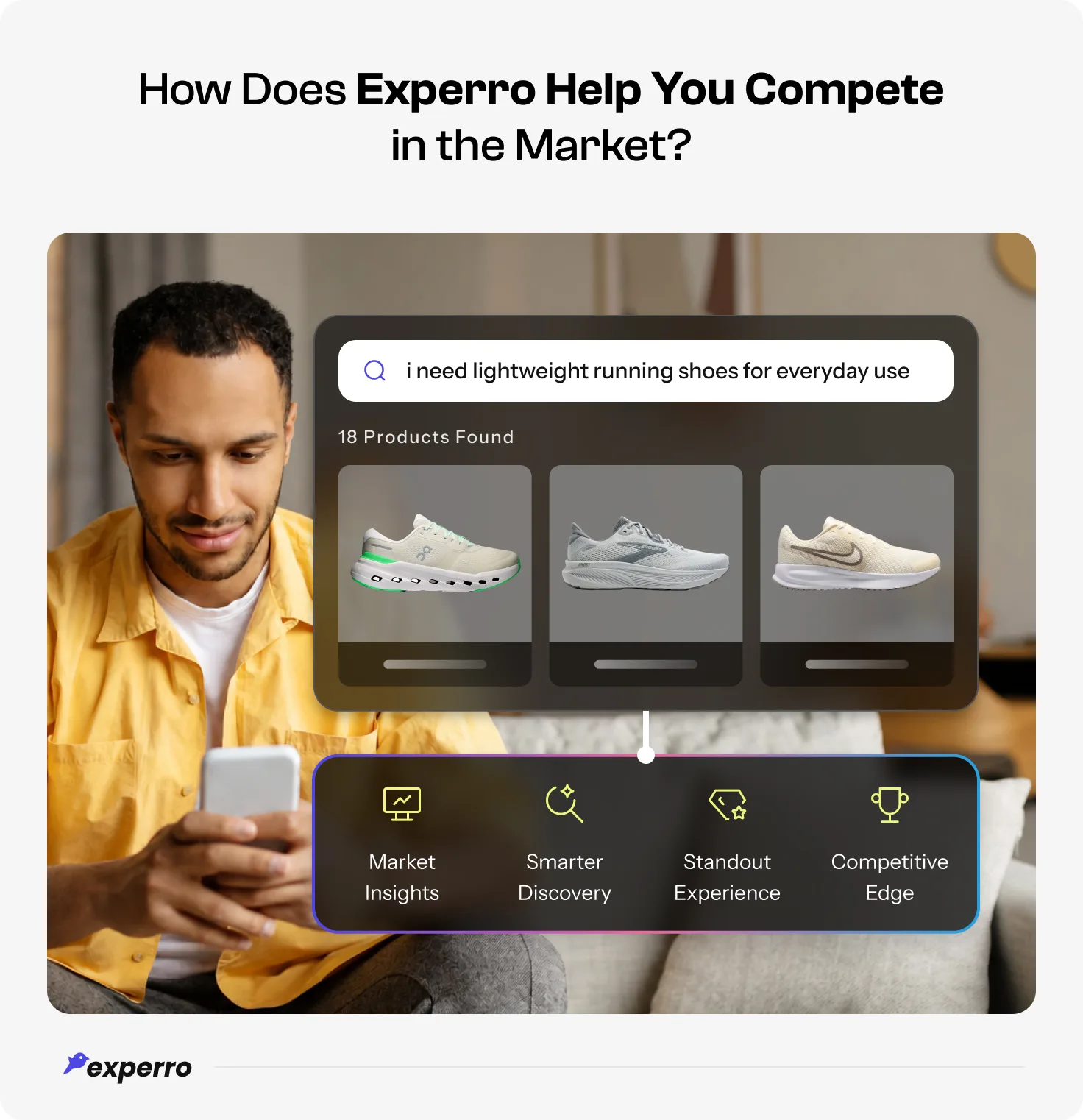
- Search not finding the right products? GenAI Search understands what your shopper means, including synonyms, long-tail queries, and product attributes, so you can get them to relevant results faster.
- Too many SKUs, too much friction? AI Browse adapts to how your shopper explores, helping you make large assortments easier to navigate without endless filtering.
- Your shopper knows what they need but not what to search? Conversational Discovery lets them describe it naturally and helps guide them to the right products.
- Showing every visitor the same experience? AI personalization uses real-time behavior to help you make discovery more relevant to each shopper.
- Your recommendations feel too generic? Behavioral recommendations use real shopper signals to surface relevant products and create stronger cross-sell and upsell opportunities.
- Still guessing what your shoppers want? Experro turns search and browsing behavior into actionable merchandising intelligence, helping you respond to real demand.
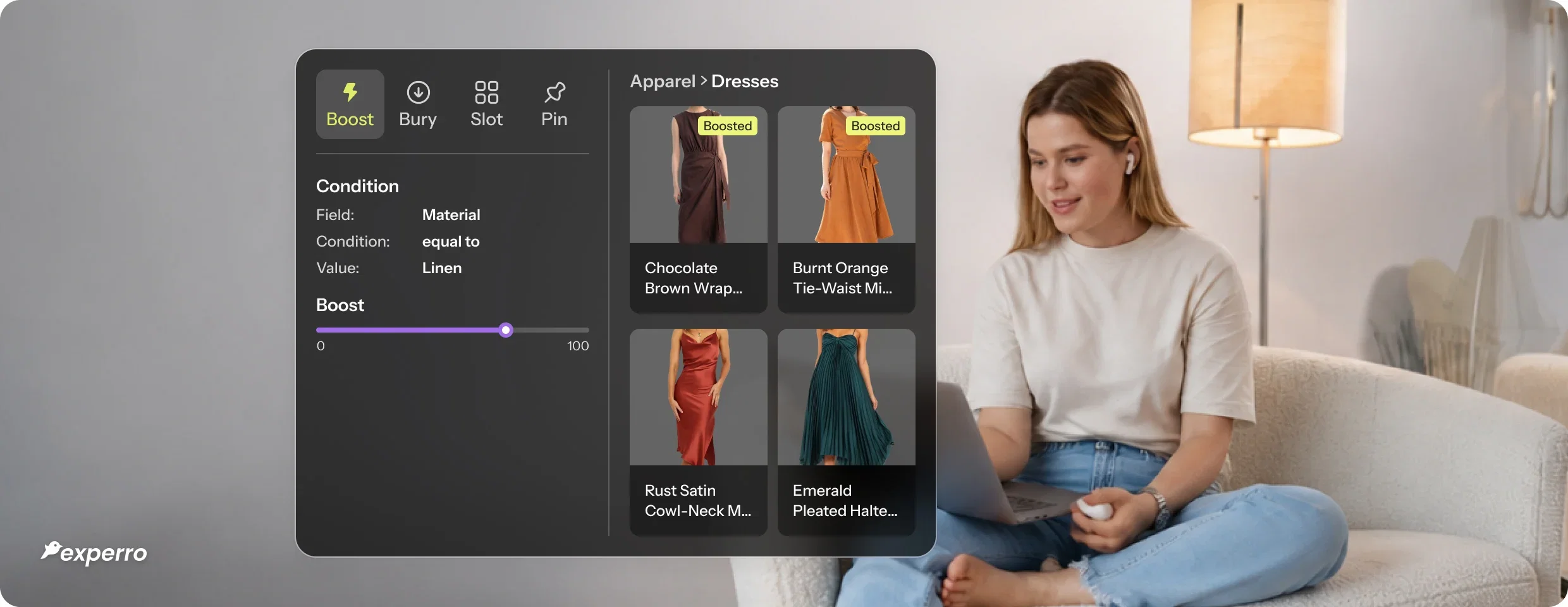
- Want AI without losing control? Experro Merchant Assistant gives your team AI-powered recommendations while you stay in control of what gets merchandised.
The result: your shopper finds products faster, your team makes smarter decisions, and you create an eCommerce customer experience that gives competitors fewer easy ways to catch up.
Give Shoppers a Reason to Choose You
When shoppers can compare almost everything, competing on price or product assortment alone isn’t enough. The brands that stand out make shopping easier, faster, and more relevant.
That starts with product discovery. Help shoppers find what fits their needs, explore relevant options, and move confidently toward purchase. AI makes this experience more responsive by understanding intent, behavior, and preferences.
Experro brings GenAI Search, AI Browse, Conversational Discovery, personalization, recommendations, and intelligent merchandising together to help you create a stronger eCommerce competitive advantage.
Ready to give shoppers a better reason to choose you? Contact Experro to see how AI-powered product discovery can help you compete more effectively.
FAQs

With 6+ years of experience in AI, software, and digital transformation across tech, healthcare, and fashion, Rahul focuses on making complex ideas simple, clear, and actually useful. He has learned how often great ideas get lost in complexity, which is why he centers his writing on clarity, helping entrepreneurs and leaders cut through noise and make decisions with confidence.
Subscribe to Our Newsletter!
Get the latest insights delivered straight to your inbox.