

core insights box
- Over 70% of business-to-business buyers start their purchase journey with search, making it the most critical stage of digital commerce.
- Intelligent B2B eCommerce search understands intent, context, and technical details—not just keywords.
- Optimized search reduces friction, speeds up ordering, and drives stronger buyer loyalty.
- Experro empowers B2B brands with AI-driven search that delivers precision, personalization, and scalability.
Finding the right product should be simple, even in a complex B2B catalog.
B2B search works differently from B2C. Buyers deal with detailed specifications, bulk pricing, and part numbers, often under tight procurement timelines.
In this context, every second matters. A strong eCommerce search can be the difference between a smooth purchase and a missed opportunity.
Intelligent B2B eCommerce search understands buyer intent, adapts to unique behaviors, and turns complex product discovery into quick, accurate, and personalized results.
For modern B2B brands, search is more than a tool. It is a strategic advantage that drives faster decisions, repeat orders, and long-term customer loyalty.
What Is B2B eCommerce Search?
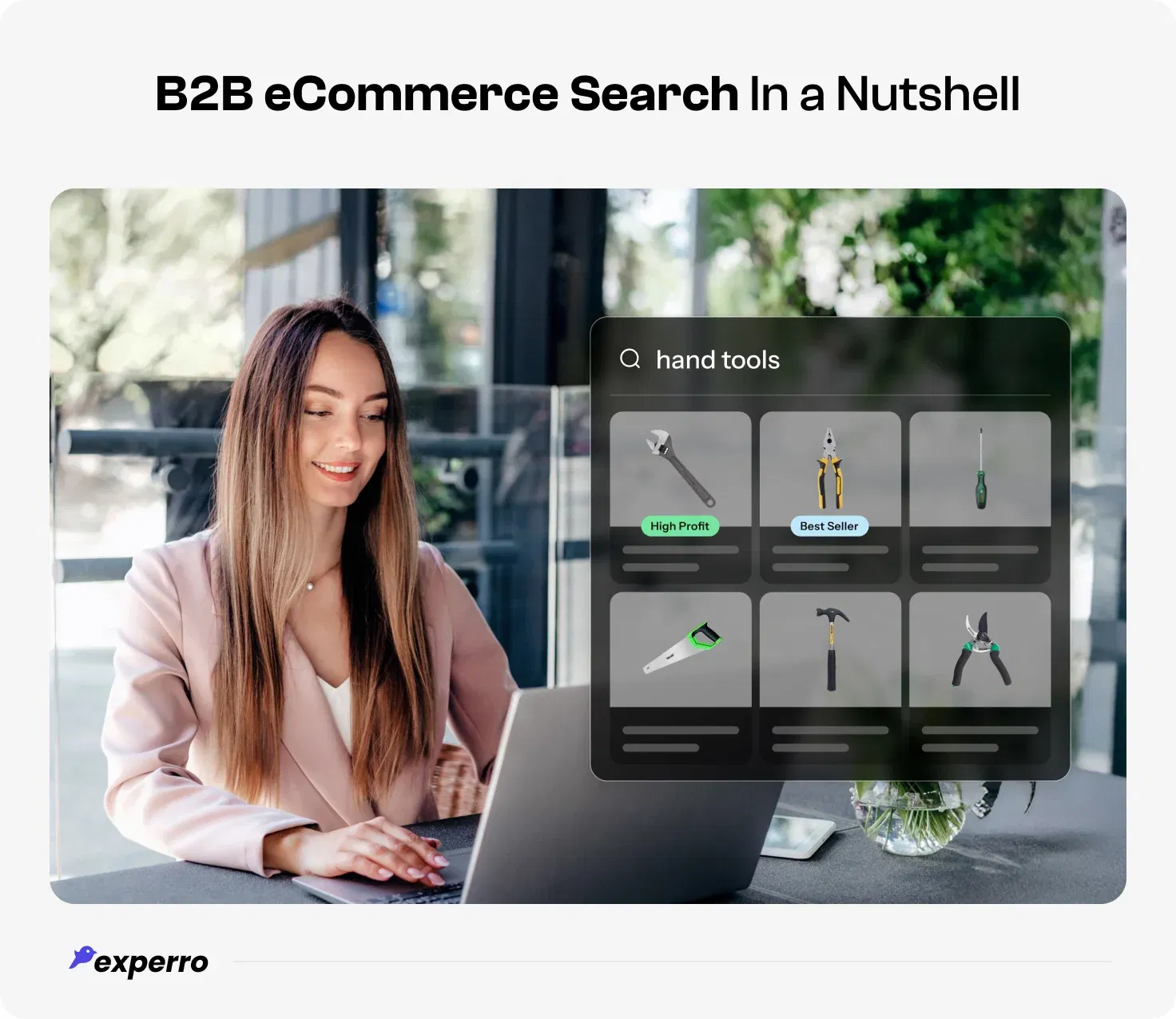
Definition - B2B eCommerce search refers to the intelligent search functionality that helps B2B buyers find, filter, and purchase products quickly on a B2B eCommerce site or portal.
Unlike B2C, B2B product search often involves technical specifications, part numbers, SKUs, and tiered pricing. It must understand the buyer's intent, handle complex data, and deliver accurate, personalized results.
In short, the B2B eCommerce search engine powers efficient discovery across massive catalogs and simplifies B2B order management for distributors, wholesalers, and manufacturers.
The majority of both B2B product inquiries and regular online purchases begin with a search, making it one of the most critical elements of any B2B eCommerce platform.
What Role Does AI & ML Play in Improving B2B Product Search?
AI and ML enhance B2B product search by understanding buyer intent, predicting relevant products, and personalizing results.
These are the technologies that help handle complex catalogs, improve accuracy, and speed up the discovery and purchasing process for B2B buyers.
Now that you know what B2B eCommerce search is and the role of AI and ML, let’s explore the must-have features that make it powerful, precise, and future-ready.
Key Features of B2B eCommerce Search (The “Must-Haves”)
Modern B2B eCommerce search requires features that go beyond search terms. It must combine intelligence, flexibility, and scalability to match how buyers actually search, browse, and order.
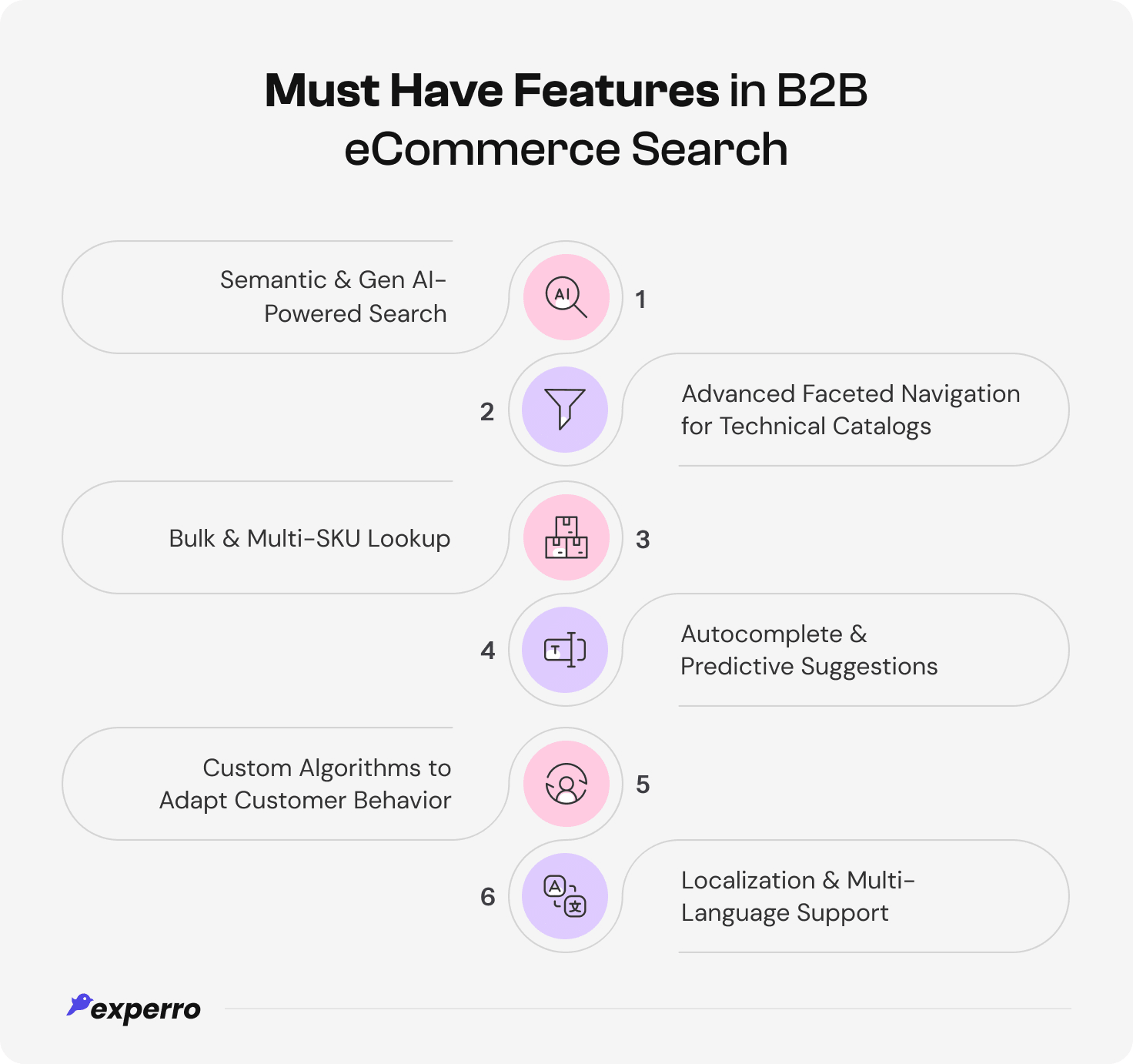
1. Semantic and Gen AI-Powered Search
AI search for B2B eCommerce understands intent, not just words. It interprets industry terms, synonyms, and context to return accurate matches.
AI-driven B2B search and semantic technology help buyers find the right product, even with incomplete or vague inputs.
It ensures relevance and personalization by learning from user behavior. This makes it a foundation for personalized search in B2B customer journey.
As a result, buyers using technical jargon or partial product info to get accurate results, reducing frustration and improving conversion rates.
2. Advanced Faceted Search Navigation for Technical Catalogs
For industries with large catalogs, searching and filtering for B2B eCommerce are critical.
Buyers need to narrow results by product attributes such as size, voltage, compatibility, or material.
B2B catalog search with advanced filters enhances precision and speeds up product discovery, especially for industrial search users handling complex inventories.
This means buyers can quickly find the right products without getting overwhelmed, improving efficiency and satisfaction.
3. Bulk and Multi-SKU Lookup
B2B buyers often order in volume or re-purchase multiple SKUs. A strong search by SKU feature simplifies finding and adding products to carts in bulk.
Reorder-friendly search B2B capabilities reduce repetitive actions, help streamline procurement, and boost customer satisfaction.
Consequently, buyers save time on bulk orders, which accelerates procurement and encourages repeat business.
4. Autocomplete and Predictive Suggestions
An intelligent B2B eCommerce search plugin should predict queries as the users type. Autocomplete shortens the search journey and prevents errors in long or technical product names.
One of the major focuses in B2B eCommerce trends 2025 is predictive suggestions, which helps improve both engagement and conversions.
In practice, this reduces errors and speeds up product discovery, making the search experience seem seamless.
5. Custom Algorithms to Adapt Customer Behavior
Every B2B enterprise eCommerce search should adapt based on behavior and preferences.
This adaptability ensures that buyers get the most relevant and personalized results every time they search. Machine learning customizes ranking and results, aligning with B2B buyer search behavior.
This delivers a B2B search bar experience that feels intuitive, reducing time to purchase and increasing order value.
Therefore, the search experience feels intuitive, reducing time to purchase and increasing order value.
6. Localization and Multi-Language Support
For global B2B websites, multi-language search ensures inclusivity and search relevance across regions. Localized catalogs, currencies, and language-aware search improve engagement.
This feature makes your enterprise B2B search relevant in every market.
With these B2B eCommerce platform features in place, your search engine is built for performance. But what does that mean for your business outcomes? Let’s dive into the real benefits of an optimized B2B search.
As a result, global buyers get relevant results in their language and currency, increasing adoption and satisfaction.
What Are the Benefits of an Optimized B2B Search?
An optimized B2B ecommerce site search doesn’t just improve usability; it directly influences business performance and buyer loyalty.
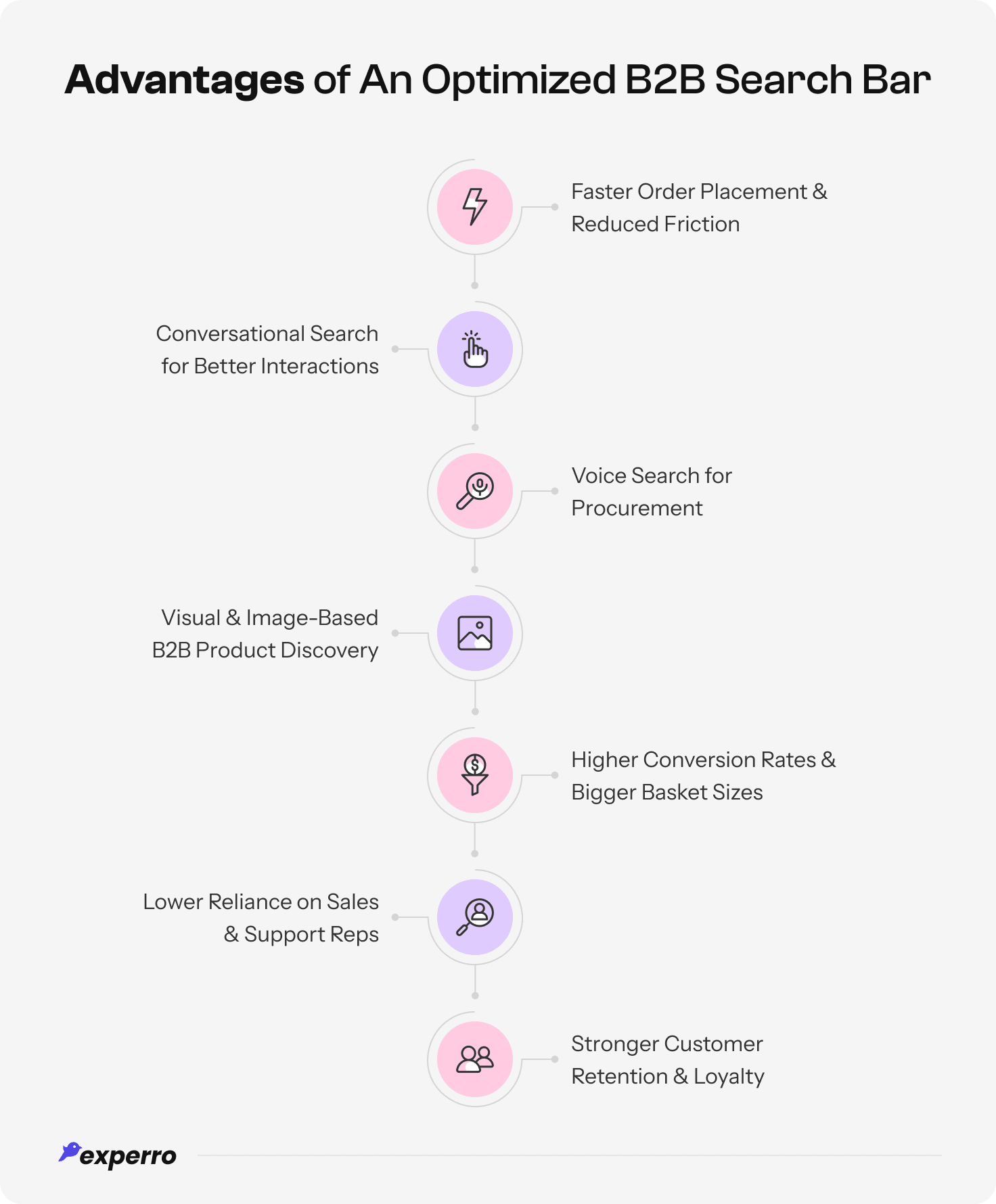
Let’s explore how it drives measurable results across the B2B digital commerce ecosystem.
1. Faster Order Placement and Reduced Friction
With efficient search for B2B eCommerce, buyers can locate products instantly and reorder without browsing.
This speed reduces drop-offs and supports digital merchandising strategies that ensure smoother checkout experiences.
It simplifies complex procurement journeys and helps large organizations manage repeat purchases easily. Optimized search also minimizes human error and boosts overall buyer satisfaction.
2. Conversational Search for Better Interactions
Conversational commerce brings natural language understanding to B2B search.
It can interpret phrases like “show me 100 units of 3-inch steel bolts”, creating more human-like, accurate, and engaging B2B eCommerce search and product discovery experiences.
Buyers feel more connected when the system “understands” them, mirroring real-world interactions. It transforms transactional journeys into more intuitive and efficient conversations.
3. Voice Search for Procurement
Voice-based B2B search for eCommerce allows busy buyers to search hands-free using voice commands to reorder or check specifications.
This eCommerce voice search capability is invaluable in industrial environments like warehouses or workshops.
It speeds up product identification, making multitasking easier for on-site professionals. By enabling fast, spoken queries, it enhances convenience and productivity across procurement teams.
4. Visual and Image-Based B2B Product Discovery
Visual search enhances B2B product search eCommerce by allowing buyers to upload product images or parts for reference identification.
It removes the need for manual searches and simplifies finding complex or hard-to-describe items. This capability is crucial for industries with thousands of SKUs or technical parts.
It also reduces dependency on sales teams and shortens the path from discovery to purchase.
5. Higher Conversion Rates and Bigger Basket Sizes
A powerful B2B eCommerce site search engine leads users directly to what they need, driving conversion rate optimization.
Precise and intelligent search results encourage larger basket sizes and improve overall B2B eCommerce site search conversions.
Buyers spend less time searching and more time purchasing, thus increasing sales. This improved relevance directly translates to stronger bottom-line growth.
6. Lower Reliance on Sales and Support Reps
AI-driven B2B search empowers buyers to find answers instantly without contacting sales or support teams.
This self-service model enhances operational efficiency while reducing business overheads. It allows teams to focus on strategic accounts rather than routine queries.
As a result, businesses achieve faster turnaround times and improve buyer autonomy.
7. Stronger Customer Retention and Loyalty
Hyper-personalized search results and smart reorder suggestions create frictionless buying experiences.
A dependable B2B enterprise eCommerce search fosters trust, loyalty, and long-term buyer relationships.
By anticipating user needs, it strengthens emotional engagement and repeat purchases. Over time, this consistent experience becomes a key differentiator in competitive markets.
See which search behaviors matter the most with insights from B2B eCommerce statistics.
While the benefits are undeniable, achieving this level of efficiency isn’t always easy. Let’s uncover the biggest challenges B2B businesses face when optimizing their site search.
What Are the Challenges in Implementing B2B Search? (The “Roadblocks”)
Despite its importance, optimizing B2B eCommerce site search comes with challenges that can impact usability, scalability, and buyer experience.
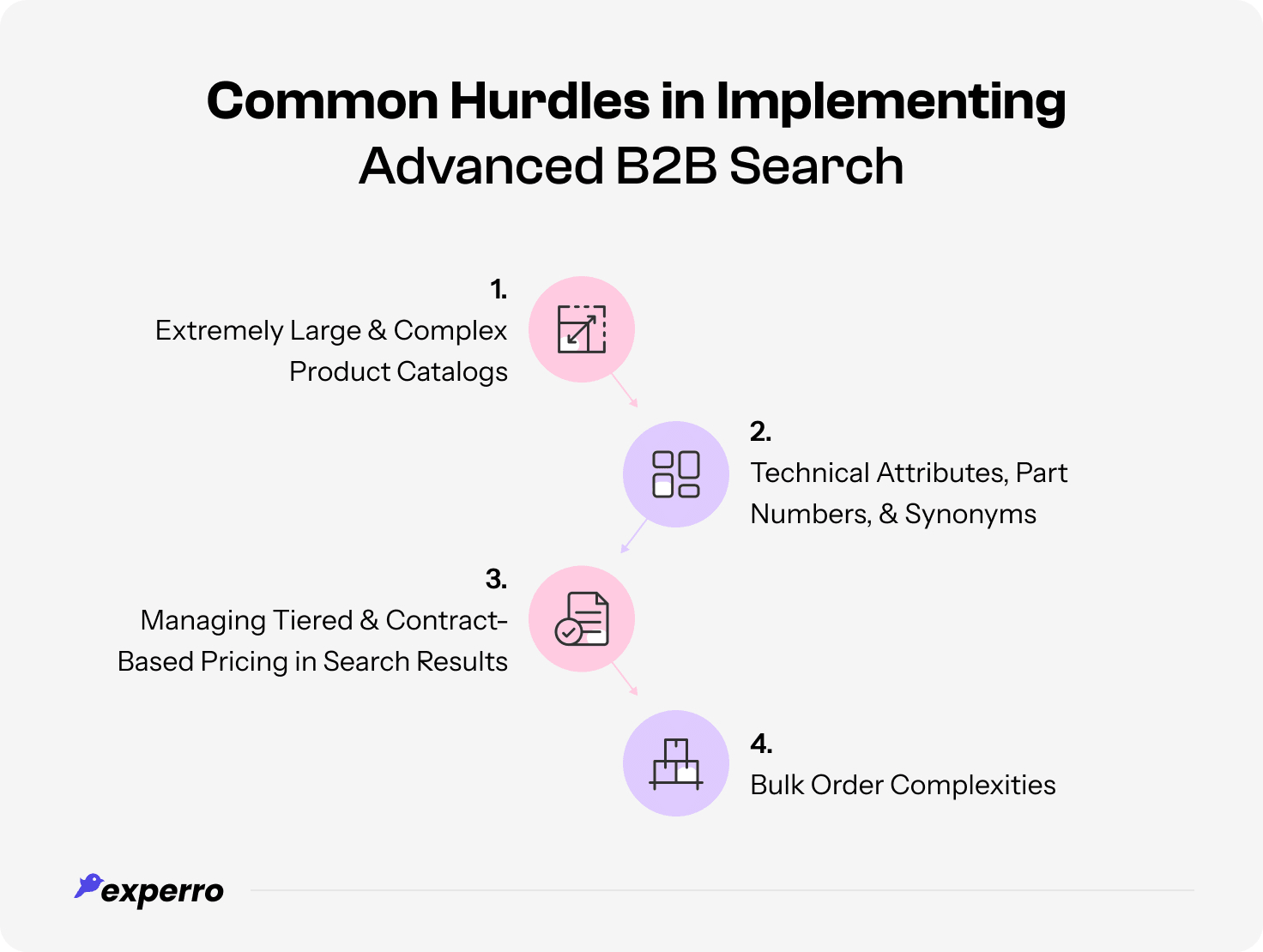
1. Extremely Large and Complex Product Catalogs
B2B sellers often manage vast inventories with thousands of SKUs, variants, and specifications. Searching through such massive catalogs can strain indexing systems and slow down response times, especially when buyers expect instant results.
Handling large-scale data efficiently requires a robust catalog management approach for speed and contextual relevance.
However, to handle this seamlessly, Experro’s B2B best search engine for eCommerce scales effortlessly with huge catalogs using AI-powered indexing and built-in catalog management for structured, fast, and relevant discovery.
2. Technical Attributes, Part Numbers, and Synonyms
B2B buyers often search using part codes, abbreviations, or industry-specific terms.
Traditional keyword-based search engines struggle to interpret these complex patterns, leading to irrelevant matches or zero results. This creates frustration and slows down procurement workflows.
To solve this, Experro’s advanced semantic search for B2B uses AI-driven understanding to interpret synonyms, technical attributes, and partial codes accurately, ensuring more meaningful and context-aware results.
3. Delivering Real-Time Search Insights and Analytics
Without visibility into buyer search behavior, businesses miss valuable opportunities to improve their site experience.
Many B2B platforms lack analytics to identify no-result queries, popular products, or drop-off points, making optimization difficult. This limits their ability to understand what buyers truly need.
To overcome this, Experro provides real-time eCommerce analytics that tracks buyer intent, keyword trends, and performance metrics, helping businesses refine search relevance and drive higher engagement.
4. Supporting Multi-Region and Multi-Language Search
Global B2B enterprises cater to diverse audiences with unique languages, currencies, and product preferences.
Traditional search systems struggle to adapt to these variations, leading to inconsistent results and lower engagement in regional markets.
To simplify this, Experro supports multi-region and multi-language search, offering localized catalogs, currency support, and language-aware indexing that deliver relevant results for every buyer in every market.
Now that we’ve addressed the common obstacles, let’s turn our focus to the best practices that can help you build a smarter, more scalable B2B search experience.
What Are the Best Practices for B2B Search? (The “Fixes”)
Implementing B2B eCommerce search best practices ensure relevance, performance, and scalability.
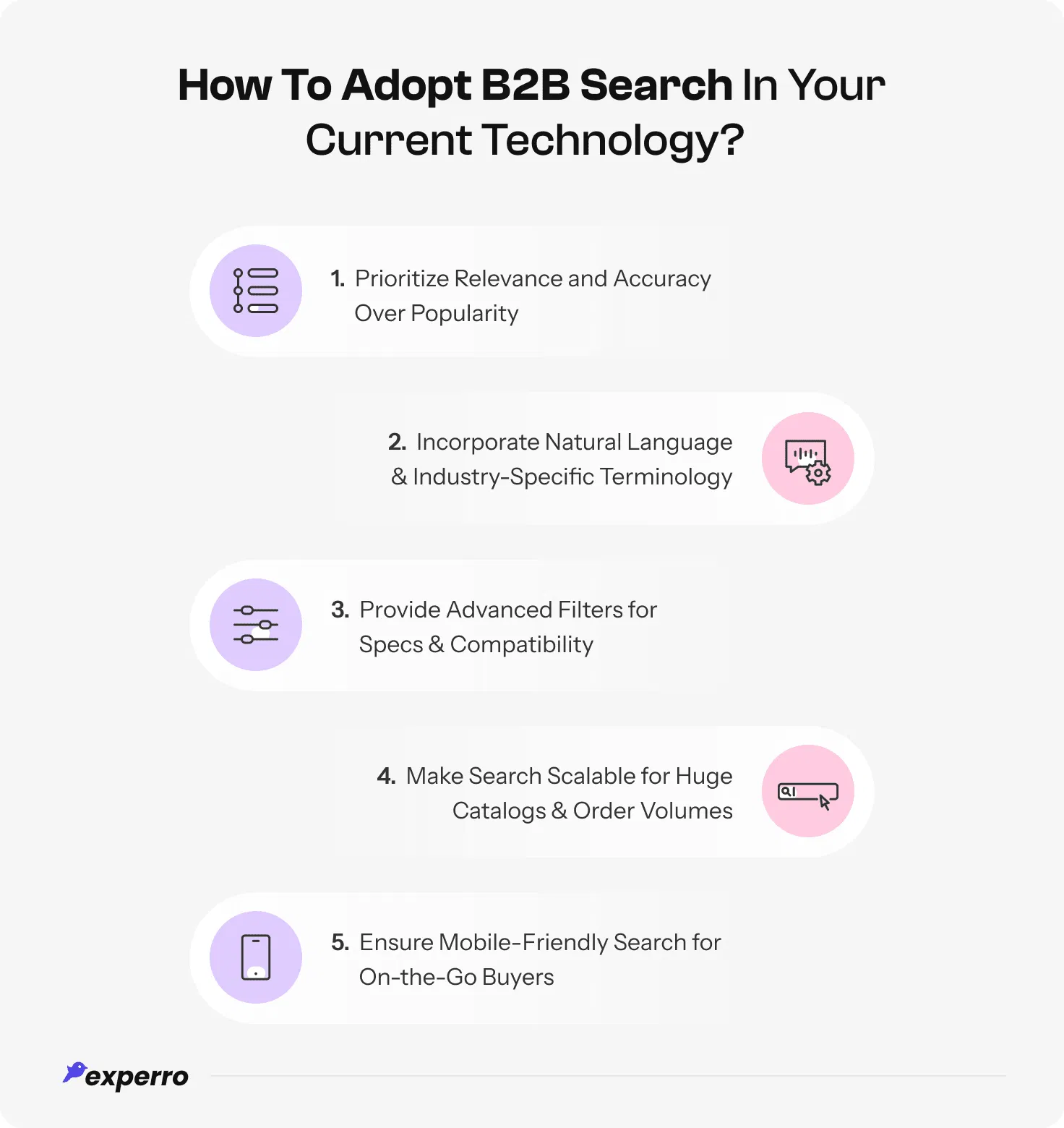
1. Prioritize Relevance and Accuracy Over Popularity
For B2B businesses, relevance is everything. Search engines must go beyond keyword matching to understand specifications, context, and buyer intent.
More than 90% of B2B buyers begin their purchase journey with search, highlighting its importance in digital commerce.
That’s why prioritizing relevance over popularity ensures results that reflect true buyer needs. This approach improves accuracy, supports complex B2B product searches, and drives higher conversions.
2. Incorporate Natural Language and Industry-Specific Terminology
Adopting natural language search in B2B enables buyers to communicate the way they speak, not the way systems expect.
Integrating domain-specific terms, abbreviations, and synonyms ensures smoother discovery for specialized parts or equipment.
It also helps eliminate friction for professionals unfamiliar with exact product names or SKUs.
3. Provide Advanced Filters for Specs and Compatibility
Advanced eCommerce filters and product categories allow buyers to refine search results by specifications, materials, or compatibility.
This feature is essential for industrial eCommerce site search, where accuracy builds trust and confidence.
By simplifying comparisons, filters shorten decision cycles and enhance product discoverability.
4. Make Search Scalable for Huge Catalogs and Order Volumes
Scalable search infrastructure ensures reliable performance even as product data and traffic grow.
Enterprise B2B search systems must support massive catalogs and frequent bulk orders without delays.
Investing in scalable architecture helps businesses maintain speed, stability, and relevance during peak operations.
5. Ensure Mobile-Friendly Search for On-the-Go Buyers
Many B2B buyers place orders through mobile devices while on-site or in the field. A responsive and easy-to-navigate mobile-first site experience improves accessibility and convenience.
Optimizing B2B eCommerce site search for smaller screens ensures buyers can search, compare, and reorder anytime, anywhere.
Following these best practices lays the foundation for success. To truly stand out, you need a search experience that deeply understands your buyers, and that is exactly where Experro comes in.
Why Top B2B Brands Choose Experro for Smarter Search?
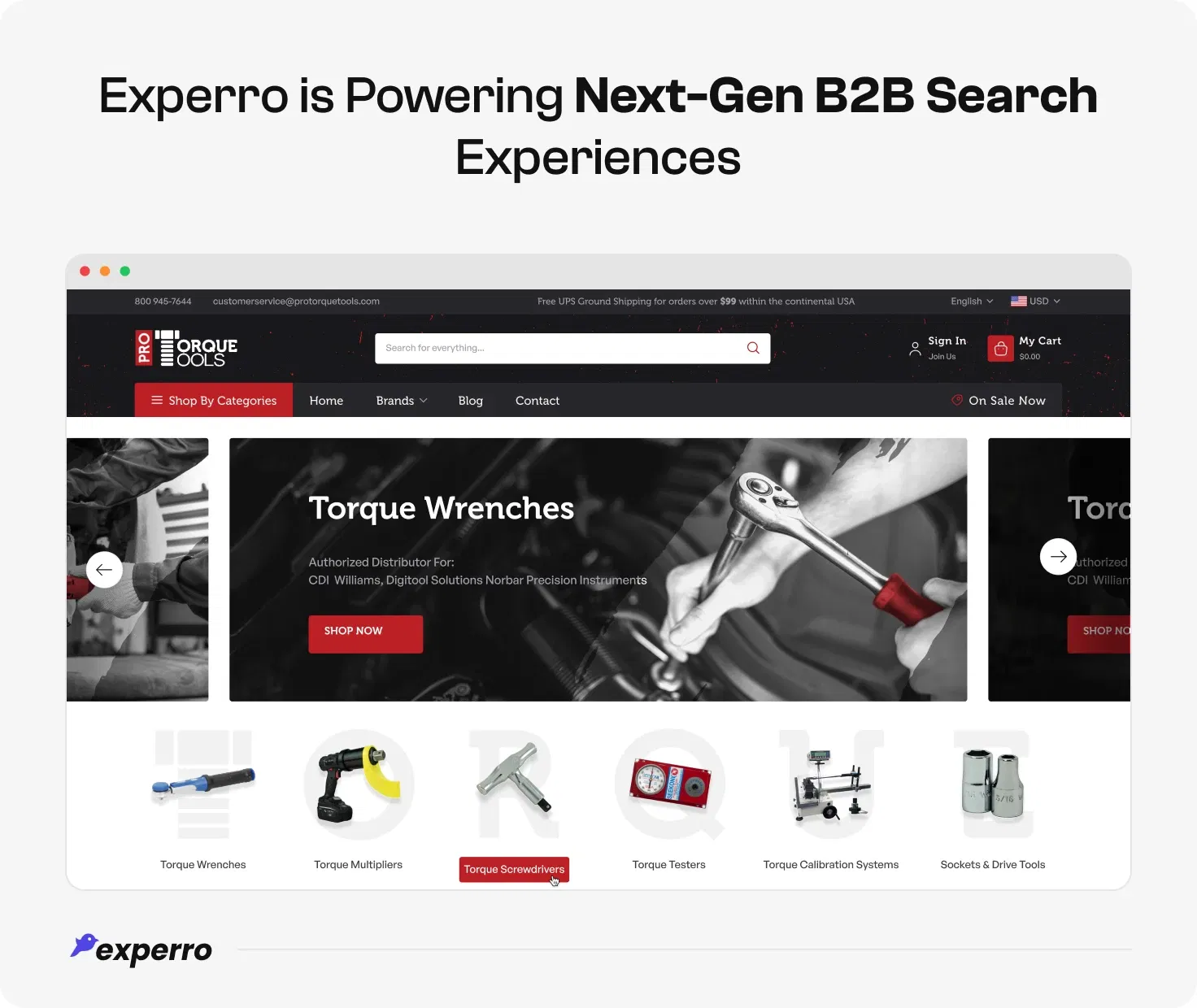
Experro powers modern B2B businesses with smarter and more personalized search.
The agentic platform combines semantic intelligence, natural language processing, and real-time personalization to make B2B product discovery faster and more accurate.
With features like industrial eCommerce search, visual search, conversational AI, and predictive analytics, Experro turns complex catalogs into easy-to-navigate, conversion-ready experiences.
It also supports multilingual catalogs, and profile-based product recommendations — all within a single unified B2B eCommerce platform.
If you’re ready to enhance search functionality in B2B eCommerce and improve buyer satisfaction, Experro is the best platform that makes it happen.
Conclusion
In B2B eCommerce, search determines how quickly buyers can find and purchase products. A strong search improves customer experience, loyalty, and sales.
Today, AI and personalization shape B2B product discovery, making optimized search essential for success.
Are you ready to elevate your B2B search experience and boost conversions? Schedule a call with Experro today to see how intelligent search can transform your store.
FAQs

Pallavi is an ambitious author recognized for her expertise in crafting compelling content across various domains. Beyond her professional pursuits, Pallavi is deeply passionate about continuous learning, often immersing herself in the latest industry trends. When not weaving words, she dedicates her time to mastering graphic design.
Subscribe to Our Newsletter!
Get the latest insights delivered straight to your inbox.