
- Generative AI
- Search
- eCommerce
- 6 min read
Klevu vs Algolia vs Experro: Which to Choose and Why?
Published
18 August 2026

core insights box:
- Need a smarter search? Klevu covers AI search and merchandising. Need deeper technical control? Algolia gives developers the APIs to build it themselves. Need a discovery that understands shoppers? Experro combines ALL INTO ONE - AI search, personalization, recommendations, and merchandising around real shopper intent.
- Want more than search? Experro helps turn every product search into a more relevant and personalized shopping journey.
Site search isn't a support feature anymore. It's one of the highest-converting pages on your entire storefront, and most brands still treat it like an afterthought.
That's the real reason "Klevu vs Algolia vs Experro" keeps trending. Teams finally realized search drives revenue, not just navigation, and they want the platform that proves it.
Klevu, Algolia, and Experro each one earns real conversion lifts for the right business, and also not fit for every business model.
This guide walks through pricing, merchandising control, AI capabilities, and total cost of ownership for all three, so you can match the platform to your actual catalog.
At A Glance: Which Platform Is Right for You?
Short on time? Here's where you probably land if you're hunting for the best eCommerce search platform for your store.
You want AI search, merchandising, and personalization in one place, without hiring extra developers. Experro is your best fit.
- Enterprise retail with an in-house dev team - Experro or Algolia
- Mid-market Shopify or Magento store - Experro or Klevu
- B2B or complex catalog businesses - Experro
- Teams without dedicated developers - Experro or Klevu
- API-first, custom-built storefronts - Experro or Algolia
The table below shows you the heads-on comparison now.
| Experro | Algolia | Klevu |
| Core model | Unified AI product discovery platform | Search-as-a-service API | Search and merchandising app |
| AI Shopping Assistant | Built-in Conversational AI Agent (EMA) | Add-on via Agent Studio/Ask AI | Not native |
| Merchandising control | Business-user friendly, no dev tickets | Merchandising studio, dev help often needed | Automated, but limited manual control |
| Personalization | Real-time, native to the platform | Requires custom logic | Not personalized to individual users |
| Pricing model | Unified platform pricing | Usage-based, scales with traffic and records | Flat within the contract term |
| Best for | One connected discovery layer | Developer-first teams needing a fast API | A fast Shopify or Magento install |
Pros & Cons of Algolia vs Klevu vs Experro
You don't need a marketing pitch. You need to know what each platform actually does well, and where it falls short.
Here’s what users are saying, based on reviews, feedback, and insights from trusted sources.
1. Algolia

Algolia is a generic, high-performance search API built for developers. It's flexible, fast to customize, and excellent at raw speed. It isn't built specifically for eCommerce merchandising out of the box.
| Pros of Algolia | Cons of Algolia |
| Industry-leading query speed, with search results typically returned in 70 to 100 milliseconds. | Usage-based pricing that climbs with record counts and traffic spikes, which G2 reviewers flag often.1 |
| Developer-first experience with well-documented APIs, SDKs for Android, iOS, and .NET, and 200+ integrations. | Extensive setup usually needs your engineering team, not just business users.2 |
| Fine-tuning search relevance can take some trial and error, especially with custom ranking and filters.3 | |
| Limited rule-level analytics can make it harder to see which rules are most impactful and identify redundant rules.4 | |
| Startup credits can expire before a product launches, limiting their value for pre-revenue teams.5 |
Quick take: great if you already have engineering teams to own it and can absorb usage-based costs as you scale.
If your team has developers who can own the build, and you're comfortable with metered pricing, Algolia is a strong technical pick. Teams researching Algolia alternatives are usually the ones without that engineering bandwidth, or the ones who got a surprise bill after a traffic spike.
2. Klevu
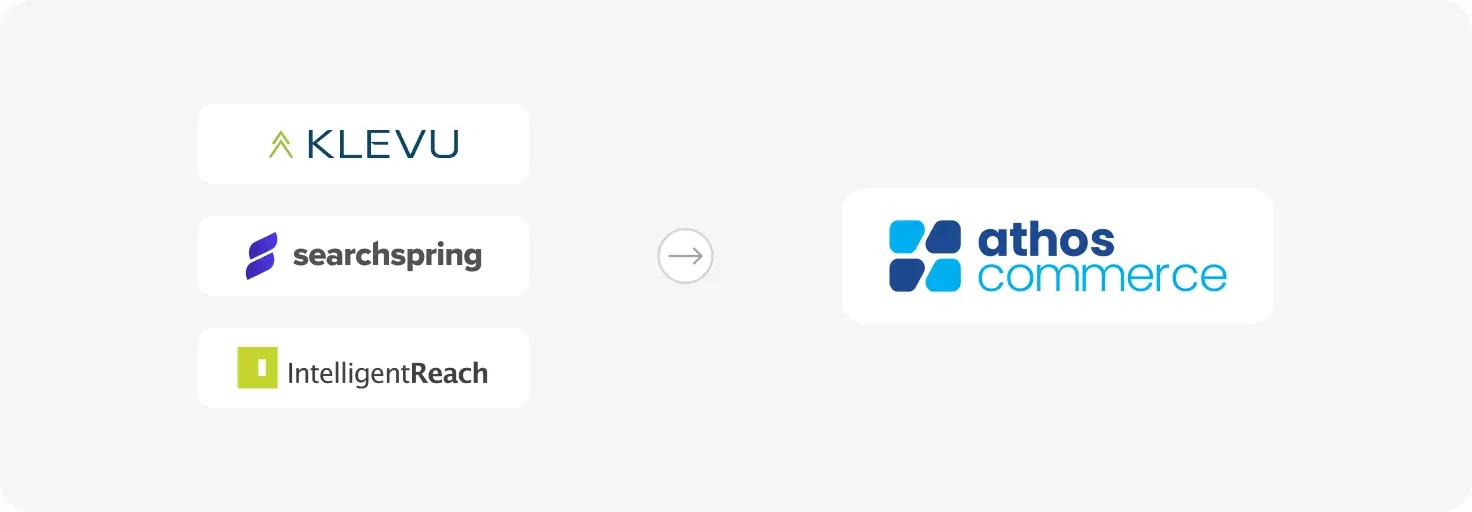
Klevu Is Now Athos Commerce: What You Need to Know!
In January 2025, Klevu merged with Searchspring and Intelligent Reach. The new parent company is called Athos Commerce.
Here's what actually changed: the brand name and the parent company. Here's what didn't: Klevu still runs as its own product, with its own roadmap.
Searchspring and Intelligent Reach do too. As of 2026, all three still run on separate contracts, separate pricing, and separate integrations. There's no single unified platform underneath the new brand yet.
That matters for you. If you shortlist "Klevu" today, you're evaluating one piece of a bigger, still-merging portfolio, not a finished product.
That's one reason so many teams researching Klevu alternatives want a platform built as one system from day one, instead of three companies stitched together after the fact.
Klevu's strength has always been fast, no-code setup for Shopify and Magento. That hasn't changed under the Athos Commerce brand.
| Pros of Klevu | Cons of Klevu |
| Native, no-code Shopify and Magento integration; the Shopify app often installs in under an hour | Higher pricing and annual contracts can make Athos costly for smaller eCommerce teams.6 |
| Flat pricing within a contract term (Premium, Premium+, and Enterprise) avoids surprise cost spikes | Migration can be challenging for businesses with established eCommerce setups.7 |
| Large-catalog merchandising rules can be cumbersome to manage and update.8 | |
| The dashboard can feel dated compared with newer commerce platforms.9 | |
| New users may need time to learn and navigate the platform effectively.10 |
Quick take: fast to launch, light on personalization and merchandising control once you scale.
3. Experro

Experro is built as one AI-native platform. Search, merchandising, personalization, recommendations, and a Gen AI shopping assistant all run on the same system.
| Pros of Experro | Cons of Experro |
| AI-powered search and product discovery that helps eCommerce teams deliver faster, more relevant results.11 | A newer entrant than long-established, API-first players like Algolia. |
| Composable, headless architecture with a Visual Builder and Front-end Hosting for faster deployment.12 | Best fit is teams that want an integrated platform, not a narrow point solution. |
| Native B2B Product Discovery for complex catalogs and account-based buying.13 | |
| Smooth integrations connect with existing eCommerce and web systems while reducing manual work.14 | |
| AI shopping assistant and intent-driven experiences that help shoppers discover products using context and intent.15 | |
| Personalization and tailored recommendations that create more relevant shopping journeys and boost engagement.16 |
Quick take: if you want one platform instead of three vendor contracts, this is your category.
How to Choose the Right Product Discovery Platform
Feature lists are easy to compare and easy to be misled by. Here's what actually moves your conversion rate, your team's workload, and your cost over a multi-year contract.
- Search & Product Discovery
- Merchandising Controls
- Scalability
- Personalization & Recommendations
- Ease of Implementation
- AI Capabilities like Conversational AI
- Integration with Your Commerce Stack
Conclusion
Klevu, now under the Athos Commerce brand, remains solid for Shopify and Magento merchants who want fast, no-code search with predictable, flat pricing. Algolia is still the strongest pick if you have developers who want raw speed and can manage usage-based costs as traffic grows.
Experro is built for you if you want search, merchandising, personalization, and Gen AI unified in one platform, instead of managed across separate, loosely connected tools.
Don't just trust our words, trust the results. Browse real results in Experro's case studies.
Your right choice depends on your team's technical resources, your catalog complexity, and how much control you want to hand your merchandising team versus your developers.
Want to see what a unified AI-native product discovery platform looks like on your own catalog? Contact our team today!
Citations
- Algolia Pros & Cons on G2
- Algolia Pros & Cons on G2
- Peerspot Review of Algolia
- Algolia Pros & Cons on G2
- Capterra Review of Algolia
- Athos Commerce Pros & Cons on G2
- Athos Commerce Pros & Cons on G2
- Athos Commerce Pros & Cons on G2
- Athos Commerce Pros & Cons on G2
- Athos Commerce Pros & Cons on G2
- Athos Commerce Pros & Cons on G2
- Athos Commerce Pros & Cons on G2
- Experro Pros & Cons on G2
- Experro Pros & Cons on G2
- Experro Pros & Cons on G2
- Experro Pros & Cons on G2
FAQs

With 6+ years of experience in AI, software, and digital transformation across tech, healthcare, and fashion, Rahul focuses on making complex ideas simple, clear, and actually useful. He has learned how often great ideas get lost in complexity, which is why he centers his writing on clarity, helping entrepreneurs and leaders cut through noise and make decisions with confidence.
Subscribe to Our Newsletter!
Get the latest insights delivered straight to your inbox.
Recommended Reads