
- Generative AI
- Product Discovery
- eCommerce
- 8 min read
Conversational AI Isn't Just Talking. It's Selling For Real!
Published
14 August 2026

key takeaways
- Shoppers can simply say what they want, and Conversational AI helps them find it faster.
- When AI understands intent, product recommendations feel more relevant, personal, and genuinely helpful throughout shopping.
- Smarter search turns frustrating zero-results moments into useful product suggestions that keep shoppers exploring.
- Experro brings AI-powered search, personalization, recommendations, and conversational discovery together to make shopping feel effortless.
Type a vague product description into a search bar and you'll usually get a page of near-misses instead of what you meant. That mismatch is exactly what conversational ai in eCommerce is meant to fix.
The shift isn't small. The conversational commerce market is projected to hit $22.56 billion by 2031, and online shoppers are the ones pushing it there.
A traditional chatbot runs on hand-coded rules and only answers the questions it was programmed for. Conversational AI works differently. It's built on natural language processing, machine learning, and increasingly large language models, so it understands human language instead of matching keywords, and it can carry out multi-step actions on its own.
Shoppers have adjusted their expectations right along with the technology. A clunky online shopping experience doesn't get a pass anymore, not when conversational commerce tools have made shopping online this easy almost everywhere else.
So where does conversational AI technology actually fit inside an eCommerce business? Four places, and each one does a different job.
What Is the Role of Conversational AI in eCommerce?
Conversational AI for eCommerce isn't one feature doing one job for your store. It plays four distinct roles across the shopping journey, shaping each interaction based on where your shopper is and what they need at that moment.
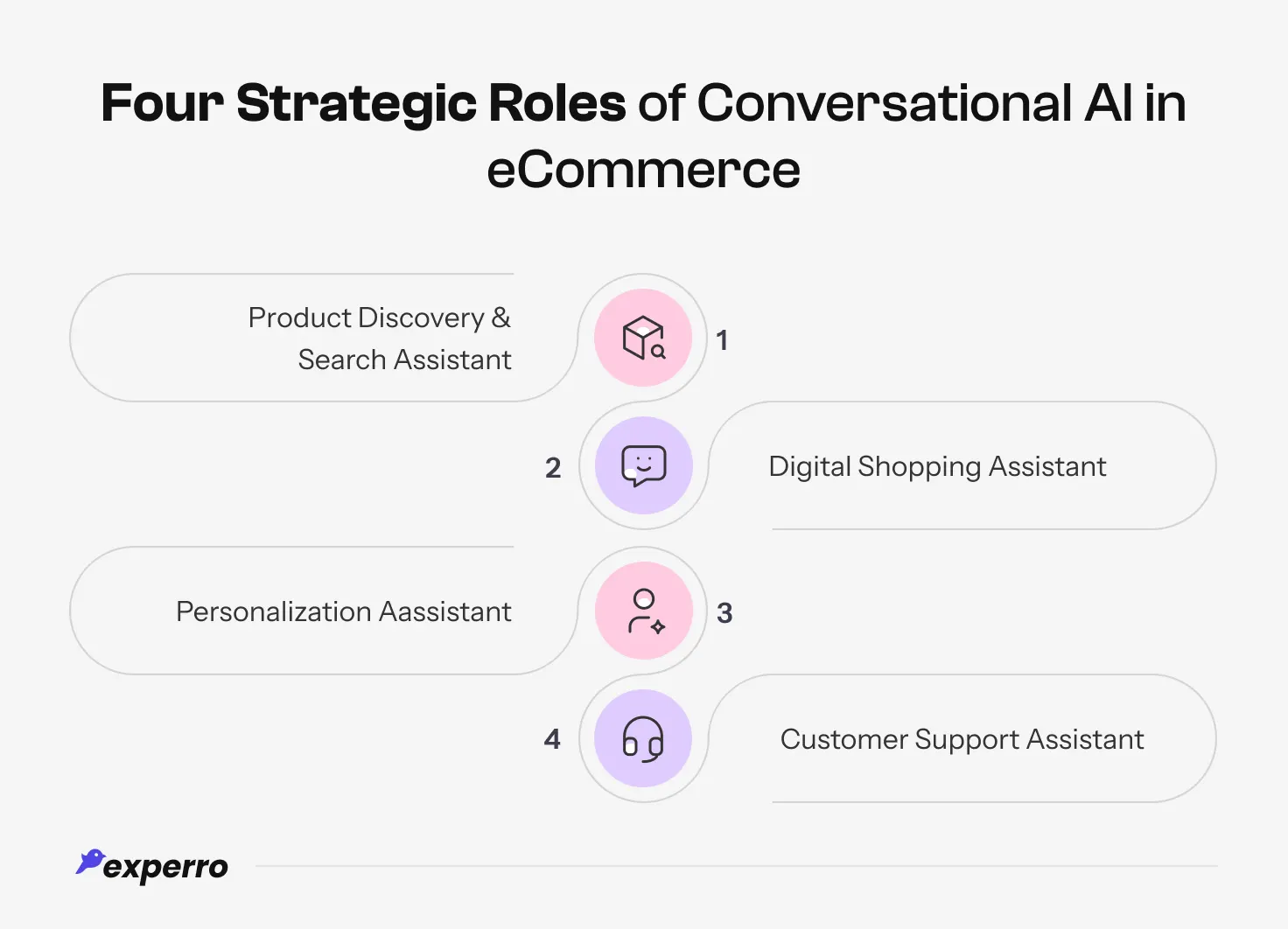
Conversational AI for eCommerce breaks down like this:
- A product discovery assistant helps shoppers find the right item through natural conversation.
- A digital shopping assistant guides shoppers from comparison to checkout.
- A personalization assistant uses customer data to tailor recommendations in real time.
- A customer support assistant resolves customer inquiries before and after purchase.
You probably don't need all four running on day one. Here's what each role actually does, and how to implement conversational commerce AI without overbuilding from the start.
How Does Conversational AI Help With Product Discovery?
As a product discovery assistant, conversational AI in eCommerce reads shopper intent and matches it to relevant products, even when shoppers don’t use your exact product terms.
In practice, that means it:
- Understands natural-language queries, not just exact keywords
- Holds conversation context across a session instead of treating each search as new
- Delivers results that match what the shopper meant to find
- Cuts down on zero-result searches that push shoppers to a competitor
- Extends to voice assistants too, since hands-free, voice-activated search runs on the same intent engine
That's the real difference between basic autocomplete and true conversational search: one guesses at keywords, and the other understands what you're trying to find.
Birk Sport, a Norwegian bike shop chain, shows this well. Its eCommere chatbot helps shoppers narrow down bike types through conversation instead of forcing them through a maze of filters.
Experro pairs AI-powered search with semantic understanding and personalization, so product discovery and product search work as one system instead of two.
How Does Conversational AI Work as a Digital Shopping Assistant?
Search finds products. A digital shopping assistant helps a shopper choose between them. Some call it a personal shopping assistant, others a virtual shopping assistant, but the job stays the same: always available, always ready to compare options.
It handles the kind of human conversation a good in-store associate would:
- Understands what the shopper is trying to get done
- Recommends options based on stated and inferred customer preferences
- Answers product questions instantly, no waiting on hold
- Compares items side by side and explains the real differences
- Guides customers from browsing to checkout with confidence
This is where an AI shopping assistant proves its worth in eCommerce specifically. It isn't answering generic FAQs. It's guiding an actual purchase decision using real product data.
Experro builds this by combining conversational AI with search, personalization, and recommendations in one flow, instead of a chatbot bolted onto a separate, existing tech stack.
How Does Conversational AI Power Personalization?
Personalization is where conversational AI shows the clearest return. AI-driven recommendations can lift revenue by 5 to 40 percent, and personalized recommendations alone can improve conversion rates by up to 23 percent.
As a personalization assistant, it pulls in customer data (browsing behavior, purchase history, and real-time context) and uses all of it to provide tailored product suggestions throughout the session, not just once at login.
That means:
- Surfacing recommendations tuned to the individual shopper
- Suggesting complementary or similar products at the right moment
- Supporting cross-sell and upsell without feeling pushy
- Adjusting instantly as behavior shifts, instead of relying on a stale profile
It's also where proactive messaging comes in: you can nudge shoppers who've left something in their carts instead of simply waiting for them to come back on their own.
The payoff goes beyond a bigger cart, too. Personalized conversations make it easier to discover relevant products, build trust, and turn a one-time purchase into a reason to return.
Research shows that companies that excel at personalization generate 40% more revenue from those activities than average players. Personalized recommendations are one way brands can make that experience more relevant to what you're browsing, considering, and buying.
Experro helps eCommerce teams personalize every interaction in real time, adjusting as shopper signals change rather than relying on fixed rules that quickly become outdated.
How Does Conversational AI Support Customer Service?
Support is where conversational AI in eCommerce got its start, and it's still one of its biggest wins. AI-powered chatbots can now automate 70 to 80 percent of routine customer queries.
As a customer support assistant, it acts as the first line of response, then hands off to a human agent the moment a conversation needs one.
It typically covers:
- Instant answers to common customer inquiries
- Order tracking, returns, exchanges, and post-purchase support
- Self-service resolution for routine issues
- A clean handoff to a human agent for anything complex
That handoff matters. Shoppers value a solved problem over a fast reply that doesn't fix anything, and it shows directly in customer satisfaction levels.
Ninety-four percent of shoppers say good service encourages them to buy again, and conversational commerce AI can reduce support costs by roughly 30 percent while customer experience quality holds steady.
Experro brings conversational AI in eCommerce into the shopping journey, using AI agents for eCommerce to help customers find answers, explore products, and move forward without jumping between systems.
What Business Impact Can Conversational AI Create?
The case for conversational AI in eCommerce shows up in real numbers, not just in these conversational commerce use cases.
| Impact Area | What Changes |
| Product discovery friction | Fewer zero-result searches, faster path to the right product |
| Team efficiency | Routine queries handled by AI agents, freeing teams for higher-value work |
| Shopper confidence and conversions | Guided comparisons remove hesitation right when it counts, which is core conversion rate optimization territory |
| Personalized commerce experiences | Real-time recommendations turn one-time buyers into repeat customers |
Fixing discovery friction alone protects revenue that would otherwise leak out of the purchasing process through purchase friction, often at the worst possible moment: right before checkout.
There's a data layer behind all of this too. AI technology analyzes customer feedback and shopper behavior to surface valuable insights that shape merchandising, not just chat responses.
Put those four impact areas together, and a conversational AI chatbot solution for eCommerce can influence more than customer satisfaction. It can improve product discovery, guide shoppers toward relevant products, support purchase decisions, and ultimately contribute to revenue growth.
How Does Experro Help Brands Enable Conversational AI Experiences?
Most conversational AI commerce solutions solve one part of the shopping journey.
Experro’s Conversational AI agent connects discovery, guidance, personalization, and purchase assistance in one conversational experience, helping shoppers find relevant products without jumping between disconnected tools.
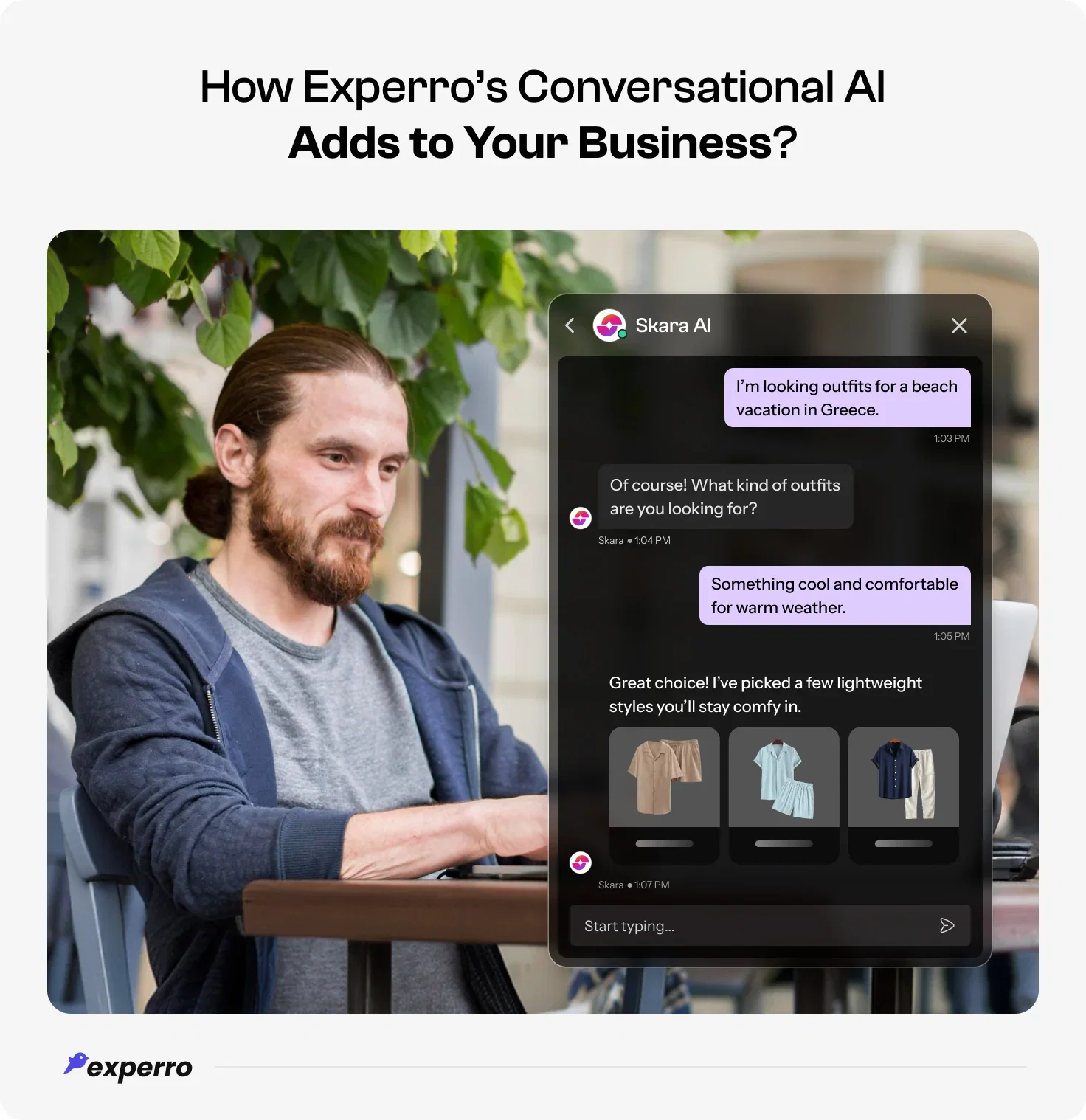
- Connects shopper intent to relevant products, so customer conversations deliver accurate discovery instead of generic scripted replies.
- Combines AI search, personalization, and recommendations into one interactive shopping experience.
- Keeps every AI-driven conversation aligned with the business through merchandising controls and product relevance management.
- Uses real shopper signals, not assumptions, to build context-aware interactions across the entire customer journey.
- Scales conversational commerce across multiple channels, including messaging platforms, social media platforms, and the storefront itself, without relevance breaking down.
Conversational AI Is Becoming a Core eCommerce Capability
Conversational AI has moved well past its old job as a support widget bolted onto the checkout page.
Built into an eCommerce platform the right way, it spans discovery, personalization, engagement, and day-to-day operations as a set of connected capabilities, not one generic chatbot feature.
Brands that treat it as four separate roles, matched to real bottlenecks instead of trends, end up with shopping experiences that are faster, more relevant, and easier to scale as the catalog and customer base grow.
That's the shift worth building toward now, before shopper expectations move even further ahead.
Ready to see what conversational AI could look like for your store? Contact us and our team will walk you through how Experro brings AI-powered search, personalization, and conversational shopping together, tailored to your catalog and current tech stack.
FAQs

With 6+ years of experience in AI, software, and digital transformation across tech, healthcare, and fashion, Rahul focuses on making complex ideas simple, clear, and actually useful. He has learned how often great ideas get lost in complexity, which is why he centers his writing on clarity, helping entrepreneurs and leaders cut through noise and make decisions with confidence.
Subscribe to Our Newsletter!
Get the latest insights delivered straight to your inbox.