- Customer Data Platform
- Personalization
- Generative AI
- 14 min read
Data-driven Personalization You're Missing Out On In 2026
Published
26 June 2026Updated
28 September 2026

core insights box:
- Customers no longer compare you to competitors, they compare you to the best experience they had anywhere online.
- By the time you react to customer intent, the opportunity to influence a purchase may already be gone.
- The brands winning with personalization aren't doing more personalization; they're making smarter decisions in the moments that matter most.
- Experro brings customer data together, helping you turn real-time intent into personalized experiences that drive measurable revenue growth.
Let's imagine a customer returning to your online store for the fifth time.
You've seen what they've searched for, the products they've viewed, the items they've added to their cart, and the purchases they've made before.
The data is there.
Yet when they return, they see the same products, the same promotions, and the same experience as someone visiting for the very first time.
That's where many eCommerce brands struggle. The challenge isn't collecting customer data anymore. It's turning that data into relevant experiences before the moment of intent disappears.
The reality is that customers don't see your systems, platforms, or data sources. They only see the experience you deliver. And when that experience feels generic, all the data in the world means very little.
This guide explores how data-driven personalization helps unify customer data, uncover customer intent, and create relevant shopping journeys that increase engagement, improve conversions, and build long-term customer loyalty with Experro.
What Is Data-driven Personalization in eCommerce?
Data-driven personalization in eCommerce is the process of using customer data and real-time behavioral signals to tailor shopping experiences based on individual user intent rather than assumptions.
Data-driven personalization analyzes customer actions such as searches, browsing behavior, product views, comparisons, purchase history, and other interactions to understand user intent.
It then uses these insights to deliver personalized content, product recommendations, and real-time personalization that improve product discovery and create more relevant shopping experiences.
To understand why this approach is more effective, it's important to see how data-driven personalization differs from traditional personalization.
How Data-driven Personalization Differs From Traditional Personalization?
At first glance, both approaches may seem similar because they aim to create personalized customer experiences.
The real difference lies in how they understand customer intent and respond to it.
| Aspect | Traditional Personalization ❌ | Data-driven Personalization ✅ |
| Approach | Based on assumptions | Based on customer data |
| Targeting | Targets broad segments | Targets individuals |
| Decisions | Uses fixed rules | Uses real-time insights |
| Experience | Delivers generic messaging | Delivers personalized experiences |
| Adaptability | Changes slowly | Adapts to customer behavior |
| Focus | Focuses on groups | Focuses on individual preferences |
| Outcome | Limited relevance | Higher engagement and conversions |
| Strategy | One-size-fits-many | One-to-one personalization |
What Are the Benefits of Data-driven Personalization for eCommerce?
Every irrelevant shopping experience costs more than a sale; it can cost future loyalty.
Here are the key benefits of data-driven personalization for eCommerce and how it helps you build stronger customer relationships and sustainable growth.
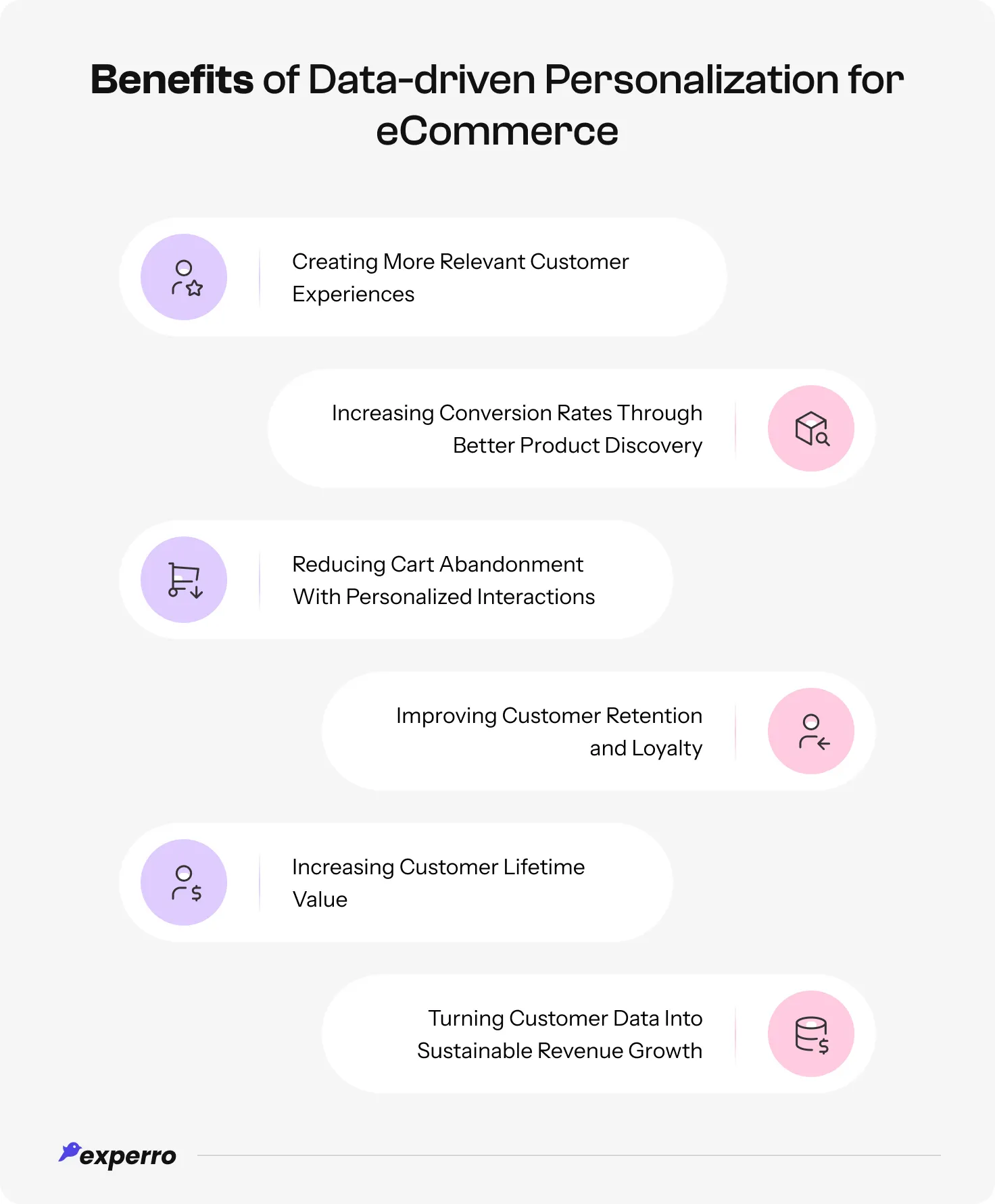
1. Creating Super Relevant Customer Experiences
Customers don't remember every interaction, they remember the ones that feel relevant.
By analyzing browsing history, purchase history, customer interactions, and behavioral data, you can better understand customer behavior and individual preferences.
This allows you to create personalized experiences that align with intent, making every stage of the customer journey more useful and engaging.
2. Increasing Conversion Rates Through Better Product Discovery
Customers are more likely to buy when finding the right product feels effortless.
Data-driven personalization uses customer behavior, engagement patterns, and insights to recommend relevant products at the right time.
Through personalized content and data-driven product recommendations, brands reduce decision fatigue and help customers reach purchase decisions faster.
To see how recommendation engines influence buying decisions, explore eCommerce recommendations guide.
3. Reducing Cart Abandonment With Personalized Interactions
Many abandoned carts are caused by uncertainty, not a lack of purchase intent.
Personalized reminders, relevant recommendations, and AI-driven personalization help customers continue where they left off.
Together, these strategies play a critical role in reducing cart abandonment by re-engaging shoppers with timely, relevant experiences.
These interactions reduce friction, reinforce purchase confidence, and keep high-intent shoppers moving toward conversion.
4. Improving Customer Retention and Loyalty
Customers stay loyal to brands that consistently understand their needs.
Using eCommerce customer data and a unified customer view, your business can deliver relevant experiences across multiple channels.
This consistency strengthens customer satisfaction, builds trust, and increases long-term customer loyalty.
5. Increasing Customer Lifetime Value
The most valuable customers are often the ones who keep coming back.
Data-driven personalized experiences help you identify repeat purchase patterns and uncover upsell and cross-sell opportunities based on customer behavior and individual preferences.
Over time, these personalized interactions increase customer lifetime value while also building stronger and more lasting customer relationships.
6. Turning Customer Data Into Sustainable Revenue Growth
Customer data creates value only when it leads to better decisions.
Brands that combine high quality data, data analytics, and omnichannel personalization can continuously improve customer engagement, conversion rates, and other key performance indicators.
Instead of relying on one-time campaigns, they build a scalable data-driven personalization strategy powered by customer intelligence.
Many leading brands enhance these efforts with predictive-customer-analytics to anticipate future customer needs and uncover growth opportunities before they become obvious.
According to McKinsey, companies that excel at personalization can generate 40% more revenue from those activities than their average-performing peers.
The real benefit of data-driven personalization isn't simply delivering different experience, it's delivering the most relevant experience for every customer, every time.
Now, let’s look at the types of customer data used for personalization.
What Types of Customer Data Are Used for Personalization?
The quality of personalization depends on the quality of customer data behind it.
The more accurately brands understand customer behavior, preferences, and intent, the easier it becomes to deliver personalized experiences that feel relevant throughout the customer journey.
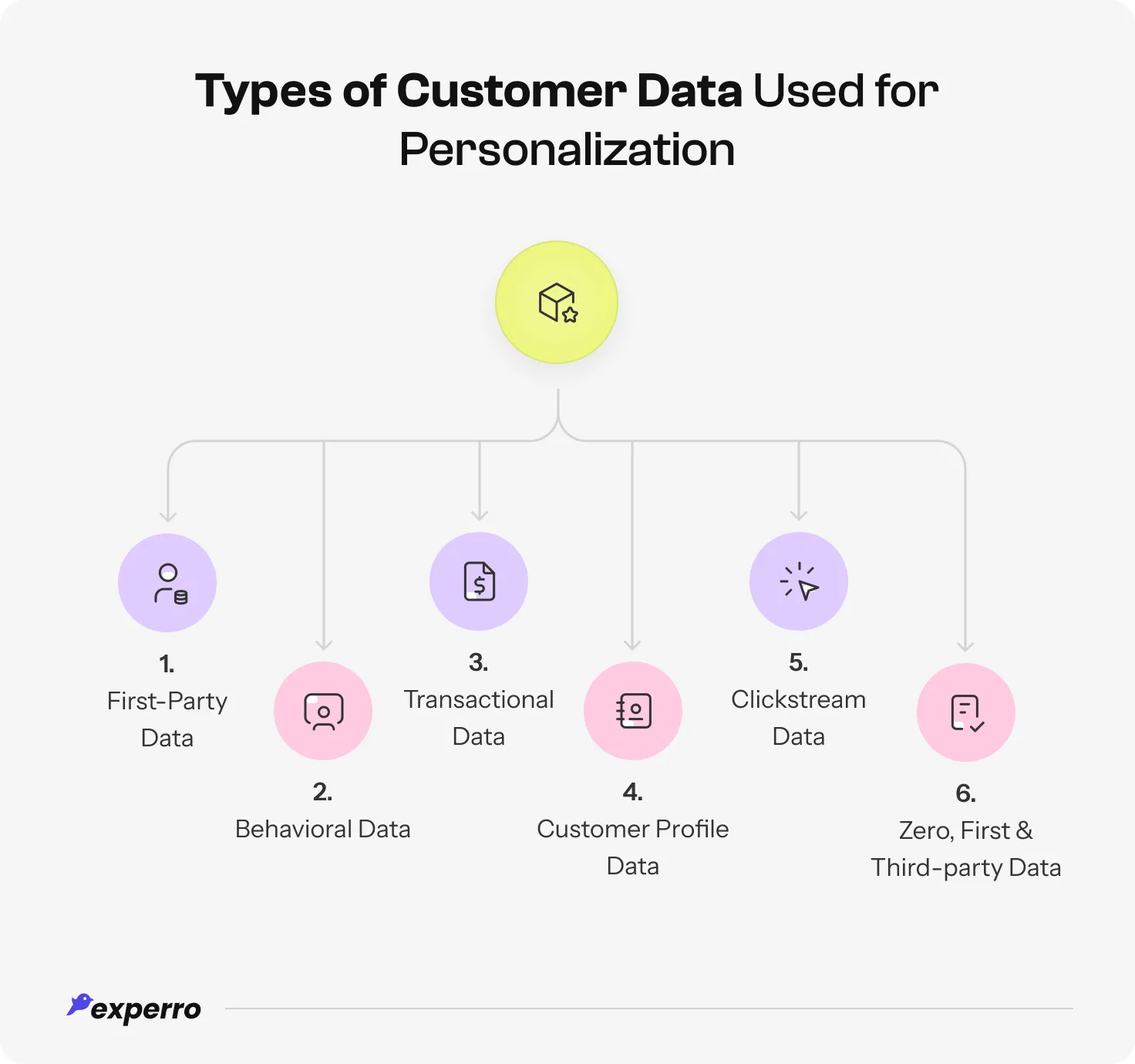
1. First-party Data
First-party data comes directly from customer interactions across your owned channels. As privacy expectations evolve, it has become the foundation of effective data-driven personalization and customer data for personalization.
2. Behavioral Data
Behavioral data captures browsing history, searches, clicks, and engagement patterns. These signals help brands understand customer intent and deliver more relevant experiences in real time.
3. Transactional Data
Transactional data reveals what customers actually buy, how often they purchase, and what they prefer. These insights support smarter data-driven product recommendations and higher customer lifetime value.
4. Customer Profile Data
Customer profile data combines preferences, demographics, and historical interactions into a single view. Instead of treating every shopper the same, it enables profile-based recommendations that reflect individual interests, preferences, and buying behavior.
5. Clickstream Data
Clickstream data tracks the paths customers take before converting. It helps brands identify buying intent earlier and power more effective real-time personalization.
6. Zero-party, First-party, and Third-party Data
Each data source offers different insights, but first-party and zero-party data are becoming increasingly important. They provide more reliable customer insights while supporting privacy-conscious personalization.
To connect these data sources into a unified customer view, explore customer data integration.
The goal isn't to collect more data, it's to use the right data to better understand customers and deliver more relevant experiences.
What Types of Data-driven Personalization Are Used in eCommerce?
Modern eCommerce success is no longer driven by traffic alone, it is driven by how intelligently every interaction adapts to customer intent in real time.
Data-driven personalization transforms behavioral signals, browsing patterns, and purchase history into tailored experiences that improve conversions, engagement, and long-term customer loyalty.
1. Product Recommendation Personalization
Recommend products that match each shopper's interests using browsing behavior, purchase history, and intent signals. By delivering data-driven personalization at scale, you create more relevant shopping experiences that drive higher conversions and average order value.
2. Homepage and Dynamic Content Personalization
With 80% of consumers more likely to purchase from brands that offer personalized experiences, your homepage should never be one-size-fits-all.
Create adaptive homepage experiences that respond to real-time customer behavior by displaying personalized banners, categories, and product recommendations that reflect each shopper's interests and engagement patterns from their very first visit.
3. Personalized Search Experiences
Improve on-site search by ranking results based on user intent, past interactions, and behavioral signals, helping customers find the right products faster and reducing friction in the buying journey.
4. Behavioral Email and SMS Personalization
Trigger personalized email and SMS campaigns based on real customer actions like browsing, cart activity, and repeat visits to deliver timely messages that increase engagement and drive higher conversions.
5. Offer and Promotion Personalization
Deliver targeted discounts and promotions based on customer behavior, value, and purchase intent so offers feel relevant, avoid over-discounting, and improve conversion efficiency across segments.
6. Omnichannel Personalization Across Touchpoints
Ensure a seamless personalized experience across web, mobile, email, and other channels by leveraging the power of omnichannel personalization, so customers receive consistent messaging and relevant recommendations regardless of where they interact with your brand.
7. Post-purchase and Retention Personalization
Modern eCommerce is moving toward personalization backed by data, where the customer journey continues even after checkout.
Brands use onboarding, reorder reminders, and re-engagement journeys to stay connected in a helpful, timely way.
True personalization is not about showing more, it’s about showing what matters most at the exact moment it matters.
How Do Brands Use Data-driven Personalization for eCommerce?
Every shopper is different. Some know exactly what they want, while others are still exploring, comparing, or looking for the right fit.
The best eCommerce brands recognize these differences and use customer data to create experiences that feel personal, not generic.
Here's how leading brands use data-driven personalization to make every shopping journey more relevant and engaging.
1. Helping Customers Buy With Confidence
Buying online often comes with uncertainty.
Will this size fit? Is this the right product? Should I choose this option or another one?
When those questions go unanswered, customers hesitate. Many leave without buying, even when they're interested.
ASOS tackles this challenge by analyzing customer preferences, purchase history, return patterns, and fit-related data to recommend the most suitable size for each shopper.
Instead of relying on a generic size chart, it adapts recommendations using real customer behavior and product data.
The lesson goes far beyond fashion.
The more uncertainty you remove from the buying journey, the easier it becomes for customers to make confident decisions. That's where data-driven personalization creates real value not by pushing products, but by helping customers choose the right ones.
2. Making Product Discovery Feel Natural
A large product catalog should create opportunities, not overwhelm shoppers.
Yet many customers leave because finding the right product feels like too much work.
Etsy solves this challenge by analyzing search behavior, browsing patterns, and customer interests to personalize search results and product recommendations.
Instead of expecting shoppers to browse thousands of listings, it brings the most relevant products closer to what they're actually looking for.
The insight is simple.
Customers don't want more choices. They want the right choices.
When product discovery adapts to customer intent, shopping becomes faster, easier, and far more enjoyable.
3. Learning From Every Customer Interaction
Every customer interaction is a signal.
A search reveals intent. A click shows interest. A purchase confirms a decision. Even a return or review provides valuable feedback.
Stitch Fix has built its personalization strategy around continuous learning.
Customer preferences, purchase decisions, ratings, returns, and written feedback all become signals that improve future recommendations. Every interaction helps the platform understand the customer a little better.
This principle applies to every eCommerce business.
The brands that consistently learn from customer behavior don't just deliver better recommendations. They build shopping experiences that become more relevant with every visit, creating stronger relationships and lasting customer loyalty.
Data-driven personalization isn't about collecting more customer data. It's about understanding your customers better with every interaction and turning those insights into experiences that help them make better buying decisions.
Common Challenges in Scaling Data-driven Personalization
Personalization isn't limited by a lack of customer data, it's limited by how effectively that data is connected, analyzed, and activated.
As personalization efforts scale, many organizations encounter challenges that impact relevance, efficiency, and customer engagement.
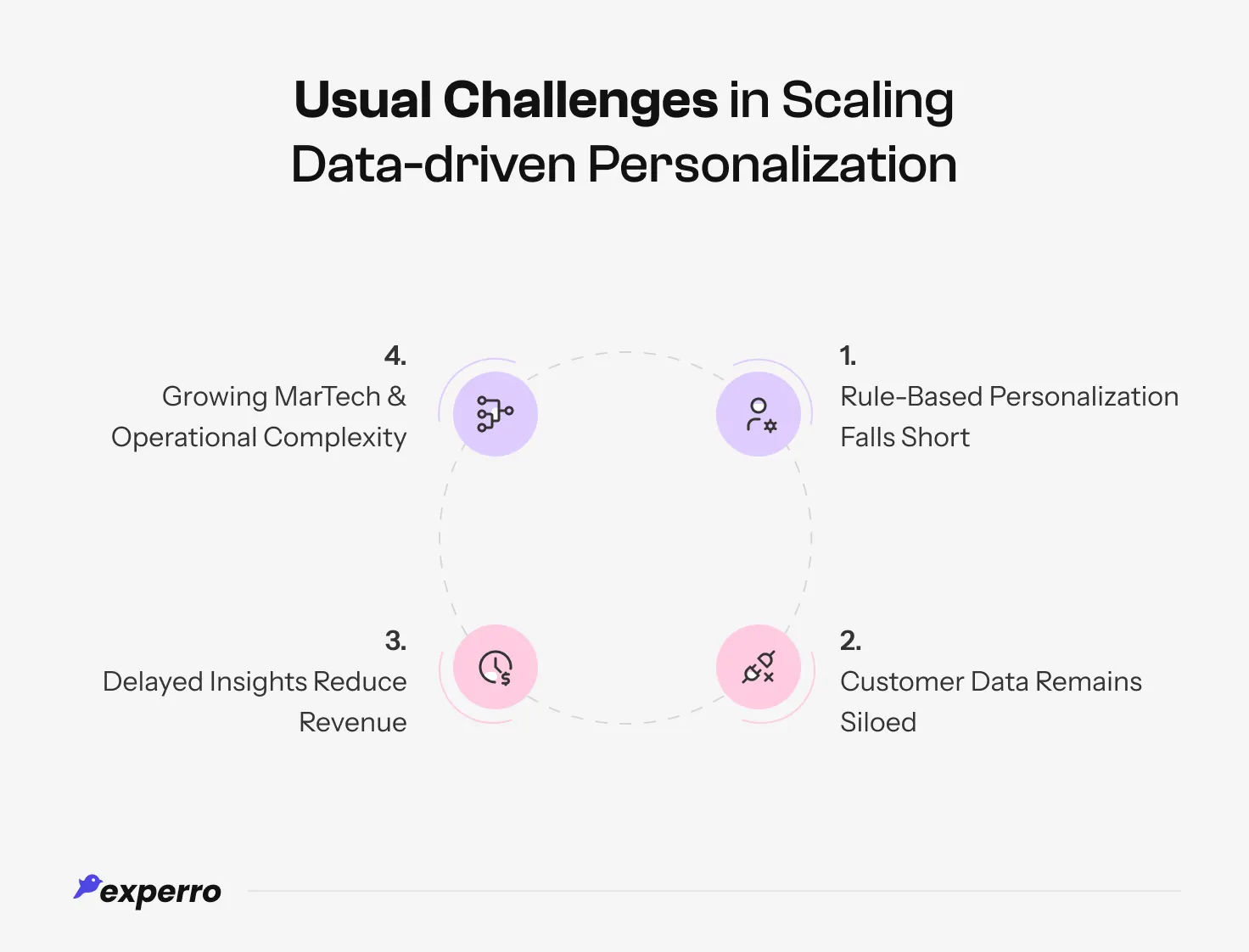
1. Rule-based Personalization Can't Keep Up With Your Customers
Your customers' needs change with every search, click, and interaction. Rule-based personalization relies on predefined conditions, making it difficult to respond to real-time customer behavior. As a result, experiences often feel generic or outdated.
2. Your Customer Data Is Scattered Across Multiple Systems
When your customer data is spread across different platforms, you lose the complete picture. Without a unified customer view, delivering consistent and relevant experiences becomes much harder.
3. Slow Insights Cost You Revenue
Customer intent changes quickly. If you can't act on behavioral data in real time, you risk missing valuable opportunities to engage, convert, and retain customers.
4. More Tools Don't Always Mean Better Personalization
As your MarTech stack grows, disconnected systems create complexity instead of value. The real challenge isn't collecting more customer data, it's turning the data you already have into relevant experiences when it matters most.
These are the challenges that would come your way while scaling the data backed personalization.
How Experro Helps You Execute Data-driven Personalization for eCommerce
Have you ever wondered why some data-driven personalization strategies deliver measurable growth while others struggle to gain results?
The difference isn't collecting more customer data. It's how effectively you connect, understand, and activate that data across every customer interaction.
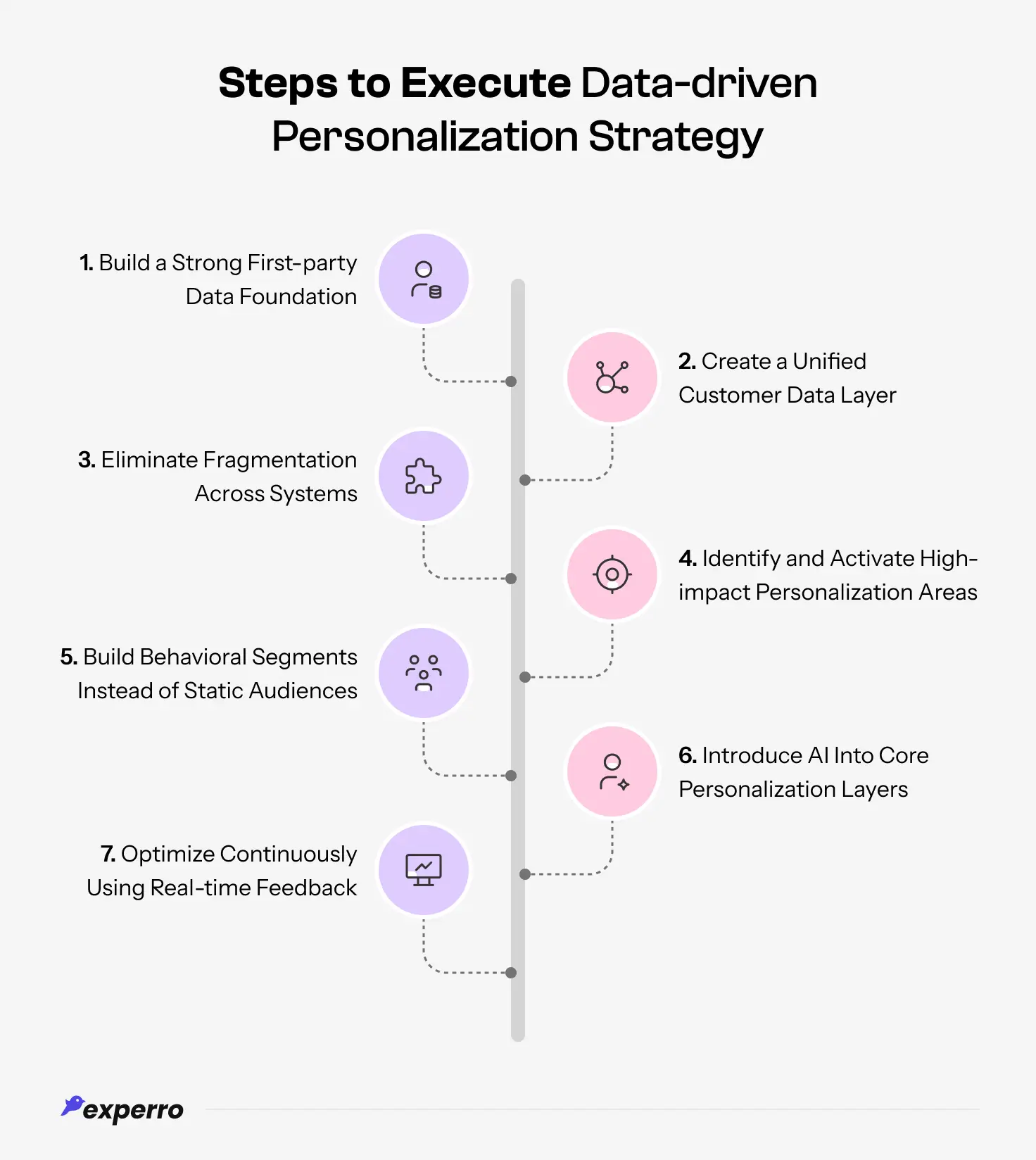
1. Build a Strong First-party Data Foundation
The first step in implementation is capturing reliable first-party data in eCommerce, including browsing behavior, search activity, product interactions, and purchase signals.
Experro transforms these real-time customer signals into actionable intelligence that supports every personalization decision.
Powered by this unified customer understanding, gen AI personalization helps you deliver experiences that become more relevant as customer behavior evolves.
2. Create a Unified Customer Data Layer
Once your data is collected, the next step is to bring it together. Without a single view of your customer, personalization can feel disconnected across channels.
Experro helps you solve this by building a unified customer intelligence layer. It combines your behavioral, transactional, and engagement data into one real-time customer profile. This profile updates with every interaction and helps you better understand each customer.
3. Eliminate Fragmentation Across Systems
A major implementation challenge is disconnected systems CMS, search, analytics, and commerce platforms often operate in silos, preventing true personalization.
Experro removes this barrier by connecting content, commerce, and customer data into a single experience ecosystem, ensuring every touchpoint is driven by the same intelligence layer.
4. Identify and Activate High-impact Personalization Areas
Effective personalization is not about doing everything. It is about focusing on what truly drives revenue.
Some touchpoints have a bigger impact than others. These are the moments when customers are exploring, deciding, or ready to buy.
This is where data-driven personalization strategies for retail make the most impact. By focusing on high-intent areas like search, product discovery, homepage, and product pages, you guide customers toward what they need at the right moment.
5. Build Behavioral Segments Instead of Static Audiences
Traditional segmentation relies on fixed rules, but real customer behavior changes dynamically throughout the journey.
Experro enables behavior-driven segmentation in real time, allowing brands to group customers based on live actions such as clicks, searches, and engagement depth, making personalization far more precise and relevant.
6. Introduce AI Into Core Personalization Layers
AI should not be added everywhere. Instead, it should be implemented where it directly improves decision-making and customer experiences.
Experro combines AI-powered search, product recommendations, and content personalization into a single platform, making it a best data-driven personalization solution for brands looking to deliver relevant, real-time shopping experiences driven by customer data and intent.
7. Optimize Continuously Using Real-time Feedback
Implementation is not a one-time setup, it is a continuous optimization loop driven by customer behavior and performance insights.
Experro provides real-time search analytics on engagement, conversion, and interaction patterns, enabling brands to refine personalization strategies continuously and improve outcomes over time.
When implemented correctly, a data-driven personalization strategy becomes more than a marketing capability, it becomes a living system that learns from every customer interaction and consistently improves business performance.
Bringing Data-driven Personalization Together for Revenue Impact
Data-driven personalization is what separates scaling eCommerce brands from those stuck in fragmented execution.
When first-party data, unified customer insights, behavioral signals, and AI come together, personalization becomes a continuous growth system that turns every interaction into measurable revenue impact.
The real shift happens when search, discovery, recommendations, and retention are no longer isolated efforts but part of one connected experience layer that adapts to customer intent in real time.
Instead of adding more tools, the focus should be on simplifying execution and building a system that learns and improves with every interaction.
Experro helps eCommerce teams do exactly that by unifying data, content, and commerce into a single platform for scalable personalization.
If you’re ready to move from disconnected personalization efforts to a unified, revenue-driven experience system, talk to us at Experro and explore how to get started with implementation today.
FAQs

With 6+ years of experience in AI, software, and digital transformation across tech, healthcare, and fashion, Rahul focuses on making complex ideas simple, clear, and actually useful. He has learned how often great ideas get lost in complexity, which is why he centers his writing on clarity, helping entrepreneurs and leaders cut through noise and make decisions with confidence.
Subscribe to Our Newsletter!
Get the latest insights delivered straight to your inbox.
Recommended Reads