- eCommerce
- Personalization
- Generative AI
- 15 min read
Real-time Personalization in 2026: What Actually Works
Published
2 June 2026Updated
2 July 2026

core insights box:
- Real-time personalization is not about showing different products, it is about reacting fast enough so the shopper never feels like the store is figuring it out too late.
- Every search, click, and scroll signals intent in real time, but most eCommerce systems treat it as stored data, and that delay quietly reduces conversions.
- When experiences stop being static and shift to real time, discovery feels less like browsing and more like store guiding each step toward what matters.
- Experro makes that shift practical by connecting search, personalization, and discovery into a real-time layer that adapts instantly to shopper behavior so relevance is always one step ahead not one step behind.
The store that looks perfectly healthy on the surface, has a steady traffic, fast loading pages, live ads running. Yet conversions stay flat. HOW???
The problem is not effort. It is relevance.
Every shopper sees the same experience — the same homepage, the same recommendations, the same offers — regardless of intent.
There is a gap between the revenue your store is generating today and what your existing traffic could actually deliver if every session were more relevant.
Real-time personalization closes this gap by adapting your store to each visitor as they browse, turning behavioral signals into revenue before the session ends.
This getting started with personalization guide will show you exactly how to go about it.
What is Real-time Personalization?
Definition - Real-time personalization is the approach in eCommerce where the shopping experience continuously adapts in the exact moment a shopper is browsing using live signals like searches, clicks, scrolls, and product interactions to understand intent as it forms.
Instead of showing fixed or generic content, the experience reshapes itself instantly with more relevant products, recommendations, and messages while the user is still in-session.
Think of it like walking into a store where the assistant doesn’t wait for you to explain what you want. They quietly notice what you’re looking at, what you return to, and what you compare, then adjust the entire experience around your intent in real time.
That is what makes it powerful. The store stops feeling static and starts feeling aware, responsive, and naturally aligned with what the shopper is trying to find in that very moment.
This shift is also reshaping how brands think about content personalization, especially in 2026, where experiences are no longer static but continuously adapted to match real shopper intent.
Traditional vs Real-time Personalization (Why Old Systems Fail)
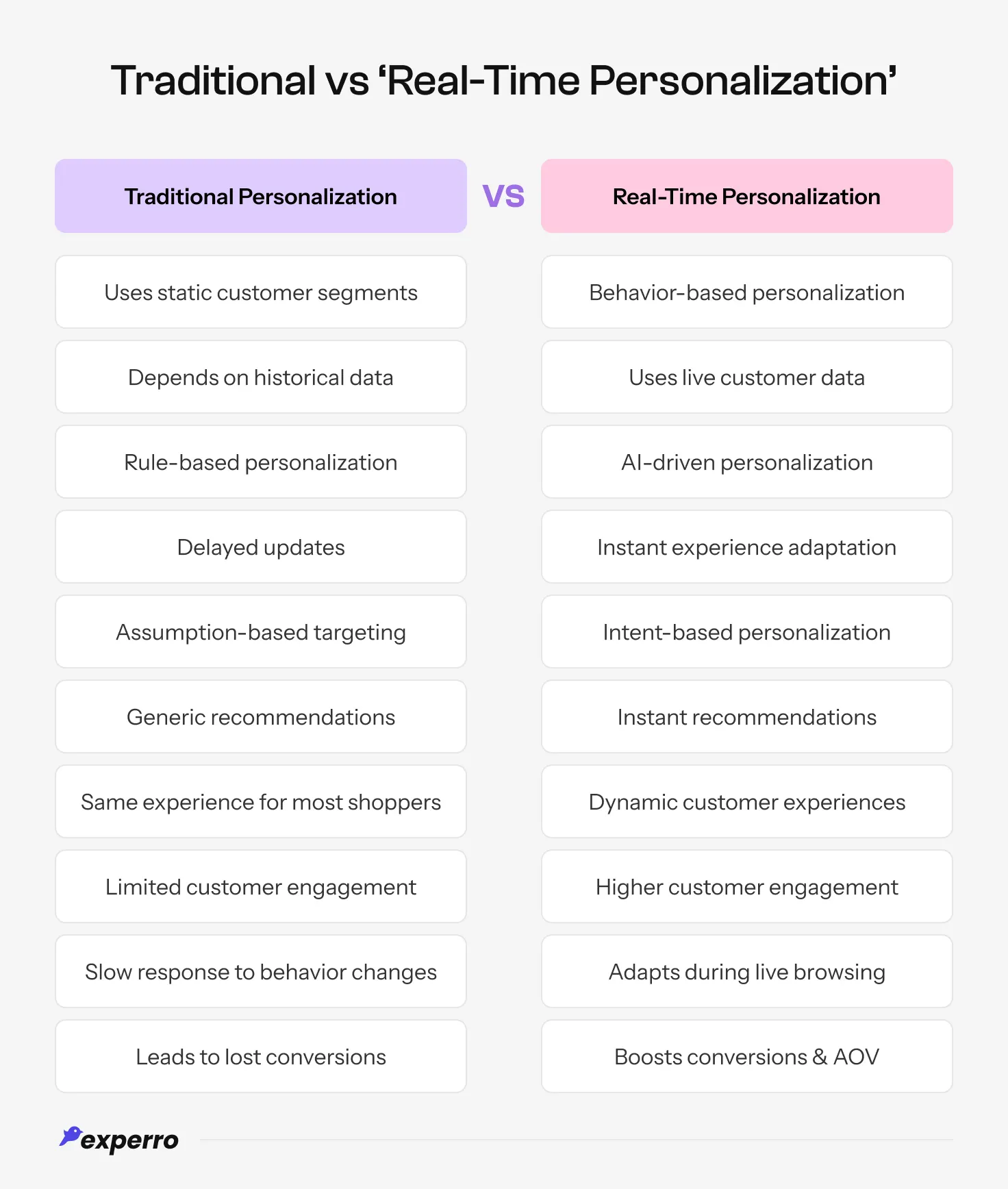
Traditional personalization relies on static customer segments and outdated assumptions, while real-time personalization adapts instantly to live shopper behavior, intent, and customer interactions.
| Bases of Difference | Traditional Personalization | Real-time Personalization |
| Data Type Used | Uses static customer segments | Focuses on individual customer behavior |
| Core Approach | Depends on historical data | Uses live customer data |
| Personalization Logic | Rule-based personalization | AI-driven personalization |
| Data Source | Depends on historical data | Focuses on real-time individual customer behavior |
| Experience Style | Generic recommendations or bad personalization | Real-time shopper intent personalization |
| Engagement Level | Limited customer engagement | Higher customer engagement |
| Responsiveness | Slow response to behavior changes | Adapts during live browsing |
| Update Speed | Delayed updates | Instant experience adaptation |
| Conversion Impact | Leads to lost conversions | Improves conversion rates and average order value |
How Real-time Personalization Works?
Real-time personalization works by analyzing live customer behavior and instantly adapting the eCommerce experience while the shopper is still browsing.
Instead of relying only on historical data or static customer segments, modern real time personalization platforms use live shopper signals, behavioral analytics, AI and ML to deliver highly relevant and personalized experiences in real time.
Modern real time eCommerce personalization systems continuously process customer interactions, search intent, browsing behavior, and engagement patterns to improve product discovery, customer engagement, and conversions.
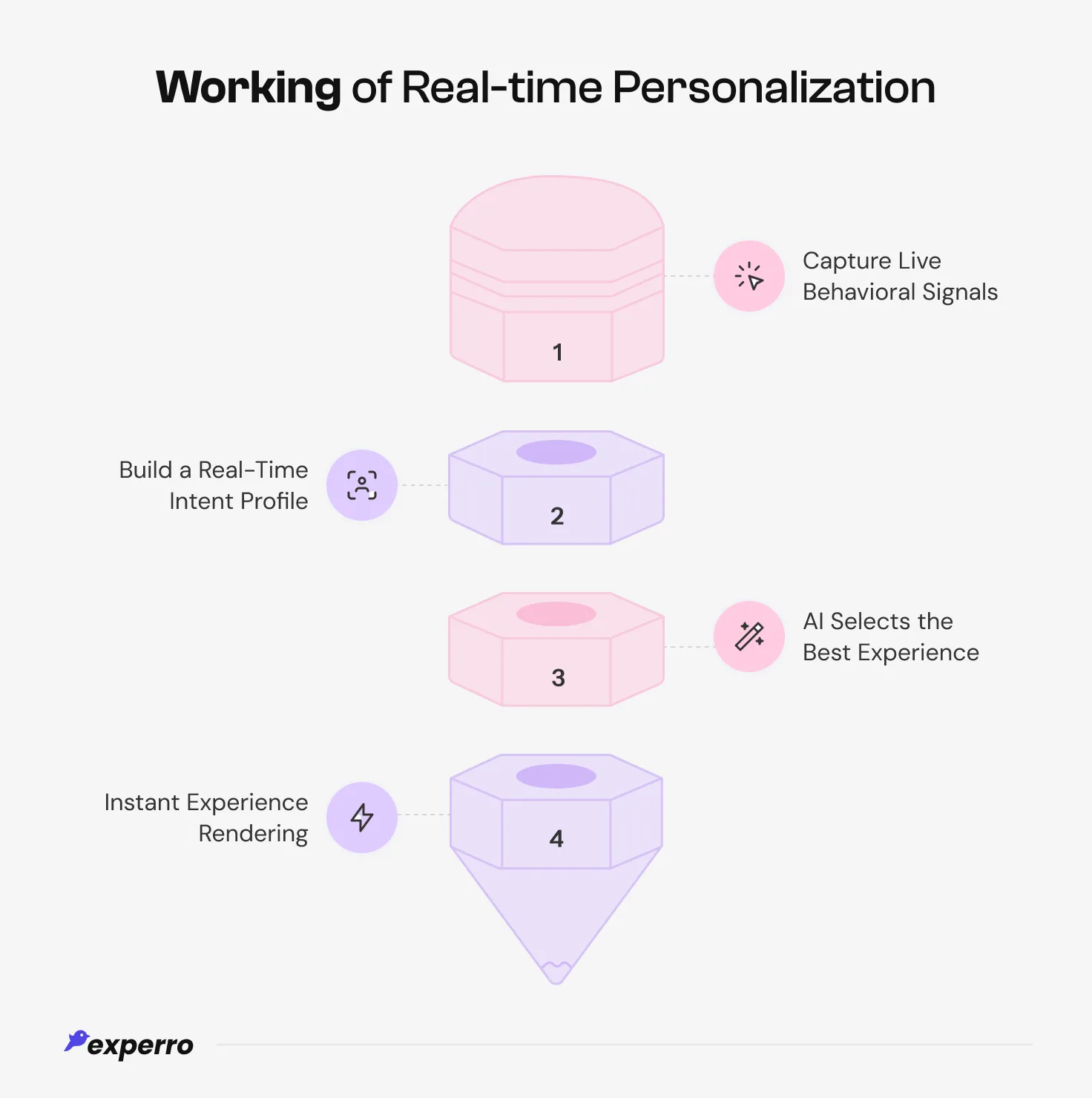
Here is how the process typically works:
Step 1: Capture Live Behavioral Signals
The system starts collecting live customer data as soon as a shopper interacts with the online store.
This includes:
- Products viewed
- Search queries
- Clicks and scroll behavior
- Time spent on pages
- Cart activity
- In-session behavior
- Device and location signals
- Customer interaction patterns
- Real-time shopper intent signals
These live behavioral signals help the real-time personalization engine understand what the customer is interested in at that exact moment. This directly powers personalized search, where search experiences adapt dynamically based on live shopper intent.
This is one of the biggest advantages of real time website personalization because brands can personalize experiences dynamically instead of relying on outdated customer data.
Step 2: Build a Real-time Intent Profile
The personalization engine then combines streaming behavioral data, customer profiles, purchase history, search behavior, and live session activity to build a dynamic real-time intent profile.
This helps the system understand:
- What the shopper is likely searching for
- Their buying intent
- Product preferences
- Interest level
- Stage in the customer journey
- Probability of conversion
Unlike traditional personalization systems, AI and ML continuously update customer intent while the shopper browses. This is where the idea of agentic personalization comes in, where the system not only reacts to behavior but also continuously refines and adapts its understanding of intent in real time.
This allows brands to personalize in real time and deliver a more relevant shopping experience across the entire customer journey.
Step 3: AI Decision Engine Selects the Best Experience
Next, artificial intelligence and machine learning models analyze the live shopper signals and decide what experience should be shown instantly.
The real-time personalization software may personalize:
- Product recommendations
- Search results
- Homepage banners
- Dynamic website content
- Personalized offers
- Push notifications
- Category pages
- Cross-sell and upsell recommendations
This type of real time search personalization helps brands deliver highly relevant product discovery experiences based on real-time shopper intent instead of static rules or outdated assumptions.
Modern real-time product personalization platforms can also optimize experiences across mobile, desktop, email, and multiple digital touchpoints simultaneously.
Step 4: Instant Experience Rendering
Once the AI-driven decision is made, the personalized experience appears immediately on the eCommerce website.
The shopper sees relevant products, dynamic content, personalized recommendations, and offers tailored to their current behavior and preferences.
This creates a smoother customer journey, improves customer engagement, and increases conversion opportunities.
That is why many brands now invest in real time personalization solutions and analytics to improve customer retention, average order value, and revenue growth.
Real-time personalization captures shopper signals, understands intent, decides the right experience, and delivers it instantly.
This flow turns each interaction into a relevant moment, helping brands move from static journeys to AI-driven personalization and real-time personalized experiences.
It naturally extends into website personalization, where every on-site interaction is shaped by user behavior so the experience feels more relevant, responsive, and aligned with what the shopper is trying to do.
Handpicked read! - How to improve the effectiveness of BigCommerce personalization?
What Are the Benefits of Real Time Personalization for eCommerce?
Modern shoppers expect relevant experiences from the first click. Studies show that 71% of consumers expect personalized interactions from brands, and 76% feel frustrated when this does not happen.
There are various examples of real-time personalization wherein it is clearly evident that eCommerce brands have instantly adapted to live customer behavior.
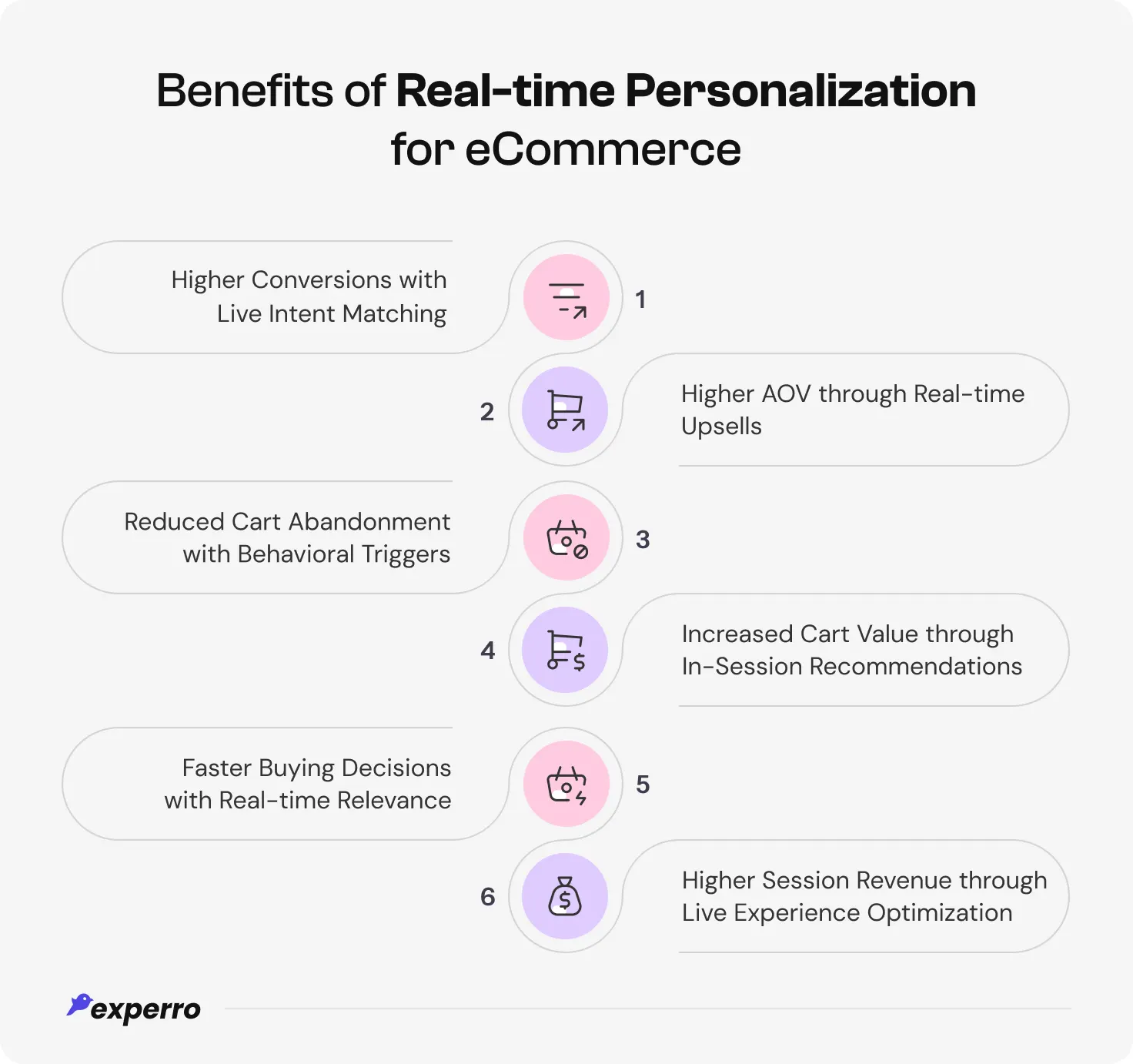
Here are the biggest benefits of real-time personalization for modern eCommerce businesses.
1. Higher Conversions with Live Intent Matching
One of the biggest advantages of real-time personalization is its ability to understand customer intent instantly.
Instead of showing generic products or static recommendations, the system analyzes live shopper behavior such as searches, clicks, product views, and browsing activity in real time.
This helps brands deliver highly relevant products, personalized recommendations, and dynamic experiences exactly when shoppers are most likely to engage.
When customers quickly find products that match what they are actively looking for, the path to purchase becomes smoother and faster.
That is why brands using real time personalization in eCommerce often see higher engagement, improved customer satisfaction, and stronger conversion rates.
2. Higher AOV through Real-time Upsells
Real-time personalization also helps brands increase average order value by making upselling and cross-selling more intelligent and contextual.
Modern real-time personalization engines use AI and ML to analyze live shopper intent and recommend complementary or higher-value products during the browsing session itself.
For example, a customer viewing skincare products may instantly see personalized recommendations for serums, moisturizers, or bundles related to their interests.
Because these recommendations are based on real-time behavior. Instead of static rules, they feel more natural, relevant, and helpful to the shopper.
This creates more opportunities to increase cart value while improving the overall customer experience.
3. Reduced Cart Abandonment with Behavioral Triggers
Cart abandonment remains a major challenge in eCommerce, with the global average rate at nearly 70%.
Cart abandonment often happens when shoppers lose interest, get distracted, or hesitate during the buying journey.
With real time website personalization, brands can respond to these hesitation signals immediately instead of waiting until after the customer leaves.
AI-driven systems can detect behaviors such as exit intent, inactivity, repeated product comparisons, or abandoned carts and instantly trigger personalized experiences like:
- Limited-time offers
- Personalized discounts
- Cart reminders
- Relevant product recommendations
- Free shipping incentives
When personalization is paired with timely incentives, its impact becomes even stronger. In fact, 55% of consumers say targeted discounts based on personalization improve their experience, especially in re-engagement moments like email follow-ups and reminders.
These behavioral triggers bring shoppers back at the right moment and significantly improve the chances of completing a purchase.
4. Increased Cart Value through In-Session Recommendations
One of the most powerful benefits of real-time personalized experiences is the ability to continuously optimize recommendations while the shopper is actively browsing.
As customer behavior changes during the session, the personalization engine updates product suggestions dynamically in real time.
This helps shoppers discover products that are more aligned with their interests, preferences, and buying intent.
Instead of forcing customers to search endlessly, the system guides them toward products they are more likely to purchase.
This improves product discovery, increases customer engagement, and reduces cart abandonment across the shopping journey.
5. Faster Buying Decisions with Real-time Relevance
Modern shoppers expect fast and frictionless experiences.
When customers see irrelevant products or generic content, they often become overwhelmed or leave the site entirely.
That is why real-time search personalization and AI-driven recommendation systems play such a critical role in modern eCommerce.
By showing highly relevant products, content, and offers instantly, brands can reduce decision fatigue and help shoppers make faster purchasing decisions.
The experience feels smoother, smarter, and more aligned with what the customer actually wants in that moment.
This not only improves conversions but also builds stronger customer trust and loyalty over time.
6. Higher Session Revenue through Live Experience Optimization
Real-time personalization does not optimize just one interaction.
It continuously improves the entire customer experience throughout the browsing session.
Modern real time personalization platforms analyze live engagement signals and dynamically optimize:
- Homepage content
- Search experiences
- Product recommendations
- Promotional banners
- Category pages
- Personalized offer
- Mobile experiences
This live optimization helps brands maximize customer engagement and revenue opportunities during every visit.
With advanced real-time personalization analytics, businesses can also understand how shoppers interact with personalized experiences and continuously improve performance over time.
As customer expectations continue evolving, the future of real-time personalization will become even more AI-driven, predictive, and behavior-focused.
That is why more brands are investing in scalable real time personalization solutions and platforms like Experro real-time personalization to deliver smarter, faster, and more connected shopping experiences at scale.
Learn more about benefits of real-time personalization.
Real-time Personalization Use Cases in AI-Driven Commerce
Modern eCommerce depends on delivering relevant experiences in real time. Using AI, ML, and live behavioral data, real-time personalization helps brands improve engagement, increase conversions, and drive revenue growth.
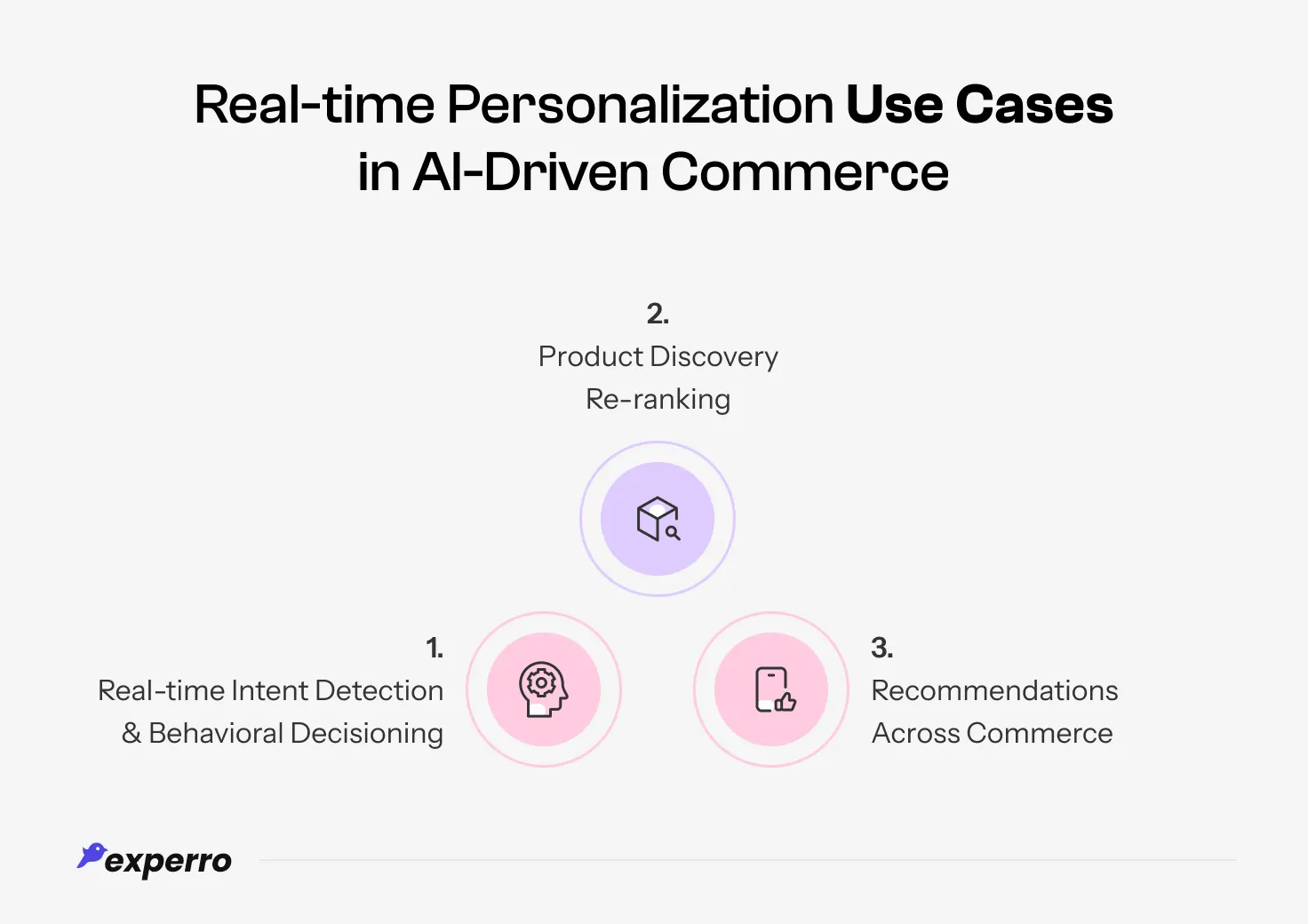
Here are some of the most impactful real-time personalization use cases in AI-driven commerce.
1. Real-time Intent Detection and Behavioral Decisioning
One of the most powerful applications of real-time eCommerce personalization is the ability to detect customer intent while the shopper is actively browsing the site.
AI-powered systems continuously analyze live behavioral signals such as:
- Search queries
- Product views
- Click patterns
- Scroll behavior
- Cart activity
- Time spent on pages
- Navigation patterns
Using this live behavioral data, the real-time personalization engine builds an intent profile and predicts what the shopper is most likely looking for at that exact moment.
The system then makes instant behavioral decisions to personalize the experience dynamically.
For example, if a shopper repeatedly searches for premium running shoes, the platform may instantly prioritize high-performance sports products, personalized recommendations, and related content across the storefront.
This type of real time shopper intent personalization helps brands deliver more relevant experiences, reduce friction, and improve conversion opportunities in real time.
2. Product Discovery Re-Ranking
Traditional product discovery often relies on static product rankings that show the same results to every shopper.
But modern customers expect product discovery experiences that adapt to their preferences and behavior instantly.
With real time search personalization, AI-driven systems dynamically re-rank products based on live shopper intent, engagement patterns, popularity signals, and browsing behavior.
Instead of displaying generic search results, the platform prioritizes products that are most relevant to the individual customer.
For example, two shoppers searching for the same keyword may see completely different product rankings based on their interests, behavior, purchase history, and real-time engagement signals.
This dynamic product discovery experience improves:
- Search relevance
- Product visibility
- Customer engagement
- Session depth
- Conversion rates
That is why product discovery optimization has become one of the most important use cases for modern real time personalization platforms.
3. Personalized upsell and cross-sell recommendations
Modern shoppers interact with brands across multiple commerce surfaces. These include search pages, category pages, homepages, mobile apps, email campaigns, and checkout experiences.
Around 65% of U.S. consumers prefer to buy from brands that personalize their experience across these touchpoints. This shows how important consistency has become in driving purchase decisions.
AI-driven recommendation systems deliver personalized product suggestions across all these surfaces in real time. They adjust instantly as shopper intent changes.
This allows brands to personalize:
- Homepage recommendations
- Search suggestions
- Category page products
- Frequently bought together sections
- Cross-sell recommendations
- Upsell opportunities
- Cart recommendations
- Post-purchase experiences
The result is a shopping journey that feels more connected and relevant. Recommendations match what shoppers are interested in at that moment, instead of relying on static rules or past behavior.
This improves engagement, increases average order value, and creates smoother eCommerce experiences across the full journey. As real-time personalization evolves, these systems will become even more predictive and capable of delivering highly relevant recommendations at scale.
How Experro Powers Real-time Personalization at Scale?
Personalizing the shopping experience for a handful of shoppers is easy. When personalization happens at scale, it is tricker to get it right if done with some other eCommerce platform.
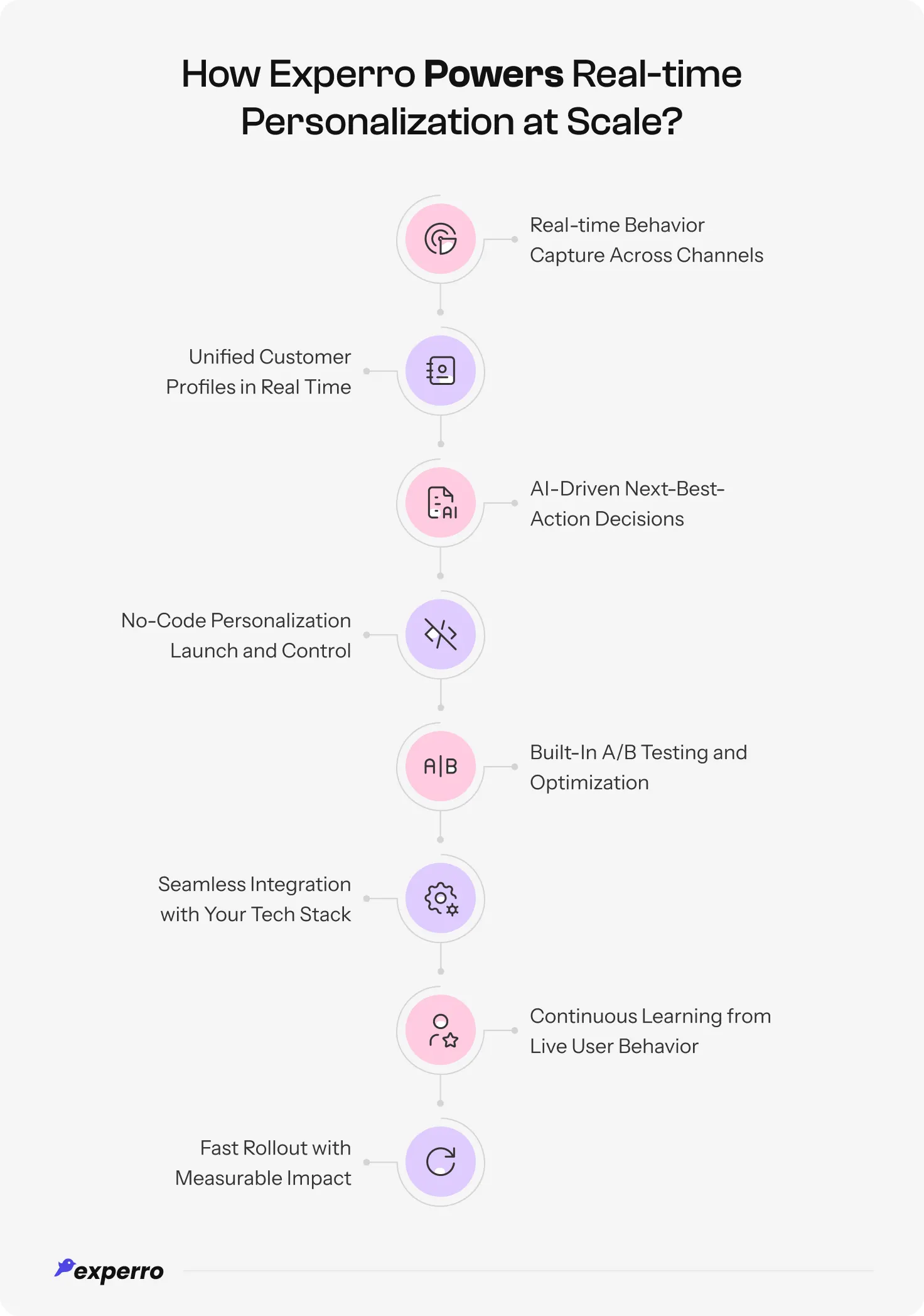
1. Real-time Behavior Capture Across Channels
Experro captures live customer interactions across websites, mobile apps, search experiences, storefronts, and digital commerce channels in real time; all under omnichannel personalization.
The platform continuously analyzes clicks, product views, searches, scroll behavior, cart activity, and in-session engagement signals to understand evolving customer intent.
This real time personalization software helps brands personalize in real time and create more connected shopping experiences powered by live behavioral data instead of outdated customer assumptions or static audience segments.
2. Unified Customer Profiles in Real Time
Experro powers real-time personalization at scale by building unified customer profiles that continuously evolve with every interaction. It combines behavioral analytics, customer profiles, purchase history, engagement signals, and browsing activity into a single, real-time view of the shopper.
This unified view enables profile-based recommendation, where product suggestions and experiences are driven by live intent rather than static or fragmented customer data.
As a result, businesses can deliver highly contextual and consistent personalization across every stage of the customer journey.
By continuously updating customer intent using real-time behavioral data, Experro improves personalization accuracy, strengthens engagement, and ensures a seamless experience across modern digital commerce environments.
3. AI-Driven Next-Best-Action Decisions
Experro uses advanced AI and machine learning models to analyze customer intent and determine the next-best experience instantly.
The platform dynamically personalizes product recommendations, search results, homepage banners, promotional offers, and dynamic content using live shopper behavior and predictive decision-making.
This type of AI and machine learning in real-time personalization helps brands deliver highly relevant customer experiences, improve product discovery, and optimize conversions through intelligent behavioral decisioning at scale.
4. No-Code Personalization Launch and Control
Experro enables marketing and eCommerce teams to launch, manage, and optimize personalization campaigns without heavy developer dependency.
Using no-code tools, businesses can quickly create dynamic content, personalized offers, recommendation strategies, and storefront experiences across multiple commerce surfaces.
This flexibility helps brands scale real time website personalization faster while improving operational efficiency, campaign agility, and customer experience optimization across the entire storefront.
5. Built-in A/B Testing and Optimization
Experro includes built-in A/B testing and real-time personalization analytics that help brands continuously optimize customer experiences using live performance data.
Businesses can test personalized recommendations, search experiences, dynamic content, landing pages, and promotional strategies to identify what drives better engagement and conversions.
Continuous experimentation helps brands improve performance, optimize customer journeys, and maximize revenue growth through data-driven personalization and AI-powered experience optimization.
6. Seamless Integration with Your Tech Stack
Experro powers real-time personalization at scale by working smoothly with existing eCommerce platforms, CMS systems, analytics tools, customer data platforms, and other commerce technologies.
This allows businesses to activate real time personalization solutions without replacing their current setup or disrupting existing workflows.
With this level of connectivity, customer data integration becomes more unified, helping brands bring together information from different systems into a single, usable flow. This makes personalization more accurate and aligned with real shopper behavior.
It helps businesses deliver more consistent and connected experiences across websites, mobile channels, search, recommendations, and the broader digital commerce ecosystem.
7. Continuous Learning from Live User Behavior
Experro continuously learns from live customer interactions, behavioral trends, search intent, and engagement patterns in real time.
As shoppers browse, search, click, and interact with products, the platform dynamically updates recommendations and personalization strategies using AI-driven behavioral learning models.
This continuous optimization improves recommendation relevance, customer engagement, and shopping experiences while helping brands adapt faster to evolving customer preferences and buying intent.
8. Fast Rollout with Measurable Impact
Experro helps businesses deploy scalable real-time personalization strategies quickly without long implementation cycles or operational complexity.
Brands can rapidly launch AI-powered personalization experiences and measure business impact through conversion rates, engagement metrics, average order value, cart performance, and revenue growth.
This fast deployment model allows businesses to scale personalization efficiently while delivering measurable improvements across product discovery, customer experience, and digital commerce performance.
Conclusion - Every Shopper Deserves a Unique Experience
eCommerce has evolved far beyond static storefronts and one-size-fits-all customer journeys. Today’s shoppers expect brands to understand their intent instantly, personalize every interaction, and deliver experiences that feel relevant in the moment.
That shift from static commerce to intelligent, AI-driven real-time personalization is transforming how modern brands engage, convert, and retain customers.
When businesses deliver personalized recommendations, adaptive search experiences, and context-aware interactions in real time, shopping becomes faster, easier, and more meaningful for customers.
And the impact goes beyond conversions alone. Real-time personalization helps brands build trust, strengthen loyalty, increase customer lifetime value, and create experiences shoppers genuinely remember.
In modern commerce, relevance is no longer optional. It is the foundation of sustainable growth.
Ready to deliver smarter, faster, and more personalized customer experiences at scale? Discover how Experro powers AI-driven real-time personalization for modern eCommerce brands. Contact us to learn more.
FAQs

With 6+ years of experience in AI, software, and digital transformation across tech, healthcare, and fashion, Rahul focuses on making complex ideas simple, clear, and actually useful. He has learned how often great ideas get lost in complexity, which is why he centers his writing on clarity, helping entrepreneurs and leaders cut through noise and make decisions with confidence.
Subscribe to Our Newsletter!
Get the latest insights delivered straight to your inbox.