
- eCommerce
- B2B
- Generative AI
- 13 min read
B2B eCommerce Best Practices You CANNOT AFFORD to Ignore!
Published
21 July 2026Updated
12 August 2026

core insights box:
- Every easier buying experience gives business buyers another reason to choose your brand over competitors.
- Simplify product discovery, ordering, and reordering to turn everyday buying into lasting customer relationships.
- The strongest B2B brands compete by removing complexity, not by adding more features or processes.
- Experro helps B2B brands simplify complex buying journeys with AI-powered search, personalization, and merchandising.
Your buyers don't struggle because they can't find products. They struggle when finding, evaluating, and purchasing them takes more effort than it should. 😕
That's why B2B eCommerce best practices matter more than ever. With 80% of B2B sales interactions expected to happen through digital channels, every search, click, and buying decision has become a moment that shapes customer trust.
Today’s business buyers expect more than a digital catalog. They want accurate product information, smarter search, seamless self-service, and buying experiences that help them move forward with confidence.
The brands leading B2B commerce understand this shift. They aren't adding complexity to compete; they're removing friction, creating smoother journeys that save buyers time and strengthen long-term relationships.
This guide explores B2B eCommerce best practices that simplify buying journeys, improve efficiency, and create digital experiences buyers trust and return to.
Which B2B eCommerce Best Practices 'Actually' Drive Results?
B2B buyers don't browse for inspiration. They arrive with a job to do, and every extra click, slow search, or missing detail puts that purchase at risk.
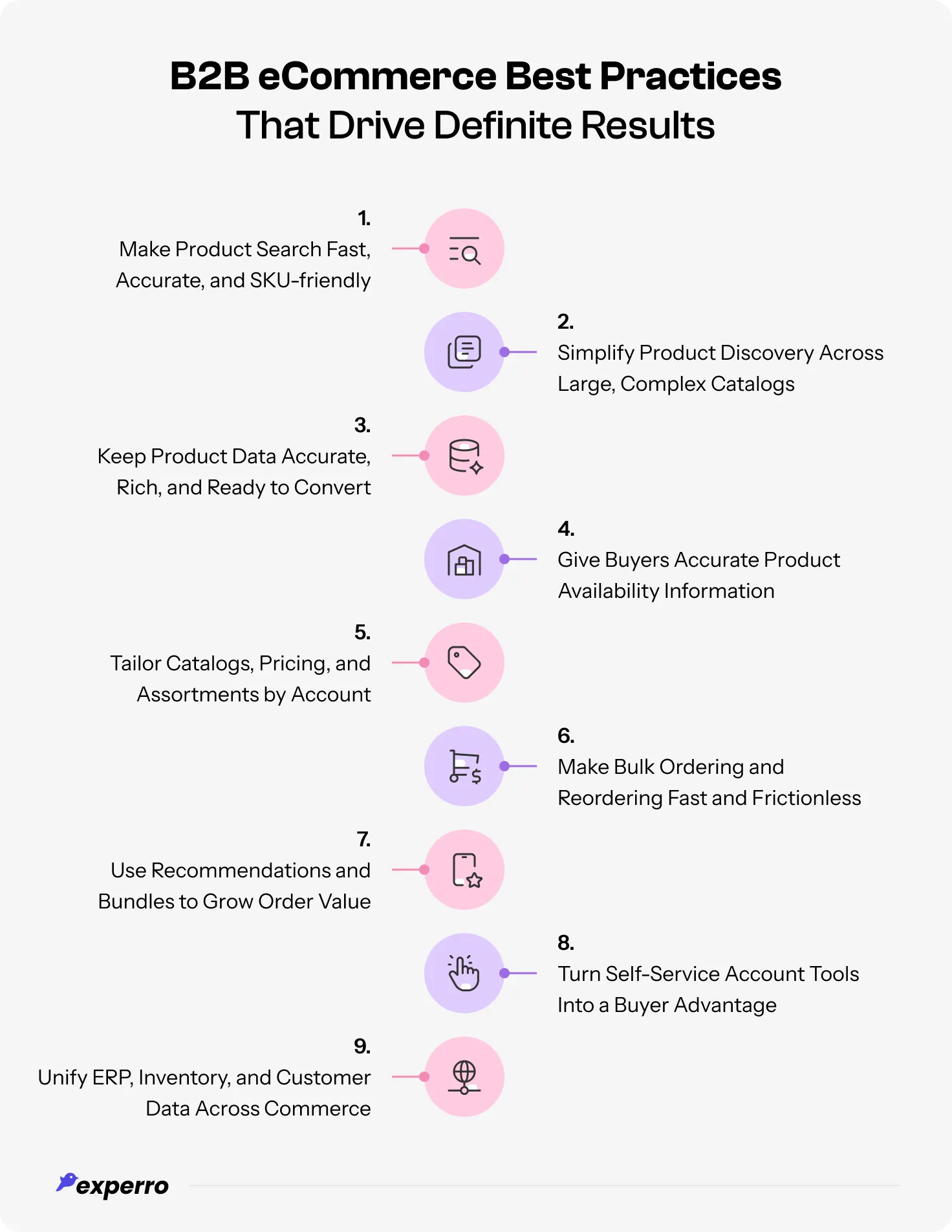
Here are the B2B eCommerce best practices buyers notice and businesses benefit from, turning friction into faster purchases and stronger customer relationships.
1. Make Product Search Fast, Accurate, and SKU-friendly
Picture this: a procurement manager, coffee in hand, typing a 16-digit part number into your search bar at 8am on a Monday. If nothing useful comes back, you've already lost a little trust.
SKU search helps B2B buyers find the exact products they need in seconds, and in B2B commerce, that speed isn't a luxury; it's an expectation.
Business buyers don't browse for inspiration like consumers do. Instead, they arrive with intent, hunting for exact SKUs, part numbers, or technical specs mid-reorder. This is one of the core reasons B2B product search experiences work so differently in B2B. The intent behind every query is transactional, not exploratory.
When buyers can't find what they need quickly, they don't stick around trying again. Even a small increase in page load time from one to three seconds can raise bounce rates by 32%.
And it's not a small inconvenience, since 75% of B2B buyers would switch suppliers for better digital experiences.
So build search that supports fuzzy search, SKU lookups, and filters for attributes like material, size, or compliance ratings, the kind of setup we break down further in B2B eCommerce search.
Ultimately, in B2B eCommerce, search isn't a feature. It's the front door to your entire purchasing process.
2. Simplify Product Discovery Across Large, Complex Catalogs
Now imagine that same buyer facing 40,000 SKUs and zero idea where to start.
Overwhelming, right? That's the daily reality for most B2B ecommerce platforms, catalogs built at a scale retail navigation was never designed to handle.
It helps to understand how product search vs product discovery actually differ, since solving for one without the other leaves buyers stranded halfway through their journey.
This is where data-driven personalization makes the biggest difference, learning purchase patterns across customer segments and quietly doing the sorting work for your buyers.
It's no longer bleeding-edge tech, either, as 67% of B2B companies already leverage AI for growth.
Add smart categorization, faceted filtering, and guided navigation, and suddenly that intimidating catalog feels like it was built just for them.
Because complex pricing, multiple stakeholders, and wildly different use cases are all in play, no two buyers shop for your site the same way.
Visual merchandising tailored to business buyers, saved searches, and intuitive filters all reduce the mental load of a massive assortment. It's a core piece of any B2B eCommerce digital merchandising strategy worth its salt. worth its salt.
The payoff? Buyers spend less time hunting and more time buying, which quietly strengthens your sales cycles and customer satisfaction with every visit.
3. Keep Product Data Accurate, Rich, and Ready to Convert
Here's an uncomfortable truth: a missing spec sheet can cost you a six-figure deal.
B2B buyers don't commit budget on guesswork. They expect detailed specifications, CAD files, compliance certifications, and compatibility data before they're willing to discuss pricing.
Even when you provide all that information, buyers don't rely on your product pages alone. Eighty-five percent of millennial B2B buyers check peer reviews before buying, one of several data points covered in our roundup of B2B eCommerce statistics.
Rich, structured data also fuels every recommendation engine you've got, because AI tools can only predict demand when the underlying catalog is clean. This is where a deliberate approach to product data enrichment pays for itself many times over.
Treat product information like infrastructure, not admin work: standardized product attributes, consistent formatting, regular audits.
Do this well, and you'll see it in fewer returns, fewer support tickets, and stronger search engine optimization, because clean data ranks, and ranked pages convert.
4. Give Buyers Accurate Product Availability Information
Few things kill a customer-brand relationship faster than "Sorry, that's actually out of stock!" after the order's already confirmed.
Real-time inventory levels help build trust in B2B transactions, especially for buyers juggling their own supply chain commitments downstream. One late shipment on their end can ripple into missed deadlines on someone else's.
That's why integrating backend systems ensures accurate inventory levels and customer data in real-time, connecting your ecommerce platform directly to the warehouse floor, not a spreadsheet updated "sometime last week".
AI tools can predict demand to prevent stockouts, giving your team a heads-up before shortages become a customer's problem. Tracking the right B2B eCommerce KPIs and metrics makes it much easier to spot these gaps before they turn into lost orders.
Pair accurate stock counts with honest lead times, and you're speaking directly to what B2B buyers prioritize: speed and efficiency on complex purchases.
Transparency isn't just good manners; it's a competitive advantage. By using predictive customer analytics to provide accurate availability, businesses build trust that helps buyers purchase with confidence and return for future needs.
5. Tailor Catalogs, Pricing, and Assortments by Account
One price for everyone? In B2B, that's basically a red flag.
71% of B2B buyers expect personalized interactions, and when they don't get it, 76% of customers feel frustrated.
That's not a minor gap in expectations. That's most of your audience, unhappy. 😔
Custom catalogs ensure different clients see only the products they're authorized to purchase, with no confusion, no wrong SKUs, no awkward pricing conversations.
Layer in contract pricing, tiered pricing, and customer-specific pricing that actually reflects negotiated terms and volume history. Getting this right is central to any real B2B eCommerce pricing strategy.
This is what personalization in B2B eCommerce really means, tailoring the entire experience to a specific company's contract, not just their name in an email.
And it's not just a "nice touch", since personalization can increase revenue by 4% without discounts.
Give each buyer access based on their role and purchasing authority. This simplifies the B2B customer journey, reduces buying friction, and transforms your eCommerce site into a trusted extension of your account management team, available whenever customers need it.
6. Make Bulk Ordering and Reordering Fast and Frictionless
Think about placing the same 200-item order every month but having to search for every product again. Frustrating, right? B2B buyers don’t want to repeat the same work when they already know what they need.
That’s why strong B2B eCommerce practices focus on making repeat purchases simple. Quick-order forms, saved lists, CSV uploads, and one-click reordering help buyers place orders faster with fewer manual steps.
A smoother B2B buying process starts by understanding how procurement teams actually operate. When your digital store supports bulk orders, recurring purchases, and approval of workflows, buyers can complete tasks without unnecessary delays.
Every extra click creates friction. By reducing customer purchase friction and simplifying checkout, you create a better B2B eCommerce customer experience that saves buyers' valuable time.
This matters even more when multiple stakeholders, purchase orders, and complex approval processes are involved. Your online store should make these workflows easier, not add more complexity.
When reordering feels effortless, buyers stay productive, relationships become stronger, and your business can build scalable B2B eCommerce growth strategies that drive long-term success.
7. Use Recommendations and Bundles to Grow Order Value
Ever notice how the best sales reps just seem to know what you'll need next?
That's the instinct AI-driven personalization brings to B2B eCommerce, surfacing complementary products, replacement parts, and smart bundles based on real purchase history, not guesswork, one of many ways AI transforms B2B eCommerce.
And this isn't some experimental add-on anymore, as 84% of retailers are using or considering AI in eCommerce right now.
Bundling isn't just a B2C trick, either. In B2B, it might mean pairing maintenance parts with equipment or grouping the SKUs your buyers always order together anyway. A well-built eCommerce recommendations strategy is what makes these bundles feel relevant instead of random.
Done right, it lifts average order value without ever feeling like an upsell, because it's relevant, not random. This is one of the simplest strategies to improve margins in B2B eCommerce without touching your price list.
AI chatbots go beyond support by offering 24/7 assistance and product recommendations during conversations. This helps businesses deliver better B2B eCommerce customer experience best practices with faster, more personalized buyer journeys.
8. Turn Self-Service Account Tools Into a Buyer Advantage
Here’s something B2B businesses can’t ignore - buyers want more control over their purchasing journey. 100% of buyers prefer to self-serve at least part of their buying process, and 83% of B2B buyers choose digital self-service channels over waiting on a call.
That’s why self-service portals are becoming a key part of modern B2B eCommerce best practices. Buyers can track orders, manage accounts, find product details, and reorder without depending on support teams.
For businesses, the benefit goes beyond convenience. Self-service reduces repetitive requests, lowers support costs, and gives sales teams more time for meaningful customer conversations.
With AI-powered search and natural language processing (NLP), these portals can become even smarter by helping buyers find answers faster and complete tasks with less effort.
As digital-first buying grows, self-service is becoming a defining part of B2B eCommerce trends, helping businesses deliver faster, more convenient buying experiences while staying ahead of evolving customer expectations.
9. Unify ERP, Inventory, and Customer Data Across Commerce
This is the behind-the-scenes work buyers never notice, until something goes wrong. A wrong price, outdated stock level, or missing detail can quickly turn a smooth purchase into a frustrating one.
The problem? Many businesses still have data spread across different systems. ERP, inventory, and customer data need to work together, so buyers and teams always see the same information.
That’s where customer data integration becomes important. It connects customer information across systems and creates the foundation needed for B2B eCommerce platform scalability best practices as your business grows.
With connected data, businesses can deliver better search, smarter merchandising, accurate pricing, and smoother B2B order management across every channel.
It also gives AI tools the reliable data they need for natural language search, recommendations, and predictive insights.
When everything works together, every B2B eCommerce best practice becomes easier to execute, helping businesses scale without creating more complexity.
Are These Hidden Mistakes Holding Your B2B eCommerce Growth Back?
Your B2B eCommerce site may be live, but is it truly helping buyers purchase faster and easier? Success comes from removing the small roadblocks that create friction throughout the buying journey.
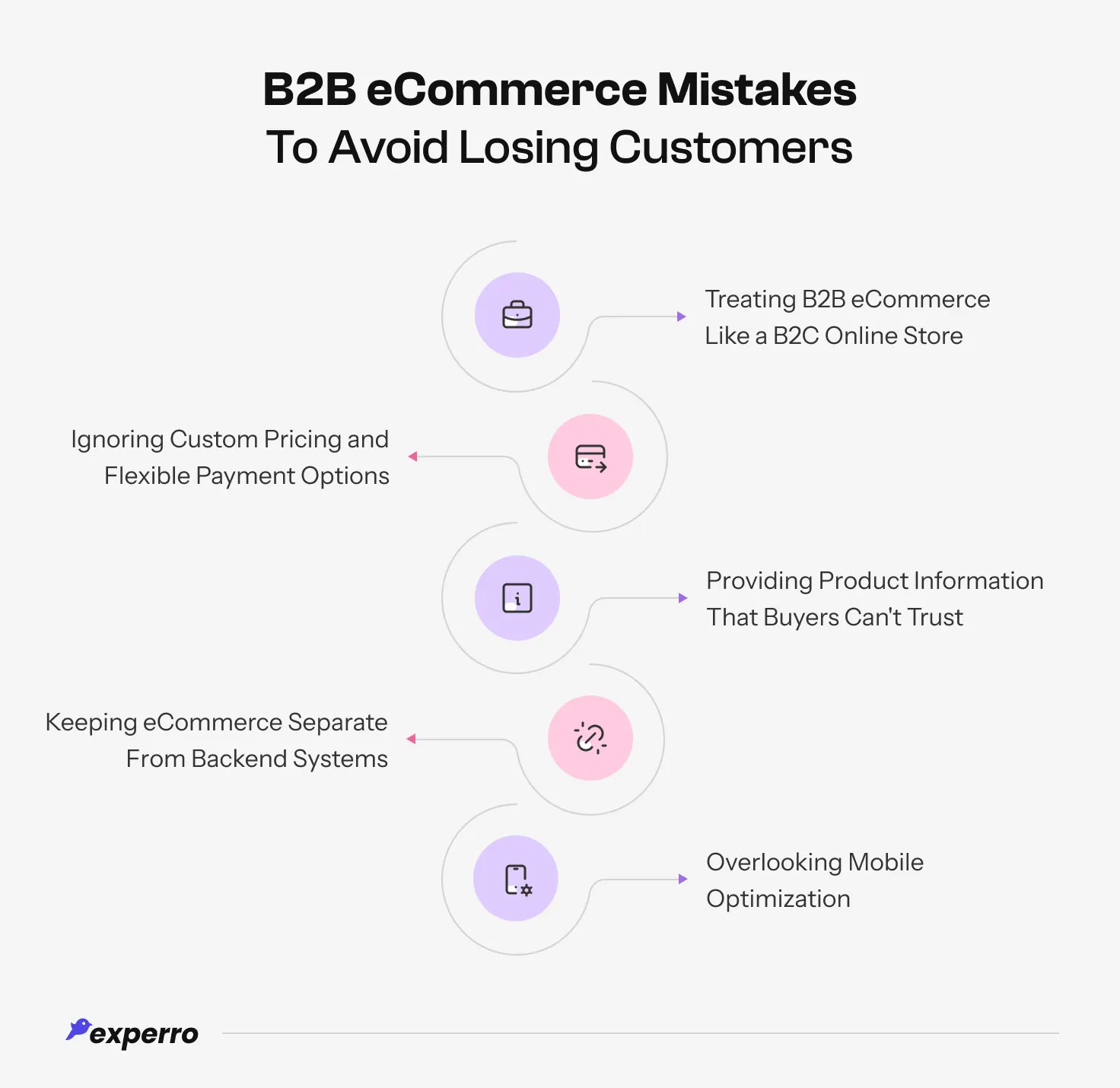
Even minor gaps can frustrate customers and slow growth. Businesses that first learn how to overcome B2B eCommerce challenges are better positioned to apply modern B2B eCommerce best practices 2026 that create smoother, more trusted buying experiences.
1. Treating B2B eCommerce Like a B2C Online Store
Your business model is different, so your digital experience should be too. Business customers expect custom pricing, account-based buying, approval workflows, and dedicated account management not a standard business-to-consumer shopping experience.
Understanding how B2B differs from D2C and B2C makes one thing clear: consumer playbooks don't work for business buyers. The best B2B eCommerce best practices reflect how businesses actually buy.
2. Ignoring Custom Pricing and Flexible Payment Options
Negotiated contracts are part of doing business. If your platform can't support custom pricing, customer-specific catalogs, purchase orders, ACH payments, or Net 30 and Net 60 terms, you're creating the kind of friction that many common eCommerce challenges and solutions are designed to address.
Flexible payment options simplify purchasing, improve customer satisfaction, and help turn more business buyers into loyal, long-term customers.
3. Providing Product Information That Buyers Can't Trust
Business buyers don't make decisions with incomplete information. Missing specifications, technical documents, certifications, or inconsistent inventory force them to contact sales teams, slowing the buying process.
A well-structured product content strategy closes that gap, improves product discovery, builds buyer confidence, and helps customers complete purchases without unnecessary back-and-forth.
4. Keeping eCommerce Separate From Backend Systems
An eCommerce site performs best when it's connected to your enterprise resource planning (ERP), CRM, inventory, and order management systems.
Real-time integration keeps pricing, stock, and customer information accurate, helping you streamline operations and deliver a consistent buying experience across every digital touchpoint.
5. Overlooking Mobile Optimization
Today's business customers don't always buy from a desk. More than 90% of B2B buyers prefer mobile-optimized experiences, and 65% of B2B traffic now comes from mobile devices.
A fast, mobile-friendly eCommerce site improves usability, supports Google's mobile ranking signals, and keeps buyers engaged wherever they work.
Every improvement you make removes friction from the buying journey. By following proven B2B eCommerce website best practices, connecting your existing business systems, and designing experiences around real business needs, you can strengthen customer relationships, improve operational efficiency, and create sustainable business growth.
How Experro Helps You Create Smarter B2B Buying Experiences
Buyers don't read playbooks on B2B eCommerce best practices. They just leave if things don't work.
Experro closes that gap with AI-powered search, personalization, and product intelligence that actually helps buyers enjoy shopping on your Experro-powered platform.
That's what a modern B2B eCommerce strategy looks like...
- Experro's AI-powered search understands buyer's intent, not just keywords, so people find products fast, even in huge, messy catalogs. That's B2B eCommerce customer experience best practices, done right.
- Every click and search reveal what a buyer wants. Experro turns that into real-time recommendations that feel relevant, not random, the kind of B2B online shop best practice buyers now expect.
- Experro gives teams live commerce insights to guide pricing and visibility, backed by real demand signals, helping brands protect margins.
- Experro connects customer behavior, product data, and business insights, so teams spot conversion opportunities faster and act on practical B2B eCommerce business tips.
- Search, personalization, recommendations, and commerce intelligence, all on one scalable platform, built for real B2B eCommerce growth strategies.
At the end of the day, the best tips for B2B eCommerce business success aren't about doing more. They're about giving buyers what they need, faster, and building the trust that keeps them coming back.
Build a B2B Commerce Experience That Buyers Choose Again
At the heart of every successful B2B commerce experience is a simple idea: make buying easier for the people who rely on your business. When customers can quickly find what they need, access the right information, and complete orders without frustration, every interaction becomes more valuable.
The best B2B brands don’t stop at launching a digital solution; they keep improving based on what their customers need. By removing everyday challenges, creating smoother buying journeys, and delivering personalized experiences, businesses can earn lasting trust and loyalty.
Your customers’ expectations are always evolving, and your commerce experience should evolve with them. Contact our B2B commerce experts today to explore your goals and create a seamless buying journey that delivers real value for your customers and your business.
FAQs

With 6+ years of experience in AI, software, and digital transformation across tech, healthcare, and fashion, Rahul focuses on making complex ideas simple, clear, and actually useful. He has learned how often great ideas get lost in complexity, which is why he centers his writing on clarity, helping entrepreneurs and leaders cut through noise and make decisions with confidence.
Subscribe to Our Newsletter!
Get the latest insights delivered straight to your inbox.