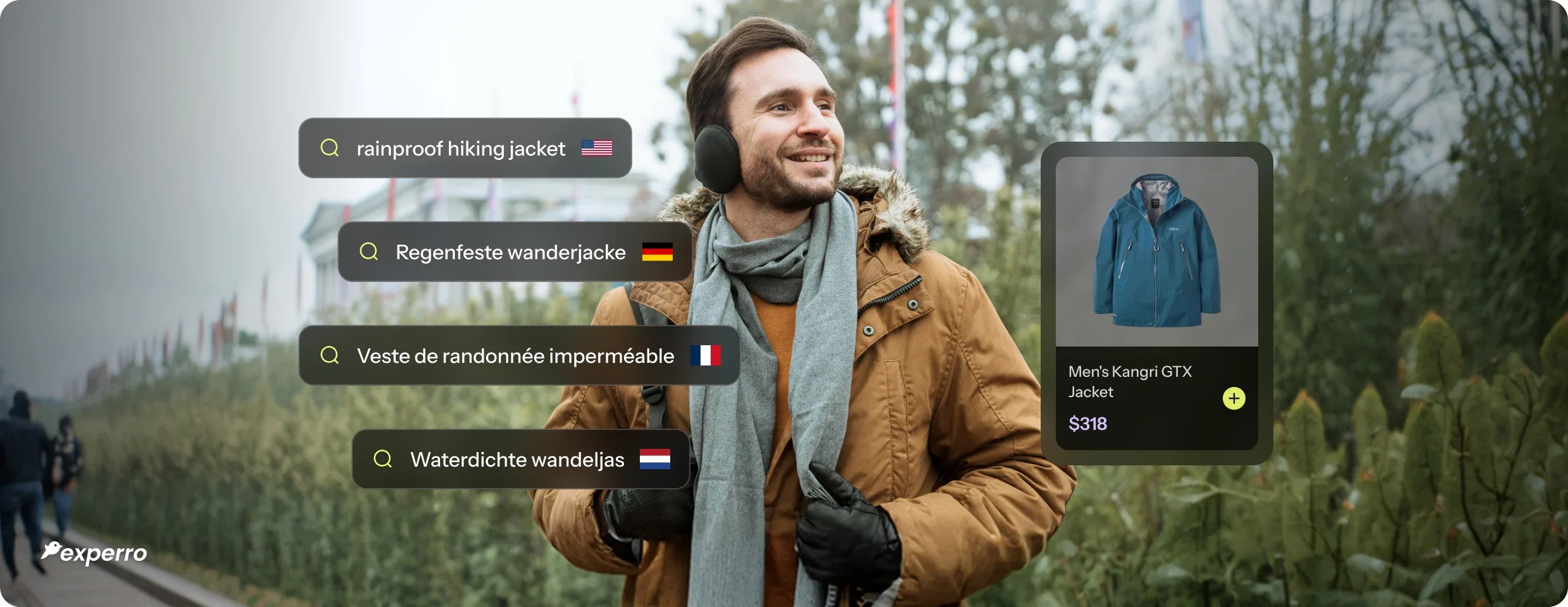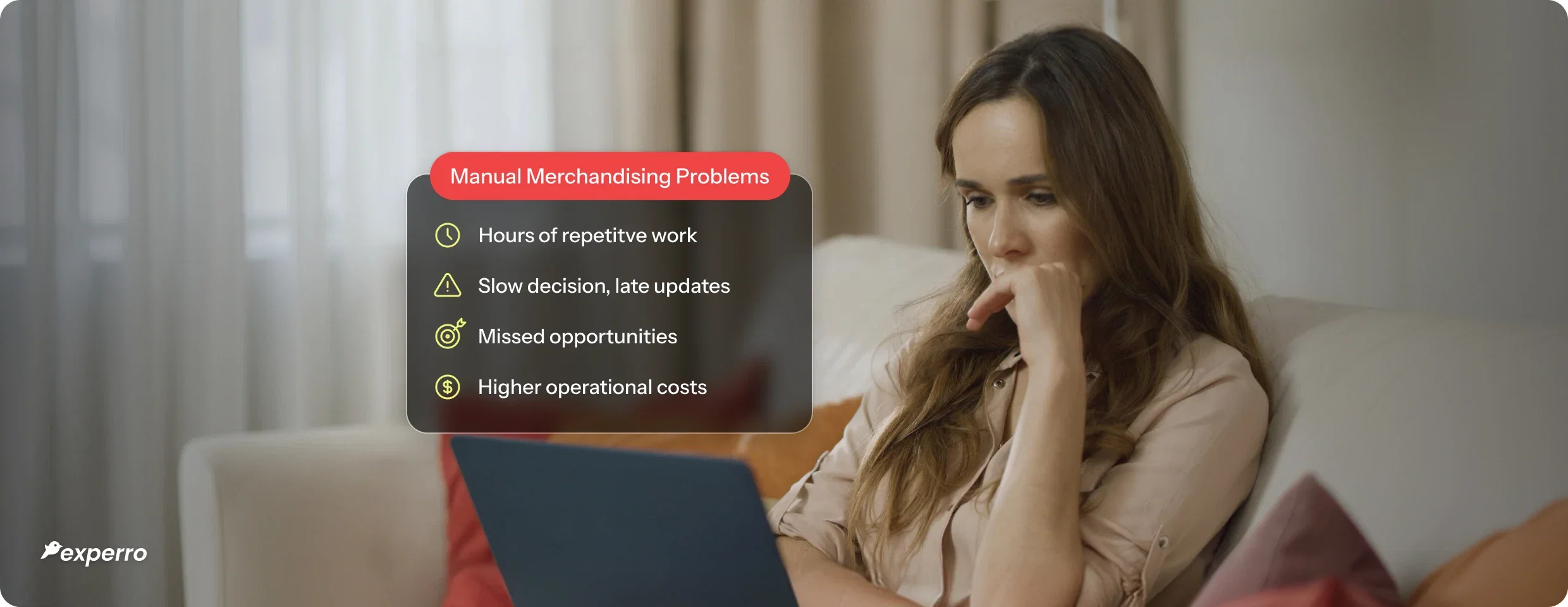
- eCommerce
- Recommendations
- Generative AI
- 13 min read
7 Product Recommendation Strategies Shoppers Can’t Escape
Published
30 June 2026Updated
28 September 2026

core insights box
- A product recommendation strategy turns scattered intent into clear direction, helping shoppers discover products before they actively search.
- The best recommendations feel natural because timing, context, and intent align, making every purchase decision feel effortless and obvious.
- Ever felt like a store just “knew” what you needed? That’s what Experro brings to your product recommendation strategy, delivering the right product at the right time, every time.
Every customer is telling you what they want. Not with words, but through clicks, searches, scrolls, product views, and buying patterns.
The real question is: is your product recommendation strategy turning those signals into recommendations that match customer intent❓❓❓
eCommerce brands collect more behavioral data than ever before. But many struggle to turn it into product recommendations that feel relevant.
Instead, shoppers see the same popular products, generic bestsellers, or suggestions that feel disconnected from what they’re trying to find.
The cost of this gap is increasing. Product recommendations can influence up to 26% of online revenue, while 71% of consumers expect personalized experiences.
The best brands take a different approach. They build product recommendation strategies that learn from customer behavior and adapt in real time.
So, what turns a recommendation into the next product a customer wants to buy?
In this guide, you’ll discover the strategies that make product recommendations feel timely, relevant, and worth acting on.
Building a Full Product Recommendation Strategy That Works
Every recommendation should move a shopper one step closer to a purchase.
A strong product recommendation strategy helps your product recommendation tactics deliver relevant experiences that guide customers toward the right products at the right time.
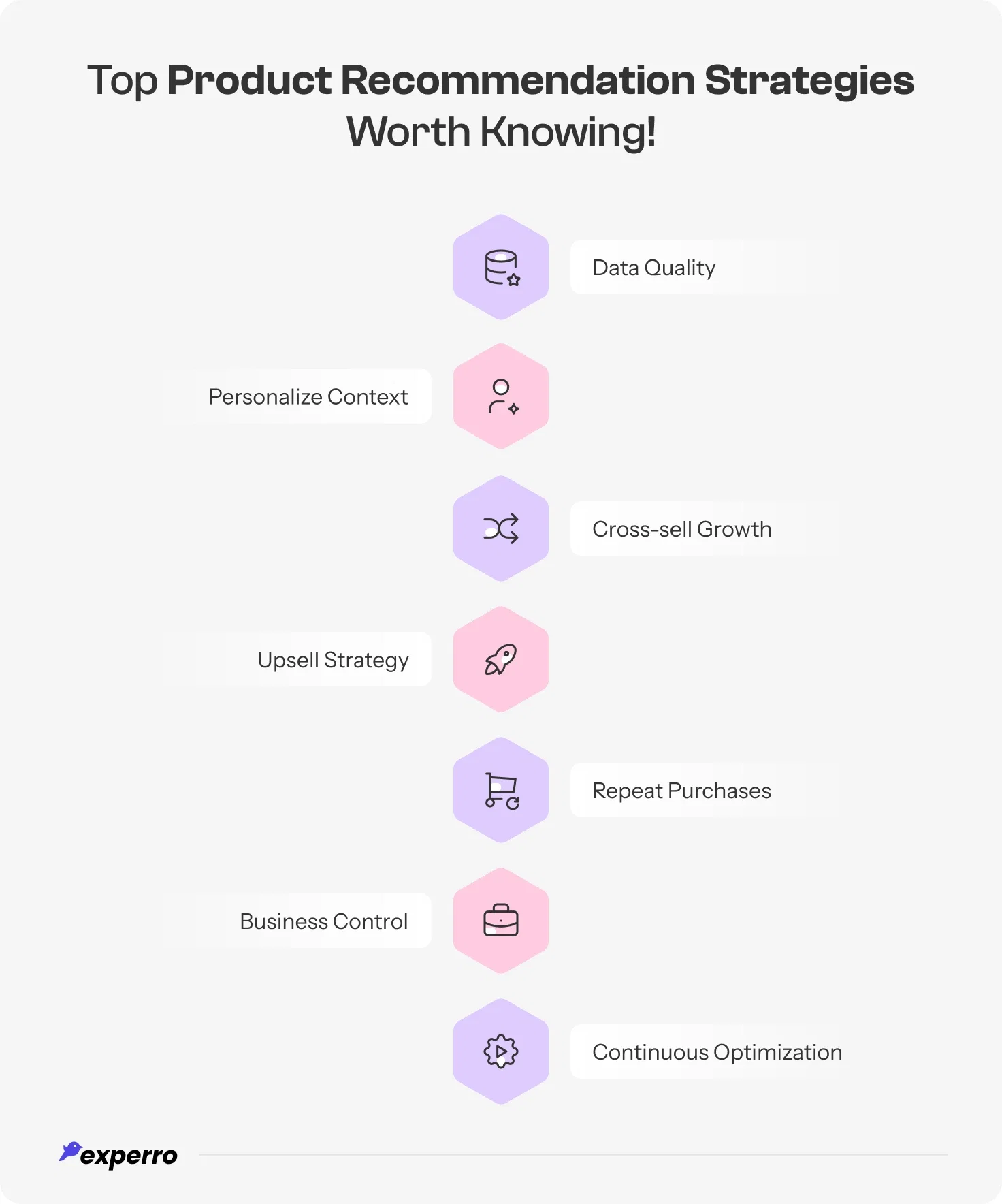
1. Drive Product Discovery
Most eCommerce businesses don't have a product problem. They have a visibility problem.
Customers can only purchase products they discover, yet many online stores contain hundreds or thousands of products competing for attention.
Without guidance, shoppers often see only a small portion of the catalog before leaving or making a decision.
This is exactly where structured discovery logic matters. Instead of treating search and browsing as separate journeys, modern systems align them through concepts explained in product search vs product discovery, where discovery becomes an experience rather than a task.
Common product recommendation widgets that improve product discovery include:
- Best sellers
- Trending products
- New arrivals
- Featured products
These widgets are especially effective on homepages and category pages, where customers are actively exploring. They also create valuable social proof by showing what other customers are viewing and purchasing, making it easier to discover relevant products with confidence.
Research shows that more than 70% of purchased products appear within the first rows of category pages.
Simply put, the easier it is for shoppers to discover relevant products, the easier it becomes to boost sales, increase customer engagement, and improve the overall customer experience.
2. Personalize Recommendations Using Context and Behavior
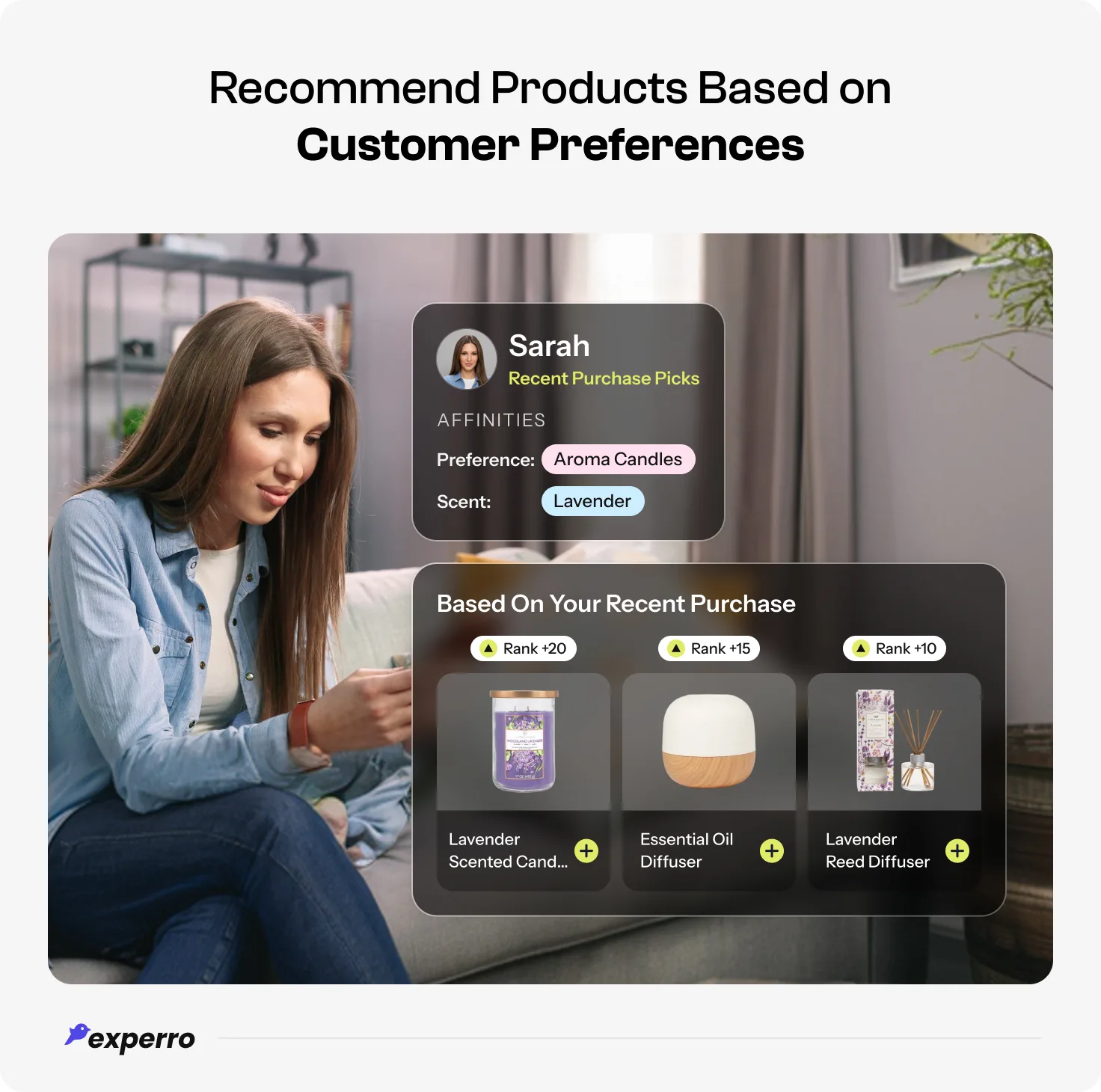
Imagine customer A comparing several smartphones to decide which one to buy. And customer B has just purchased a smartphone.
The first benefits from recommendations for similar models, while the second is more likely to be interested in accessories such as a protective case, screen protector, wireless charger, or earbuds.
Showing both customers the same recommendations ignores where they are in their buying journey and creates a generic shopping experience.
This is where real-time intelligence becomes essential. Systems designed around real-time personalization continuously adjust recommendations based on live behavioral signals, not static profiles.
Similarly, deeper user understanding often comes from approaches like profile-based recommendations, where long-term preferences and short-term intent are combined.
These recommendations can be powered by:
- Browsing history
- Purchase history
- User preferences
- Affinity signals
- Similar products
- Complementary products
- Frequently Bought Together recommendations
Modern recommendation engines use machine learning algorithms, collaborative filtering, and content-based filtering to uncover complex patterns in customer behavior.
Many also incorporate contextual recommendation signals such as location, seasonality, and timing.
The result is a more personalized shopping experience that feels relevant rather than random.
Considering that 56% of online shoppers are more likely to return to websites that recommend products they care about, personalization has become one of the most important product recommendation strategies for eCommerce growth.
3. Use Cross-selling to Increase Basket Size
Customers often need more than the product they originally came to buy.
The opportunity is recognizing those needs before the customer leaves.
Cross-selling works best when it reduces effort instead of increasing choice overload. This aligns closely with the principles in reduce customer purchase friction, where smoother decision paths naturally improve conversion outcomes.
Common cross-selling recommendations include:
- Complementary products
- Add-ons
- Frequently paired products
- Commonly purchased products
For example, a customer purchasing a camera may also need a memory card, carrying case, or tripod.
Or someone buying skincare products may benefit from a cleanser, serum, or moisturizer designed to work together.
This is why 'Frequently Bought Together' recommendations remain one of the most effective recommendation tactics. They use real purchase behavior to identify products other customers commonly buy together.
As a result, customers complete their purchase more confidently, while businesses create more upsell and cross-sell opportunities, increase basket size, improve conversion rates, and generate more revenue from every transaction.
4. Use Upselling to Maximize Order Value
Upselling only works when it respects intent.
Instead of pushing higher-priced items, effective systems highlight better-fit alternatives that genuinely improve outcomes for the customer.
This is where optimization principles similar to those in generative AI for conversion optimization become important, where timing, relevance, and context determine whether a recommendation converts or gets ignored.
Common upsell patterns include:
- Premium alternatives
- Product upgrades
- Higher-value products
- Enhanced feature options
For instance, a customer considering a basic laptop may benefit from a model with better performance, more storage, or longer battery life. The recommendation succeeds because it solves a problem rather than simply increasing the price.
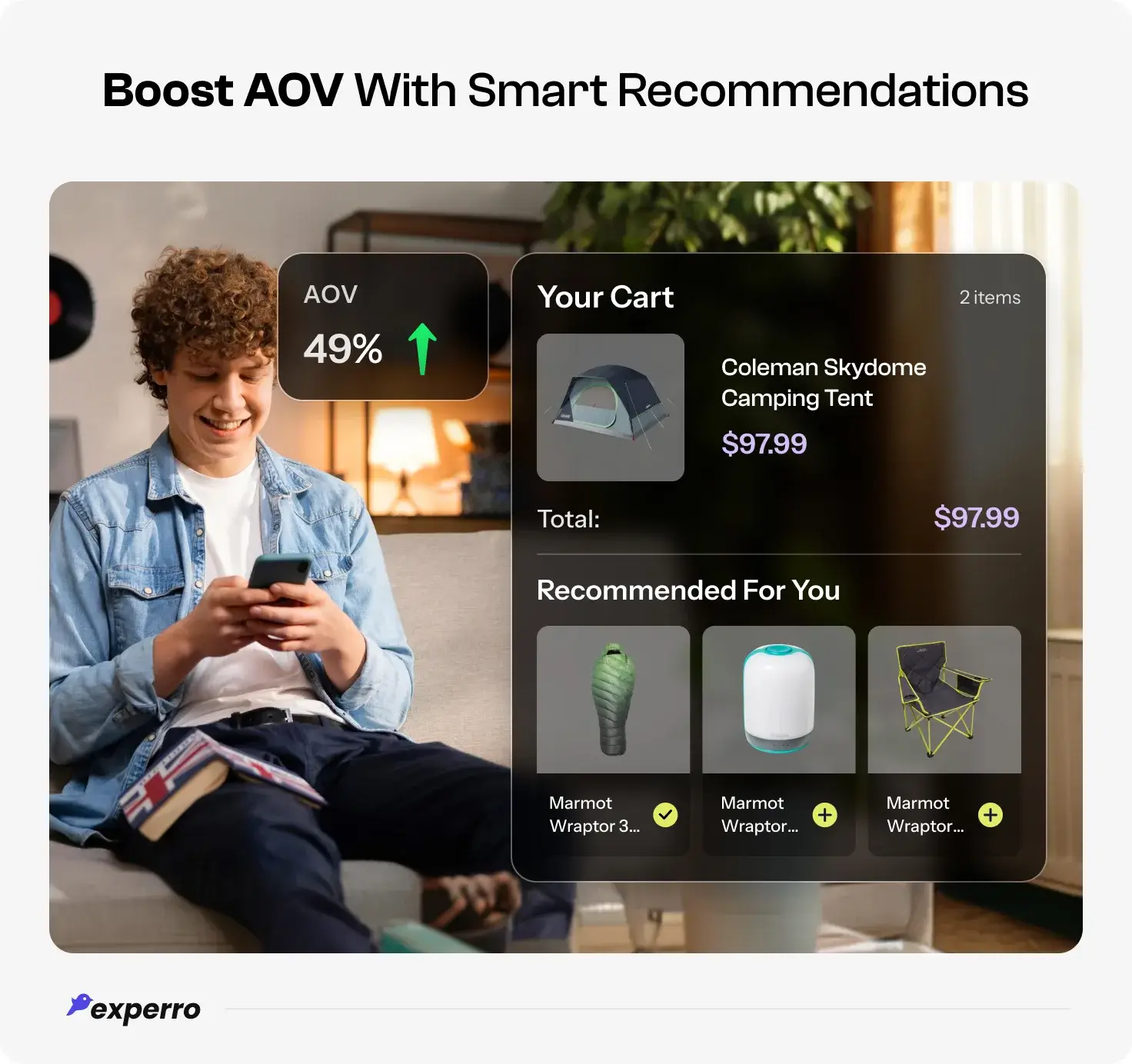
Personalized recommendations make upselling even more effective because relevance drives decision-making. In fact, studies show that personalized recommendations can increase average order value (AOV) by as much as 54%.
When customers see clear value in an upgrade, product recommendation tactics make every recommendation more meaningful. Customers make informed decisions, while businesses increase revenue without sacrificing the customer experience.
5. Encourage Repeat Purchases and Loyalty
The journey doesn’t end at checkout. In fact, that is where the most valuable phase begins.
Retention-focused recommendation systems extend engagement beyond the first purchase, using timing and customer behavior to drive meaningful re-engagement and long-term loyalty.
Retention-focused recommendations often include:
- Replenishment recommendations
- Repeat purchase suggestions
- Personalized post-purchase recommendations
- Loyalty-focused recommendations
These online product recommendation strategies are particularly effective for consumable products, subscription-based products, and items customers regularly reorder.
Purchase history provides valuable insight into future needs. Instead of guessing what customers may want next, recommendation engines can use real behavioral data to deliver relevant recommendations at the right time.
Personalized experiences not only encourage repeat purchases but also strengthen customer satisfaction and customer loyalty.
This is one reason why data-driven personalization continues to play a major role in customer retention and long-term eCommerce revenue growth.
6. Balance AI Recommendations With Business Goals
The most effective product recommendation strategy is not showing the most relevant product every time.
In real commerce, relevance can still fail. A product may match intent perfectly, but if it is out of stock, low in margin, or misaligned with business priorities, it creates friction instead of driving conversion.
This is where recommendation systems must go beyond prediction and connect with real commerce logic like digital merchandising, where product visibility is shaped by both customer behavior and business rules.
At the same time, search intelligence helps decode intent behind searches, clicks, and browsing patterns so decisions are grounded in real user signals.
A strong product recommendation strategy always balances both sides.
Key factors include:
- Inventory availability
- Merchandising priorities
- Promotions and campaigns
- Product profitability
- Seasonal priorities
The best systems do not rely only on AI. They combine machine learning models with rule-based controls to protect business constraints while keeping recommendations relevant.
These product recommendation tactics ensure business rules are respected while maintaining personalization quality.
The outcome is simple: not more suggestions, but smarter ones that sell, protect margins, and improve customer experience at the same time.
7. Continuously Optimize Recommendation Performance
Even the best product recommendation strategy won't stay effective forever.
Customer expectations change. Product catalogs evolve. Shopping behavior shifts. What works today may not deliver the same results a few months from now.
That's why leading eCommerce businesses treat recommendation optimization as an ongoing process rather than a one-time implementation.
The first step is measuring performance across key metrics such as:
- Customer engagement
- Conversion rates
- Add-to-cart rate
- Average order value
- Recommendation-driven revenue
Once you know what's working, continuous A/B testing and experimentation help you refine recommendation widgets, placements, layouts, messaging, and recommendation algorithms to improve performance for different audiences.
The most successful brands understand that a winning recommendation strategy is never finished. They continuously test, learn, and adapt to improve product recommendation strategy, ensuring every recommendation becomes more relevant over time.
Customers return because recommendations help them discover the right products when they need them most. That's what builds trust, strengthens loyalty, and drives sustainable growth.
You can learn about the benefits of product recommendations to learn more.
Now that we have gone through all the product recommendation strategies, the next section will guide you through the best practices of product recommendation execution.
Are You Following the Product Recommendation Best Practices?
Customers don't need more recommendations, they need better ones.
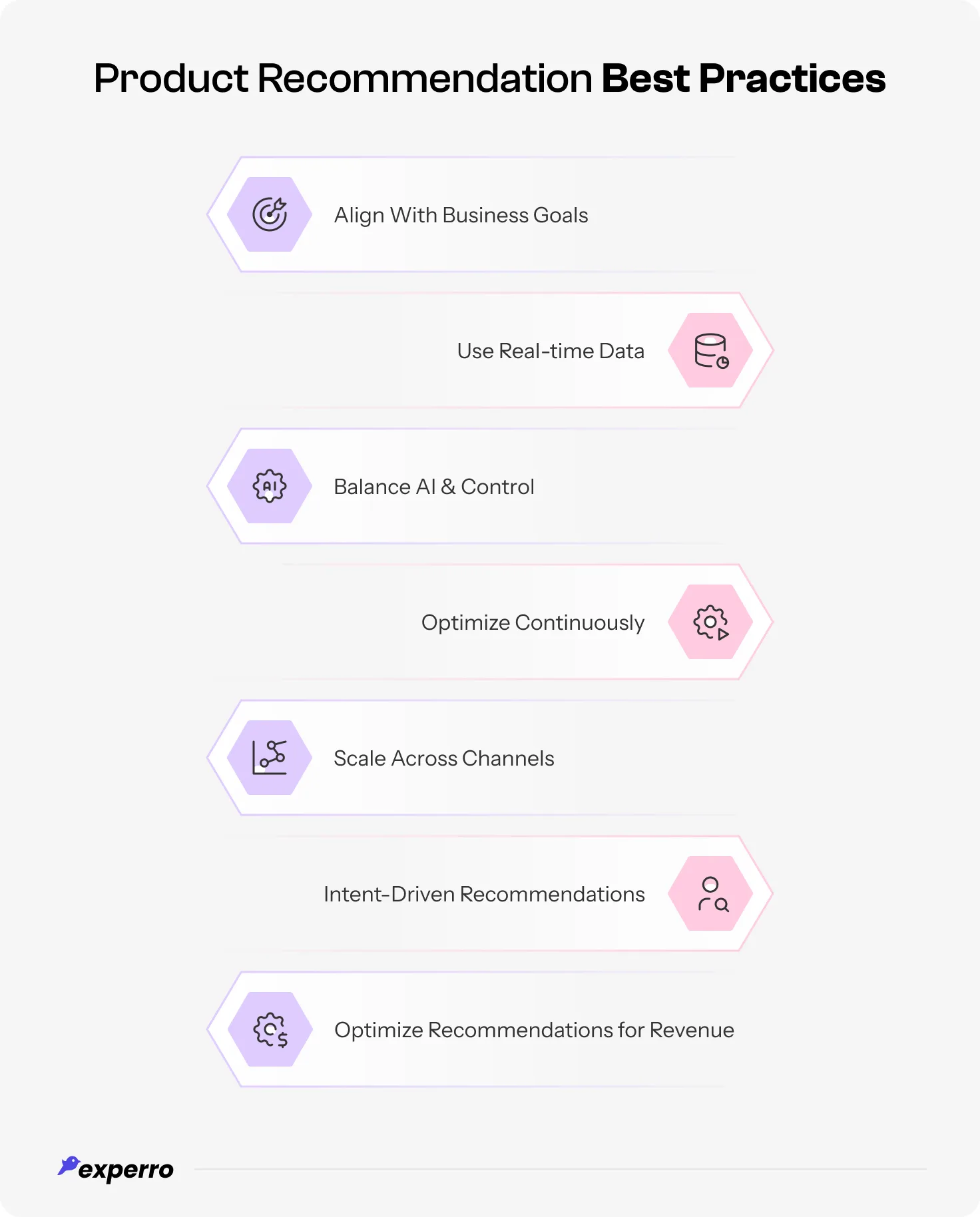
Here are the best practices for implementing product recommendations that help you deliver the right recommendations at the right time.
1. Align Recommendations to Business Outcomes First
Every recommendation should exist for a reason, not just to fill space on a page. The most effective systems start by linking recommendation types to measurable business goals like average order value (AOV), conversion rates, and revenue growth.
Instead of using the same logic everywhere, align recommendations with intent across the journey:
- Homepage recommendations should focus on discovery and engagement
- Category pages should improve navigation and product filtering through relevance
- Product detail pages (PDPs) should strengthen purchase confidence and upselling
- Cart pages should increase basket size through complementary products
- Post-purchase experiences should drive repeat purchases and customer loyalty
This alignment turns recommendations into structured decision points instead of random suggestions. As a result, your eCommerce product recommendation strategy becomes directly tied to business performance instead of just user interaction.
2. Build on Real-time Commerce and Behavioral Data
Static recommendations lose relevance fast because customer intent changes in real time. A strong system adapts using real-time commerce and behavioral data from your eCommerce site.
To improve recommendation accuracy, it relies on product recommendation best practices based on real actions like clicks, browsing, and purchases.
- User behavior and browsing behavior
- Purchase history and browsing history
- Customer data and behavioral data across sessions
- Product data and catalog updates
- User preferences and affinity signals
When you unify customer signals, your system can use stronger product recommendation tactics that reflect what shoppers actually want, instead of guessing.
Machine learning-powered recommendations and algorithms then turn every click, scroll, and interaction into meaningful insights, improving relevance over time.
This is how personalization shifts into real-time, adaptive experiences
3. Balance AI Recommendations with Business Control
AI improves relevance, but without control, it can conflict with business priorities. That’s why the best AI product recommendation strategy always blends intelligence with merchandising rules.
To maintain balance, you should:
- Apply rules based on margin, stock availability, and inventory management
- Prioritize high-value and strategic products
- Control recommendation widgets across key pages like PDP, cart, and category pages
- Align recommendations with campaigns and business objectives
- Blend AI-generated insights with merchandising strategy
This ensures that recommendations are not only personalized but also commercially viable.
With platforms like Experro, this balance lets you control the logic while still leveraging AI product recommendations and contextual recommendation systems, grounded in product recommendation best practices that improve performance without losing business alignment.
4. Continuously Optimize Recommendation Performance
A successful recommendation system is never static. It evolves based on customer behavior, product performance, and market changes.
To continuously improve your system, you should regularly measure:
- Impact on conversion rates
- Contribution to average order value (AOV)
- Influence on add to cart rate
- Engagement with recommendation widgets
- Overall eCommerce revenue impact
However, measurement alone is not enough. You must also actively experiment.
Try out continuous product recommendations:
- Placement (homepage, PDP, cart, checkout, post-purchase)
- Recommendation types (cross-sell, upsell, personalized suggestions)
- Layouts and recommendation widgets
- Algorithm-driven recommendations vs rule-based logic
A/B testing helps improve product recommendation tactics by showing what actually works for users. Over time, it boosts engagement and revenue by refining recommendation strategies.
With ongoing testing, machine learning-powered recommendations keep improving over time, built on product recommendation best practices and sharpened through real user behavior.
5. Scale Personalization Across the Entire Customer Journey
Customers don’t experience your eCommerce store in a single moment, they move across multiple touchpoints. A high-performing system ensures that personalized product recommendations follow them seamlessly across the journey.
To scale effectively, you should deliver:
- Personalized discovery on homepage experiences
- Contextual recommendations on category pages
- Conversion-focused suggestions on product detail pages
- Basket-building recommendations on cart pages
- Retention-focused recommendations after purchase
This creates a unified personalized shopping experience that feels consistent, relevant, and intentional across every interaction.
Modern eCommerce recommendation engines powered by machine learning algorithms and collaborative filtering make this possible by continuously learning from user behavior, product interactions, and customer preferences.
The result is not just better engagement it is stronger customer retention, improved customer satisfaction, and higher lifetime value.
6. Use the Right Recommendation Types for the Right Context
A well-built system doesn’t rely on just one approach. It matches different recommendation types to the right customer context based on what users are doing in the moment, using product recommendation best practices to deliver more relevant dynamic recommendations.
To improve relevance, you should strategically use:
- Recommended For You: Personalized suggestions based on customer behavior
- Frequently Bought Together: Cross-sell opportunities that increase AOV
- Recently Viewed Products: Session continuity and return engagement
- Similar Products: Comparison-driven decision support
- Inspired By You: Behavior-driven personalization
- Pick Up Where You Left Off: Recover abandoned carts
- Trending and Popular Products: Social proof and discovery acceleration
This mix ensures that every recommendation engine output aligns with a specific moment in the customer journey rather than using generic logic.
7. Optimize for Revenue, Not Just Engagement
One of the most important shifts in modern eCommerce is moving from engagement-based optimization to revenue-based optimization.
A recommendation that gets clicks but does not contribute to revenue is not successful.
To optimize effectively, you should:
- Measure revenue generation per recommendation widget
- Track influence on average order value (AOV) and conversion rates
- Evaluate downstream impact, not just immediate clicks
- Prioritize high-impact placements over high-traffic ones
- Continuously refine based on performance data and business outcomes
In fact, research shows that personalized recommendations can significantly increase eCommerce revenue when aligned with customer intent and behavioral data, making them one of the most powerful levers in digital commerce.
A modern product recommendation strategy is not built on isolated tactics. It is a connected system that combines:
- Customer data and behavioral intelligence
- Real-time personalization strategies
- AI-driven recommendation algorithms
- Business rules and merchandising control
- Continuous A/B testing and optimization
- Scalable, cross-channel personalization
When all of these elements work together, recommendations stop being passive suggestions.
They become a dynamic eCommerce growth engine that improves discovery, increases average order value, enhances customer engagement, and drives measurable revenue across the entire customer journey.
Why Choose Experro for AI-Powered Product Recommendations?
The right recommendation at the right moment can turn a casual browser into a confident buyer. But delivering that experience consistently requires more than static rules or manual merchandising.
With Experro's AI-powered product recommendations, brands can turn real-time customer behavior into personalized experiences that adapt to every shopper's intent and context.
From product discovery to checkout, Experro helps deliver relevant recommendations that increase conversions, boost average order value, strengthen customer engagement, and drive sustainable business growth.
Conclusion
Product recommendations have become a strategic advantage for modern eCommerce brands. They influence how shoppers discover products, compare options, and make confident purchase decisions throughout the buying journey.
The most successful brands treat product recommendations as an ongoing optimization strategy rather than a one-time feature.
By continuously learning from customer behavior and adapting recommendations in real time, they create more relevant shopping experiences that increase conversions, strengthen customer loyalty, and support long-term growth.
Talk to one of our experts to discover how AI-powered product recommendations can help you improve conversions, boost AOV, and deliver personalized shopping experiences that keep customers coming back.
FAQs

With 6+ years of experience in AI, software, and digital transformation across tech, healthcare, and fashion, Rahul focuses on making complex ideas simple, clear, and actually useful. He has learned how often great ideas get lost in complexity, which is why he centers his writing on clarity, helping entrepreneurs and leaders cut through noise and make decisions with confidence.
Subscribe to Our Newsletter!
Get the latest insights delivered straight to your inbox.