- Generative AI
- Product Discovery
- Personalization
- 12 min read
Possible to Get 100% Control Over Omnichannel Customer Journey
Published
10 July 2026
core insights box
- Build around how customers actually shop so every interaction feels connected, intuitive, and easier to continue across channels.
- Reduce the effort it takes to discover, compare, and buy so customers stay engaged instead of dropping off mid-journey.
- With Experro, unify fragmented touchpoints into seamless journeys that feel better for customers and simpler for teams to manage.
Here's a number worth sitting with: brands with strong omnichannel engagement retain 89% of their customers. Weak ones retain just 33%.
That gap isn't small. It's the difference between a business people stay loyal to, and one they quietly abandon without ever saying why.
Think about how your customer actually shops. They find a product on Instagram, check it out on your website, ask a quick question in chat, then buy on your app. To them, that's one journey, not four disconnected visits.
And with 98% of people switching devices/channels every single day, they simply expect everything to follow them along the way.
Most brands aren't built for that. The cart built on one device doesn't carry over to the next. The chat forgets what was already asked. The recommendations start from zero, like nothing happened before, and your customer feels it, even if they can't quite name what broke.
They won't complain. They'll just leave. This guide is about making sure they never have to.
The question is... is your brand ready for this?
What Is an Omnichannel Customer Journey?
An omnichannel customer journey is a customer experience in which customer identity, context, preferences, and previous interactions remain connected across every customer touchpoint.
As customers move across multiple channels, each interaction builds on the last, allowing the entire customer journey to continue without losing context or starting over. If you're new to the concept, learn more about what omnichannel eCommerce is.
The defining characteristic of an omnichannel customer journey is continuity. Customer data, interaction history, and preferences stay connected across touchpoints. This allows every interaction to continue from the last instead of feeling like a separate experience. That continuity is made possible by integrated customer data across channels.
Why Omnichannel Journeys Matter More Than Ever in 2026
Customers don’t think about channels, they expect a seamless journey with your brand.
In 2026, connected experiences across touchpoints and devices make understanding the difference between omnichannel vs multichannel more important than ever.
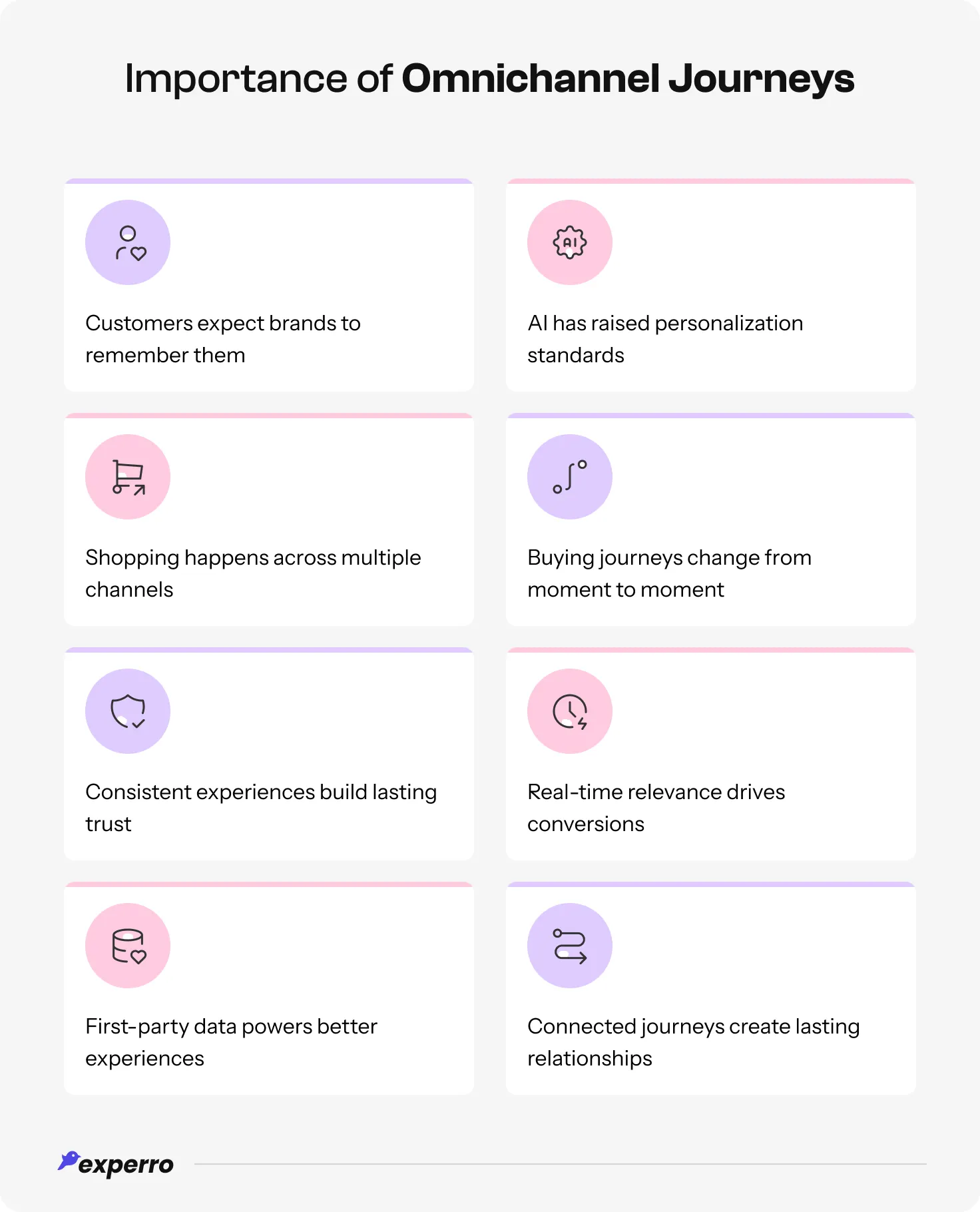
Let’s explore why omnichannel journeys matter and what brands need to get right to meet rising customer expectations.
1. Customers Expect Brands to Remember Them
Customers expect brands to remember what they viewed, bought, asked, or abandoned across channels.
When that context carries forward, the journey feels personal; when it does not, the brand feels disconnected.
2. AI Has Raised Personalization Standards
AI has reset expectations across the omnichannel customer journey in eCommerce, where real-time personalization adapts search, recommendations, and content using omnichannel journey analytics across customer touchpoints, reshaping the buyer journey into a seamless personalized experience.
3. Shopping Happens Across Multiple Channels
That shift matters because shopping no longer happens in one place. Around 73% of shoppers use multiple channels, and journeys now span roughly six touchpoints before a purchase decision.
4. Buying Journeys Change From Moment to Moment
Your customers’ intent can shift in an instant. They may browse on mobile, compare on desktop, and return through email or support.
Your brand needs journeys that adapt to these changing moments, not fixed paths that ignore customer context.
5. Consistency Builds Trust and Loyalty
As journeys stretch across touchpoints, consistency becomes critical. When pricing, product information, and support stay aligned, trust grows, and strong omnichannel experiences can lift retention to nearly 89%.
It is one of the clearest signs that a better digital customer experience creates long-term value, not just short-term convenience.
6. Real-time Relevance Drives Conversions
However, consistency alone is not enough. Data-driven personalization enables brands to use real-time customer insights to deliver timely recommendations, reminders, and support.
By understanding intent and behavior, brands reduce friction, maintain engagement, and convert customer interest into action.
7. First-party Data Powers Better Experiences
That level of relevance depends on the connected customer data. As privacy expectations rise, first-party data gives brands the context needed to understand behavior, personalize interactions, and unify the omnichannel customer journey.
8. Connected Journeys Create Lasting Relationships
Ultimately, connected journeys do more than improve a single sale. They increase retention, lift lifetime value, and make customers feel understood, which is what turns convenience into long-term loyalty and makes personalized omnichannel experiences more valuable over time.
In short, omnichannel customer journey strategies matter in 2026 because customers no longer stick to one channel.
They expect every interaction to feel connected, consistent, and relevant, making customer journey orchestration essential for coordinating experiences across touchpoints without breaking the flow.
What Actually Powers an Omnichannel Customer Journey
In simple terms, well-executed omnichannel customer journey strategies help a brand recognize customers instantly, understand what they need, and respond in real time across every touchpoint, creating a smooth, connected experience instead of isolated channel interactions.
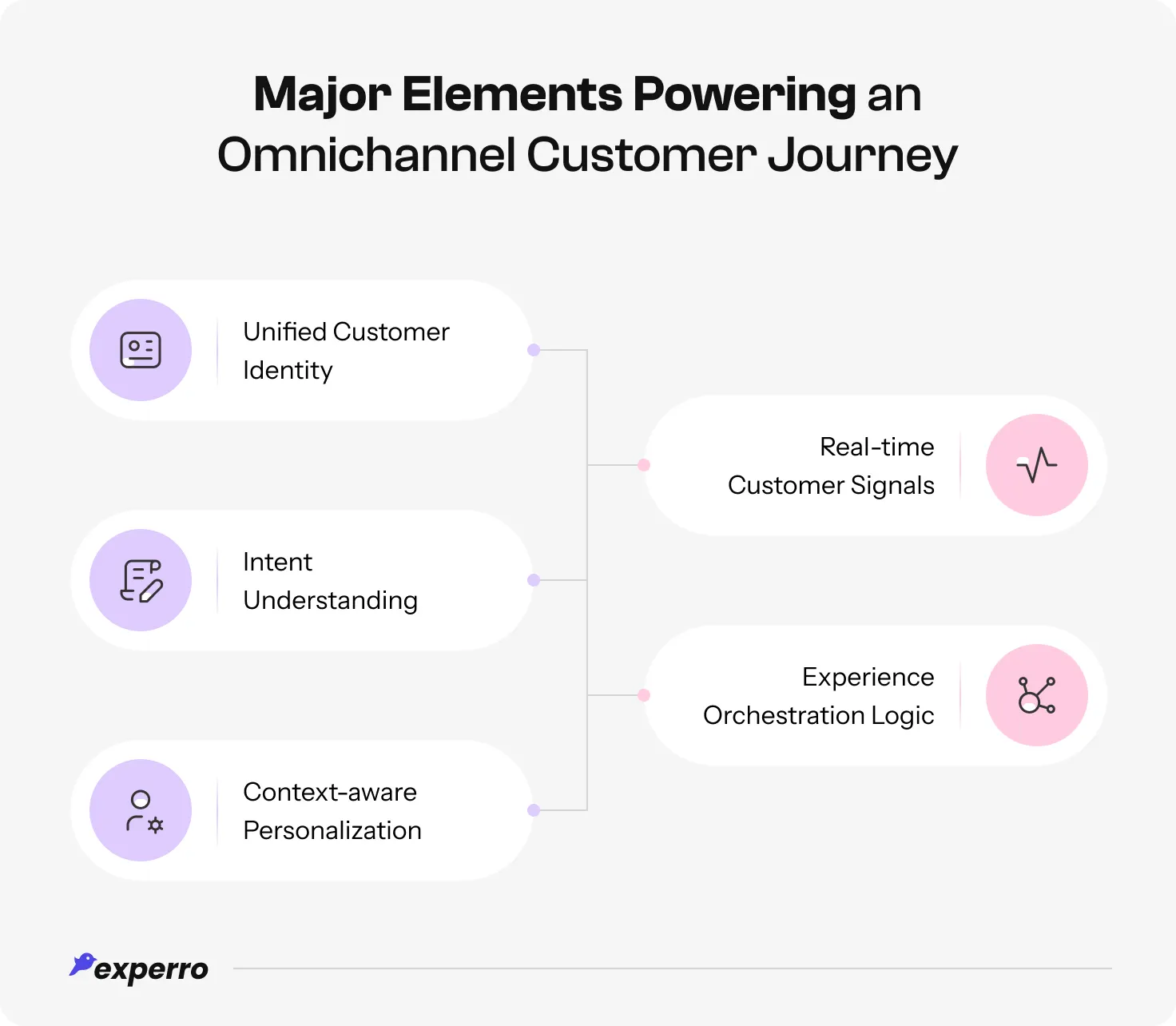
1. Unified Customer Identity
It starts with a unified customer identity. By bringing together customer data, purchase history, preferences, and past interactions, brands can recognize the same person across digital channels, physical stores, and customer service touchpoints, creating the foundation for effective digital customer experience.
2. Real-time Behavioral Signals
However, identity alone is not enough.
Omnichannel customer journeys also rely on real-time behavioral signals such as clicks, searches, browsing patterns, and engagement data to understand what customers are doing right now, similar to the customer insights uncovered through search intelligence.
3. Intent Understanding
Those signals only become useful when brands can interpret intent.
Knowing whether a customer is exploring, comparing, hesitating, or ready to buy helps shape more relevant and timely customer interactions across channels, just as stronger conversational commerce experiences respond to customer intent.
4. Experience Orchestration Logic
Once intent is clear, the omnichannel customer journey determines what should happen next.
It connects customer insights, business rules, and journey context to deliver a consistent experience across the entire customer journey, rather than the disconnected execution often seen in traditional channel strategies.
5. Context-aware Personalization
Finally, context-aware personalization turns insights into action.
It adapts content, recommendations, and messaging based on customer behavior and context, helping create seamless, personalized omnichannel retail customer journeys across every touchpoint through more relevant merchandising.
In simple terms, a well-executed omnichannel customer journey strategy helps a brand recognize customers instantly, understand what they need, and respond in real time across every touchpoint, creating a smooth, connected experience instead of isolated channel interactions.
The Five Stages of a Modern Omnichannel Customer Journey
A modern omnichannel customer journey is not a straight path from awareness to purchase.
It is an experience lifecycle where customer behavior, touchpoints, and expectations stay connected across the entire customer journey, before, during, and after conversion.
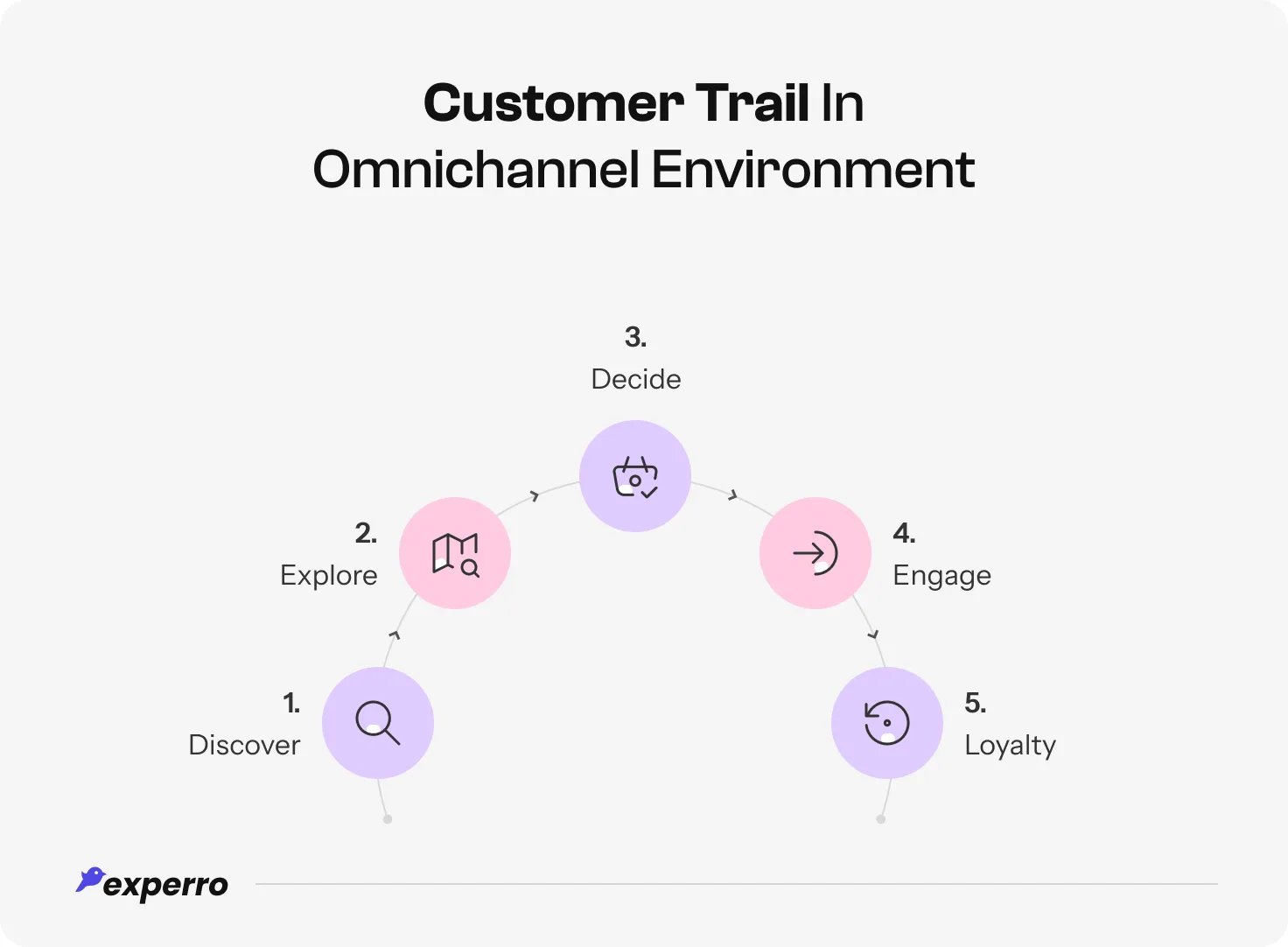
1. Discovery Moment
The journey begins when a potential customer first encounters your brand through search, social media, ads, marketplaces, or referrals.
Because 86% of shoppers research online, discovery is no longer just about visibility. It is the first moment your brand must feel relevant, especially through stronger eCommerce search and product discovery experiences.
2. Exploration Phase
Once interest is sparked, customers start exploring multiple channels.
They may browse your website, compare products on mobile, read reviews, open emails, or visit physical stores, expecting each interaction to add clarity instead of restarting the journey.
3. Decision Moment
The decision stage is where intent turns into action. By this point, shoppers have often interacted with a brand across several touchpoints.
Clear product information, trust signals, timely personalization, and a frictionless path to purchase often determine conversion, much like stronger eCommerce conversion rate optimization.
4. Post-purchase Continuation
The omnichannel customer journey does not end at checkout.
Order updates, onboarding, customer support, replenishment reminders, and relevant follow-up communication shape whether the experience feels complete, helpful, and worth continuing after the sale.
5. Loyalty Loop
When post-purchase interactions stay connected, useful, and personalized, customers are more likely to return, repeat, and advocate.
That matters because strong omnichannel engagement can lift retention and long-term customer value, especially when brands improve the experience through smarter post-holiday customer retention strategies.
In the end, most omnichannel customer journeys fail because connection breaks before continuity can form. When identity, data, context, and execution stay disconnected, customers do not experience one brand, only separate channels.
That’s why brands like Cadence focused on unifying operations behind the scenes, because omnichannel success depends less on channel presence and more on connected execution.
Where Most Brands Get Omnichannel Customer Journeys Wrong
Most omnichannel journeys fail not because of lack of effort, but because of broken continuity.
One of the biggest issues is over-reliance on disconnected personalization a challenge explored in personalization gone wrong in eCommerce.
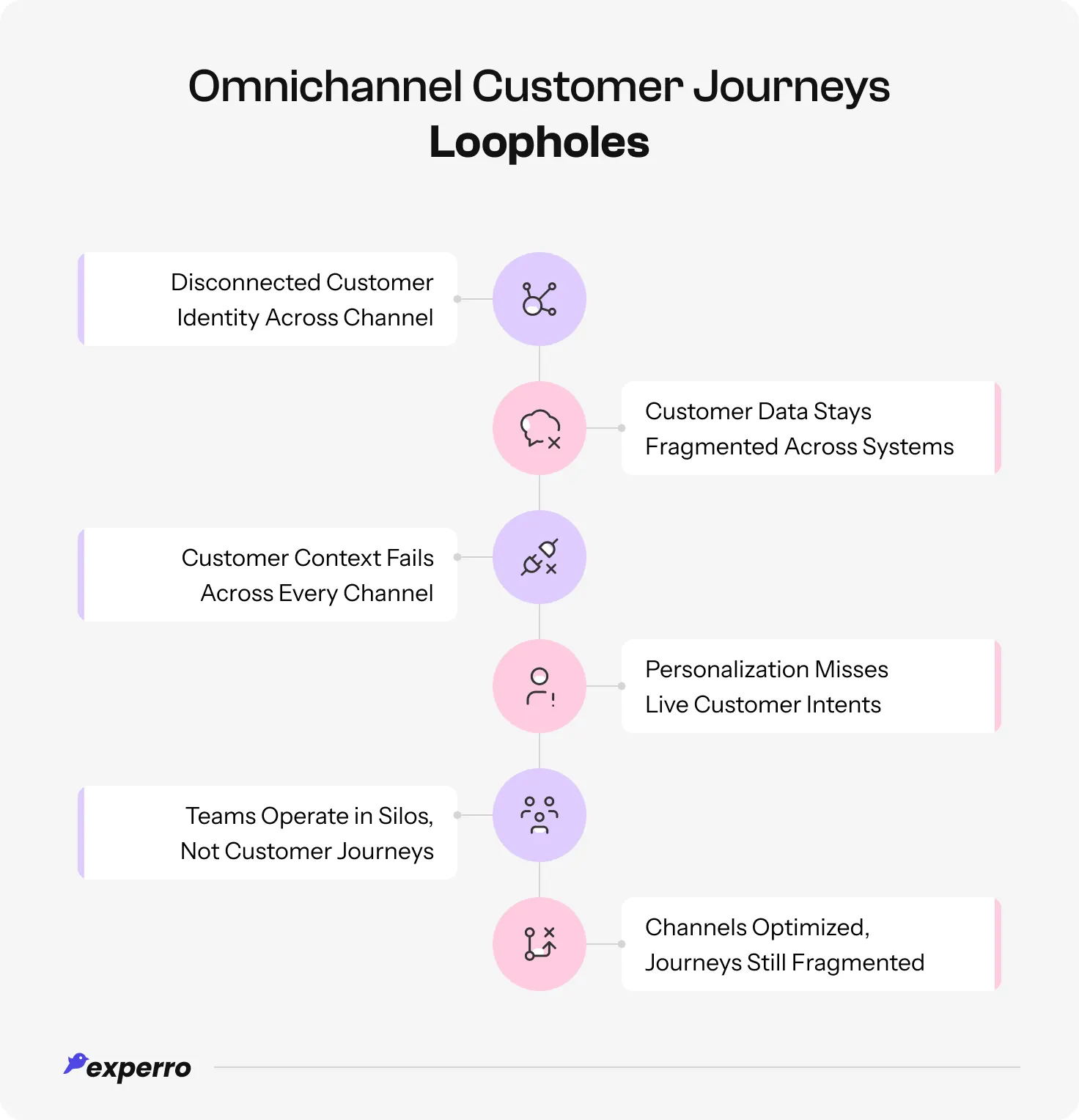
1. Customer Identity Disconnects Across Touchpoints
The first issue appears when brands cannot recognize the same customer across channels. If browsing behavior, purchase history, email engagement, and support interactions stay disconnected, every new touchpoint feels like a restart instead of a continuation.
2. Customer Data Stays Fragmented Across Systems
Once identity is disconnected, customer data becomes difficult to use in meaningful ways. When commerce, CRM, service, and marketing systems hold separate pieces of the story, teams lose the unified customer view needed to personalize consistently.
3. Channels Fail to Carry Context Forward
Without connected data, channels cannot share customer context. A customer may click an email, browse on mobile, and contact support, yet none of those interactions inform the next one, which makes the journey feel repetitive and disconnected.
4. Personalization Misses Real-time Intent
When context does not carry forward, personalization quickly loses relevance. Instead of responding to real-time customer intent, brands rely on delayed campaigns or generic recommendations, turning what should feel helpful into something forgettable or mistimed.
5. Teams Work in Silos Instead of Around the Journey
As personalization weakens, teams often fall back into siloed execution. Marketing, commerce, support, and store teams may all work hard, but without shared customer context, the experience still feels inconsistent from one touchpoint to the next.
6. Brands Optimize Channels, Not Journey Continuity
That leads to the final mistake: improving each channel separately instead of strengthening the journey between them. Websites, apps, email, customer service channels, and physical stores may perform well individually while the omnichannel customer journey still feels fragmented.
In the end, omnichannel customer journeys break down when every touchpoint feels like starting over instead of moving the relationship forward.
Omnichannel customer journey strategies keep identity, data, context, and execution connected, so customers move through one cohesive brand journey instead of a series of disconnected interactions.
Experro enables smarter omnichannel customer journey strategies by connecting customer signals across touchpoints to deliver relevant experiences and guide shoppers to the right products.
Example of Target Store: A Blueprint for High-performing Omnichannel Commerce
Target is a strong omnichannel customer journey example because it does not treat digital and physical channels as separate experiences. It connects browsing, inventory, and fulfillment into one continuous journey.
A customer might discover a product on Target’s app, check whether it is available at a nearby store, save it to their cart, and complete the purchase through pickup, curbside, or delivery. Each step carries forward instead of starting over.
That continuity is what makes the experience work. Cart data, preferences, and purchase history stay connected across touchpoints, reducing friction in the omnichannel consumer journey and making decisions easier.
It also shows what a strong omnichannel customer journey map should do in practice: connect intent, context, and action across channels.
For eCommerce brands, the takeaway is clear. Better omnichannel journey and customer experience starts when commerce data, inventory visibility, and fulfillment work as one system rather than separate channel operations.
How Experro Helps You Build Connected Omnichannel Customer Journeys
Your customers move between channels without thinking about it. They expect your brand to remember their journey, understand their intent, and deliver relevant experiences every step of the way.
Experro helps you connect these moments with AI-powered personalization and journey orchestration. Here’s how we make it happen.
One view of your customer not scattered signals
Every click, search, and product view comes together in real time, giving you a clearer picture of who your customer is becoming.
This enables smarter omnichannel journeys and customer experiences based on real-time intent, not just past interactions.
AI that reacts while your customer is still active
Instead of relying on delayed reports or fixed rules, Experro helps you respond in the moment, so every next interaction reflects what your customer is interested in right now.
A journey that "never resets"
Your customers switch devices, return days later, or continue exploring from where they left off. Experro keeps the context connected, so every interaction feels familiar without repetition or friction.
Discovery that feels effortless for your customer
Customers don’t want to spend time digging through endless options. Experro helps them discover products that match their intent, making every search and interaction feel more relevant, simple, and natural.
Every interaction moves your customer forward
Experro connects customer signals across touchpoints, helping you deliver relevant experiences that guide shoppers toward the right products at the right moment.
You stop guessing and start understanding
Instead of broad assumptions, you get real time behavior signals that help you understand what your customer needs in the moment.
At the end, it is simple. Experro helps you build a 360-degree customer view, making it easier to deliver one connected journey instead of stitching together disconnected experiences.
That is also what makes it one of the top omnichannel platforms for customer journey optimization, where every interaction feels understood and every step moves customers closer to buying.
Conclusion - Building Experiences That Keep Customers Moving...
At the end of the day, customers remember how easy it felt to move from one step to the next. If they have to pause, repeat, or rethink, the experience breaks. If everything flows naturally, they keep going.
That is where Experro makes a real difference. It helps you turn scattered interactions into a connected flow where every action has context and every step feels like a continuation, not a restart.
So instead of trying to manage more tools or fix more gaps, you can focus on giving your customers what they actually want, a smooth path from discovery to decision.
Contact us to explore how Experro can help you build experiences that stay connected, stay relevant, and stay effortless across every touchpoint.
FAQs

With 6+ years of experience in AI, software, and digital transformation across tech, healthcare, and fashion, Rahul focuses on making complex ideas simple, clear, and actually useful. He has learned how often great ideas get lost in complexity, which is why he centers his writing on clarity, helping entrepreneurs and leaders cut through noise and make decisions with confidence.
Subscribe to Our Newsletter!
Get the latest insights delivered straight to your inbox.