
- eCommerce
- Product Discovery
- Generative AI
- 13 min read
How To Fix Poor Product Discovery in Automotive Retail
Published
9 June 2026Updated
10 June 2026
core insights box
- Auto-parts shoppers are the highest-intent buyers in eCommerce.
- Standard search tools were never designed for catalog complexity at this scale.
- Traditional eCommerce search struggles with fitment data, SKU cross-references, OEM numbers, and massive automotive catalogs.
- Poor discovery is a revenue problem, not just a UX problem.
- Smarter discovery for auto-parts requires six specific capabilities working together (Experro has them all).
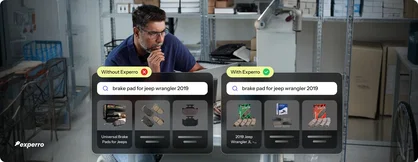
Auto-part shoppers usually know what they are looking for. They type in a part number, describe their vehicle, or search for "rear brake pads for a 2018 Jeep Wrangler" precisely.
Your store returns a wall of results — half of them irrelevant, a quarter of them incompatible, and the right one buried somewhere on page three. The shopper gives up and heads to a dealer down the street.
That is not a traffic problem. It is not a product problem either. It is a search and discovery problem and it is one of the most consistent revenue leaks in auto-parts eCommerce.
Auto-parts is one of the fastest-growing segments in online retail with a forecast of USD 1.31 Trillion in 2034.
However, it is also one of the most technically demanding when it comes to helping shoppers find what they actually need.
Catalogs run into millions of SKUs. Compatibility data is non-negotiable. And the margin for error (the wrong part showing up) is effectively zero.
This blog breaks down what is broken in auto-parts discovery, what it costs, and what smarter discovery looks like when it is working correctly.
Are ‘Auto-parts Shoppers’ Different from Regular Online Shoppers?
Yes, fundamentally. And once you understand that difference, it changes how you think about your entire store experience.
Most eCommerce shoppers browse. They are inspired by an ongoing sale or they are casually comparing options. They will take a recommendation, get distracted, or come back later. Auto-parts shoppers do not work that way.
When someone searches for a part, they already know what they need. The car is sitting in the garage. The job needs to get done. They may have already watched a tutorial on how to replace the part themselves. The question is not "what should I buy?" — it is "does this store have exactly what I need, and can I trust that it fits my vehicle?"
That level of purchase intent is rare in eCommerce. It should work in a store's favor. A shopper who is ready to buy is the best kind of shopper. But when the search and discovery experience cannot match that intent, the conversion does not happen.
A DIY weekend mechanic, a professional technician ordering in bulk, a fleet manager sourcing replacement parts — all three arrive with high purchase intent, very specific needs, and zero patience for vague results or irrelevant listings.
DID YOU KNOW?
Auto-parts shoppers don't browse — they come in ready to buy. The question is whether your store can meet them there.
If your store fails to surface the right part quickly, they will not troubleshoot. They will leave.
Why Is an Auto-parts Catalog So Much Harder to Navigate Than Other eCommerce Catalogs?
Most eCommerce categories have complexity. Auto parts are in a category of their own.
Here is what a typical auto-parts catalog is dealing with:
- Volume - A mid-size auto-parts e-store can carry anywhere from 500,000 to several million SKUs. That is not unusual — it is the baseline for anyone competing seriously online.
- Fitment data - Every part does not just have a name and a price — it has a compatibility matrix. Getting fitment right is critical. Getting it wrong means a return, a refund, and a customer who does not come back.
- OEM vs. aftermarket vs. universal parts - One repair job can often be completed with an OEM part, an aftermarket alternative, or a universal fit — and each comes with different pricing, quality, and compatibility implications. These three categories frequently share names, part numbers, and descriptions, which makes search results messy by default.
- Part number fragmentation - The same physical component can carry a different number depending on the brand, the region, the year it was manufactured, or the cross-reference system being used. A shopper who enters one version of a part number expects your store to understand all the others.
- Technical search language - Auto-parts buyers use specific terminology — year/make/model combinations, OEM reference codes, symptom-based searches like "squeaking front brakes 2020 Honda CR-V," and sometimes full VIN-based lookups.
Understanding how eCommerce product search algorithms work is a useful starting point — but the auto-parts vertical takes those challenges to a different scale entirely. Most eCommerce platforms were not designed to handle this level of catalog complexity natively. And when the underlying structure is this tangled, product discovery breaks fast.
Why Do Standard eCommerce Search Tools Fail Auto-parts Shoppers?
Because they were not built for this.
Standard keyword search is designed for catalogs where a product name, a description, and a few attributes are enough to help someone find what they are looking for.
That model breaks down completely when a catalog has millions of SKUs, layered compatibility data, and buyers who search in part numbers and symptom descriptions.
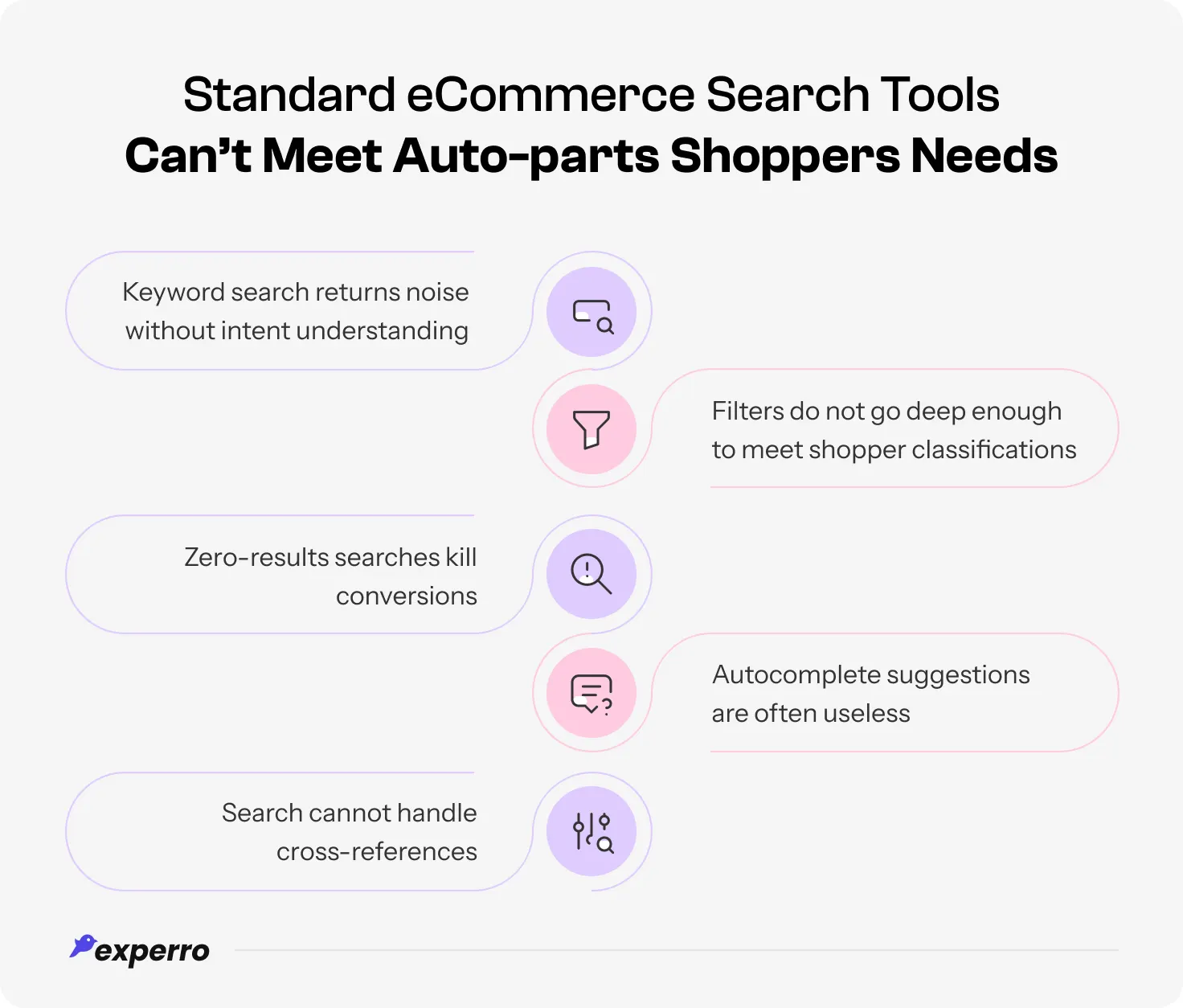
Here is exactly where it falls apart:
1. Keyword search returns noise
Search for "oil filter" and you get 4,000 results — with nothing telling the shopper which ones actually fit a 2019 Toyota Tacoma. They either spend 20 minutes filtering manually or they leave.
2. Filters do not go deep enough
Year / Make / Model dropdowns exist on most auto-parts sites, but they are often bolted on rather than native to the search engine. The filter runs on top of the search result, not inside it — so incompatible parts still surface.
3. Zero-results searches kill conversions
When a shopper enters a cross-referenced part number or uses phrasing your index does not recognize, they hit a dead end. Turning no-results pages into recoverable experiences is a quick win for many stores, but it does not fix the underlying search problem.
4. Autocomplete suggestions are often useless
Popularity-based autocomplete does not help a mechanic looking for a specific torque converter. It needs to understand vehicle context, technical language, and part number conventions.
5. Search cannot handle cross-references
A Bosch part number and a Denso part number for the same spark plug are completely different character strings. Standard keyword search does not know they refer to the same product.
These gaps show up across every metric that matters: lower conversion rates, higher return rates, and more customer service volume from shoppers who ordered the wrong part — not because they were careless, but because the search experience did not surface the right one.
Running a structured audit of your site search can pinpoint exactly where those gaps are showing up in your data.
What Does Poor Product Discovery Actually Cost an Auto-parts Store?
More than most store owners realize and, in more places, than just search.
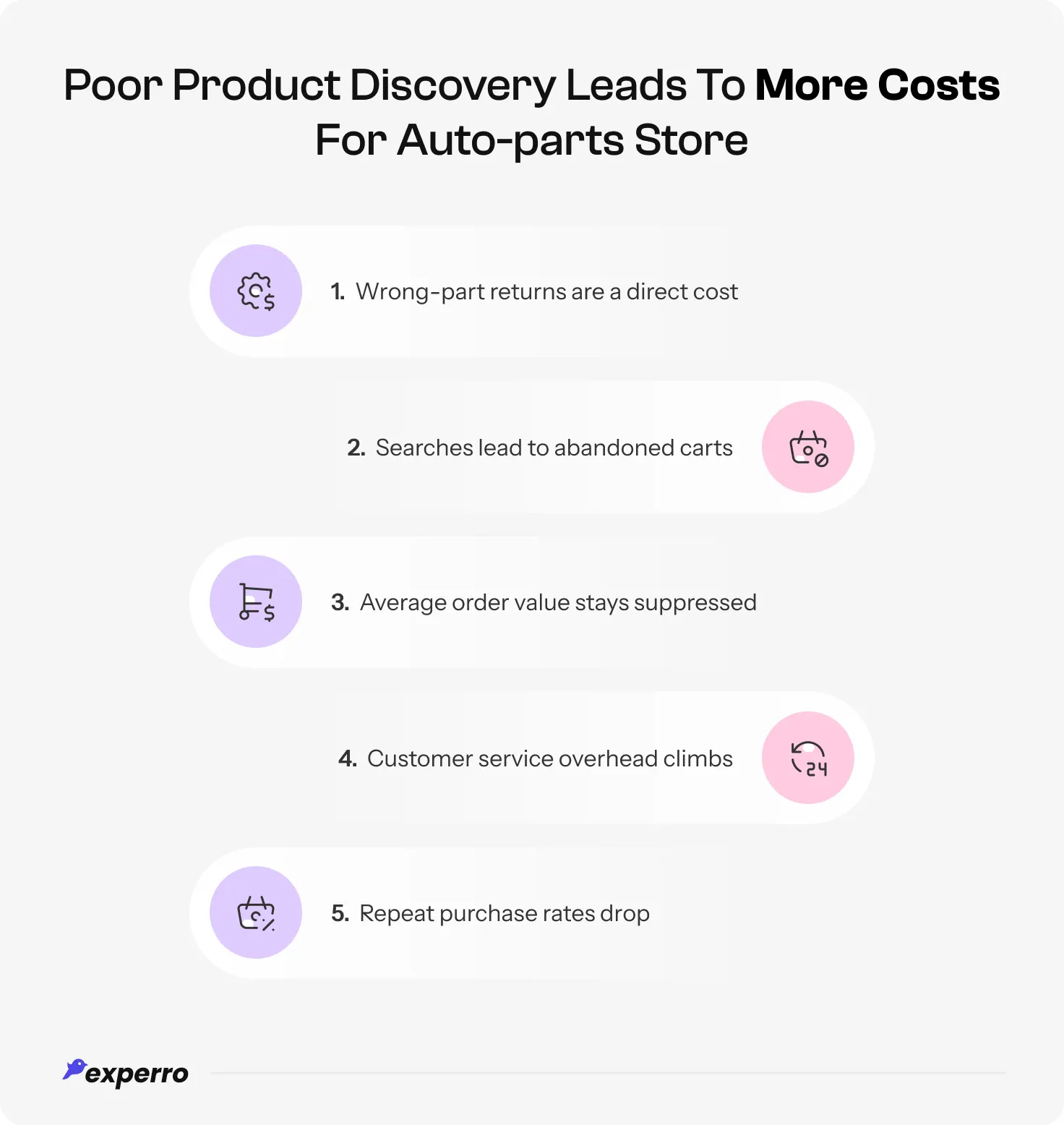
Let us take you through each in detail:
1. Wrong-part returns are a direct cost
The return process in auto-parts is expensive on both ends. The store absorbs shipping, restocking, and labor — and the customer's trust takes a hit that may not recover. If wrong-parts returns are above 3–5%, a search and discovery failure is almost certainly contributing.
2. Abandoned searches become abandoned carts
Shoppers who fail to find what they need during a search session are significantly less likely to convert — and far more likely to leave without browsing further. Research on zero-results eCommerce pages confirms how quickly these dead ends translate to lost revenue.
3. Average order value stays suppressed
When a shopper finds the right part but the store does not surface compatible accessories — brake hardware kits, brake fluid, or rotors alongside brake pads — upsell revenue quietly walks out the door. AI-powered recommendations exist to capture this value automatically. Without them, that money consistently goes somewhere else.
4. Customer service overhead climbs
"Is this part compatible with my car?" is one of the most common support queries in auto-parts eCommerce. It is also almost entirely avoidable with smarter discovery. Every time the search experience does not answer that question, a support agent does — at a real cost per ticket.
5. Repeat purchase rates drop
Auto-parts is a category with natural return customers. A car needs regular maintenance. But repeat business is only reliable when the customer trusted the first experience enough to come back. A discovery failure on the first purchase breaks that cycle before it starts.
What Does "Smarter Discovery" Mean for an Auto-parts eCommerce Store?
It is a reasonable question — because smarter discovery gets used as a vague promise more often than it should.
In the context of an auto-parts e-store, smarter discovery means the ability to connect what a shopper intends to find with what is actually in the catalog (accurately and instantly) even when the shopper's input is imprecise, technical, or incomplete.
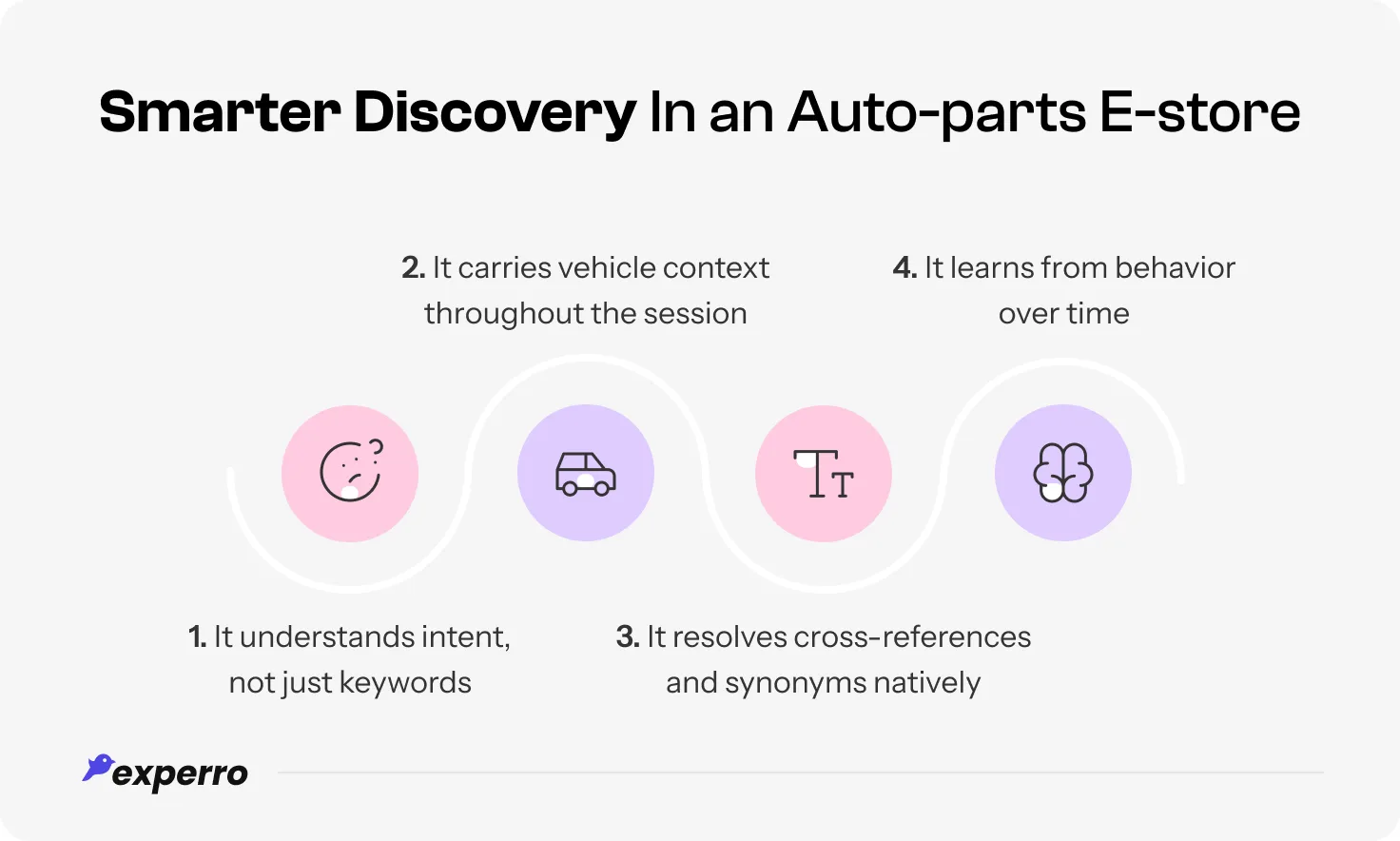
A few things separate smarter discovery from basic search:
1. It understands intent, not just keywords
A shopper who types "my Civic is overheating" is not giving you a keyword. They are describing a problem.
Smarter discovery interprets that as a search for coolant, radiator caps, thermostats, or hoses — depending on what is in your catalog and what fits their vehicle.
2. It carries vehicle context throughout the session
A shopper who selects their vehicle at the start should see that context applied to every subsequent search, every category page, and every recommendation.
They should not see that the filter applied only to their first search.
3. It resolves cross-references and synonyms natively
Part number A from Brand X and Part number B from Brand Y are the same physical component. Smarter discovery knows this and surfaces both accurately.
4. It learns from behavior over time
What gets clicked, what gets added to cart, what gets returned — discovery platforms use this data continuously to improve results. It is not a static index. It evolves. That distinction is what separates a discovery platform from a search box.
Understanding the difference between product search and product discovery matters a great deal for store owners deciding where to invest — because the two are not the same thing, and treating them as identical is one of the most expensive mistakes in this category.
What Specific Discovery Capabilities Does an Auto-Parts Store Need?
This is where it gets practical.
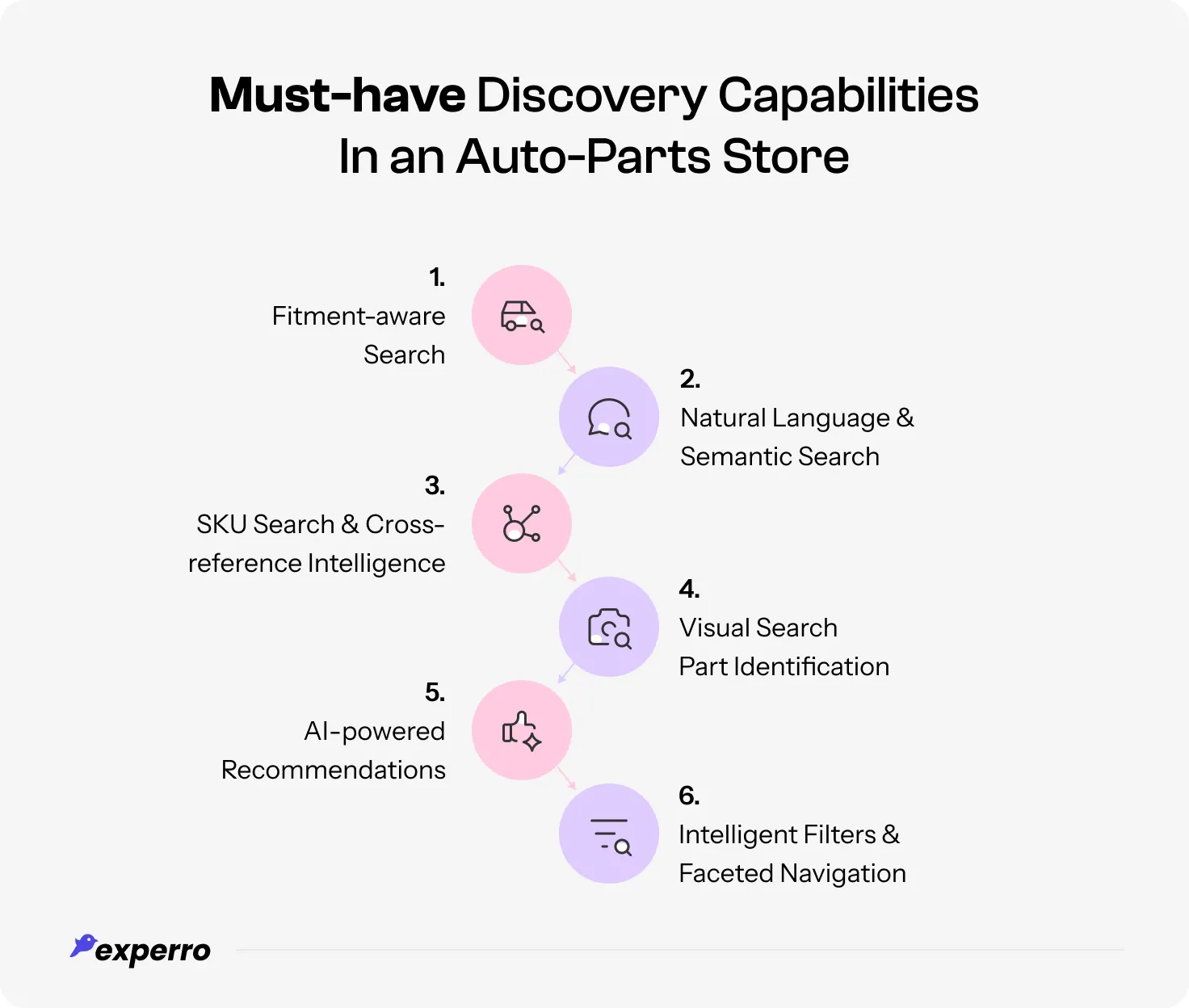
The following capabilities are requirements in auto-parts eCommerce; not optional enhancements.
1. Fitment-aware Search
Search results should be scoped automatically to a shopper's vehicle — not through a filter applied after the fact, but through a search engine that already knows the vehicle and uses that context to shape every result.
Year, make, model, trim, and engine configuration should all factor in by default.
2. Natural Language and Semantic Search
Shoppers do not always speak in part numbers. Semantic search — powered by large language models — understands queries like "rear suspension noise fix for a 2021 Ram 1500" and maps them to the right product categories.
How search algorithms interpret and act on intent is one of the most significant capability upgrades any auto-parts store can make to its catalog navigation.
3. SKU Search and Cross-reference Intelligence
Auto-parts is one of the few categories where part number search is not just useful — it is mission-critical. A smart SKU search layer needs to handle OEM codes, aftermarket numbers, and cross-references across brands and data standards like ACES and PIES — so shoppers find the right product regardless of which number format they use.
4. Visual Search and Image-based Part Identification
A mechanic who has the part in hand but does not know the name or number can photograph it and find a match. This closes the gap between "I need to replace this" and "I found exactly what I need".
Visual search is particularly valuable for professional buyers who work with parts that have worn or unreadable labels.
5. AI-powered Recommendations
When someone adds brake rotors to their cart, the intelligent response is to surface brake pads, hardware kits, and brake fluid immediately — driven by catalog compatibility logic, not generic co-purchase patterns. AI-powered recommendations increase average order value without requiring manual merchandising effort.
6. Intelligent Filters and Faceted Navigation
Filters in an auto-parts store need to adapt to the product type being browsed. Searching for tires? Surface width, aspect ratio, and rim size. Searching for oil filters?
Thread pitch, diameter, and engine compatibility. Advanced eCommerce filters and facets that adapt to context are what separate a navigable catalog from a frustrating one.
Does Personalization Actually Matter in Auto-parts eCommerce?
It does — and the stores that understand this early are the ones that build durable customer relationships in a category that should, by its nature, generate repeat business.
Personalization in auto-parts is not about aesthetic preference or inspired browsing. It is about context. And in this vertical, context is everything.
1. Returning customers should see a different experience
If a shopper bought oil filters and air filters for a 2020 Ford F-150 last quarter, they should not have to re-enter that vehicle information on their next visit. Their vehicle context, preferred brands, and purchase history should inform the session automatically.
2. Different buyer types warrant different experiences
A DIY home mechanic, a professional technician, and a fleet purchasing manager all shop from the same catalog — but in fundamentally different ways. Personalization that adapts to behavior patterns, not just demographics, recognizes these differences and responds to them.
3. Cross-sell and upsell become more accurate
Personalized recommendations in auto-parts are not guesswork. They are driven by vehicle fit, purchase history, and realistic maintenance schedules. An oil change kit recommendation timed to when the previous purchase would likely need replenishing is personalization that delivers real value to the buyer — not just to the store.
4. Category page merchandising improves with behavioral data
The top products on a category page should not just be the global bestsellers — they should reflect what is most relevant to the individual shopper. Real-time personalization at the category and search results level is what makes this possible at scale.
The payoff is compounding: shoppers who trust that your store understands their vehicle and their history come back more often and spend more when they do. Personalized search experiences improve the more a shopper interacts with the store and that is a competitive advantage that gets harder to replicate the longer it runs.
How Experro Powers Smarter Discovery for Auto-parts Stores
This is where the technology closes the gap.
Experro is an AI and ML-powered product discovery platform built for the complexity that auto-parts eCommerce demands.
Unlike general-purpose search tools, Experro was designed to handle catalogs where fitment accuracy, part number intelligence, and buyer context all have to work together — at scale, in real time.
Here is what Experro brings to an auto-parts e-store:
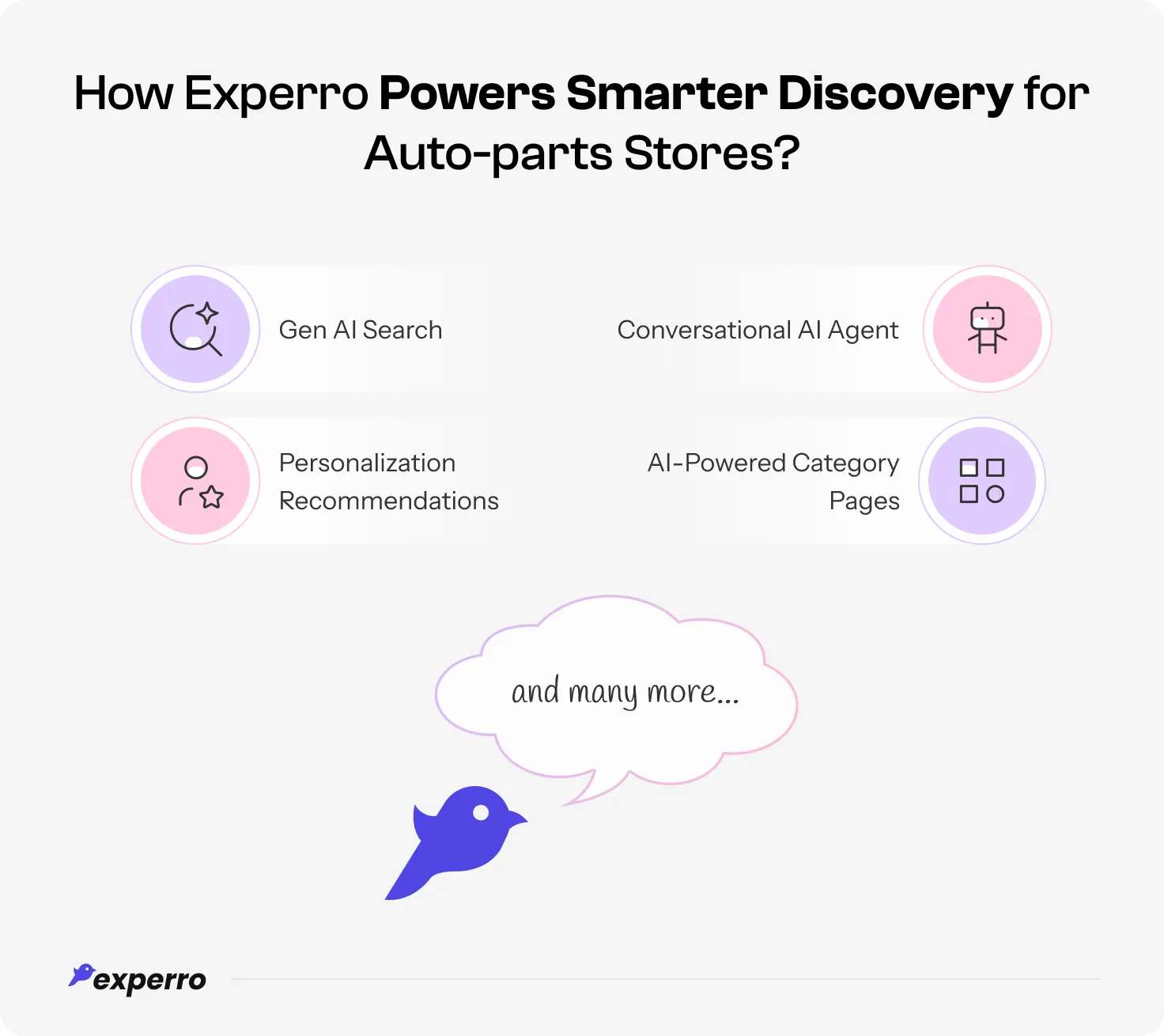
Stores that operate at the level of complexity auto-parts demands need a platform built specifically for it. See how Experro approaches the full auto-parts discovery problem.
Conclusion
Auto-parts shoppers come in ready to buy. That is genuinely rare in eCommerce — and stores that can meet that intent precisely, consistently, and without friction are the ones that build repeat business and grow margin over time.
The catalog complexity is not going away. The year/make/model matrix keeps expanding as new vehicles hit the road, the aftermarket grows with them, and buyer expectations for instant, accurate results only increase.
The question is not whether smarter discovery is worth the investment. It is whether your current setup can actually keep up with the catalog you are running and the buyers you are trying to serve.
If the answer is no, it is worth understanding exactly where the gaps are — and what a platform built specifically for automotive eCommerce can do about them. Contact us to learn more.
FAQs

Ekta holds over 6 years of experience in marketing, SEO, AIO, GEO, and SERP optimization. She combines strategic content planning with hands-on execution to drive results. Known for her dedication and attention to detail, Ekta ensures every piece of content delivers value to readers. When she's not crafting content strategies, you'll find her practising yoga or petting dogs!
Subscribe to Our Newsletter!
Get the latest insights delivered straight to your inbox.