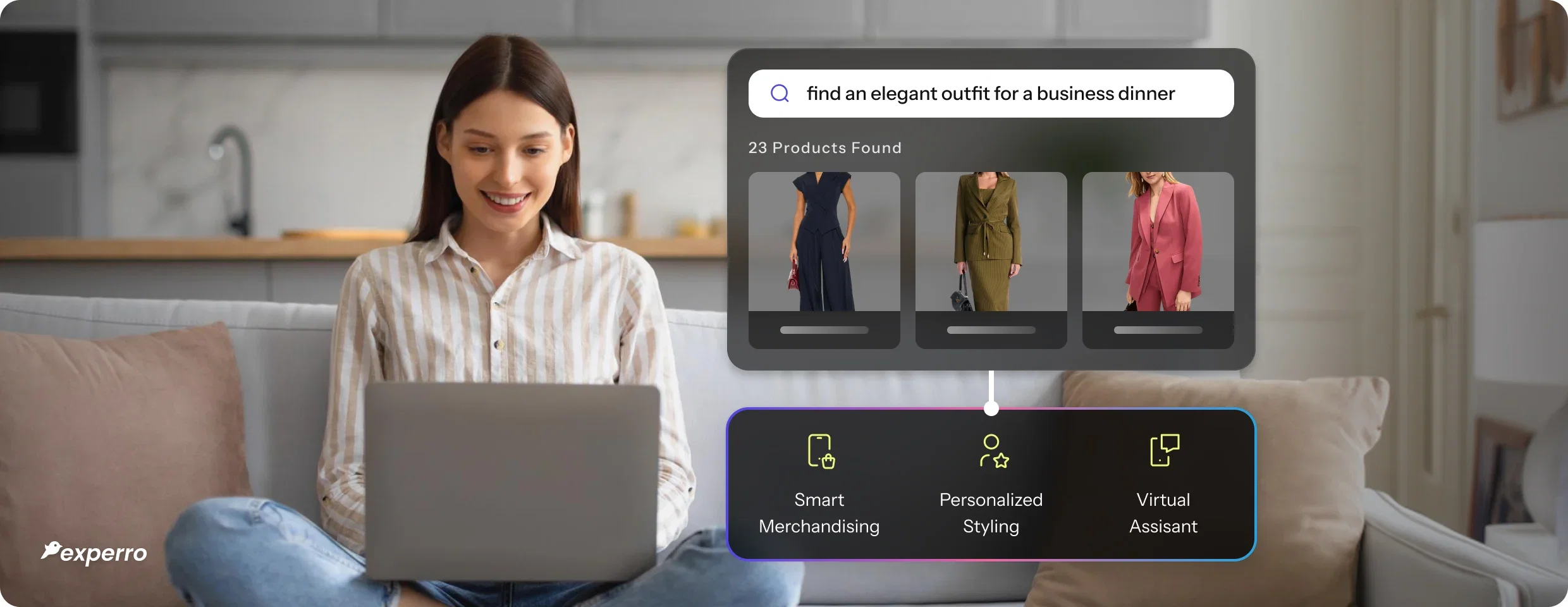
- Generative AI
- eCommerce
- B2B
- 9 min read
How to Use AI to Increase B2B Sales? 8 'Real' Use Cases
Published
14 November 2025Updated
15 May 2026

core insights box
- AI in B2B eCommerce isn't about adding features, it's about removing the manual work that slows down every order, every quote, and every buyer interaction.
- B2B brands using generative AI for pricing, reordering, and product discovery are closing deals faster while their competitors are still building quotes in spreadsheets.
- Experro is built for B2B complexity from the ground up, AI-powered search, account-level personalization, and intelligent merchandising that works across thousands of SKUs without manual rules.
What if your B2B store could handle a thousand accounts the same way your best sales rep handles their top ten?
Same relevance. Same speed. Same personalization but across every buyer, every product, every order.
That's not a hypothetical anymore! That's what AI in B2B eCommerce actually does when it's applied right. And the B2B brands doing it are pulling ahead fast.
AI in B2B eCommerce is picking up because it solves these problems at the operational level by personalizing the buyer experience per account, automating pricing and quoting workflows, predicting what buyers need before they ask, and freeing your team to focus on relationships instead of repetitive tasks.
This blog walks through where AI fits into a real B2B eCommerce operation, which use cases are driving results today, and how to get started without overhauling everything you've already built.
What Are the Key Applications of AI in B2B eCommerce?
The role of AI in B2B eCommerce is expanding rapidly. Artificial intelligence in B2B eCommerce is transforming procurement, personalization, and operations through data-driven insights and automation.
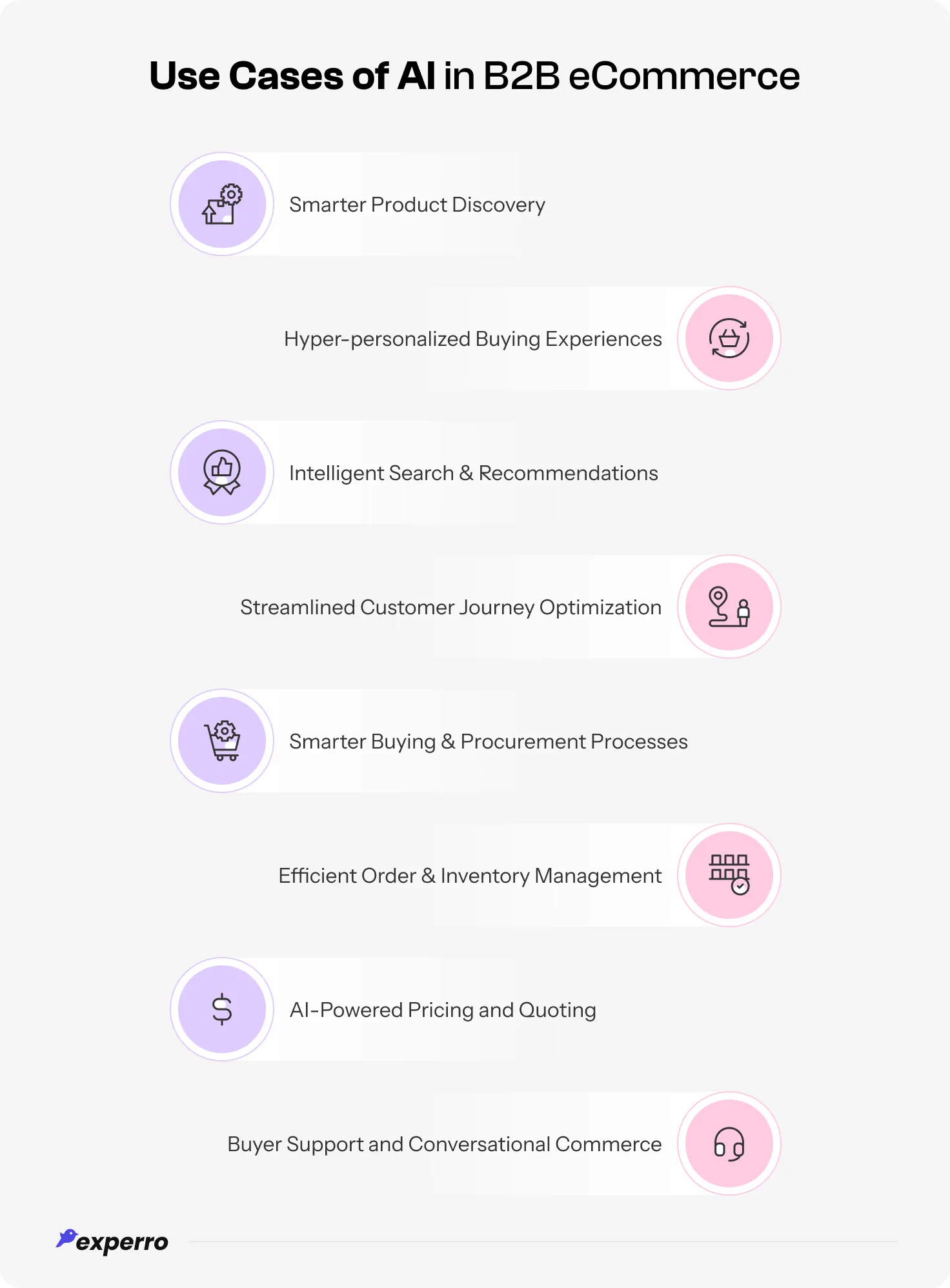
B2B eCommerce is heading toward $105.85 trillion by 2033. That kind of growth doesn't reward businesses doing things the same way. It rewards the ones using AI to move faster, price smarter, and serve buyers better than their competitors.
Here are the major AI use cases in B2B eCommerce:
1. AI-Powered Smarter Product Discovery for B2B Buyers
Finding the right item in a massive catalog is one of the key challenges for B2B customers. AI-powered B2B eCommerce platforms leverage machine learning algorithms to understand search intent, product details, and user context.
These intelligent AI systems connect customer queries with exact SKUs, suggest complementary items, and even predict future demand.
Likewise, artificial intelligence in eCommerce also enhances B2B product discovery through semantic search and visual search, allowing users to find items by product description, image, or function.
This makes discovery intuitive and highly relevant, solidifying AI in B2B eCommerce as a key driver of smarter digital buying.
2. AI-Driven Hyper-Personalized Experiences in B2B eCommerce
B2B buyer expect a shopping experience that feels tailored to your needs. With AI for B2B eCommerce, your business can deliver tailored pricing, catalogs, and product suggestions that match each buyer’s profile and past behavior.
AI powers B2B eCommerce personalization by analyzing contextual cues and generating tailored recommendations at scale. It understands not just what a buyer wants, but when and why they want it.
The growing importance of AI in B2B eCommerce shows how AI in B2B eCommerce transforms customer engagement into one-to-one digital experiences.
3. Intelligent Search and Smart Product Recommendations
The customer journey often starts with the search bar. With AI for B2B eCommerce, search becomes predictive, context-aware, and user-focused.
Using machine learning in B2B eCommerce, search systems analyze patterns and deliver hyper-relevant results that improve over time.
AI in B2B eCommerce enhances B2B eCommerce search through behavior-based rankings and autosuggestions. In addition, advanced generative models refine the experience by creating dynamic product bundles, alternatives, and accessories tailored to buyer needs.
This level of precision helps businesses cut search time, improve discoverability, and boost conversions across every interaction.
4. Optimizing Every Step of the B2B Customer Journey
Understanding and improving the B2B customer journey is one of the most powerful applications of AI in B2B eCommerce.
Artificial intelligence in B2B eCommerce analyzes every interaction to detect friction points, predict customer intent, and guide customers toward faster decisions.
Through AI in B2B digital commerce, businesses can automate touchpoints like retargeting, messaging, and product education. Gen AI in B2B Commerce can even generate personalized communications for each stage of the journey, driving engagement and retention.
Combined with B2B eCommerce automation with AI, this creates smoother, smarter buying paths that adapt to customer behavior in real time.
5. Smarter Buying and Procurement Decisions
Procurement is complex; involving negotiations, budgets, and approvals. AI for B2B eCommerce simplifies it with predictive analytics, dynamic pricing, and automated purchase workflows.
Additionally, By applying machine learning in B2B eCommerce, systems forecast inventory needs, optimize purchase timing, and identify cost-saving opportunities.
Furthermore, Gen AI in B2B Commerce adds intelligence to B2B buying by generating supplier comparisons, drafting quotes, and automating routine approvals.
This strategic automation helps B2B procurement teams make data-driven decisions, accelerate order cycles, and strengthen supplier relationships.
6. Efficient Order and Inventory Management for B2B Sellers
B2B order management relies on precision and predictability to keep operations running smoothly. With AI, sellers can move from reactive processes to proactive control, ensuring every order is accurate, and every item is where it needs to be.
Additionally, AI-driven automation in B2B eCommerce helps forecast demand shifts, automate restocking, and align fulfillment workflows with real-time sales data. This reduces errors, minimizes delays, and strengthens overall supply chain performance.
Generative AI takes it further by summarizing order insights, flagging potential bottlenecks, and supporting smarter fulfillment planning.
The result? Greater efficiency, fewer manual interventions, and more reliable experience from purchase to delivery.
7. AI-Powered Pricing and Quoting
Pricing in B2B is rarely straightforward. Every account may operate on different contract terms, volume-based tiers, regional adjustments, or negotiated discounts. Managing this complexity manually through spreadsheets, ERP lookups, and back-and-forth approvals slows down sales cycles.
AI in B2B eCommerce brings structure to this complexity. Machine learning models evaluate buyer history, order volume, competitive benchmarks, and predefined margin thresholds to recommend or auto-apply the right price for every account in real time.
Gen AI in B2B Commerce takes this further by drafting customized proposals and pricing justifications that sales teams can review and send, instead of building from scratch every time.
The result is faster deal velocity, fewer pricing errors, and stronger margins across the board without adding headcount to your pricing or sales operations team.
8. AI-Driven Buyer Support and Conversational Commerce
B2B support teams handle a high volume of repetitive inquiries every day such as order status updates, lead time questions, pricing lookups, product availability checks, and shipping confirmations.
These aren't complex problems, but when every query requires a human response, it drains resources that should be going toward managing key accounts and resolving high-value issues. At the same time, B2B buyers increasingly expect instant answers, not a 24-hour turnaround on a basic question.
AI for B2B eCommerce addresses this through intelligent conversational AI agent that go far beyond basic chatbot functionality. When connected to your CRM, ERP, and order management systems, these AI agents deliver accurate, account-specific responses in real time.
A buyer can ask where their shipment is, request a spec sheet, or check contract pricing and get the right answer instantly, 24/7, without waiting for a human to look it up.
Machine learning in B2B eCommerce enables these systems to improve over time, learning from interaction patterns to handle increasingly nuanced queries.
AI in B2B isn't a feature you add. It's a shift in how your store operates. When pricing, discovery, and reordering run on intelligence instead of manual effort, that's when you see the numbers move!

Where Should You Actually Start with AI in B2B eCommerce?
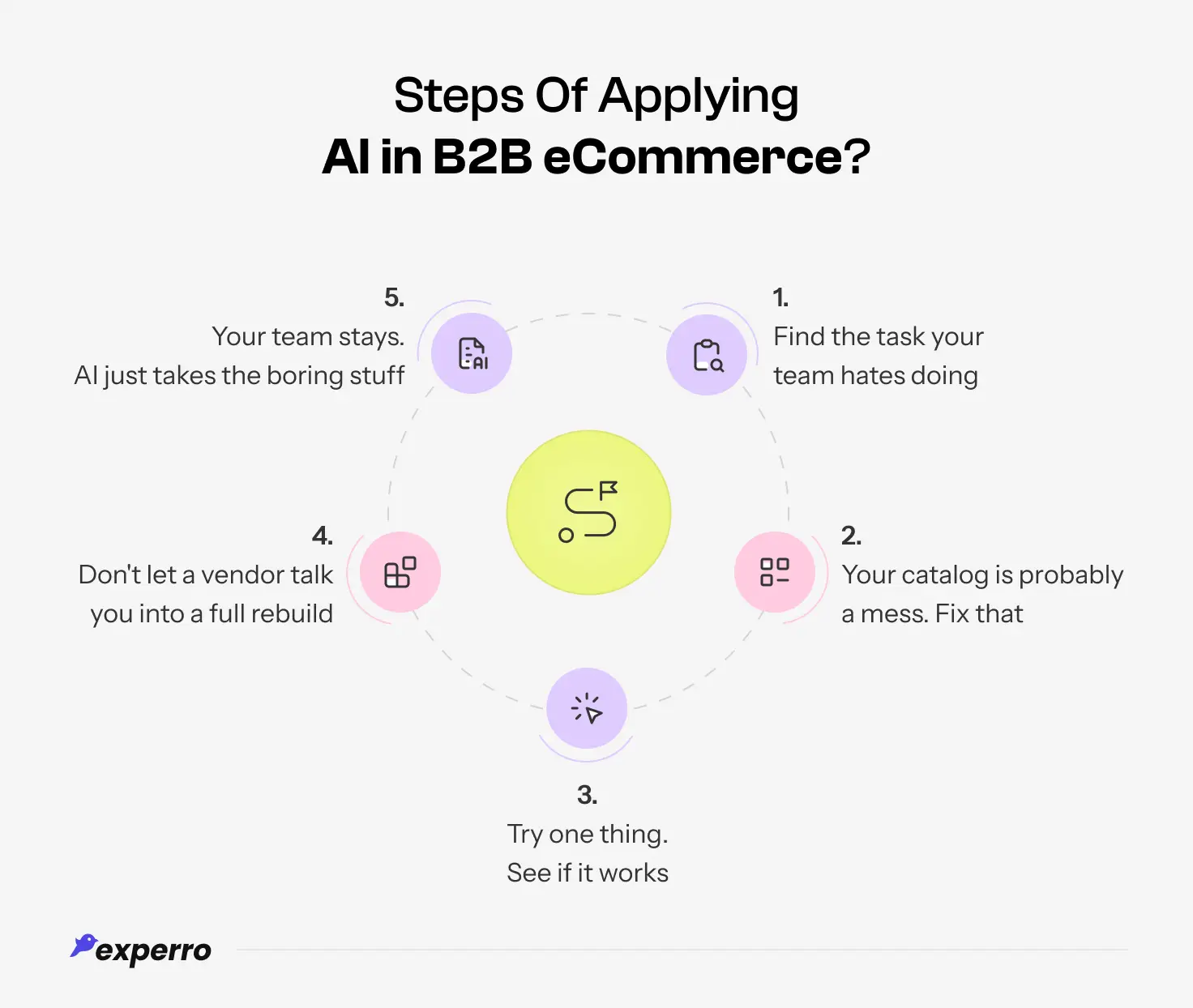
Now that you know where AI fits in a B2B eCommerce operation, the real question is how do you actually get it running without overcomplicating things? Here's how to start, step by step:
1. Find the task your team hates doing
Look at what they do every single day that they shouldn't have to. Building quotes from scratch, fixing wrong prices, answering "where's my shipment" 40 times a day. Whatever eats the most hours, that's your first AI use case. Not the feature that looks cool in a demo.
2. Your catalog is probably a mess. Fix that
Go through it and be honest. If half your SKUs have missing specs or the same product is listed three different ways, sort that out before you touch AI. AI needs clean data to be useful. You can do it manually (again that takes time), or leverage Experro's AI product enrichment to fill in missing attributes, standardize descriptions, and clean up inconsistencies at scale.
3. Try one thing. See if it works
Run AI on reorder automation for your top 20 accounts, or test it on pricing for a single product category. Give it two to three months. If the numbers move, expand. If they don't, you picked the wrong workflow, try another one.
4. Don't let a vendor talk you into a full rebuild
Whatever platform you bring in, make sure it works with your existing ERP, CRM, and PIM. None of that should need replacing. If someone tells you otherwise, walk away.
5. Your team stays. AI just takes the boring stuff
They stop doing the work they're tired of and stay on what needs a human brain like key accounts, negotiations, the decisions that actually build your business.
Thus, this is the process of implementing use cases of AI in the B2B eCommerce funcitoning.
Experro Is the AI Upgrade Your B2B eCommerce Has Been Waiting For!
Creating an intelligent B2B eCommerce platform with AI goes beyond adding automation. Experro’s AI-powered B2B platform unifies data, search, personalization, and analytics into a single intelligent ecosystem.
It’s about unifying data, searching, personalization, and analytics into one ecosystem. Experro’s AI-powered B2B eCommerce platform brings this vision to life.
With AI-driven B2B product discovery, machine learning in B2B eCommerce, and hyper-personalized experiences, Experro helps businesses turn complex buying processes into effortless digital journeys.
The agentic platform empowers companies to streamline the B2B customer journey, enhance engagement, and scale faster with intelligent commerce capabilities.
Conclusion
AI is transforming the way B2B companies buy, sell, and connect. From B2B product discovery to procurement and order management, AI in B2B eCommerce is the foundation for agility and innovation.
Adopting AI for B2B eCommerce allows businesses to deliver personalized, efficient, and predictive experiences that build stronger customer relationships.
By leveraging Gen AI in B2B commerce, your business can create a truly intelligent and future-ready ecosystem.
To learn how Experro can help you build an AI-powered B2B commerce experience, schedule a call with our experts for a personalized demo and strategy consultation.
FAQs

Pallavi is an ambitious author recognized for her expertise in crafting compelling content across various domains. Beyond her professional pursuits, Pallavi is deeply passionate about continuous learning, often immersing herself in the latest industry trends. When not weaving words, she dedicates her time to mastering graphic design.
Subscribe to Our Newsletter!
Get the latest insights delivered straight to your inbox.