
- BigCommerce
- Personalization
- Generative AI
- 13 min read
What Can Make BigCommerce Personalization Work Better?
Published
26 May 2026Updated
20 July 2026

core insights box
- BigCommerce personalization often fails because static recommendation logic cannot adapt to real-time shopper intent across evolving customer journeys.
- Modern shoppers expect adaptive eCommerce experiences across search, merchandising, category pages, and personalized recommendations that evolve continuously.
- Experro improves BigCommerce personalization using AI-driven personalization and real-time intent understanding to deliver measurable revenue growth outcomes.
Imagine returning to a BigCommerce store after viewing the same product twice. You left without buying it, but when you come back, nothing changes. The homepage does not surface related products, the recommendations do not reflect your interest, and the shopping journey starts from zero again.
That's not a design flaw. It's a personalization failure. 🚨⚠️🆘🚨📢🔔⚠️
71% of shoppers feel frustrated when brands serve generic content instead. That frustration ends the session before a product is even considered.
BigCommerce merchants lose customers at that moment. The platform's native tools, including recommendation widgets, basic segmentation, and rule-based merchandising, were built for a simpler era.
Today's shopper has been trained by Amazon, influenced by Netflix, and shaped by Spotify. They expect real-time intelligence, not static experiences.
Meanwhile, revenue leaks quietly, loyalty weakens, and cart abandonment continues rising.
This article breaks down where BigCommerce personalization fails in 2026, why those gaps are growing, and what ecommerce brands must do to create experiences that actually convert.
Why Traditional BigCommerce Personalization No Longer Works?
Traditional BigCommerce personalization once helped brands improve engagement and product discovery, but its impact is steadily fading as shopper expectations evolve toward faster, more relevant, and intent-driven experiences.
Today, nearly 80% of consumers are more likely to purchase from brands offering personalized experiences, showing just how strongly personalization now influences conversions, average order value, and long-term revenue growth.
Yet despite this demand, most systems still fail to move beyond static logic and outdated approaches.
To understand what’s missing and how modern strategies evolve, it helps to begin with getting started with personalization, especially for teams shifting toward more adaptive, intelligent models.
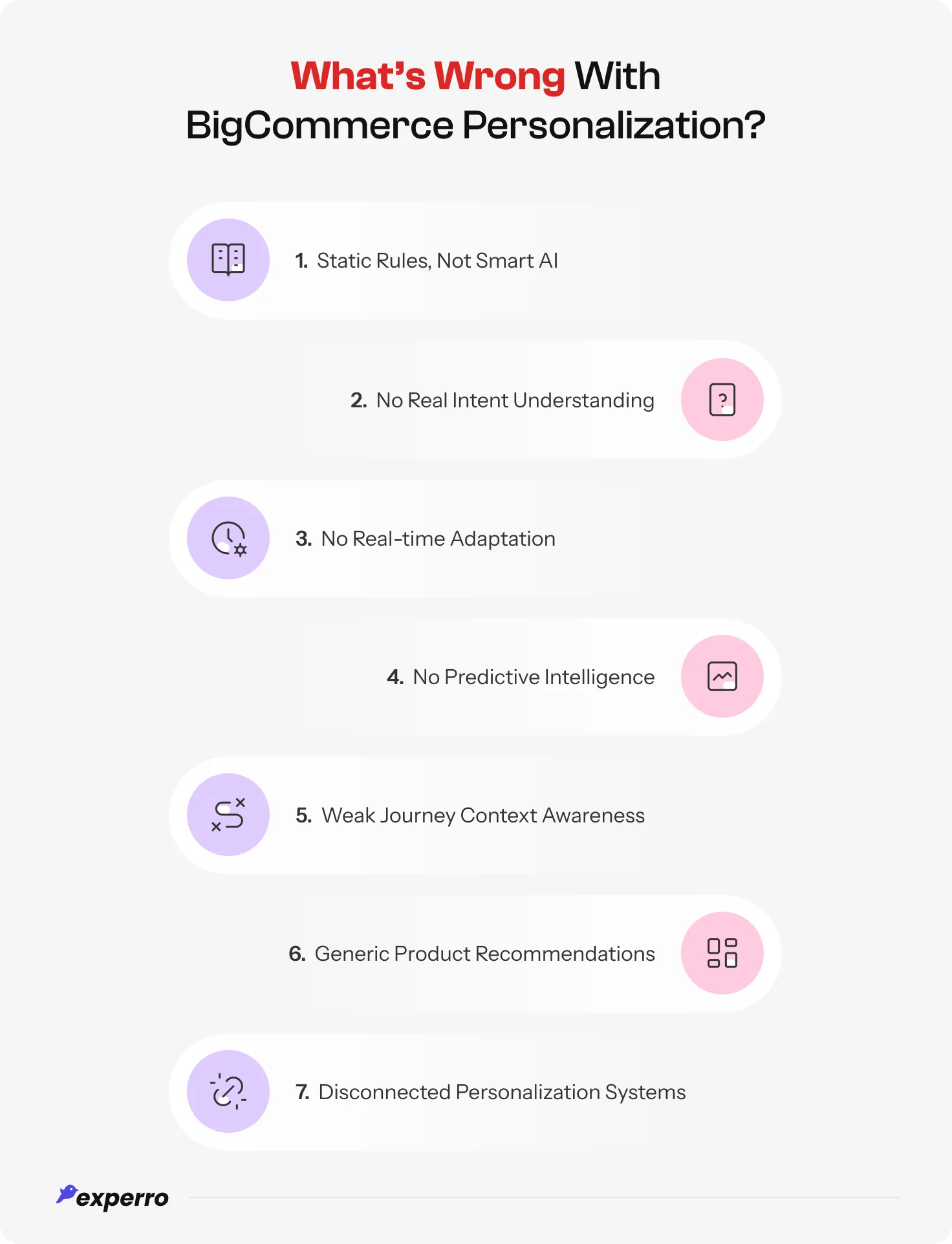
Let’s break down why BigCommerce personalization is not good enough anymore.
1. Built on Static Rules Instead of AI Personalization for BigCommerce Store
Traditional BigCommerce personalization no longer works because it is fundamentally built on static, rule-based logic rather than adaptive intelligence.
Instead of responding to real-time shopper behavior, most systems rely on fixed conditions like “if product viewed, show similar item”, which limits how relevant and timely the experience can be.
This creates a major gap in modern eCommerce environments where intent changes quickly and cannot be captured through rigid segmentation. As a result, personalization becomes reactive instead of predictive, missing key moments that influence purchase decisions.
Without BigCommerce AI personalization or a modern personalization engine, these static systems fail to evolve with customer behavior, which is why businesses increasingly find that traditional approaches can no longer meet today’s expectations for dynamic, intent-driven shopping experiences.
2. No Understanding of Customer Intent or Behavior
Another major issue in BigCommerce personalization issues is the inability to understand true shopper intent.
A customer while browsing interacts through multiple signals such as search behavior, clicks, scroll depth, and engagement patterns. However, traditional systems like BigCommerce stores fail to properly interpret this customer behavior in real time.
As a result, BigCommerce product personalization often feels generic instead of meaningful.
Even when businesses try to implement personalization for BigCommerce, the system relies heavily on outdated customer segmentation, rather than intent-driven intelligence.
This creates a disconnect between what customers want and what the system shows, leading to poor personalized recommendations and weak engagement across the shopping experience.
3. Lack of Real-time Personalization in BigCommerce
Modern eCommerce requires real-time personalization in BigCommerce, but native systems are not designed for live adaptation.
If a shopper changes intent mid-session inside an online store, traditional BigCommerce native personalization gaps prevent the experience from adjusting accordingly.
For example:
- A user browsing budget products is still shown premium bundles
- A high-intent buyer sees irrelevant targeted promotions
- Cart users receive unrelated recommendations
This lack of responsiveness highlights why BigCommerce personalization fails, especially during active user sessions where intent is changing in real time.
Without real-time intelligence, the shopping experience remains static, reducing engagement and directly impacting conversion rates.
This gap is exactly what advanced solutions like Experro’s BigCommerce integration help enhance the BigCommerce's native recommendations in real-time with AI-driven personalization across the shopping journey.
4. No Predictive or AI-Driven Personalization Capability
Another key limitation is the absence of predictive intelligence. Traditional BigCommerce personalization systems are not designed to anticipate next-best actions or future customer needs; they only react to what has already happened.
Without predictive modeling:
- Upsell and cross-sell opportunities are missed
- Average order value remains low
- Targeted promotions lack relevance
- Purchase intent is not optimized
Even though BigCommerce product personalization exists, it does not extend to forward-looking recommendations, making it ineffective for scaling revenue.
This is one of the key reasons businesses need to explore advanced BigCommerce personalization solutions or external tools.
5. Weak Context Awareness Across the Shopping Journey
Traditional BigCommerce personalization platform setups do not adapt to the shopper’s funnel stage.
A user on a PDP, cart page, or checkout page receives the same level of personalization, leading to weak contextual alignment across the eCommerce store.
This creates major BigCommerce personalization limitations, such as:
- Irrelevant recommendations during checkout
- Lack of urgency-based messaging
- Weak cart-level personalization
- Disconnected personalized content flow
Modern personalization for BigCommerce stores requires contextual intelligence that adapts in real time to each stage of the shopping journey.
Without it, even strong BigCommerce customization capabilities fail to drive meaningful conversions or revenue impact.
👉 Read also - PDP optimization strategy
6. Generic Recommendations and Weak Engagement Impact
Most BigCommerce third-party personalization apps or native modules rely on basic similarity-based logic.
This results in generic recommendations that do not reflect true customer segmentation or intent.
Even when businesses try to fix BigCommerce personalization, the outcome often remains unchanged because the underlying logic is not AI-driven.
Consequences include:
- low engagement with recommendation blocks
- reduced effectiveness of personalized experiences
- weaker influence on purchase decisions
missed opportunities to improve average order value
This is why many merchants explore the best personalization app for BigCommerce, as native tools often fail to deliver meaningful impact.
7. Disconnected from Modern AI Commerce and Integration Ecosystem
Modern eCommerce requires full-stack personalization across email, SMS, and onsite experiences. However, BigCommerce personalization integration remains limited in native systems.
While integrations exist, such as marketing tools for targeted promotions, they still fail to unify customer intelligence across channels, a gap commonly discussed in eCommerce challenges and solutions around delivering consistent personalization across the customer journey.
This creates challenges in:
- Leveraging customer data effectively
- Building consistent personalized content
- Connecting offline and online customer experience
- Optimizing omnichannel eCommerce personalization
As a result, merchants struggle to scale personalization across the full BigCommerce store ecosystem.
This is a key reason why BigCommerce personalization is not good enough for modern AI-first commerce.
BigCommerce has multiple issues and these limitations directly affect store performance by lowering conversions, reducing average order value, and weakening customer retention. Instead of improving outcomes, personalization fails to consistently influence purchase decisions.
As a result, businesses are moving away from static BigCommerce personalization toward AI-driven, real-time personalization solutions that better understand intent and deliver more relevant, connected shopping experiences.
This shift makes one thing clear — future-ready personalization is no longer about displaying products, but about understanding shoppers in real time and guiding every decision with intelligence. Overcoming the BigCommerce limitations is the way to achieve your business KPIs now.
How Experro Fixes BigCommerce Personalization to Drive Revenue?
Even in most BigCommerce stores where personalization is already enabled, the experience often feels strangely static as shoppers move through the journey.
You browse, click, and explore products, but the system doesn’t really adjust to what your behavior is signaling in real time. Recommendations appear, but they often feel loosely connected to actual intent, almost like they’re reacting too late.
That’s where Experro changes the experience through its personalization experience hub, bringing personalization into a unified, intent-aware layer that continuously adapts to shopper behavior and turns passive browsing into a guided, high-conversion journey.
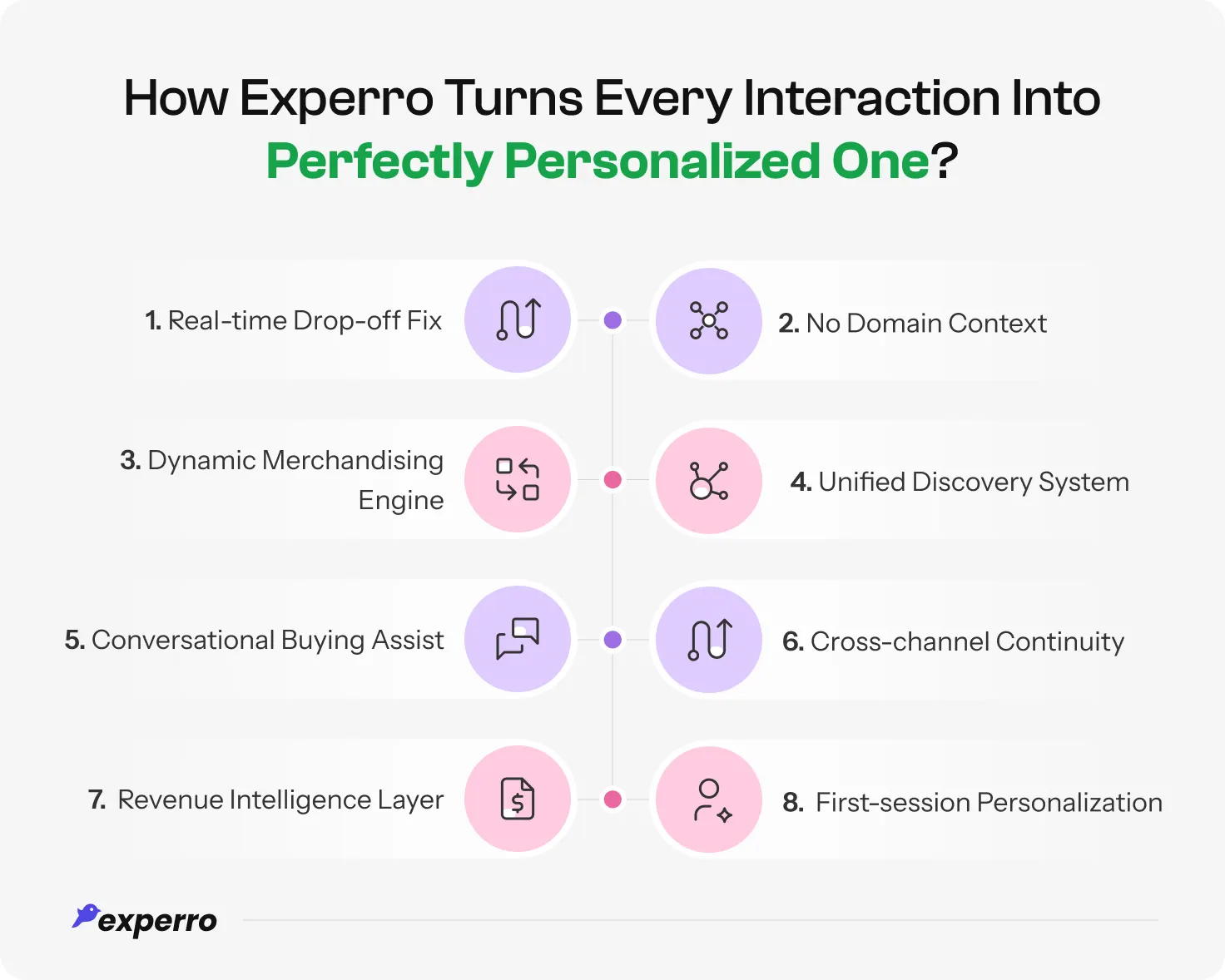
1. Real-Time Search, Browse & Category Personalization That Prevents Early Drop-Offs
Most BigCommerce stores lose revenue early in the journey due to BigCommerce personalization not showing relevant results, where search and category pages behave like static catalogs instead of adaptive discovery systems.
This creates a costly pattern: shoppers land with intent but leave without clarity.
Experro fixes this by continuously interpreting live interaction signals such as:
- Search refinement behavior
- Scroll depth and hesitation points
- Category switching patterns
- Product engagement intensity
Instead of waiting for historical data, the system adapts instantly within the same session.
2. Intent-Driven Product Discovery That Eliminates Generic Recommendations
A common limitation in BigCommerce personalization is generic recommendations, where shoppers receive similar product suggestions regardless of intent stage or purchase readiness.
This is where Experro stands out as the best personalization app for BigCommerce. Experro strengthens BigCommerce AI personalization by moving from reactive recommendations to intent prediction modeling that adapts to live shopper behavior in real time.
Instead of relying only on past actions, it evaluates:
- Comparison behavior across multiple products
- Hesitation before add-to-cart actions
- Category exploration depth
- Engagement consistency across sessions
This improves real-time personalization in BigCommerce, ensuring recommendations stay aligned with intent rather than static patterns.
This approach also reflects how modern teams evaluate best eCommerce personalization platforms when aiming to scale conversion-driven experiences.
3. Dynamic Merchandising That Converts Every Visitor Context into Revenue
A major revenue gap in BigCommerce personalization not updating promotions is static storefront behavior, where every visitor sees the same homepage, banners, and targeted promotions, regardless of intent.
This leads to wasted impressions and low engagement relevance.
Experro transforms merchandising into a dynamic system that adapts in real time based on:
- Intent strength
- Customer segment behavior
- Engagement depth within session
- Prior browsing and purchase patterns
This creates differentiated storefront experiences:
- New visitors see discovery-first layouts designed to explore
- Returning customers see continuity-driven product surfaces
- High-intent shoppers see conversion-optimized collections
- Instead of fixed campaigns, the storefront becomes a living system that continuously adjusts to maximize engagement and purchase probability.
This ensures merchandising is no longer decorative; it becomes a conversion engine.
4. Unified Discovery Engine That Removes Fragmented Personalization Systems
One of the most overlooked causes of BigCommerce platform personalization issues is fragmentation across search, recommendations, and merchandising systems.
Each system operates independently, leading to inconsistent product relevance across the storefront.
Experro resolves this by unifying all discovery layers into a single adaptive discovery engine powered by:
- Customer data
- Behavioral intelligence
- Sales data
- Real-time engagement signals
This ensures:
- Search influences recommendations
- Browsing behavior reshapes merchandising
- All discovery systems learn from the same intelligence layer
Instead of three disconnected systems, there is one unified model governing the entire platform. This way, you can also improve the way your BigCommerce search works.
This eliminates conflicting experiences and ensures every interaction improves the next, creating a continuously compounding relevance system.
5. Conversational AI That Reduces Decision Friction at Critical Buying Moments
Many BigCommerce personalization systems struggle at the decision stage, leading to BigCommerce personalization not helping users decide when shoppers are actively comparing products but still uncertain.
This becomes especially critical when intent is strong, but the system fails to guide the final choice, highlighting key BigCommerce personalization limitations in real buying journeys.
Experro solves this gap with its conversational AI agent that understands natural language intent and responds in a way that supports real buying decisions, not just browsing behavior.
For example, when a shopper is evaluating skincare products for sensitive skin and looking for a simple daily routine within a budget, they might ask for recommendations suited for gentle cleansing, hydration, and sun protection.
Instead of returning a static list, the system delivers:
- A curated set of products tailored for sensitive skin concerns and budget range
- Clear comparisons across key factors like ingredients, skin compatibility, and usage benefits
- Context-aware suggestions such as complete routine bundles for morning and night care
This reduces friction at the most critical stage of the journey — when shoppers are ready to decide but need clarity.
By turning comparison moments into guided decisions, Experro helps eliminate hesitation and improve conversion outcomes.
6. Cross-Channel Personalization That Preserves Shopper Intent Everywhere
A major limitation in BigCommerce personalization is inconsistent experiences across devices, leading to fragmented user journeys across mobile, desktop, and app environments.
Experro eliminates this by synchronizing intent across all touchpoints using unified customer data. This ensures:
- Browsing history is preserved across devices
- Product recommendations remain consistent everywhere
- Session continuity is never lost
A shopper who begins browsing on mobile and completes purchase on desktop experiences a seamless, uninterrupted journey.
This continuity directly improves conversion probability and reduces drop-offs caused by context loss.
7. Merchant Intelligence That Connects Personalization Directly to Revenue
Many merchants struggle with BigCommerce personalization due to a lack of measurable impact, where personalization efforts exist but cannot be directly linked to business outcomes.
This creates a key challenge in BigCommerce personalization, where improvements in user experience do not translate into clear revenue visibility or performance tracking.
Experro’s BigCommerce integration layer solves this by building a unified intelligence system that strengthens BigCommerce AI personalization and connects every interaction directly to revenue performance.
It provides visibility into:
- Conversion rate impact
- Average order value (AOV) contribution
- Product recommendation performance
- Revenue influence across segments and journeys
This turns the BigCommerce personalization platform into a measurable growth system, helping brands improve BigCommerce personalization while eliminating key BigCommerce personalization issues through continuous, revenue-driven optimization.
8. First-session Personalization That Works Without Historical Data
A major limitation in BigCommerce personalization is that it often fails with new users because it depends heavily on past purchase history or stored behavior, exposing clear BigCommerce personalization limitations in first-session experiences.
This becomes even more critical when understanding personalization in B2B eCommerce, where buyers often arrive with research-heavy intent, multiple stakeholders, and no prior interaction history, making early relevance essential for engagement.
This is where BigCommerce native personalization and basic customer segmentation fall short in delivering meaningful context.
Experro removes this cold-start gap in personalization for BigCommerce stores using real-time intent inference powered by BigCommerce AI personalization. Even without history, it activates real-time personalization based on live signals such as:
- current browsing behavior
- engagement patterns
- category exploration signals
This enables BigCommerce product personalization from the first interaction, ensuring that the lack of improvement over time is no longer a constraint for early-stage sessions.
Unlike traditional BigCommerce personalization issues driven by static logic, Experro delivers adaptive, intent-based experiences instantly, eliminating poor first-time visitor experiences and unlocking value from the very first session.
When Shopper Intent Changes, Your Store Should Too
BigCommerce personalization often feels right until you look at what shoppers actually do. They click, compare, hesitate, and change direction — while the store keeps showing suggestions that no longer fit what they’re thinking in that moment. That’s where conversions quietly slip away.
The real issue is simple: most personalization is still rule-based. It reacts to past actions, not the live intent unfolding in front of it. So even when a user is clearly shifting from browsing to buying, the experience doesn’t adjust with them.
Experro changes this by adding real-time, intent-aware intelligence on top of BigCommerce. It reads behavior as it happens and updates recommendations instantly, so the experience actually follows the shopper, not just their history.
If you want personalization that feels more in tune with how people really shop, explore Experro’s BigCommerce approach or reach out to see how it works for your store.
FAQs

With 6+ years of experience in AI, software, and digital transformation across tech, healthcare, and fashion, Rahul focuses on making complex ideas simple, clear, and actually useful. He has learned how often great ideas get lost in complexity, which is why he centers his writing on clarity, helping entrepreneurs and leaders cut through noise and make decisions with confidence.
Subscribe to Our Newsletter!
Get the latest insights delivered straight to your inbox.