
- BigCommerce
- Product Discovery
- Generative AI
- 12 min read
BigCommerce Issues Explained & How to Fix Them With Gen AI?
Published
29 May 2026

core insights box
- Shoppers don’t abandon because they lack intent — they abandon when search fails to understand it, turning interest into friction and missed revenue in seconds.
- When every visitor gets the same generic experience, relevance disappears—and with it, engagement, trust, and the subtle nudges that actually drive conversions.
- Growth should feel like progress, but in many BigCommerce stores it adds hidden complexity more tools, more fixes, and more friction instead of clarity.
- Experro brings everything together search, personalization, and discovery — so every shopper feels understood, every click feels relevant, and every visit moves closer to conversion.
Every click on your BigCommerce store reflects buying intent, but most stores fail to convert that intent into action.
A shopper lands, searches, scrolls for a moment… and leaves. Not because the product is missing, but because the platform doesn’t surface it fast enough. That’s not a traffic issue. That’s a discovery gap. Probably a BigCommerce recommendation algorithm that needs improvement.
As your BigCommerce store's operations scale up, such gaps quietly expand. Search becomes slightly off. Product discovery takes more effort. Page speed slows down momentum. Even SEO limits who reaches you in the first place.
BigCommerce gives you the foundation to sell, but not always the experience layer to guide intent into action. Nothing feels broken, but performance slowly becomes unimpressive.
Customers don’t complain — they disengage. 💔💔💔💔
The good news is that this is fixable. Brands closing these gaps are seeing up to 20% higher conversions. This guide shows what’s breaking, and how to fix it.
What Are the BigCommerce Problems Affecting eCommerce Growth?
BigCommerce gives businesses a strong starting point for building and managing an online store.
But as customer expectations rise, many merchants begin facing BigCommerce complaints around search, personalization, recommendations, and storefront performance.
To close these gaps, brands increasingly rely on solutions like Experro’s BigCommerce integration.
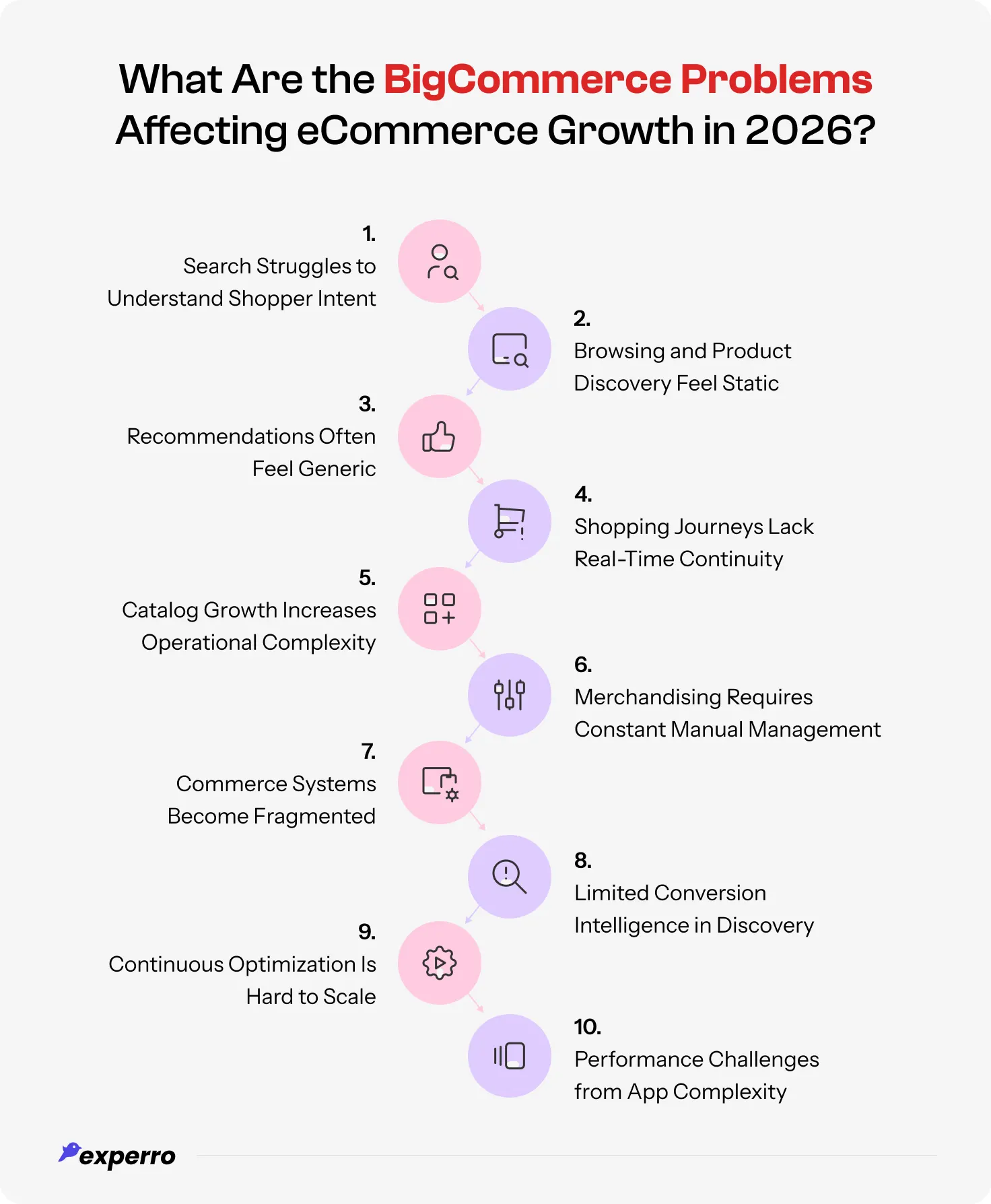
Below are the key areas where BigCommerce problems become most visible for modern eCommerce stores:
1. Search Struggles to Understand Shopper Intent
BigCommerce search often struggles when shoppers use natural, intent-based queries instead of exact product keywords.
Modern customers search in ways like:
- “comfortable shoes for long walking”
- “minimal office setup ideas”
- “gift for fitness lover”
But many BigCommerce stores still rely on keyword-based matching inside the eCommerce platform. It doesn’t understand the context.
This creates BigCommerce search limitations where:
- Results feel irrelevant
- Synonyms are not handled well
- Intent is not understood
- Product ranking feels static
As catalogs grow, these BigCommerce sites’ search and visibility issues become harder to manage manually.
Merchants often need third party apps or external tools from the app marketplace to fix search quality and improve discovery.
2. Browsing and Product Discovery Feel Static
Product browsing in many BigCommerce stores remains fixed instead of adapting to shopper behavior.
Category pages, filters, and product listings are usually manually managed. They do not change based on real-time intent or engagement signals.
This is one of the common BigCommerce limitations that becomes more visible as catalogs expand.
Merchants often face:
- Static category structures
- Manual merchandising updates
- Limited personalization in browsing
- Repetitive product exposure
- Weak discovery across large catalogs
Compared to other eCommerce platforms, this makes product discovery feel less dynamic and less engaging.
3. Recommendations Often Feel Generic
Shoppers no longer respond to generic product suggestions. They expect eCommerce stores to understand their intent in real time, just like modern marketplaces do.
But many BigCommerce stores still rely on recommendation systems that are:
- Rule-based
- Manually configured
- Static in behavior
- Weak in personalization depth
This creates major BigCommerce personalization limitations. (Read how to improve BigCommerce personalization quality.)
Modern shoppers expect recommendations based on:
- Browsing behavior
- Purchase history
- Real-time intent
- Session activity
Without this, recommendations feel repetitive and disconnected from shopper needs, causing missed conversion opportunities and lower average order value.
4. Shopping Journeys Lack Real-Time Continuity
In modern eCommerce, every action should connect across the journey.
Search should influence recommendations. Browsing should influence discovery. Product interactions should shape personalization.
But in many BigCommerce stores, these systems work separately. This is one of the biggest reasons why BigCommerce personalization fail to increase engagement, upsells, and repeat purchases.
This creates fragmented shopping experiences where:
- Search does not inform browsing (whereas, ideally, search enables better journey)
- Recommendations ignore behavior
- Personalization resets across sessions
- Product discovery feels disconnected
As more apps are added, maintaining continuity becomes even harder inside the BigCommerce platform.
5. Catalog Growth Increases Operational Complexity
As stores scale, product catalogs become harder to manage. BigCommerce merchants often face challenges with:
- Product tagging
- Inventory visibility
- Stock level management
- Category structuring
- Search optimization
These BigCommerce operational problems grow as the eCommerce business expands.
What starts as simple product catalog management becomes a complex system of manual updates and ongoing maintenance.
6. Merchandising Requires Constant Manual Management
One of the key BigCommerce drawbacks is the amount of manual work needed to maintain product visibility.
Merchants often need to continuously:
- Reorder products
- Update collections
- Adjust filters
- Manage promotions
- Control category layouts
While the platform is flexible, much of the personalized merchandising optimization still depends on manual effort or developer support.
This leads to higher BigCommerce developer dependency and ongoing operational overhead.
7. Commerce Systems Become Fragmented
To improve functionality, merchants often rely on multiple tools beyond the core BigCommerce store. These include:
- Search apps
- Recommendation engines
- Analytics tools
- SEO plugins
- Personalization platforms
- Third party integrations
While this extends BigCommerce capabilities, it also creates fragmentation across systems.
This is one of the most common BigCommerce issues for scaling eCommerce brands.
- Merchants often deal with:
- Multiple dashboards
- Data inconsistencies
- Integration complexity
- Rising monthly fees
- Slower operational workflows
8. Limited Conversion Intelligence in Discovery
Product discovery in many BigCommerce stores is focused more on visibility than performance.
Products are shown based on rules, not real-time conversion behavior.
This creates BigCommerce limitations where:
- High-performing products may not be prioritized
- Low-performing products remain visible
- Merchandising does not adapt dynamically
- Optimization is manual instead of intelligent
Without deeper behavioral intelligence, discovery systems remain reactive.
9. Continuous Optimization Is Hard to Scale
Modern eCommerce requires constant testing and optimization. Merchants need to refine:
- Search performance
- Product rankings
- Category layouts
- Recommendations
- Conversion flows
But in many BigCommerce stores, optimization depends on disconnected tools and manual processes.
This slows experimentation and reduces agility.
10. Performance Challenges from App Complexity
As merchants add more apps and integrations, storefront performance can become harder to maintain.
This includes:
- Slower page speed
- Heavy script loading
- Integration conflicts
- Reduced mobile performance
- Increased maintenance overhead
These BigCommerce technical problems often grow over time as more functionality is added through third-party apps.
Performance issues also impact:
- SEO rankings
- Organic traffic
- Customer experience
- Conversion rates
BigCommerce provides a strong eCommerce foundation, but long-term growth now depends on AI-driven personalized search and product discovery that improve customer experience, conversions, and engagement across every shopping journey.
How Does Experro Fix BigCommerce Problems in 2026?
BigCommerce works well for launching an online business quickly, especially for small and mid-sized stores.
But once catalogs expand and traffic increases, BigCommerce problems become more visible across search quality, personalization depth, merchandising control, analytics visibility, and storefront performance.
These are not surface-level issues. They directly affect how customers discover products, how merchants manage complexity, and how efficiently the store converts traffic into revenue.
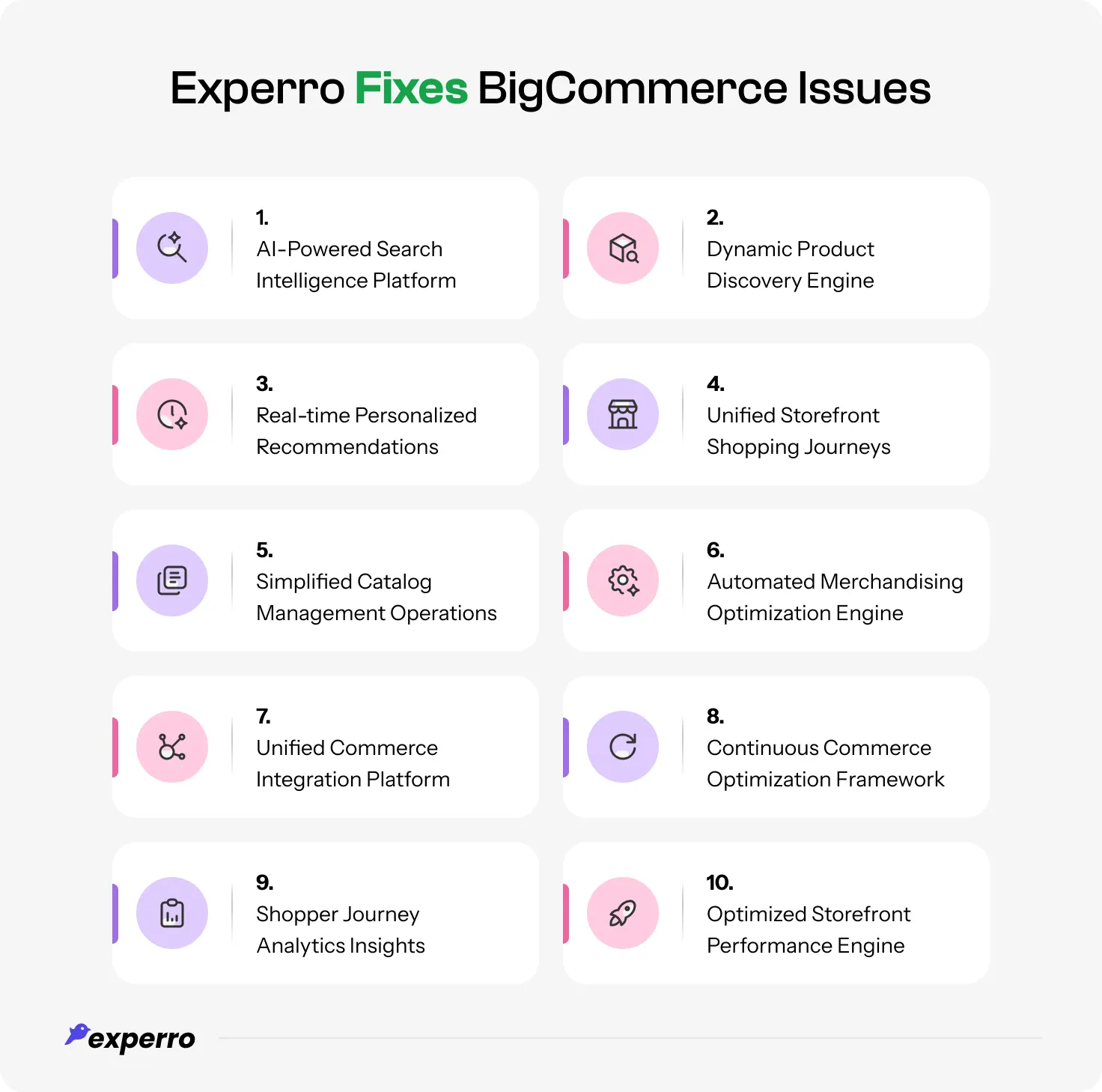
Experro solves these gaps by adding an intelligence layer on top of the BigCommerce platform. It does not replace the store. It upgrades how the store thinks, learns, and responds to shopper behavior in real time.
1. Fixing BigCommerce Search Limitations with AI Intent Understanding
BigCommerce search is built on keyword matching, which becomes a limitation when shoppers search naturally instead of using exact product terms.
This creates BigCommerce search limitations in large catalogs where relevance depends on intent, not keywords; leading many merchants to explore how to improve BigCommerce search for faster, more accurate, and intent-driven product discovery.
Experro fixes this by shifting search from keyword matching to intent understanding.
It improves search through:
- Natural language interpretation instead of strict keywords
- Context-aware query understanding based on shopper behavior
- Semantic mapping between products, categories, and intent
- Real-time ranking based on engagement and conversion signals
- Continuous learning from search-to-purchase patterns
It directly resolves:
- BigCommerce site search and visibility issues
- Incompetent BigCommerce search behavior
- Complications in BigCommerce search accuracy
- Poor relevance in BigCommerce search results
Instead of static search outputs, results become adaptive and intent driven.
Business Impact - Search becomes a conversion engine, improving product discovery, reducing drop-offs, and increasing revenue from high-intent users.
2. Turning Static Browsing into Dynamic Product Discovery
Most BigCommerce stores rely on fixed categories, manual filters, and static collections. These structures do not adapt to user behavior.
This creates one of the most persistent BigCommerce operational problems — browsing that stays the same regardless of who is visiting.
Experro replaces this with dynamic discovery that evolves in real time. It improves browsing by:
- Adjusting category ranking based on engagement signals
- Adapting filters to user context and session activity
- Reordering products based on intent and behavior
- Personalizing navigation paths for different shopper types
- Evolving collections based on demand and interaction trends
This removes heavy manual merchandising inside the BigCommerce store.
It also reduces dependency on constant category updates, which is a common issue in scaling eCommerce platforms.
Business Impact - Shoppers find relevant products faster, engagement increases, and category pages become active discovery surfaces instead of static listings.
3. Fixing Generic Recommendations with Real-Time Personalization
A major BigCommerce drawback is that recommendations are rule-based. They rely on static logic like “related products” or manual cross-sell rules.
This leads to BigCommerce personalization limitations, where recommendations do not reflect real shopper intent.
Experro replaces this with behavioral AI personalization that evolves in real time.
It analyzes:
- Browsing depth across multiple sessions
- Product interaction behavior (clicks, views, dwell time)
- Cart additions and abandonment patterns
- Search intent and query history
- Purchase history and affinity signals
It then generates:
- Context-aware product recommendations
- Dynamic cross-sell suggestions
- Intelligent upsell bundles
- Session-based personalization blocks
This reduces dependency on multiple BigCommerce third party integrations used for recommendation engines.
Business Impact - More relevant recommendations increase average order value, improve conversion rates, and strengthen customer engagement.
4. Creating Unified Shopping Journeys Across the Storefront
One of the most overlooked BigCommerce issues is fragmentation. Search, browsing, and recommendations often work as separate systems.
This creates broken journeys where each interaction resets context instead of continuing it.
Experro fixes this by unifying all discovery layers into a single intelligence system. It connects the experience by:
- Letting search behavior influence browsing structure
- Using browsing behavior to refine recommendations
- Updating product discovery based on real-time interactions
- Maintaining continuous shopper intent across sessions
- Syncing behavioral signals across all touchpoints
This reduces BigCommerce developer dependency caused by integrating multiple disconnected tools.
It also eliminates inconsistencies between different parts of the eCommerce platform.
Business Impact - A continuous journey improves engagement, reduces friction, and increases conversion consistency across the entire store.
5. Solving Catalog Complexity and Product Management Issues
As eCommerce stores scale, BigCommerce operational problems increase significantly in catalog management.
Merchants struggle with:
- Large product inventories across categories
- Inconsistent product tagging and metadata
- Stock level visibility across SKUs
- Category structuring at scale
- Product relevance alignment with search
Experro simplifies this with automated catalog intelligence. It improves product management by:
- Surfacing products based on real-time behavior
- Aligning inventory with discovery logic
- Automatically grouping related products
- Maintaining relevance across large catalogs
- Reducing manual catalog adjustments
This makes scaling large eCommerce stores more manageable and less operationally heavy.
Business Impact - Lower complexity, better catalog control, and improved efficiency in managing growing product databases.
6. Reducing Manual Merchandising Effort in BigCommerce Stores
Manual merchandising is one of the most persistent BigCommerce pain points.
Merchants constantly adjust:
- Product rankings across categories
- Featured collections on storefront pages
- Promotional placements
- Search result ordering
- Category layouts and sorting logic
Experro eliminates manual dependency with its AI browse capabilities. It continuously optimizes:
- Product placement based on engagement
- Category relevance based on behavior
- Featured sections based on performance
- Discovery logic based on conversion outcomes
This reduces BigCommerce developer dependency and removes the need for repetitive theme-level changes or CSS-based adjustments.
Business Impact - Faster merchandising, lower operational effort, and more consistent product visibility without manual intervention.
7. Unifying Fragmented eCommerce Systems and Integrations
Many BigCommerce merchants rely heavily on third party apps for search, analytics, SEO, and personalization.
This creates fragmentation across systems like:
- Search engines
- Analytics tools
- Recommendation apps
- Marketing automation platforms
- SEO optimization tools
Experro simplifies this ecosystem by acting as a unified intelligence layer. It reduces:
- BigCommerce third party integrations overload
- App dependency across eCommerce operations
- Data inconsistency between tools
- Operational complexity in managing multiple systems
This creates a more stable and unified eCommerce architecture.
Business Impact - Lower operational costs, better system consistency, and simplified eCommerce management.
8. Enabling Continuous Optimization at Scale
Optimization in BigCommerce stores is often slow because it depends on manual updates or disconnected tools.
Experro enables continuous real-time optimization across:
- Search relevance
- Recommendation logic
- Product ranking
- Category performance
- Conversion flows
This removes traditional BigCommerce limitations in experimentation and iteration.
Business Impact - Faster experimentation cycles and continuous improvement in eCommerce performance.
9. Enhancing Shopper Journey Visibility and Analytics
Many BigCommerce stores lack deep behavioral visibility into how users interact with the store.
Experro improves this by tracking:
- Search patterns and intent
- Browsing behavior across categories
- Product interaction depth
- Drop-off points in the funnel
- Full conversion journeys
This helps overcome BigCommerce SEO limitations and analytics gaps that limit decision-making.
Business Impact - Better insights lead to smarter optimization and stronger eCommerce strategies.
10. Improving Storefront Performance and Reducing App Overload
As merchants add more apps, BigCommerce stores often suffer from performance issues.
This leads to:
- BigCommerce technical problems
- Slow page load times
- Heavy script execution
- Poor mobile performance
- SEO degradation
Experro reduces this dependency by consolidating intelligence into a single layer. It improves:
- Page speed
- Core Web Vitals
- Store stability
- Mobile responsiveness
Business Impact - Better SEO rankings, faster storefronts, and higher conversion rates.
Experro enhances the BigCommerce platform by solving its deepest limitations in search, personalization, merchandising, analytics, and performance.
It transforms static eCommerce stores into intelligent systems that continuously adapt to shopper behavior.
Uncover What’s Really Blocking Your BigCommerce Store Performance
If your store is getting traffic but still not converting, the problem is rarely demand — it’s experience. Shoppers arrive with intent, but even small gaps in search, discovery, or product visibility can quietly interrupt their journey before they ever reach the product they want.
What makes this harder is that nothing looks “broken”. There are no errors, no warnings, just steady drop-offs, shorter sessions, and missed opportunities that often go unnoticed as your store grows.
But this is exactly where the real upside lies. The way shoppers search, browse, and decide inside your store directly shapes whether intent turns into action or fades away.
If this feels familiar in your store, it’s worth taking a closer look — reach out to us, and let’s uncover what’s really holding your conversions back.
FAQs

With 6+ years of experience in AI, software, and digital transformation across tech, healthcare, and fashion, Rahul focuses on making complex ideas simple, clear, and actually useful. He has learned how often great ideas get lost in complexity, which is why he centers his writing on clarity, helping entrepreneurs and leaders cut through noise and make decisions with confidence.
Subscribe to Our Newsletter!
Get the latest insights delivered straight to your inbox.