- eCommerce
- Search
- Product Discovery
- 12 min read
Fetch Global Sales with Multilingual eCommerce Functionality
Published
21 September 2026Updated
25 September 2026

key takeaways:
- Speak your shoppers’ language so every search, browse, and buying moment feels familiar and effortless.
- Go beyond translated pages by localizing products, search, payments, checkout, and support for each market.
- Let AI handle multilingual discovery by understanding intent, enriching products, and personalizing recommendations at scale.
- Make discovery work across markets with Experro’s AI search, merchandising, personalization, and product discovery without re-platforming.
A shopper searches for a product in Spanish. Another searches for the same product in German. The catalog may be the same, but the words, phrases, and ways shoppers describe what they need can vary significantly by language.
That’s what makes multilingual eCommerce more than simply translating a website. A truly multilingual shopping experience connects localized product content and a multilingual product catalog with search and discovery that can understand shoppers in their own language.
With multilingual AI search, shoppers can find relevant products even when they use different terms, phrases, or ways of describing what they need.
For global brands, that means making product discovery feel natural across markets instead of forcing every shopper into the same search experience. This guide explores how multilingual eCommerce works, why it matters, and the capabilities that help brands build better multilingual product discovery at scale.
What Is Multilingual eCommerce?
Multilingual eCommerce is an online shopping experience that allows customers to browse and purchase products in multiple languages.
It includes the language used across product information, categories, navigation, and other customer-facing store content, all of which fall under solid eCommerce catalog management once you're maintaining more than one language version.
A multilingual eCommerce website presents its store content in the languages it supports, while a multilingual product catalog makes product names, descriptions, attributes, and categories available in those languages, which is why clear product attributes matter just as much in translation as they do in a single-language catalog.
In simple terms, multilingual eCommerce means offering the same online store and product catalog in multiple languages, so customers can interact with the store in their preferred language.
What Makes a Multilingual Shopping Experience Complete?
A complete multilingual shopping experience requires three layers working as one system: localized content, localized discovery, and a localized transaction flow.
Translation alone only covers the first, which is why it's often described as only half the battle, much like the gap explored in eCommerce challenges and solutions.
Here’s a test worth running on your own site this week: open it in a browser set to a language your primary team doesn’t speak fluently and try to actually shop.
Don’t just browse. Search for something specific, filter by size or color, open a product, add it to your cart, and move toward checkout. Pay attention to where the experience breaks, just as you would when auditing your site search.
| Layer | What it covers | What happens if you skip it |
| Content | Product descriptions, categories, navigation adapted for cultural nuances | Shoppers browse but don't feel the cultural relevance needed to trust you |
| Discovery | Search, filters, facets, recommendations that understand local terms | Zero-result searches, broken filters, lost potential customers nobody notices |
| Transaction | Currency and payment options, local payment gateways, native-language support | Cart abandonment when purchase intent is highest |
Most teams translate content and stop there, but multilingual discovery can still fail when search doesn’t recognize local terms, product names, or spelling variations, leaving shoppers with irrelevant or zero-result searches.
That friction can cost sales and repeat visits. If zero-result searches are limiting discovery, fixing eCommerce zero search results can help close that gap.
Translation can lift conversions, but localizing content, discovery, and transactions together creates a more seamless shopping journey and supports stronger growth.
What You Need to Localize Across the Buying Journey
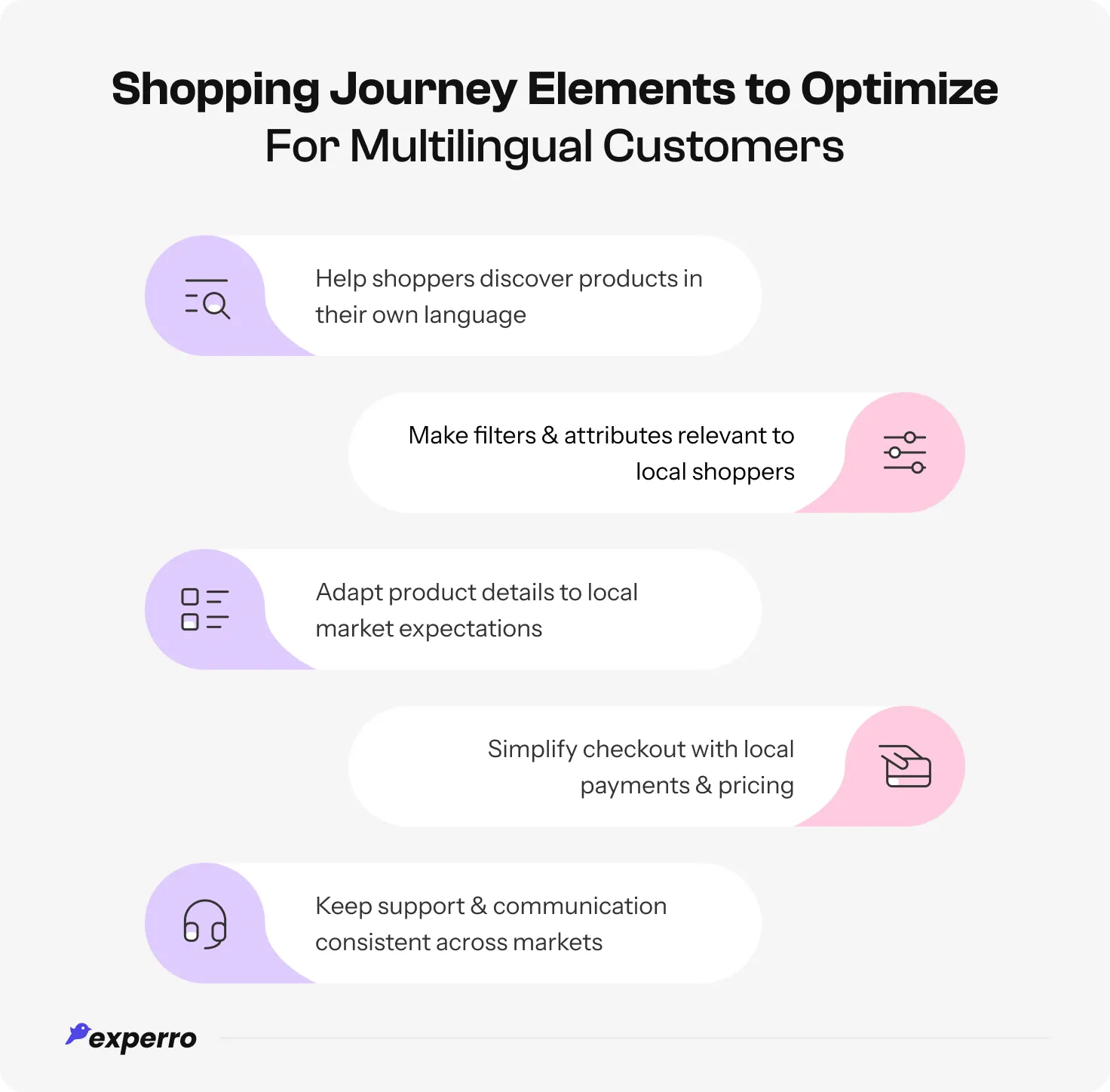
Localization should follow your shopper through the entire buying journey, not stop at translated pages.
Your multilingual eCommerce store needs to support the right language, content, and local context from product discovery to checkout, mapping closely to the stages laid out in B2B customer journey thinking, even for consumer stores.
Product Content, Categories, and Navigation
Start with what your shopper sees first: product names, descriptions, categories, navigation, and your multilingual product catalog.
The goal isn’t simply to translate these elements, but to adapt them to how shoppers in each market naturally browse, search, and describe products, the kind of nuance covered in content design for any customer-facing experience.
Your multilingual eCommerce site should also adapt product taxonomy, category names, sizes, measurements, and market-specific merchandising, and getting your product taxonomy right is often what determines whether that adaptation holds up once real shoppers start browsing.
Done well, your multilingual online store feels native to each market while keeping the core eCommerce experience consistent.
Search, Filters, Facets, and Product Attributes
Your shopper’s language matters when they search. A multilingual eCommerce platform should support multilingual AI search, multilingual query understanding, synonyms, and cross-language product matching.
Once shoppers find relevant results, advanced eCommerce filters help them narrow products without needing to use your catalog’s exact terms.
That helps your eCommerce store connect different ways of expressing the same need to the right products. Search, filters, facets, product attributes, and recommendations should work together to create stronger multilingual product discovery and a smoother multilingual shopping experience.
Cart, Checkout, Payments, and Post-Purchase Communication
Localization needs to continue through checkout, too. Your store may need to adapt to currency, pricing, taxes, shipping details, payment methods, and other information for each market and target language. Reducing friction here is also essential to effective abandoned cart recovery strategies.
The experience shouldn’t stop after the purchase. Multilingual support, order updates, shipping notifications, and customer communication should remain consistent with the shopper’s chosen language, creating the continuity expected from effective customer journey orchestration.
That gives your multilingual store true multi language functionality across the buying journey.
How to Get Multilingual SEO Right?
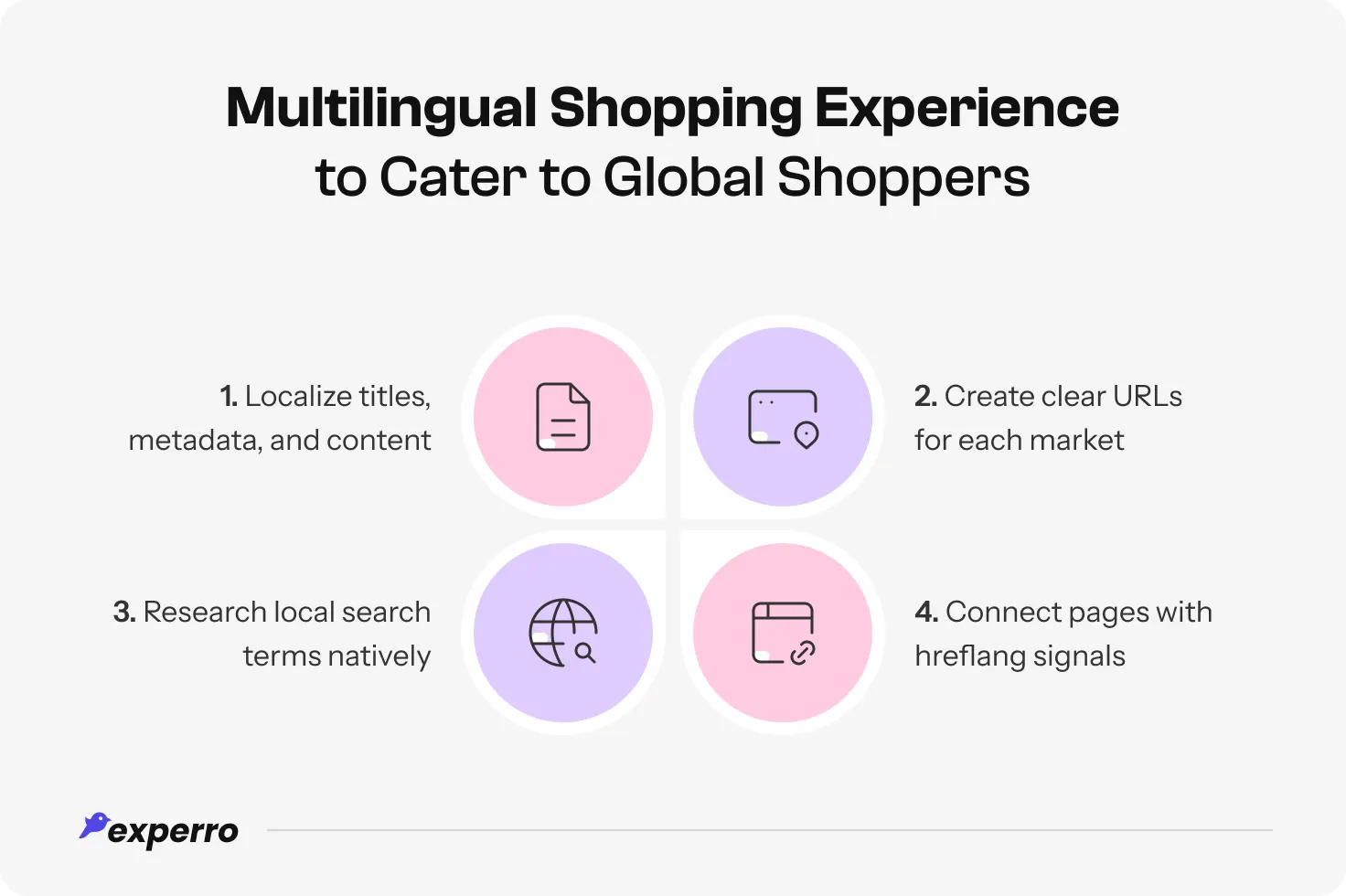
Multilingual search engine optimization requires four fundamentals: a consistent URL structure per language, correctly implemented hreflang tags, native keyword research, and localized metadata, and working through a proper eCommerce seo checklist market by market helps catch details a one-time setup misses.
Skip any one, and even a site with excellent website translation can stay invisible to local search engines, a risk covered more broadly in eCommerce seo best practices.
1. Choosing the Right URL Structure
Subdirectories, subdomains, country-code domains, any of these can work.
What can't work is switching structures halfway through, because consistency is what lets search engines index each language version separately and lets your team measure organic traffic by market later, a principle closely related to what is composable commerce and its emphasis on structural consistency.
2. Implementing Hreflang Correctly
Hreflang tells search engines which language and region a page is meant for. Get it right and click through rates in local search climbs.
Get it wrong, or skip it entirely, and you've built a well-translated site that local search engines quietly serve the wrong audience; the exact kind of gap benefits of eCommerce SEO is meant to prevent.
3. Researching Keywords Natively, Not Translating Them
A shopper in Munich rarely searches using a literal translation of your English keyword list. Build your German pages around translated keywords, and your SEO optimization work targets terms nobody actually types, undermining the same intent-matching goals covered in eCommerce SEO strategy.
Native keyword research earns its keep twice: it shapes the pages you build, and it tells you which new markets to prioritize next based on real demand instead of a hunch.
4. Localizing Metadata, Not Just Visible Copy
Metadata is usually the last thing anyone localizes and the first thing a search engine reads.
Optimize titles, descriptions, and structured data per locale, and translated content finally has a real shot at showing up in local search, not just existing on the page.
How AI Scales Multilingual eCommerce Experiences?
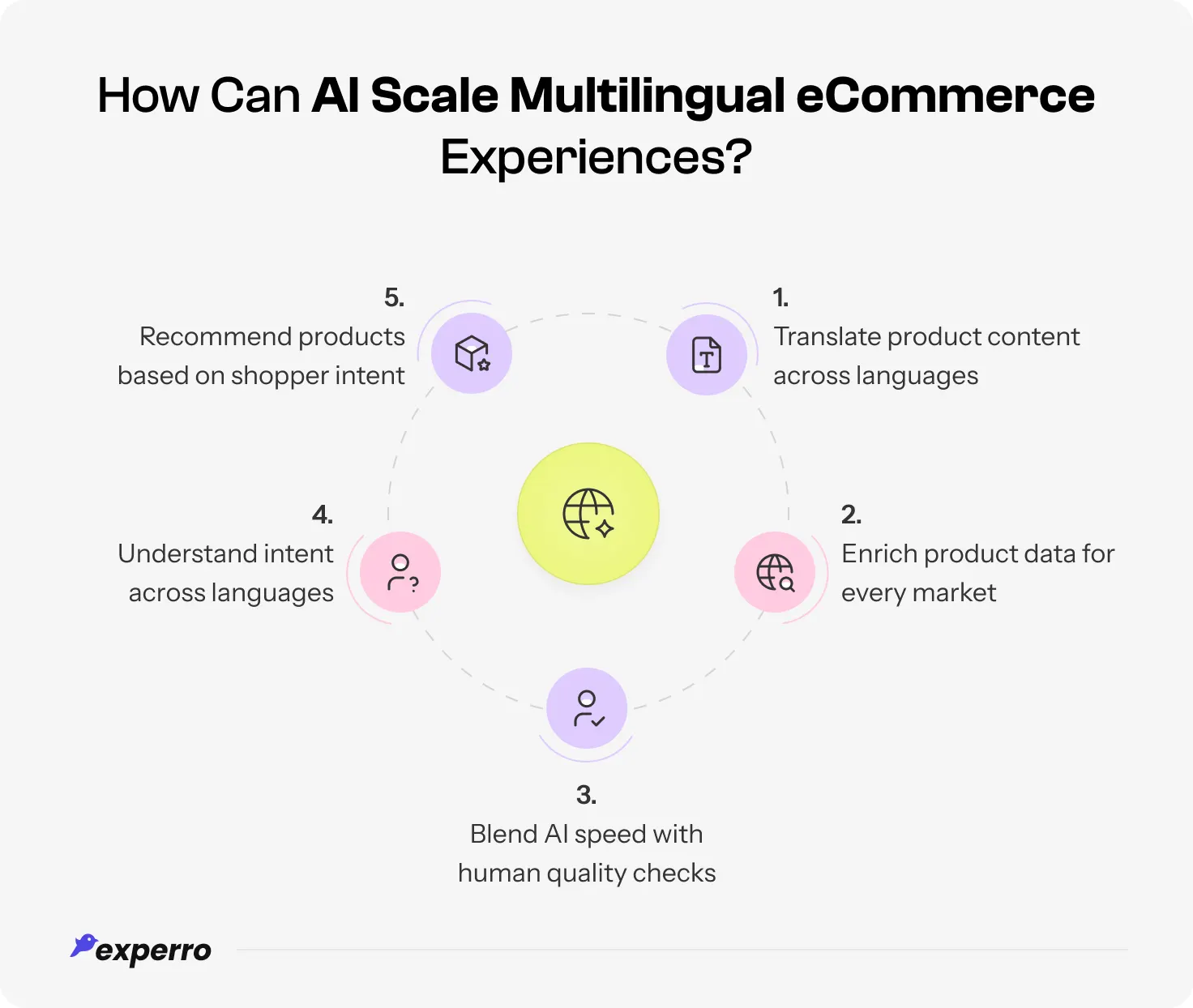
AI can help you scale a multilingual eCommerce store far beyond translating your website. It can connect localization, product data, search, discovery, and recommendations across languages.
That matters because your shopper expects more than translated pages. CSA Research found that 76% of online shoppers prefer products with information in their own language, while 40% said they would not buy from websites in other languages.
1. Translate Product Content at Scale
A growing multilingual product catalog can quickly become difficult to manage. AI can help translate product names, descriptions, categories, attributes, and other content across languages without requiring your team to localize every product manually, similar to how AI workforce automation in eCommerce reduces manual load elsewhere in the catalog.
But translation should not mean word-for-word conversion. Your shopper may use a regional phrase that has a different meaning from its literal translation, so human quality checks remain important for accuracy, cultural context, and brand voice.
2. Enrich Product Data for Different Markets
AI can also make your product data more useful across markets. It can identify product attributes, enrich descriptions, organize categories, and surface missing information that could affect how your multilingual online store presents products.
This gives your multilingual eCommerce platform stronger data to power search, filters, recommendations, and multilingual product discovery. The result is a catalog built around how shoppers explore products in each market.
3. Understand Shopper Intent Across Languages
Here is where AI becomes more valuable than traditional translation. Your shopper might search for the same product using completely different words, phrases, or sentence structures depending on the language. That matters when 59% of non-English speakers rarely or never buy from English-only websites.
AI can interpret those variations through multilingual query understanding, language-aware search, and cross-language product matching. This is the same principle behind semantic search, which helps connect different ways of expressing the same intent within a language.
It also works alongside natural language search to understand what shoppers mean before matching their queries with relevant products.
Walmart, for example, describes using AI to detect language and dialect variations, preserve product entities, and interpret multilingual queries before returning results.
4. Improve Multilingual Product Discovery
Once AI understands what your shopper means, the next challenge is connecting that intent to the right products.
A translated query can still fail when search doesn’t recognize spelling variations, typos, or closely related terms, where fuzzy search can improve matching.
Multilingual AI search can connect synonyms, regional terminology, product attributes, and different expressions of the same need. That creates stronger localized search relevance, and understanding search relevance is the first step toward improving it across every language you support.
5. Personalize Recommendations Across Languages
The experience can become even more relevant when AI combines language with shopper behavior and intent. Your multilingual eCommerce personalization strategy can use signals such as browsing activity, product interest, previous interactions, and search behavior, the same signals that power hyper-personalization in any market, multilingual or not.
That means a shopper searching in French does not simply receive French content. They can also receive language-aware recommendations that reflect what they are actually trying to find, similar to how profile based recommendations work from behavior rather than language alone.
6. Combine AI Scale With Human Quality
AI can dramatically reduce the manual work involved in localization, but it should not remove human oversight.
Product terminology, cultural references, brand language, and market-specific preferences still require judgment; a balance echoed in why rule-based personalization fails when automation runs without any human review.
The strongest approach combines AI efficiency with human review. Your team can focus on quality and market nuance while AI handles repetitive work across a growing multilingual eCommerce website.
7. Scale the Experience Across Markets
The bigger opportunity is connecting these capabilities instead of managing translation, search, and personalization as separate projects.
Your multilingual eCommerce solution should help your shopper move naturally from localized content to search and discovery, recommendations, and purchase.
That is what turns multilingual functionality into a true multilingual shopping experience. You are not simply offering the same store in more languages.
You are helping each shopper discover and evaluate products in a way that feels natural to their language and market. When content, discovery, and interactions work together, you create a more connected digital journey, one of the key benefits of a digital experience platform.
How Can Experro Improve Multilingual Product Discovery?
Break language barriers without limiting product discovery to just translation.
Experro connects AI search, product data, and personalization to help your global shoppers find relevant products across languages.
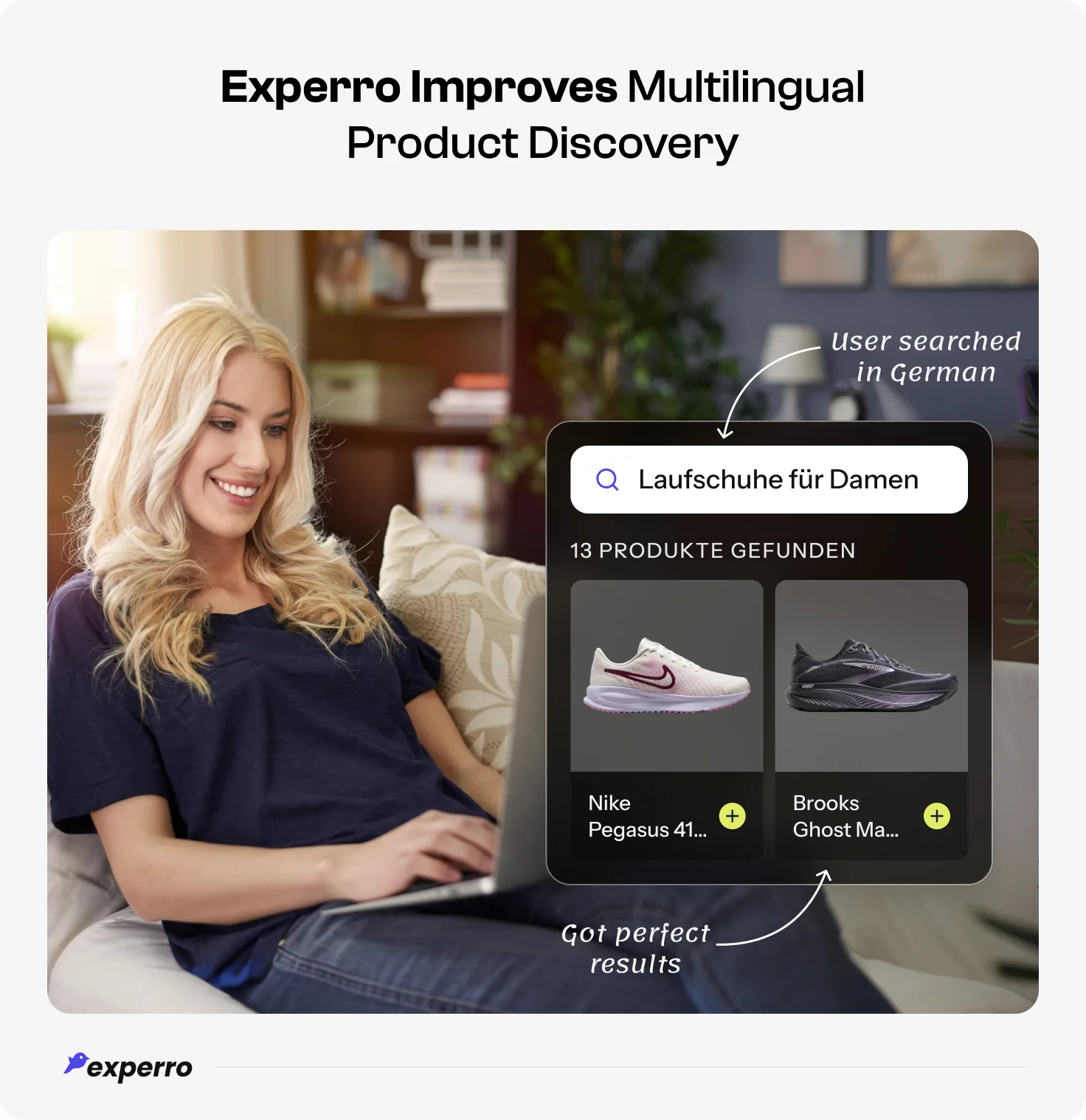
- Understand multilingual queries: Recognize different terms and expressions shoppers use to describe what they need.
- Match queries to products: Connect shopper searches with relevant products, even when the wording differs from your catalog.
- Improve search relevance: Deliver more useful results by understanding the context and intent behind multilingual searches.
- Personalize discovery: Use shopper behavior and intent to surface products and recommendations that are more relevant to each shopper.
- Simplify merchandising: Give your team control over search results and product rankings without requiring separate manual workflows for every market.
- Scale discovery across markets: Extend AI-powered search and product discovery as you introduce new languages and markets, without re-platforming.
For your team, multilingual commerce shouldn't mean asking shoppers to adapt to how your catalog is written.
Experro helps connect what shoppers search for with the products they want, creating a more natural discovery experience across languages.
Make Every Language an Opportunity to Discover
Going multilingual can open new markets, but the real opportunity is making those markets easier to shop. Translation gets your content in front of shoppers. Relevant discovery helps move them toward a purchase.
For your team, that means thinking beyond language coverage. Your search, product data, merchandising, recommendations, and personalization all need to scale together as your catalog and market presence grow.
That’s where AI can make a practical difference. Experro brings AI search, product discovery, personalization, and merchandising together, helping you deliver relevant experiences across languages without re-platforming.
You can expand your reach without creating a separate discovery strategy for every market or adding layers of manual work for your team.
Ready to make multilingual product discovery work at scale? Contact us to see how Experro can help your shoppers find the right products more naturally across languages and markets.
FAQs

With 6+ years of experience in AI, software, and digital transformation across tech, healthcare, and fashion, Rahul focuses on making complex ideas simple, clear, and actually useful. He has learned how often great ideas get lost in complexity, which is why he centers his writing on clarity, helping entrepreneurs and leaders cut through noise and make decisions with confidence.
Subscribe to Our Newsletter!
Get the latest insights delivered straight to your inbox.
Recommended Reads