
- Product Discovery
- Generative AI
- Merchandising
- 12 min read
What Are the Problems With Manual eCommerce Merchandising?
Published
16 September 2026

key takeaways:
- Manual merchandising quietly steals your best people's time, turning skilled merchandisers into human data-entry machines. That's not what they signed up for.
- Rankings and search rules go stale even before you notice. By the time you catch up, the trend's already gone cold.
- What feels manageable at a small catalog turns into a losing race once you scale. More SKUs, more channels, more chaos.
- Experro automates merchandising so your team can stop firefighting and start actually merchandising.
Are you still hiring merchants to optimize your merchandise in the store? And are they doing everything manually one by one? 😫😫😫
The biggest problems with manual eCommerce merchandising are repetitive work, inconsistent product placement, slow responses, and difficulty scaling.
A bestseller needs a ranking boost, an out-of-stock product needs to move down, or a promotion requires search and category updates. Each change adds another task to your team’s workload.
As requests pile up, your team spends more time maintaining product placement and less time improving discovery, testing strategies, and finding revenue opportunities.
An AI-powered merchandising approach can automate repetitive execution while keeping merchandisers in control. Your team sets the strategy, while automation handles ranking, boosting, burying, and placement changes across the store.
In this guide, you’ll understand where manual merchandising creates friction, which tasks can be automated, and how AI-powered merchandising can help your team manage product placement faster, maintain consistency, and scale more efficiently.
What Are the Problems with Manual eCommerce Merchandising?
Before you can fix manual merchandising, you need to see exactly where it breaks. We see these five problems come up with almost every team we talk to, no matter how big or small the catalog is.
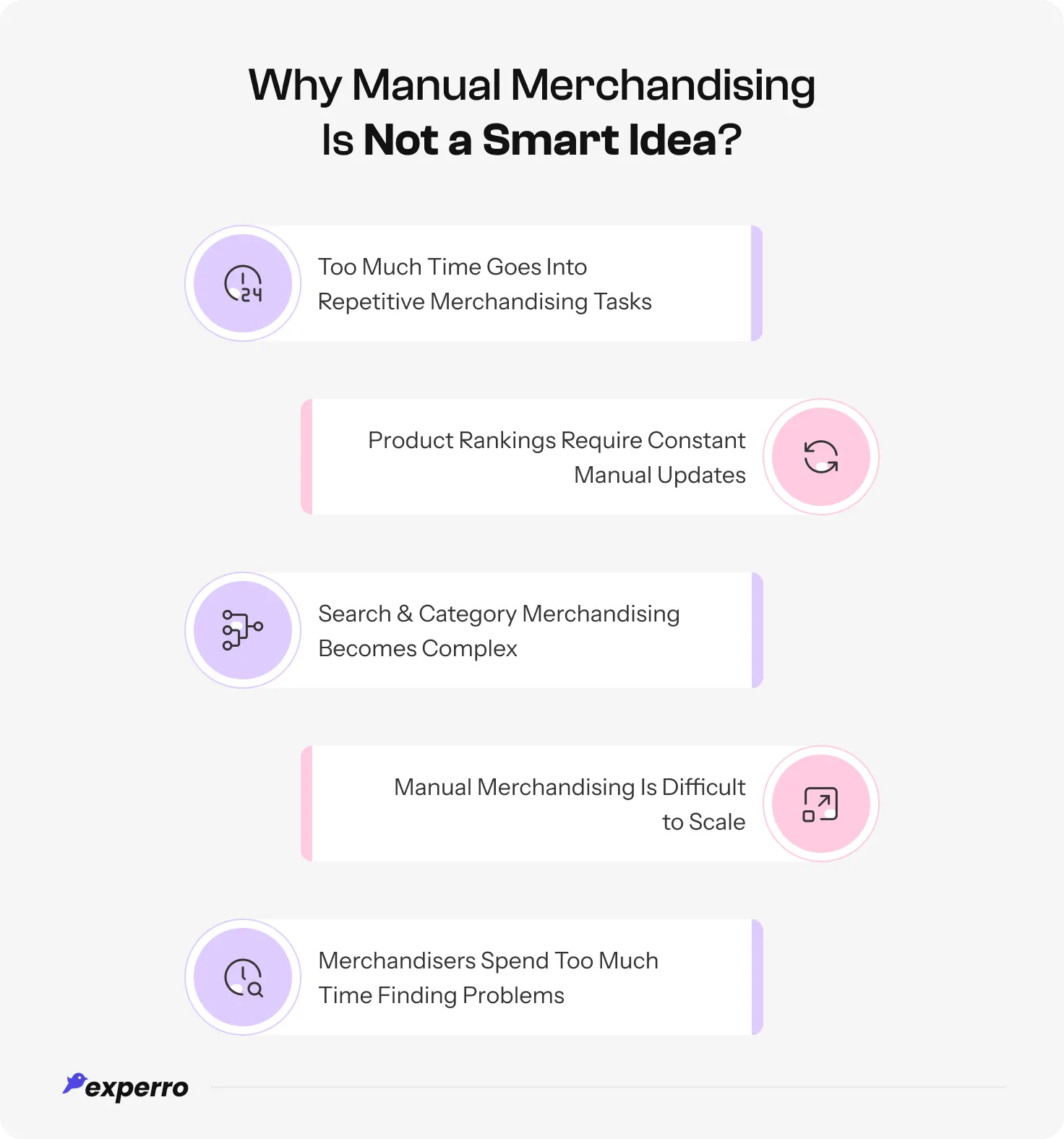
1. Too Much Time Goes Into Repetitive Merchandising Tasks
Start with the most obvious drain: time. Tagging products. Adjusting boosts. Refreshing banners. Sound familiar?
These eCommerce merchandiser tasks repeat weekly, and none of them build real operational efficiency. They're upkeep, not merchandising strategy, and your team feels that difference by Friday.
The math backs this up: digital merchandising reduces manual effort by 50-70%. That's the hours your team could reclaim every single week and put toward the operational efficiency that actually moves revenue.
Here's the part that stings more, though.
McKinsey's 2026 Global Merchant Survey found that merchants still spend about 40% of their time on low-value work such as consolidating data, preparing repetitive spreadsheets, and reconciling information across siloed systems.
Your most skilled merchandisers end up doing data entry. Their human expertise and category instincts, the stuff that took years to build, get buried under operational busywork instead of shaping the shopping experience they were hired to shape.
That time crunch didn't stop at task lists. It follows merchandisers straight into how products actually get ranked.
2. Product Rankings Require Constant Manual Updates
Manually ranking products isn't a one-time task; it's a treadmill. Inventory shifts, prices change, new arrivals land, and product placement go stale within hours.
Manual product sorting eCommerce products means weighing margins, managing inventory levels, and sales velocity across thousands of SKUs by hand. That’s not a scalable workflow; it’s decision-making under pressure, where gaps in inventory accuracy can make every merchandising decision harder to get right.
By the time a trending item finally gets top placement, current trends have often already peaked. Manual product ranking chases yesterday's demand instead of today's, and shoppers can tell.
Add multiple categories and regional catalogs into the mix, and manual product ranking stops being a task. It becomes a full-time job nobody signed up for, while keeping your product taxonomy accurate and consistent becomes harder as your catalog grows.
Ranking is only half of the battle, though. Once a product is placed, shoppers still have to find it through search.
3. Managing Search and Category Merchandising Becomes Complex
Search merchandising runs on rules: synonyms, boosts, exclusions, category logic. Every new SKU adds one more rule to maintain, along with fresh product descriptions and product attribute data to manage on top of it.
As catalogs grow, manual searchandising turns into a tangle even veteran merchandisers can't fully audit. One outdated rule quietly buries relevant products from shoppers who are ready to buy right now, today, if only they could find them.
Category pages suffer from the same fate. Without constant manual category merchandising and true search optimization, they drift out of sync with real inventory and demand signals.
The result? Shoppers search for exactly what you sell and still can't find it. That's the fastest way to lose a sale you should have won, and it chips away at customer satisfaction with every failed query.
4. Manual Merchandising Is Difficult to Scale
Growth should be good news. For manual merchandising, it's often the moment things start to break instead.
Manual merchandising works fine at a small scale. Add more SKUs, markets, or channels, and manual merchandising problems start to grow under rising labor costs.
Scaling manual eCommerce merchandising usually means hiring more people to do the same repetitive work, not building smarter merchandising strategies. That's an expensive, linear way to grow catalog management, and it caps how fast you're able to move.
New channels make this worse, fast. A manual merchandising workflow built for one storefront rarely survives the jump to multiple channels, mobile, or POS integration across physical retail stores.
Most retailers underestimate how quickly this ceiling arrives. Online retailers in particular feel it the moment their product offerings expand past a single region, omnichannel trends sound simple until you're the one running it manually.
Scaling problems are visible. The next one usually isn't, at least not until it's too late.
5. Merchandisers Spend Too Much Time Finding Problems
Before anyone fixes anything, someone has to find it first. A broken filter. A mispriced item. A zero-result search query nobody noticed.
This manual checking takes valuable time away from strategic product presentation and campaign planning. With eCommerce analytics, teams can spot these issues much faster by analyzing millions of data points in real time, without spending hours digging through dashboards.
Without real-time inventory and predictive tracking, costly mistakes often surface only after sales numbers reveal the damage. By then, it's already cost you, and immediate feedback would have caught it early enough to matter.
These five problems don't stay contained to the merchandising team. They ripple straight into how the whole store performs.
How Does Manual Merchandising Impact eCommerce Performance?
Every hour lost to manual tasks eventually show up somewhere else: lower conversion rates, weaker product discovery, less relevant customer experience, and lost revenue.
Here’s where the negative impact lands hardest.
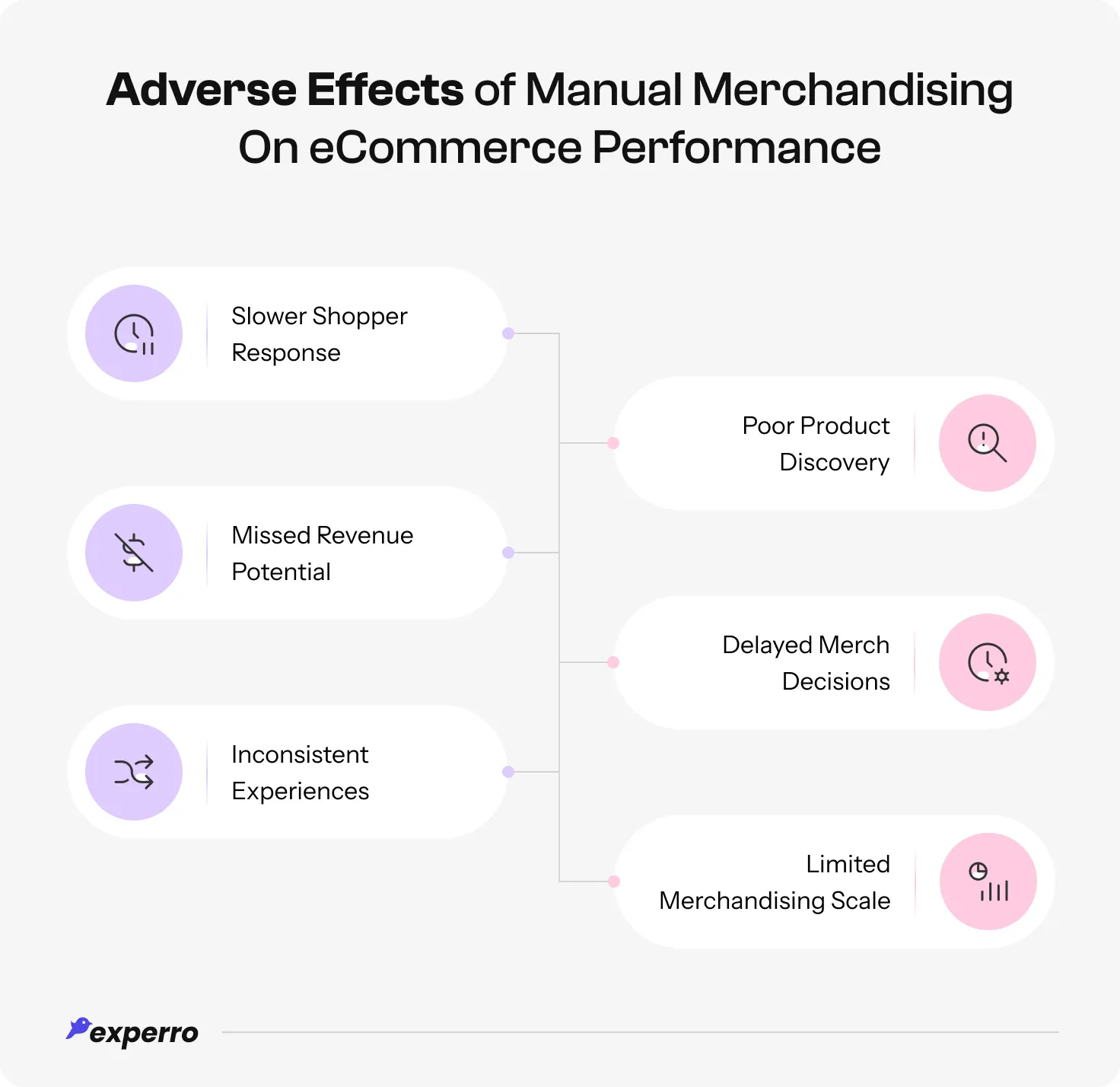
1. Slower Response to Changing Shopper Demand
Your shoppers don’t shop the same way every week. A product can suddenly take off; a promotion can gain traction, or demand can shift from one category to another.
With manual merchandising, responding to those changes takes time. Someone has to spot the shift, check what’s happening, decide what should move, and update your rankings or product placements.
Deloitte's 2026 merchandising research highlights accelerating AI and automation as retailers rethink how merchandising decisions are made.
By the time your team makes the change, the opportunity may have passed. That delay can reduce product visibility, weaken product discovery, and make it harder to capture demand while it’s happening.
Real-time personalization can help your store respond to changing shopper behavior faster and keep product experiences more relevant.
2. Poor Product Visibility and Discovery
When merchandising updates fall behind, your strongest products can end up in the wrong places. A high-performing product might be buried several positions down while a less relevant product gets prime placement.
That can reduce product visibility, limit clicks, and negatively impact the chances of conversion.
Think of it like a physical store: if your best products are pushed to the back, fewer shoppers will notice them. Online product ranking and placement play a similar role. Poor merchandising can also make onsite search and navigation less effective, forcing shoppers to work harder to find relevant products.
That’s why product discovery matters beyond simply helping shoppers find a product they already know they want. It connects search, navigation, recommendations, and product relevance to help shoppers discover what fits their needs.
3. Missed Revenue Opportunities
All of this eventually connects to revenue.
When a product stays buried, a promotion isn’t reflected quickly enough, or a ranking change takes too long to go live; you can miss valuable opportunities to convert existing demand.
Automated merchandising can lift conversion rates by 15%, creating a meaningful gap that manual processes may struggle to close. Small differences in conversion can compound across orders, average order value, and total revenue.
The connection between product relevance and revenue becomes even clearer when you look at AI product recommendations, helping shoppers discover complementary or relevant products can create additional opportunities that manual merchandising alone may overlook.
That’s the hidden cost of manual merchandising: while your team is still making yesterday’s updates, shoppers and demand have already moved on.
4. Delayed Merchandising Decisions
Manual merchandising rarely means making just one quick change. First, you have to spot the problem. Then you need to understand what changed, decide which products should move, update the ranking, category, search result, or merchandising rule, and check whether the change worked.
That can turn a simple decision into hours of work, especially when manual category merchandising is happening across a large catalog.
Now imagine doing that during a flash sale, product launch, seasonal peak, or sudden inventory change. Your shoppers are already on your store, but your merchandising may still reflect yesterday’s priorities.
Those delays can slow campaign execution, reduce product relevance, and create a less responsive shopping experience.
A stronger eCommerce merchandising strategy helps connect promotions, inventory, shopper intent, and product placement so your team can act faster.
5. Inconsistent Search and Category Experiences
When your team can’t update everything at the same pace, your shoppers start getting different experiences across your store.
Your sale category might be perfectly organized, while another category still shows products based on last month’s priorities. A product may appear in a great position on one page but be difficult to find when your shoppers search for it.
Your shoppers probably won’t know that a manual search merchandising decision caused the problem. They’ll simply feel that some parts of your store are easier to shop than others.
That inconsistency can hurt product relevance, make discovery harder, and negatively impact conversions.
Keeping your search results, categories, advanced eCommerce filters, attributes, and rankings aligned becomes even harder as your catalog grows. A stronger eCommerce search experience can help keep discovery consistent across your storefront.
Merchandising automation can reduce repetitive eCommerce merchandiser tasks by keeping product rankings, category placements, and search rules aligned as your catalog changes. Manual merchandising automation helps teams spend less time making individual updates and more time improving product discovery, relevance, and the shopper experience.
6. Limited Merchandising Scalability
And when those problems start multiplying, the bigger issue becomes clear: manual merchandising doesn’t scale easily.
More SKUs mean more products to rank. More categories mean more pages to maintain. More promotions mean more merchandising rules to create, change, and eventually remove.
Your team can only keep adding manual work for so long. Eventually, something gets missed. A product stays buried. An old rule remains active. A category doesn’t get refreshed. Your team spends more time maintaining your storefront than improving it.
That can limit how quickly your store grows without increasing operational workload.
This is where eCommerce merchandising automation can take repetitive work off your team’s plate while keeping important merchandising decisions under human control.
And that’s the real cost of manual merchandising: not one big failure, but hundreds of small delays that quietly add to weaker discovery, missed opportunities, and a harder-to-manage storefront.
Manual vs. AI-assisted Merchandising
The differences aren't subtle once they're laid out in one place. Here's how the two approaches compare.
| Factor | Manual Merchandising | AI-assisted Merchandising |
| Speed of updates | Hours to days | Real-time |
| Scalability | Capped by team size | Handles massive catalogs |
| Personalization | Static, rule-based | Dynamic, behavior-based |
| Error rate | Higher, human-dependent | Lower, data-validated |
| Forecasting | Reactive | Predictive, weeks ahead |
| Labor cost | Ongoing and rising | Cut by 50-70% |
| Merchandiser focus | Execution | Strategy |
The key benefits here aren't replacing human judgments. Retail merchandising still needs a person who understands the brand, the customer, and the moment.
It's about freeing that judgment up for the work that actually needs it, powered by data driven insights instead of guesswork. That's exactly the gap Experro Merchant Assistant was built to close.
How Experro Merchant Assistant Reduces Manual Merchandising Work
You don't need fewer merchandisers. You need fewer repetitive tasks. Experro Merchant Assistant (EMA) helps automate eCommerce merchandising without taking control from your team.
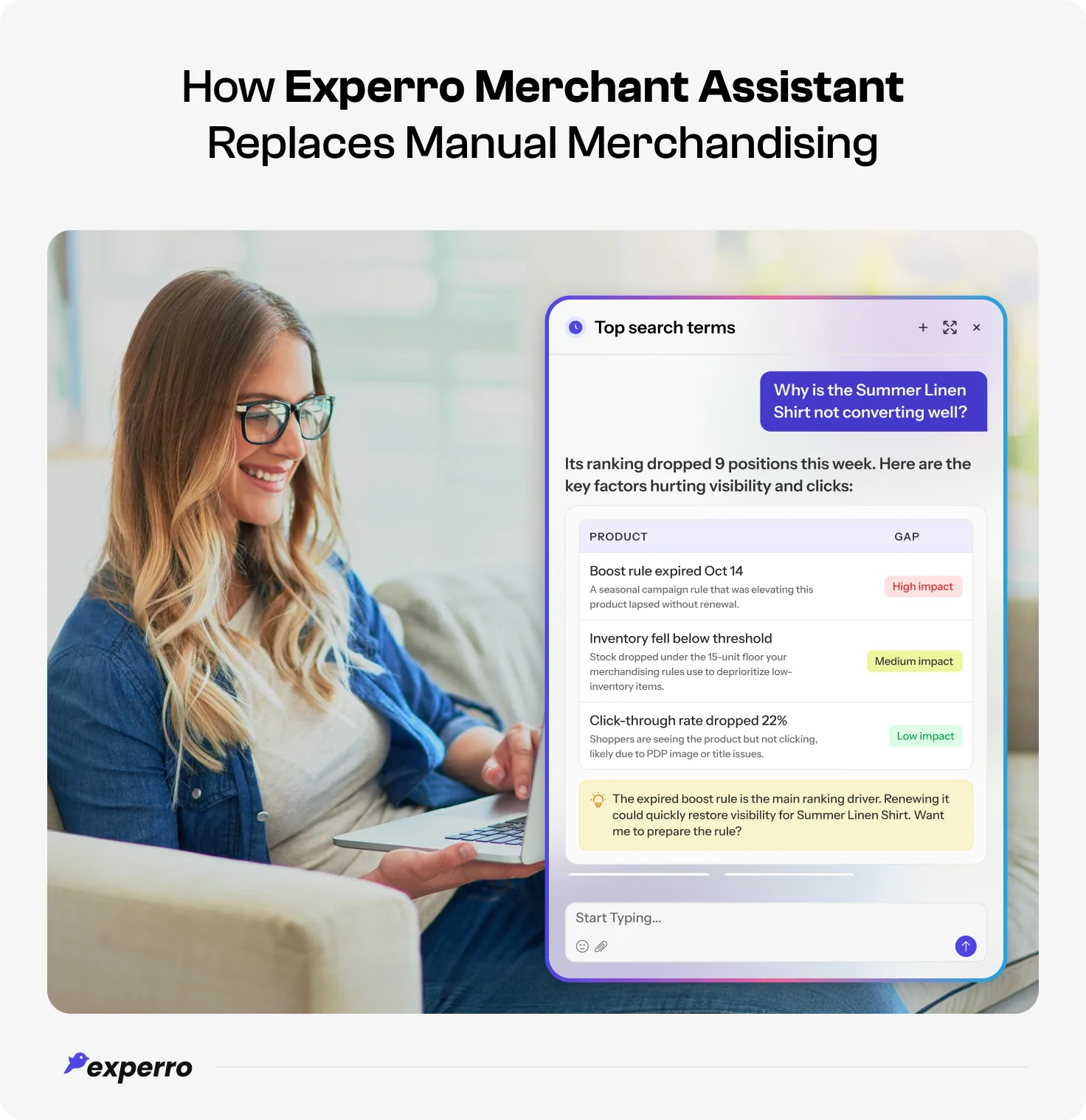
1. Ask: Find the problem - EMA monitors products, categories, and searches to flag ranking drops, stalled products, and zero-result queries before they become bigger problems.
2. Explain: Know why - See what caused the issue, from inventory gaps and pricing shifts to search relevance problems.
3. Analyze: Find the opportunity - EMA scans your catalog for patterns and underperforming products your team could easily miss.
4. Recommend: Know what to change - Get clear, actionable recommendations, such as reranking a product, adjusting a rule, or featuring an item.
5. Act: Make the change - Review, approve, and apply changes instantly. Your merchandisers keep the final say while automation handles the repetitive work.
Ask. Explain. Analyze. Recommend. Act. Less manual merchandising. Faster decisions. More time for strategy.
Conclusion: Manual Merchandising Shouldn't Keep Your Team Busy
Your merchandisers should spend less time managing repetitive updates and more time improving product discovery, responding to shopper behavior, and driving growth.
With Experro Merchant Assistant (EMA), automation handles the repetitive work while your team stays in control of the decisions that matter.
The result? Less manual work, faster decisions, and smarter merchandising at scale.
Ready to give your merchandising team their time back? See how EMA can help you work smarter and merchandise more effectively. Fill contact form now!
FAQs

With 6+ years of experience in AI, software, and digital transformation across tech, healthcare, and fashion, Rahul focuses on making complex ideas simple, clear, and actually useful. He has learned how often great ideas get lost in complexity, which is why he centers his writing on clarity, helping entrepreneurs and leaders cut through noise and make decisions with confidence.
Subscribe to Our Newsletter!
Get the latest insights delivered straight to your inbox.